Bible Study and Engagement Ministries sit close to the center of Christian discipleship because Scripture itself claims a singular role in forming the people of God. Donors who fund Bible engagement are not underwriting a generic educational project; they are investing in the ordinary means by which the Spirit renews minds, steadies consciences, and builds durable churches.
The challenge is that “Bible engagement” can name very different realities: translation and distribution, literacy and language development, small-group study, digital content, campus ministry, training for pastors, or media designed to reach seekers at the edges of the church. Each model carries different costs, different theories of change, and different risks. Mature giving begins by distinguishing the work clearly and then asking whether the ministry’s practices match the theological and practical claims it makes.
Across our verification work at Most Trusted, we see a consistent pattern: Bible study ministries that bear long-term fruit usually combine doctrinal clarity with disciplined governance, financial candor, and evidence that people are actually being formed—rather than merely consuming content. That is the animating logic of The Most Trusted Standard, our 15-criteria framework for evaluating Christian nonprofits across faith foundation, financial integrity, governance and leadership, and transparency and effectiveness.
Why Bible engagement is a high-stakes giving category
Scripture is not presented as an optional enhancement to Christian life. Paul writes that “all Scripture is breathed out by God” and is profitable for teaching, reproof, correction, and training in righteousness (2 Timothy 3:16). Jesus locates fidelity not in religious sentiment but in hearing and doing his words (Matthew 7:24–27). A ministry that helps the church read, understand, and obey the Bible is working near the load-bearing walls of Christian formation.
At the same time, donors should not confuse “more Bible content” with “more biblical maturity.” The modern information environment rewards volume, novelty, and emotional intensity. Bible engagement work can drift into brand-driven commentary, algorithm-shaped outrage, or shallow inspiration that does not produce repentance, reconciliation, or endurance. The Bible itself warns that hearing without doing is self-deception (James 1:22).
Need remains real, even in Bible-saturated cultures
Even in settings where Bibles are plentiful, sustained engagement is not automatic. Pew Research Center has documented that regular Scripture reading is far from universal among U.S. Christians and varies meaningfully by tradition and practice patterns Pew Research Center. For donors, this means “Bible access” and “Bible use” are not interchangeable outcomes, and a ministry’s stated problem must be specific.
Global translation and access still matter
On the global front, translation and language development remain foundational. Many communities still lack full Bible translation or have limited access to materials in heart languages. Work in this domain is often slow, expensive, and technically complex; it can also be among the most enduring gifts a donor can make when it is done with ecclesial humility and strong accountability.
Formation requires more than distribution
Historically, the church has treated the public reading of Scripture, preaching, catechesis, and communal study as a single ecosystem. Donors serve the church best when they ask whether a ministry strengthens that ecosystem or replaces it with a personalized, leader-dependent platform that weakens local pastoral care.

Mapping the ministry landscape donors actually fund
The phrase “Bible Study and Engagement Ministries” covers a wide set of approaches. Clarifying the operating model is a practical act of stewardship because it forces the questions that matter: Who is being served? Through what mechanism? Under what theological and pastoral authority? With what measurable outcomes?
Translation, literacy, and language development
These ministries work in linguistics, translation, publishing, and increasingly in oral Bible storytelling for non-literate contexts. Donors should expect long timelines, high specialization, and partnerships with local churches. When done well, this category resists “hero narratives” and treats local believers as co-laborers rather than beneficiaries.
Church-based discipleship and small-group resourcing
Many ministries create curriculum, train small-group leaders, and equip churches to teach Scripture faithfully. The best versions of this work have a clear ecclesiology: they exist to strengthen the church’s ministry of the Word, not to build a parallel flock that depends on the nonprofit’s brand.
Campus and young adult Bible engagement
College years can be a hinge point for faith. Ministries in this space often combine Bible study with mentoring, apologetics, and leadership development. Donors should ask how these ministries disciple students into local church membership rather than into an enduring identification with the campus organization alone.
Digital Bible content and media ministries
Apps, podcasts, video teaching, and social media content can lower barriers and reach people who would not walk into a church. The tension is that digital scale can mask shallow engagement. A ministry can count downloads, streams, and subscribers without knowing whether the content is producing holiness, church attachment, or doctrinal clarity.
Pastoral and lay training
Training pastors and lay leaders to handle Scripture responsibly can multiply impact through local congregations. The core donor question is not merely the quality of instruction but the character of the institution: safeguards, doctrinal commitments, and whether training is connected to real ministry contexts where graduates are known and accountable.
What effective Bible engagement actually looks like
Donors often ask for a simple metric that separates “fruitful” ministries from “busy” ones. Scripture does not give us a dashboard, but it does give us criteria. Faithfulness to the apostolic gospel, love that expresses itself in costly obedience, and communities that endure under pressure are not secondary outcomes; they are the substance of Christian maturity.
Outcome language that respects spiritual reality
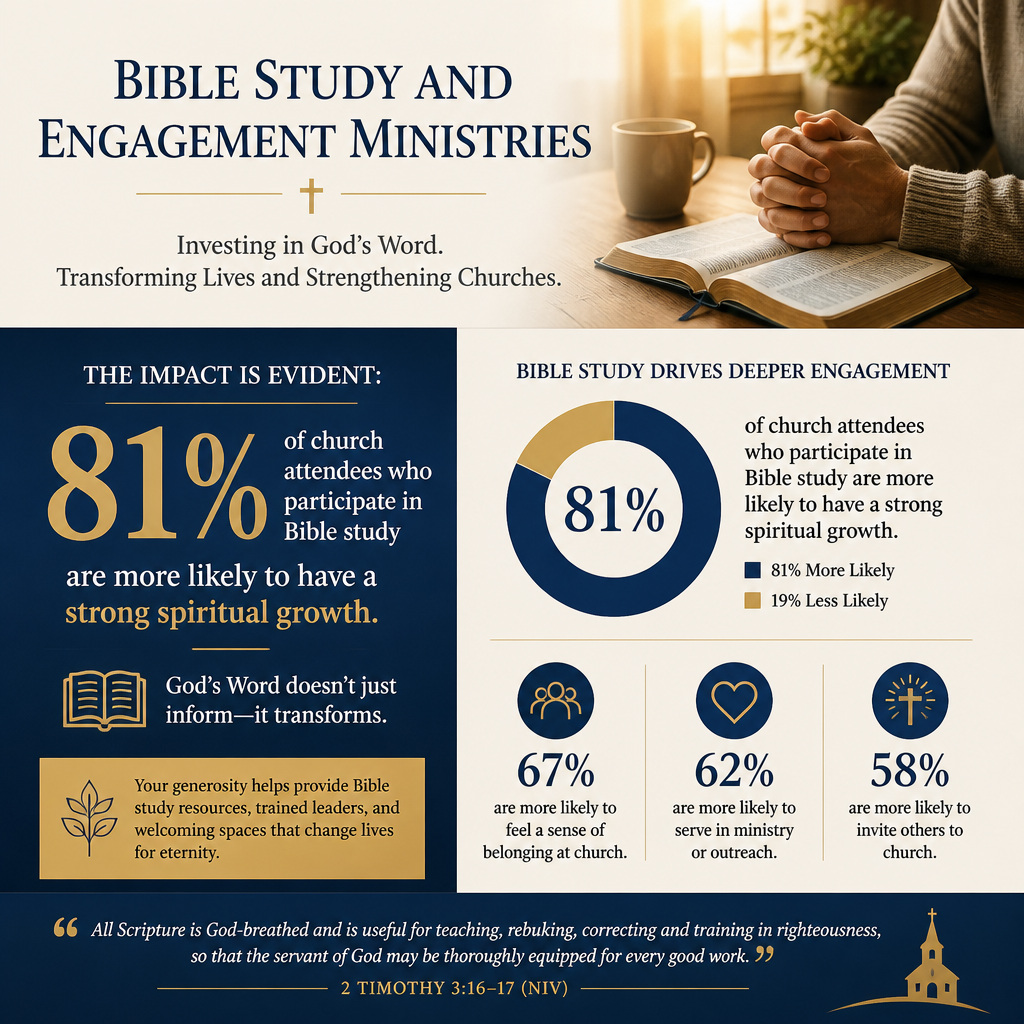
Some ministries hide behind spiritual language to avoid accountability; others adopt a purely secular measurement posture that cannot name discipleship without embarrassment. Better practice is candid about what can be measured and what must be discerned. Attendance, completion rates, and leader training are useful leading indicators. Yet donors should also ask for credible qualitative evidence: testimonies with corroboration, pastoral references, and follow-up showing durable change rather than momentary enthusiasm.
Integration with the local church
Bible engagement that disconnects believers from the sacraments, shepherding, and discipline of the church is not neutral. The New Testament assumes Christians are joined to identifiable communities under qualified leadership (Hebrews 13:17). Donors should look for ministries that explicitly strengthen congregational life: curricula designed for churches, partnerships with pastors, and pathways that move individuals from private consumption to communal obedience.
Doctrinal clarity paired with humility
Christians genuinely disagree about interpretive questions, ecclesial traditions, and secondary doctrines. A serious Bible ministry does not pretend those disagreements do not exist. It states its doctrinal commitments plainly, teaches with charity, and refuses to monetize controversy. Donors should reward ministries that handle disputed texts with integrity rather than with rhetorical aggression.
Common risks donors should name before giving
Bible engagement work has distinctive temptations. The Bible is authoritative, and any ministry that teaches it can drift into unaccountable influence. The donor’s task is not suspicion for its own sake, but sober love: protecting the church and the name of Christ by insisting that ministries handling the Word do so with transparency and integrity.
Celebrity dynamics and leader dependency
When a ministry’s reach depends on a single personality, governance tends to weaken. Boards become ornamental, financial decisions centralize, and dissent is treated as disloyalty. Donors should ask whether the ministry can survive faithful transitions, whether the board is meaningfully independent, and whether the organization has documented safeguards for moral failure, financial misconduct, and conflicts of interest.
Metrics that reward attention rather than formation
Digital Bible teaching can chase engagement statistics that correlate poorly with spiritual maturity. Donors should be cautious when the only reported outcomes are impressions, views, downloads, or “decisions” without follow-up. A ministry may be able to demonstrate growth in audience while also producing fragmentation, doctrinal confusion, or cynicism toward the church.
Proof-texting, ideological capture, and shallow teaching
Every generation faces the temptation to enlist Scripture as a weapon for pre-decided causes. When Bible study becomes a vehicle for partisan identity, the Bible is no longer allowed to correct the hearer. Donors should look for interpretive seriousness: attention to context, whole-Bible theology, and a willingness to teach hard passages without evasion or sensationalism.
Financial opacity in “free” content models
Many Bible engagement ministries offer resources at no cost, which can be a genuine service to the church. The risk is that donors cannot easily see the true unit economics: what it costs to produce and distribute content, what portion of gifts goes to fundraising, and whether executive compensation and related-party transactions are handled with appropriate restraint. Transparency is not a public-relations posture; it is a moral discipline for institutions entrusted with the church’s money.
How donors can evaluate Bible engagement ministries with confidence
Responsible giving requires more than checking whether a ministry’s mission statement sounds biblical. It requires evidence that the organization is structurally capable of sustaining faithfulness over time. This is where independent verification adds concrete value, not as a substitute for spiritual discernment, but as a guardrail against avoidable failures.
Faith foundation that is explicit and accountable
Donors should expect more than vague Christian branding. Look for a clear statement of faith, alignment with historic orthodoxy, and public teaching that matches those commitments. When a ministry claims to serve the whole church, donors should ask how it navigates denominational differences without collapsing doctrine into the lowest common denominator.
Governance and leadership that can withstand pressure
The board’s composition, independence, and documented oversight practices matter. Donors should ask whether the board meets regularly, reviews financials, evaluates the chief executive, and manages conflicts of interest. In our assessment work at Most Trusted, organizations that meet The Most Trusted Standard generally treat governance as a spiritual responsibility, not merely a legal formality.
Financial integrity that matches the ministry’s public claims
Wise donors avoid simplistic overhead rules, but they do require clarity. A credible Bible engagement ministry can explain how funds are spent, why those costs are necessary, and what safeguards exist for restricted gifts. The broader nonprofit sector has repeatedly emphasized that overhead ratios alone are not a reliable measure of effectiveness, a point articulated in the Overhead Myth letter endorsed by major evaluators Charity Navigator. The donor question is whether spending is honest, mission-aligned, and governed with restraint.
Transparency and effectiveness that go beyond marketing
Donors should expect accessible financial statements, clear descriptions of programs, and reporting that distinguishes outputs from outcomes. For example, “Bibles distributed” is an output; “Scripture engagement in local churches increased and persisted over time” is closer to an outcome. If a ministry works internationally, donors should also look for clarity on partner selection, safeguarding policies, and how the organization listens to local church leadership.
Most Trusted exists to serve this exact donor need: giving with confidence. When we verify a ministry against The Most Trusted Standard, we are not endorsing a personality or a trend. We are assessing whether the organization’s theology, governance, finances, and reporting practices are aligned with the weight of the work it claims to do.
FAQs for Bible Study and Engagement Ministries
What is the difference between Bible distribution and Bible engagement?
Bible distribution focuses on access: translating, printing, and delivering Scripture. Bible engagement focuses on use and formation: helping people understand Scripture, read it in community, and live in obedience to Christ. The two belong together, but they require different strategies and different measures of effectiveness.
Should donors prioritize digital Bible content or local church discipleship programs?
Both can be faithful, and the better question is how the ministry’s model connects people to embodied Christian community. Digital content can reach those outside the church and can resource believers at scale, but it can also foster private consumption detached from shepherding. Church-based discipleship is often slower and less visible, but it is structurally aligned with the New Testament’s vision of the church as the home of Word, sacrament, and pastoral care.
What indicators suggest a Bible study ministry is trustworthy?
Donors should look for explicit doctrinal commitments, independent and functioning governance, transparent financial reporting, and evidence that the ministry can describe outcomes beyond audience growth. It is also prudent to look for clear safeguarding practices, conflict-of-interest policies, and a demonstrated pattern of serving local churches rather than competing with them.
Giving that strengthens the church’s life in the Word
Bible Study and Engagement Ministries are not merely one giving option among many. They are an investment in the church’s capacity to hear God’s Word, to be corrected by it, and to endure with faithfulness in a distracted age. Donors best serve this work when they fund ministries that couple theological seriousness with institutional integrity.
When a Bible engagement organization welcomes scrutiny—of doctrine, governance, finances, and outcomes—it signals confidence that the light will not expose a contradiction. That posture is not defensive; it is biblical. “Test everything; hold fast what is good” (1 Thessalonians 5:21). Our work at Most Trusted exists to make that testing practical for donors who want their generosity to be both faithful and well-placed.