
Including biblical museum ministries in your will is not merely a financial decision. It is a theological act of stewardship that asks what will remain when our voice is silent and our estate is settled. Scripture does not treat legacy as a vanity project; it treats it as a question of faithfulness, purpose, and testimony across generations.
Biblical museums and related ministries sit at an unusual intersection: education and evangelism, scholarship and discipleship, public witness and internal church formation. That mix can bear lasting fruit, but it also raises due-diligence questions that mature donors should not ignore. A planned gift commits future resources to an institution that may look different in ten or twenty years, which is why clarity and verification matter.
Begin with the ministry purpose, not the instrument
Planned giving tools are useful, but the first question is spiritual and missional: what are we trying to fund? Biblical museum ministries typically pursue some combination of preserving artifacts, teaching Scripture’s historical context, equipping pastors and lay leaders, and providing public-facing apologetics. Those goals are related, but they are not identical, and each implies different measures of fruitfulness.
Jesus’ parable of the talents assumes stewardship is evaluated in light of entrusted purpose, not simply intent (Matthew 25:14–30). A will can amplify intent, but it cannot correct for mission drift or weak governance after the fact. For that reason, we recommend donors articulate the outcomes they hope to advance—biblical literacy, faithful interpretation, responsible curation, accessible education—before selecting the legal vehicle.
Clarify what kind of biblical museum ministry you mean
“Biblical museum ministry” can describe a wide range of institutions: a museum with significant acquisitions and conservation obligations, a traveling exhibit ministry, an education center serving churches, or a research institute that supports translation and archaeology. Each carries different cost structures and risks. A museum with collections has long-term preservation duties and often restricted-gift complexity; an exhibit ministry may be more event-driven and dependent on partnerships and venue agreements.
What this means in practice is that the best planned gift is one aligned to an institution’s actual operational reality. Donors sometimes assume a legacy gift will automatically support “the mission” broadly. Many ministries, however, must treat certain funds as restricted by law, donor intent, or collections policy, which can meaningfully shape how a gift is used.
Name the values that must remain non-negotiable
Christian donors genuinely disagree about some questions in this space: how to engage public education systems, how to address contested archaeological claims, how to communicate uncertainty without undermining confidence in Scripture, and how to avoid turning faith into a museum piece. The stronger ministries do not evade those tensions; they develop transparent interpretive standards and a doctrinal posture that is both orthodox and intellectually honest.
Across our verification work at Most Trusted, we observe that long-term donor confidence is often sustained by ministries that can state, in plain language, what will not change: their faith commitments, their commitments to truthfulness, and their accountability structures. Planned giving is where those non-negotiables become most consequential.
Choose the planned gift method that matches your intent
Once mission intent is clear, the legal and tax instruments become more straightforward to evaluate. The goal is not complexity for its own sake; it is fit. Some methods maximize flexibility, others maximize certainty, and others minimize administrative burden for heirs.
The IRS maintains a basic overview of estate and gift tax concepts, which is useful background for donors and advisors alike, even when most households will not owe federal estate tax (Internal Revenue Service).
A practical menu of common options
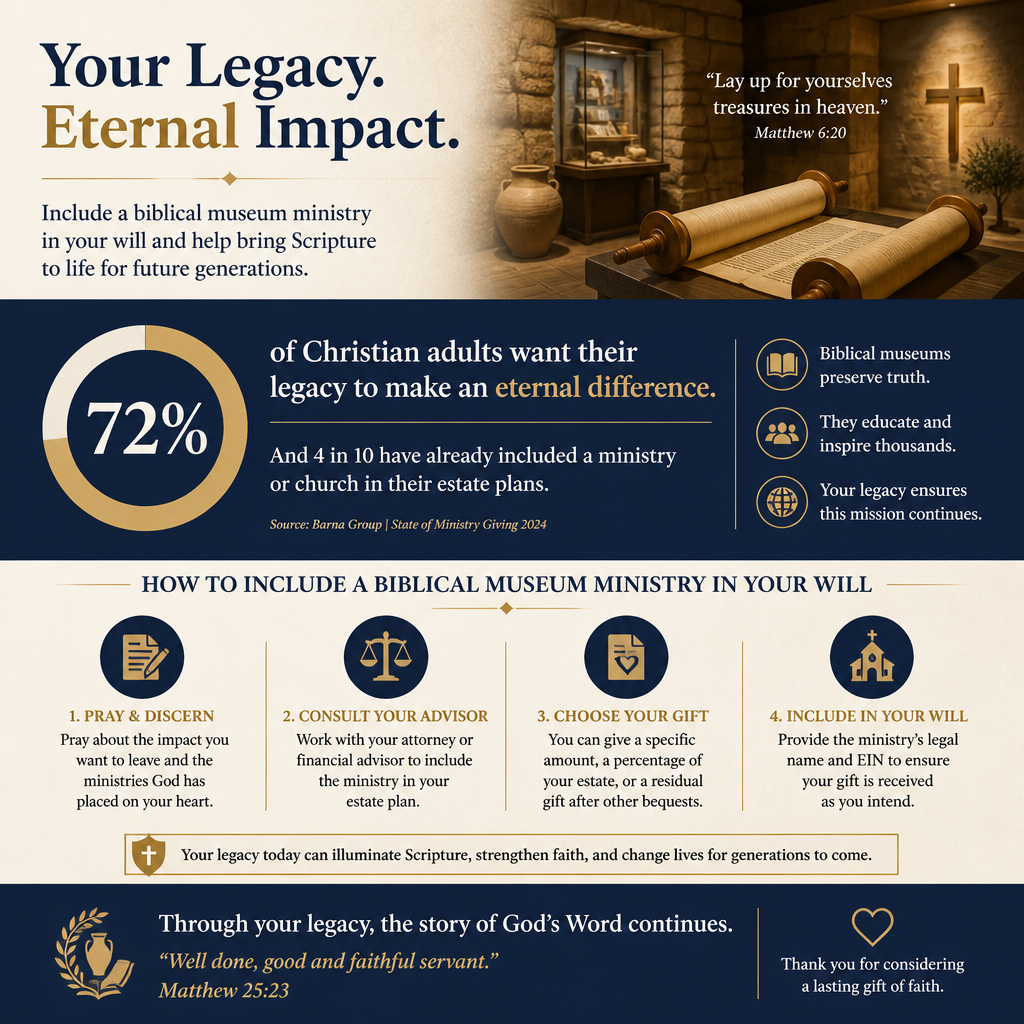
- Bequest in a will or trust: a specific dollar amount, a percentage, or a residual gift after other obligations.
- Beneficiary designation: naming the ministry on an IRA, 401(k), or life insurance policy, often simpler than amending a will.
- Donor-advised fund successor or recommendation: directing remaining funds to vetted ministries according to your priorities.
- Charitable remainder trust: providing income for a term, with the remainder to the ministry.
- Qualified charitable distribution planning: for some donors, integrating giving from an IRA during life with an estate plan.
Each option has trade-offs. Beneficiary designations are efficient but can be overlooked in an overall plan. Bequests can be customized but require careful drafting. Trusts can serve both family and ministry priorities but carry setup and administrative cost. The relevant point is theological as well as technical: a plan should not unintentionally burden heirs or the ministry with avoidable ambiguity.
Use language that prevents future confusion
Planned gifts fail most often because of small drafting errors: an outdated legal name, a missing tax identification number, or a restriction that is too narrow to be workable. If a donor restricts a gift to a program that later closes, or to a building project that becomes impractical, the ministry may have limited ability to adapt without court involvement or formal variance procedures.
We recommend working with an estate attorney who is comfortable drafting charitable provisions and confirming the ministry’s exact legal name. When donors want restrictions, the best restrictions usually describe purpose and boundaries rather than a single line-item expense. A restriction can honor donor intent while still allowing operational prudence.
Verify integrity because a legacy gift cannot be recalled
Planned giving is uniquely exposed to governance failure. A donor can stop a monthly gift if a ministry becomes careless, untruthful, or financially unstable. A bequest executed at death cannot be reconsidered. That is why verification is not an optional “extra” for legacy gifts; it is part of prudence.
The broader nonprofit field has pushed back, rightly, against simplistic evaluations based only on overhead ratios. The “Overhead Myth” letter, signed by major evaluators, argued that donors should focus on transparency, governance, and results rather than expecting artificially low administrative spending (Charity Navigator). Biblical museum ministries, in particular, often require specialized staffing—curators, conservators, educators, compliance professionals—that does not fit popular donor stereotypes of “lean ministry.”
What The Most Trusted Standard addresses
Most Trusted exists to help Christian donors give with confidence by evaluating ministries against The Most Trusted Standard, a 15-criteria framework across four areas: Faith Foundation, Financial Integrity, Governance and Leadership, and Transparency and Effectiveness. Planned gifts intensify the relevance of each area. Faith commitments matter because the gift will outlive immediate leadership. Financial integrity matters because museums and collections can create long-tail liabilities. Governance matters because boards shape mission fidelity over decades. Transparency matters because a ministry’s public claims—about history, artifacts, and impact—must be accountable to evidence.
For donors specifically exploring institutions in this space, our Biblical Museum Ministries coverage is designed to help readers distinguish between admirable aspiration and verifiable practice.
Integrity questions that are especially relevant to biblical museums
Because these ministries often operate at the border between scholarship and public persuasion, credibility is a form of ministry capital. Donors should not assume that a compelling exhibit implies responsible acquisition practices, careful provenance review, or appropriately cautious public messaging. The harder question is whether the ministry can withstand scrutiny without resorting to defensiveness or exaggeration.
When a ministry claims too much, it can damage not only its own reputation but the public credibility of Christian witness. A legacy gift should strengthen truth-telling, not inadvertently fund avoidable scandal.
Structure restrictions with humility and durability
Many mature donors want to restrict their legacy gift, and that desire is often virtuous. Restrictions can protect mission intent and prevent funds from being absorbed into unrelated projects. Yet restrictions can also become brittle. The future is not fully knowable, and museums face shifting regulatory, conservation, and educational realities.
Scripture commends careful planning while also recognizing human limits: “The heart of man plans his way, but the Lord establishes his steps” (Proverbs 16:9). Planned giving should reflect that balance—clarity without control that assumes omniscience.
Prefer purpose-based restrictions over narrow project locks
A purpose-based restriction might read like: “to advance biblically faithful public education through exhibits, collections care, and teaching resources.” A narrow project lock might read like: “to fund Exhibit A in Building B.” The first allows leadership to respond to future realities while remaining accountable to donor intent. The second can become unusable if circumstances change.
When restrictions are important, we recommend donors also include an explicit variance clause that allows the board, under defined conditions and with documented rationale, to redirect funds to a closely aligned purpose if the original purpose becomes impossible or imprudent. This is not a loophole for mission drift; it is a safeguard against needless legal gridlock.
Consider endowment and collections care with sober realism
Museums differ from many ministries because the work does not end when an exhibit opens. Preservation, insurance, storage, environmental controls, and conservation expertise are continuing obligations. Donors sometimes prefer funding “front stage” projects and hesitate to fund “back stage” preservation, even though long-term stewardship of artifacts is central to the ministry’s integrity.
What this means in practice is that an endowment-style legacy gift, or a gift designated for collections care and education capacity, can be among the most responsible forms of support—provided the ministry’s governance and reporting are strong enough to manage it well.
Prepare your heirs and advisors to execute the gift faithfully
Even the best charitable language can be undermined by poor execution. Heirs may be surprised, conflicted, or simply unclear about why a biblical museum ministry mattered to you. Advisors may not understand the ministry’s work and may default to expedience. Planned giving should include pastoral wisdom: it should shepherd the people who will carry out the plan.
Research on religion and giving consistently shows that charitable behavior is shaped by formation and community, not merely by financial capacity (Pew Research Center). Legacy giving benefits from the same principle. The gift is more likely to be honored and celebrated if heirs understand the theological and missional rationale.
Document the why, not only the what
A short legacy letter, kept with estate documents, can explain why you chose a biblical museum ministry: perhaps because the ministry strengthened your confidence in Scripture, equipped your grandchildren, or served as a credible witness to seekers. That letter does not need to pressure anyone. It should clarify the intent and make the plan intelligible.
We recommend stating the priority plainly: this gift is an act of worshipful stewardship, not a posthumous attempt to control family decisions. When heirs perceive the gift as a settled expression of faith, it is less likely to be treated as a negotiable suggestion.
Coordinate with the ministry without outsourcing discernment
Many ministries have planned giving staff who can provide sample bequest language and confirm legal names. That support can reduce errors. It should not replace independent evaluation. Donors should still confirm governance strength, doctrinal clarity, and financial transparency through verifiable means.
For donors comparing options across this domain, our Legacy and Planned Giving for Biblical Museum Ministries resources are intended to support careful, values-aligned decisions rather than impulse commitments.
FAQs for How to include biblical museum ministries in your will
Should we name a biblical museum ministry in a will or as a beneficiary on retirement accounts?
Both can be appropriate, and many donors use both. A will bequest allows customized language and can address a residual portion of the estate. Beneficiary designations on IRAs or life insurance are often simpler to execute and may be more tax-efficient in some situations. The prudent approach is to coordinate the two with an estate attorney so that the ministry gift and family provisions work together without conflict.
How can we reduce the risk that a legacy gift funds mission drift or poor stewardship?
First, evaluate the ministry’s governance, transparency, and doctrinal commitments with the seriousness appropriate to a long-term gift. Second, use clear legal naming and consider a purpose-based restriction with a variance clause to preserve intent without creating an unusable gift. Third, communicate your rationale to heirs so the gift is executed with understanding, not confusion. Most Trusted’s verification work against The Most Trusted Standard is designed to help donors make these judgments with evidence rather than assumption.
A legacy gift that strengthens Christian witness
When donors include biblical museum ministries in their will, they are investing in more than institutional survival. They are investing in the church’s capacity to teach Scripture with credibility, to steward historical inheritance responsibly, and to offer public witness marked by truthfulness. The discipline is to match generosity with verification, so that what we commend with our estate is worthy of the name of Christ and durable across time.



