
How to give appreciated stock to biblical museum ministries is, for many Christian donors, a question at the intersection of stewardship, conviction, and prudence. Done well, a stock gift can increase the ministry’s net benefit while reducing the donor’s tax friction, allowing more of the asset’s growth to serve the work rather than be diminished by capital gains.
Biblical museum ministries occupy a distinctive place in Christian philanthropy. They preserve artifacts, scholarship, and public witness that can strengthen confidence in Scripture, support pastors and teachers, and invite skeptics into serious engagement. The same distinctive mission also creates distinctive diligence questions: acquisition ethics, collection care, interpretive integrity, and the long-term financial obligations attached to physical assets.
Why appreciated stock is often a wise form of generosity
Stewardship with a clear moral logic
Scripture repeatedly frames wealth as entrusted property rather than private sovereignty. “Moreover, it is required of stewards that they be found faithful” (1 Corinthians 4:2). Giving appreciated stock can be a faithful way to release what has grown under our care, directing unrealized gain toward ministry rather than consumption.
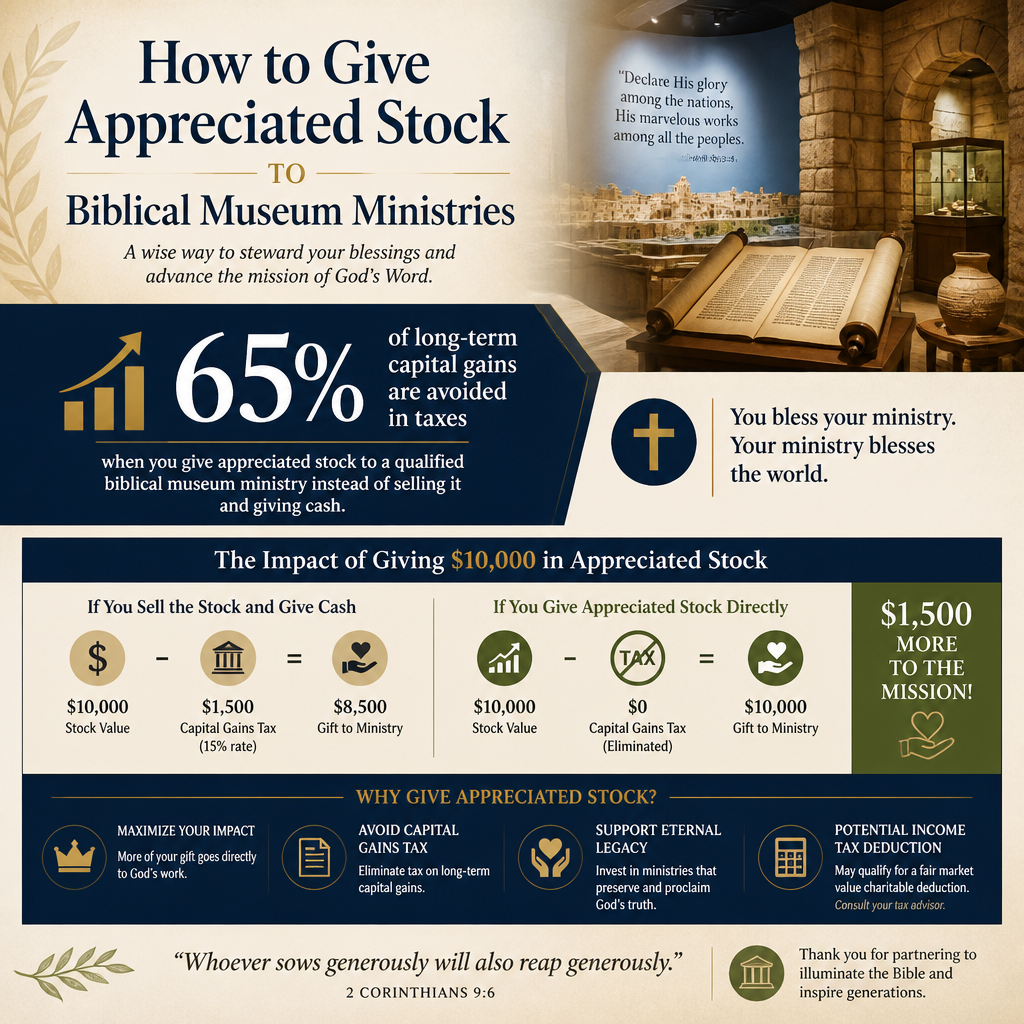
From a technical standpoint, donating long-term appreciated securities held more than one year is commonly tax-efficient because the donor may generally deduct fair market value (subject to IRS limits) and may avoid capital gains tax on the appreciation when the charity is eligible and the gift is structured properly. The IRS summarizes these rules for “gifts of appreciated property” and related deduction limitations in Publication 526.
Cash is simple, but simplicity can be expensive
Many donors default to writing a check because it feels straightforward. The harder question is whether the check is the most faithful expression of stewardship when the same giving intent could yield more ministry impact through a different asset. If a donor sells stock first and then gives cash, capital gains tax can reduce the amount that reaches the ministry, sometimes materially.
What this means in practice is that appreciated securities can function as “mission-efficient money.” The donor is not seeking a financial trick; the donor is seeking to reduce unnecessary loss so the gift can do more good.
Determine whether the ministry can receive stock safely and responsibly
Confirm basic readiness and internal controls
Not every biblical museum ministry is equipped to receive stock directly. Some can accept securities only through a third-party platform; others rely on a donor-advised fund; still others lack a brokerage relationship entirely. The operational question matters because it affects timing, documentation, and the risk of avoidable errors.
Across our verification work at Most Trusted, ministries that meet The Most Trusted Standard tend to have clear gift acceptance procedures, disciplined segregation of duties, and prompt receipting. These practices are not bureaucratic polish; they protect donors, protect staff, and reduce the likelihood that a gift intended for ministry becomes a reconciliation problem.
Ask questions that fit museum realities
Because museums steward physical collections and interpretive programs, donors should ask diligence questions that go beyond the typical “What is your overhead?” conversation. The museum field has learned to resist simplistic overhead ratios, and the nonprofit sector broadly has warned against over-relying on overhead as a proxy for effectiveness. Charity Navigator, Candid (formerly GuideStar), and the BBB Wise Giving Alliance made this case in their joint “Overhead Myth” letter hosted by Charity Navigator at charitynavigator.org.
For museum ministries, better questions include whether the organization has: ethical acquisition policies, credible provenance standards, an approach to repatriation when warranted, and the financial capacity to care for collections over decades. A museum can be doctrinally sound and evangelistically fruitful while still facing real governance and stewardship risks tied to collections and capital assets.
Practical steps for giving appreciated stock
Choose the giving pathway that fits your intent
There are several common routes for giving appreciated stock. Each has trade-offs in speed, privacy, and control. In most cases, the correct choice is the one that aligns the donor’s intent with the least administrative fragility.
- Direct transfer to the ministry’s brokerage account (often the simplest when available and well-managed).
- Donor-advised fund (useful when bundling gifts, simplifying records, or granting over time).
- Charitable trust (potentially appropriate when integrating income needs and multi-year planning).
- Qualified intermediary platform that processes securities for nonprofits (helpful when a ministry lacks brokerage capacity).
- Private foundation (more complex; can serve certain family governance aims but adds compliance burden).
Donor-advised funds have become a significant feature of modern philanthropy. Fidelity Charitable reports on this growth and its grantmaking patterns in its annual philanthropy reporting at fidelitycharitable.org. Growth is not a moral argument by itself, but it signals that many donors are seeking administrative clarity and paced giving.
Execute the transfer with precision
Stock gifts fail most often at the point of execution, not intention. Ministries commonly need the donor’s broker to initiate the transfer to avoid delays, and donors should avoid sending certificates or attempting to “mail” securities unless specifically instructed by competent professionals.
A disciplined process generally includes: confirming the correct receiving account details in writing, specifying the ticker and number of shares, noting whether the gift is restricted or unrestricted, and following up until the ministry confirms receipt. If the donor intends a gift to fund a particular exhibit, education program, or conservation project, the restriction should be documented carefully and should match what the ministry can responsibly deliver.
For donors who want to understand the broader philanthropic landscape within biblical museum ministries, the topic context matters. Our coverage of Biblical Museum Ministries reflects how mature donors often weigh mission clarity, institutional maturity, and verifiable practices alongside theological alignment.
Where diligence belongs for biblical museum ministries
Integrity and interpretive credibility
Biblical museums are not merely repositories of objects; they make interpretive claims. Those claims can encourage faith, inform scholarship, and shape the public’s perception of Christianity. For donors, this raises a legitimate question: is the ministry’s interpretive approach careful with evidence and transparent about what is known, what is debated, and what is speculative?
Christians genuinely disagree about how museums should balance apologetics, academic consensus, and evangelistic aims. A mature ministry does not hide the existence of scholarly debate, and it does not ask donors to fund certainty where the evidence supports only probability.
Governance and long-term obligations
Collections create enduring obligations: preservation environments, conservation labor, insurance, storage, security, and responsible deaccession policies. These obligations are often less visible to donors than the exhibit hall, but they can determine whether a museum’s public ministry remains viable.
Donors should look for transparent financial reporting, clear board oversight, and a posture that welcomes hard questions. Our work applying The Most Trusted Standard gives particular attention to governance and financial integrity because good intentions do not substitute for accountable structures. The ministries that treat verification as an ally rather than a threat tend to show the kind of seriousness donors should expect when funding work meant to endure beyond a single generation.
When giving intersects with multi-year planning, beneficiary designations, and long-term commitments, the surrounding discipline of planned generosity becomes especially relevant. Our work on Legacy and Planned Giving for Biblical Museum Ministries addresses the distinctive decisions that arise when donors are shaping gifts meant to outlast them.
Tax, documentation, and restrictions that can quietly undermine a good gift
Get the receipts and valuation rules right
Appreciated stock gifts are usually straightforward to acknowledge, but they are not casual. Donors should receive a contemporaneous written acknowledgment from the charity for gifts of $250 or more, a standard the IRS describes in its charitable contribution guidance at irs.gov. For publicly traded securities, donors generally determine fair market value based on market quotations, and the charity’s receipt typically does not state a value.
If the donor is giving non-publicly traded securities, the compliance complexity increases significantly, and donors may need qualified appraisals and additional IRS forms. Many museum ministries prefer not to receive complex assets unless they have a tested process and competent counsel.
Restrictions should serve ministry, not bind it
Donors are right to care about how funds are used. Restrictions can also create unintended fragility when they lock a ministry into a narrow use that becomes impractical. The more capital-intensive the ministry, the more important it is that restricted gifts align with real operational needs over time.
A disciplined approach is to ask what the ministry would fund next if it were simply trying to be faithful: conservation work, curriculum development, traveling exhibits, digitization, staff training, collection care, or debt reduction. A well-structured stock gift can then be directed toward those needs in a way that strengthens the institution rather than forcing it into a brittle plan.
FAQs for How to give appreciated stock to biblical museum ministries
Should we sell the stock and give cash instead?
Often, no. If the stock has appreciated and has been held more than one year, donating the shares directly can be more tax-efficient than selling and giving cash, because the donor may avoid capital gains tax on the appreciation and may generally deduct fair market value within IRS limits. The IRS discussion of these rules appears in IRS Publication 526. Your tax advisor should confirm how the rules apply to your situation.
What should we ask a biblical museum ministry before transferring shares?
Ask whether the ministry can receive securities directly, how quickly it liquidates donated shares, and how it receipts gifts. For museum-specific diligence, ask about acquisition and provenance policies, long-term collection care obligations, board oversight, and transparency in financial reporting and interpretive claims. These questions honor both the ministry’s mission and the donor’s stewardship responsibility.
A stock gift can be both faithful and careful
Christian generosity is not measured only by intent but also by fidelity in execution. Giving appreciated stock to biblical museum ministries can be a disciplined way to fund public witness, scholarship, and preservation while reducing avoidable tax loss. When the ministry’s governance is strong, its interpretive posture is honest, and its operational capacity is adequate, a securities gift can serve the Kingdom with both conviction and measurable integrity.



