
Planned giving options for biblical museum ministry donors are not primarily a tax strategy. They are a stewardship question: how a Christian orders resources toward what will endure, and how a donor helps preserve trustworthy access to Scripture’s world for the next generation. Because museums trade in authority—objects, provenance, interpretation, educational claims—legacy gifts also raise a second question: whether the ministry receiving the gift is structured to handle restricted funds, collections obligations, and public trust with integrity.
Scripture commends foresight without idolizing security. “A good man leaves an inheritance to his children’s children” (Proverbs 13:22), and yet Jesus warns against building larger barns as though life consisted in abundance (Luke 12:15–21). Planned giving sits inside that tension. For donors who love biblical history and want their estate to serve the church’s long obedience, clarity and restraint are virtues.
Why planned giving fits biblical museum ministries
Museums require long horizons and durable funding
Biblical museum ministries are unusually dependent on long-term assets: collections care, conservation, storage, exhibition design, education departments, and scholarly partnerships. These are not one-time expenses; they are commitments that extend across decades. A planned gift can underwrite that kind of time horizon more naturally than annual giving, particularly when a donor’s intent is intergenerational formation rather than immediate program output.
This is also where sophisticated donors should ask more questions, not fewer. Museums can be tempted toward expansion—more square footage, more acquisitions, more ambitious exhibitions—without a corresponding increase in long-term operating strength. Planned gifts can either stabilize a ministry’s future or, if poorly structured, accelerate institutional overreach.
Donor intent and interpretive integrity are inseparable
Many donors give to biblical museums because they want Christian families, skeptics, and students to encounter the Bible in its historical context. That is a legitimate aspiration, but it is not value-neutral. Interpretation, scholarship, apologetics, and public education intersect here, and Christians genuinely disagree about how museums should balance confessional commitments with academic standards.
For that reason, planned giving should not be framed as “leaving something behind” in the abstract. It is better framed as assigning spiritual and institutional responsibility. If a museum ministry mishandles provenance, overstates evidence, or obscures uncertainties, the long-term credibility cost can be severe. Donor intent should include not only what is funded, but how claims are made and verified.
Core planned giving options and how each functions
Bequests through a will or trust
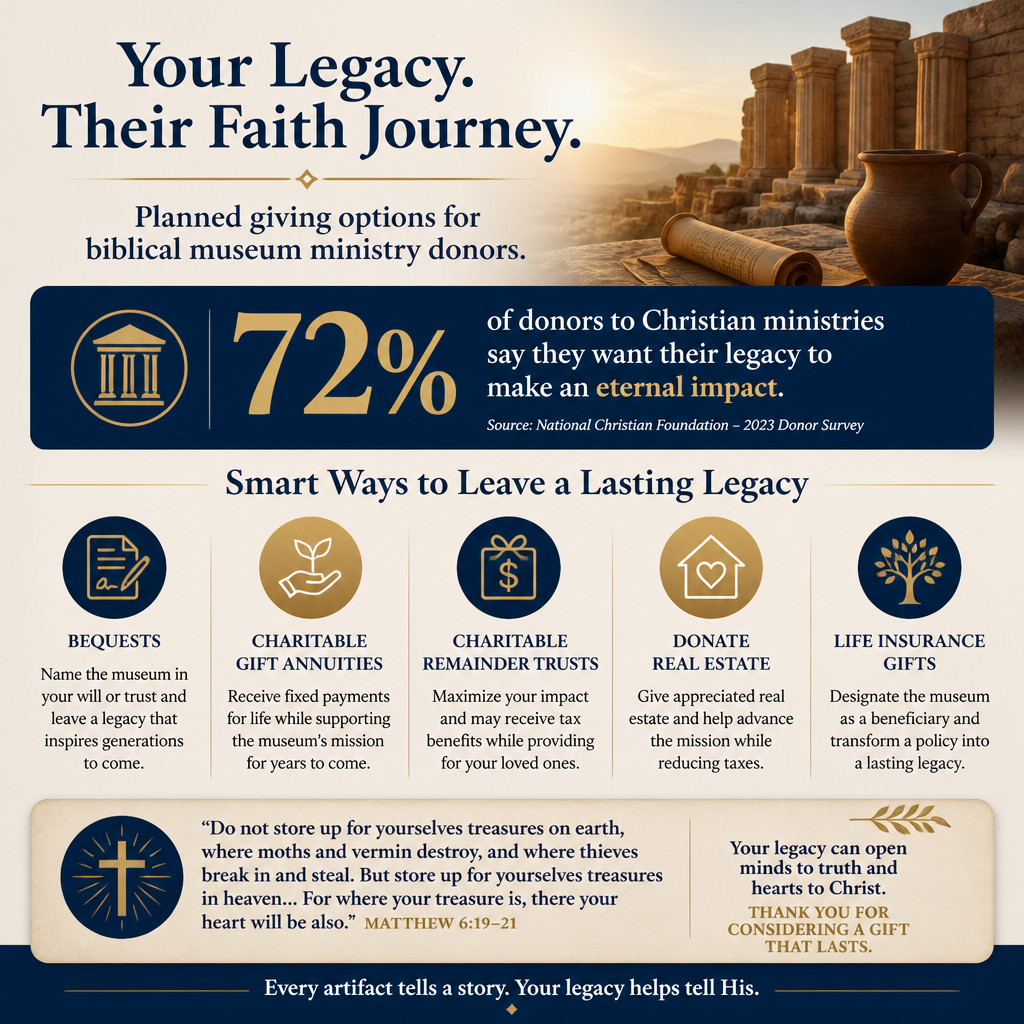
A bequest is the simplest planned gift: a donor names a ministry in a will or living trust for a specific amount, a percentage of the estate, or a “residuary” share after other obligations are met. Bequests are often appropriate for biblical museum donors because they preserve flexibility. They allow a donor to provide for family first, then direct remaining assets toward kingdom purposes without requiring a current transfer.
Practically, donors should consider whether to make the bequest unrestricted (allowing the ministry to deploy funds where needed) or restricted to a purpose such as collections care, education, or acquisitions. Restrictions can honor donor intent, but they can also create long-term rigidity if future conditions change. A restriction that seems prudent today can become a burden twenty years from now if it funds an activity the ministry can no longer sustain or ethically pursue.
Beneficiary designations for retirement accounts and insurance
Retirement accounts and life insurance policies pass by beneficiary designation, not by a will’s distribution instructions. That makes them a common missed opportunity in Christian estate planning. For many donors, naming a ministry as a beneficiary of an IRA, 401(k), or life insurance policy can be a clean expression of intent and, depending on the donor’s overall plan, can be tax-efficient.
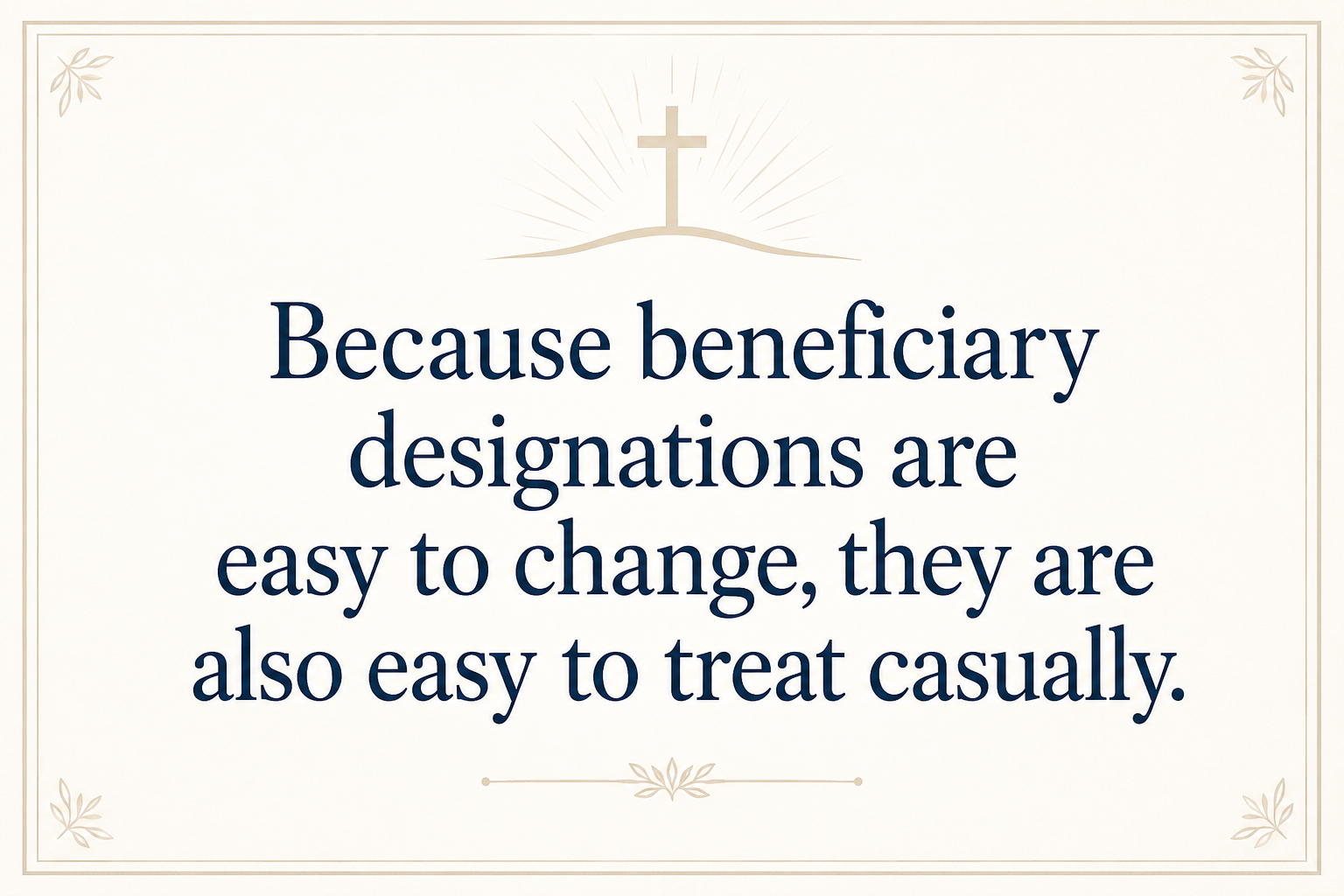
Because beneficiary designations are easy to change, they are also easy to treat casually. Mature donors typically do the opposite: they document the designation, confirm the ministry’s legal name and tax status, and ensure the gift aligns with the family plan. When donors ask us how to evaluate receiving ministries, we recommend verifying that the organization is stable enough to steward a future gift and transparent enough to be accountable for it under The Most Trusted Standard.
Gifts of appreciated assets and donor-advised fund legacies
For donors holding appreciated securities, giving stock during life can be more efficient than giving cash, since it may avoid capital gains while supporting ministry work now. Some donors then replenish the asset with cash, effectively “resetting” basis while sustaining giving. Others designate a portion of their donor-advised fund to a biblical museum ministry upon death, which can be a disciplined way to plan a legacy alongside ongoing annual grants.
These options can be wise, but they can also mask a lack of clarity. A donor-advised fund, for example, can drift without a written successor plan. The result is often administrative complexity for heirs and ambiguity about donor intent. Clarity is charity to one’s family and to the ministries one hopes to support.
Restricted gifts, endowments, and the obligations donors rarely see
Restrictions can preserve intent or create institutional strain
In museum settings, donors frequently want to restrict gifts to acquisitions, conservation, galleries, or educational programming. The impulse is understandable: museums can be judged by what visitors see. The harder truth is that visible outcomes depend on invisible infrastructure—collections management systems, climate control, security, registrars, curators, and compliance. A restricted gift that funds acquisition without funding long-term care can force a ministry into unfunded obligations.
Donors should insist on plain-language gift agreements that describe what the funds may be used for, what “success” looks like, and what happens if circumstances change. A responsible ministry will not resist that clarity. It will welcome it as a form of mutual accountability.
Endowments are not automatic solutions
Endowments can stabilize long-term work, but they require disciplined governance and transparent spending policies. Christian donors sometimes assume an endowment is the most prudent form of legacy giving. Yet endowments can also become a substitute for hard budget decisions, or they can create internal incentives to prioritize investment growth over mission urgency.
If a donor is considering an endowment gift, the questions become more technical: Who controls the endowment? What is the spending rate policy? Are funds invested consistently with Christian convictions? How is performance reported? The ministry should be able to answer these questions without defensiveness, because they are the ordinary obligations of stewardship.
- Ask for the ministry’s gift acceptance policy, including how it handles restricted gifts and non-cash assets.
- Require a written gift agreement for any restriction, with a variance clause for changed circumstances.
- Confirm long-term care costs for any collections-related restriction, not only acquisition cost.
- Clarify reporting expectations so heirs and future boards can honor donor intent.
- Ensure the ministry can legally and operationally receive the asset, especially for complex gifts.
Due diligence for legacy gifts in a trust-sensitive sector
Why verification matters before an irreversible gift
Planned gifts are often irrevocable in effect, even when legally revocable while the donor is alive. Once the donor is gone, a family cannot easily correct a misaligned mission, a governance failure, or a credibility crisis. That is why donors increasingly treat legacy giving as a diligence-heavy decision rather than a sentimental one.
Most nonprofits can present compelling stories. Fewer can demonstrate durable governance, clean financial practices, and transparent reporting. Across our verification work at Most Trusted, the ministries that meet The Most Trusted Standard tend to show consistent patterns: clear faith commitments, independent oversight, coherent financial statements, and public-facing accountability that does not depend on donor trust alone.
Particular diligence questions for biblical museums
Biblical museum ministries face sector-specific scrutiny: provenance standards, acquisition ethics, and interpretive claims that can be contested. Donors do not need to become curators, but they should ask whether the ministry has professional standards and whether it admits uncertainty where evidence is limited. A museum that overstates claims may attract short-term attention, but it risks long-term reputational harm that can undercut the very gospel credibility donors want to strengthen.
Donors who want a broader view of the field can review Biblical Museum Ministries and compare how different organizations articulate mission, scholarship, public education, and accountability. For donors weighing legacy commitments in particular, Legacy and Planned Giving for Biblical Museum Ministries is a useful context for thinking through gift structures alongside ministry readiness.
Integrating planned giving with family discipleship and pastoral wisdom
Christian estate planning is formation, not merely distribution
For many Christian donors, the most delicate part of planned giving is not technical. It is relational and spiritual: what heirs will understand about generosity, what a family’s story says about the Kingdom, and how wealth can either disciple or deform. Scripture’s warnings about riches are not theoretical. Jesus’s encounter with the rich young ruler exposes how easily possessions can possess the heart (Mark 10:17–27).
Planned giving can be a means of discipling a household when it is explained with clarity and humility. Some donors include a letter of intent that tells heirs why particular ministries matter, what theological convictions guided the plan, and what kind of stewardship the family hopes to model. When donors consult pastors or wise counsel in the planning process, it often results in fewer surprises and more peace.
Balancing generosity with legitimate obligations
Christians can turn planned giving into a false test of faithfulness, as though larger gifts necessarily signal deeper obedience. Scripture does not support that simplification. The widow’s offering in Mark 12:41–44 was praised not because it was large, but because it was sacrificial and sincere. Some donors are called to significant legacy giving; others are called to consistent generosity with quieter means.
What this means in practice is that planned giving should be integrated with responsibilities to spouse, children, church commitments, and debt obligations. When those responsibilities are ignored, legacy gifts can become a spiritual burden for heirs rather than a testimony of freedom.
FAQs for Planned giving options for biblical museum ministry donors
Should we restrict a planned gift to acquisitions or exhibitions?
Sometimes, but restrictions should be drafted with care. Acquisitions and exhibitions carry ongoing costs—conservation, insurance, storage, and professional staffing—that may exceed the original gift amount over time. We generally recommend that any restriction include a written gift agreement, a clear description of allowable uses, and a variance clause so the ministry can honor donor intent even if circumstances change.
How can we assess whether a biblical museum ministry is trustworthy for a legacy gift?
Start with governance and transparency, then move to sector-specific integrity. A ministry should be able to provide audited financials or credible financial reporting, a conflict-of-interest policy, independent board oversight, and clear program reporting. For biblical museums, donors should also ask about provenance practices, acquisition ethics, and whether interpretive claims are made with appropriate scholarly restraint. Most Trusted’s verification process evaluates ministries against The Most Trusted Standard so donors can give with confidence grounded in verifiable evidence rather than impressions.
A legacy gift should strengthen what is true
Biblical museum ministries can serve the church by preserving artifacts, illuminating Scripture’s historical setting, and inviting serious engagement with the claims of the Bible. Planned giving is one way to sustain that work beyond a donor’s lifetime, but it should be approached as an act of stewardship shaped by truthfulness, accountability, and love of neighbor. The best legacy gifts do not merely fund a future; they strengthen trust.



