Bible Distribution Ministries sit near the center of Christian mission because Scripture itself sits at the center of Christian life. If God has chosen to make himself known through the written Word, then access to that Word is not a secondary concern; it is a matter of spiritual formation, church health, and long-term witness. For donors, the question is not whether Bibles matter, but how to fund Bible access with theological clarity, cultural sobriety, and verifiable integrity.
The modern Bible distribution movement carries both promise and complexity. The promise is straightforward: where believers and seekers can read Scripture in a language they understand, in a format they can keep, teach from, and share, the church is strengthened. The complexity is equally real: shipping containers of printed Bibles can be the wrong answer in places where translation is the bottleneck, where literacy is limited, where local churches are already supplied, or where government scrutiny endangers recipients. Mature giving refuses both cynicism and sentimentality.
Across our verification work at Most Trusted, we see donors become most confident when ministries can demonstrate three things: fidelity to the gospel that Scripture proclaims, disciplined stewardship of donor resources, and transparent evidence that distribution results in real access and use. The rest of this article explains how Bible distribution works today, where the common failure modes are, and what responsible donors should require.
Why Bible access remains a frontline ministry
Christianity is a revealed religion. God speaks; God acts; and God’s people are shaped by remembering and rehearsing his words and works. Scripture repeatedly binds covenant faithfulness to the public reading and teaching of God’s Word (Deuteronomy 31; Nehemiah 8; 1 Timothy 4). When Bible distribution is done well, it is not merely publishing. It is a ministry of access that supports preaching, discipleship, family worship, evangelism, and endurance under suffering.
At the same time, donors should resist a simplistic narrative that assumes “more copies” automatically means “more biblical formation.” In some contexts, the limiting factor is not physical supply but church training, literacy, or the absence of trusted local distribution partners. In others, digital Scripture can outpace print in both reach and safety. Responsible donors fund Bible access in ways that serve the church that will actually teach and embody the Word.
Scarcity is still real, but it is uneven
Some parts of the world still lack complete translations, and others have translations but lack affordable access, especially in minority languages and in rural areas. The field has grown more data-driven in recent decades; donors can and should expect ministries to name the specific access gap they are addressing: translation, printing, distribution logistics, affordability, or the downstream work of engagement and discipleship.
When ministries cite global translation need, credible baselines matter. For example, Wycliffe Global Alliance reports progress and remaining needs in Bible translation work; donors can consult their public reporting to understand what “need” means by language group and translation stage (Wycliffe Global Alliance).
Scripture distribution is not spiritually neutral
Bibles are not generic humanitarian goods. They are texts with a doctrinal center, and distribution inevitably implies trust: which translation, which canon, which notes, which partnering churches, and which theology of conversion and discipleship. Mature donors do not apologize for caring about this. Confessional clarity and ecclesial accountability are forms of love toward recipients and toward the local church.
Access must be paired with comprehension and use
The Great Commission includes “teaching them to observe all that I have commanded you” (Matthew 28:20). Where literacy is limited, Scripture engagement may require audio, oral Bible storying, or facilitated group reading. Where literacy is present, it may require study helps, training for pastors, or structured reading plans. Donors should listen carefully for whether a ministry’s model assumes formation or actually supports it.
How Bible distribution ministries operate today
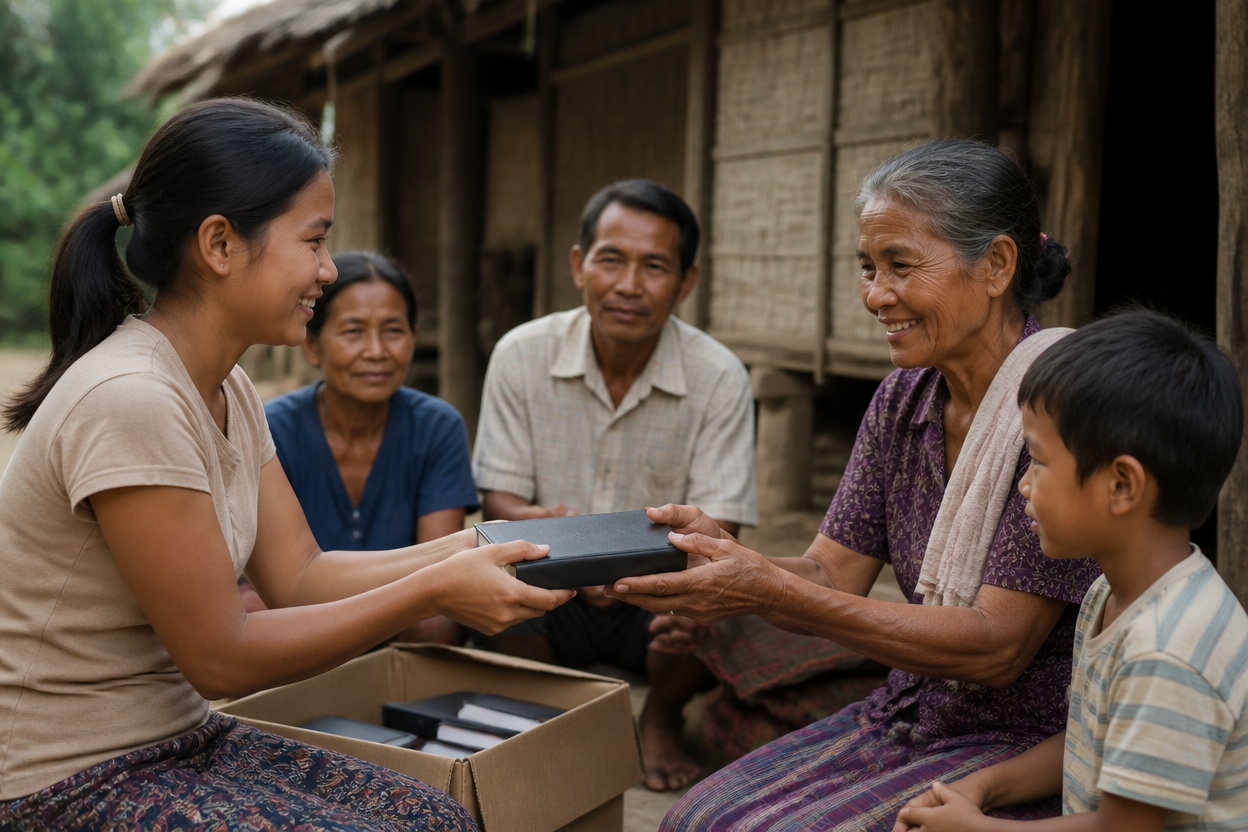
The public imagination often pictures Bible distribution as a simple supply chain: print Bibles, ship them, hand them out. Some ministries still operate that way, and in certain contexts it can be appropriate. But the stronger ministries now work across a range of models, each with distinct risks and accountability requirements.
Print distribution through church networks
In many regions, local churches remain the most credible and sustainable channel for distribution. Churches know who is seeking, who is new to the faith, and who will be discipled. They can also reduce black-market diversion by distributing through relationships rather than through anonymous mass handouts. This model rises or falls on partner selection, controls, and follow-up.
Donors should ask whether the ministry’s church partners are vetted, trained, and accountable. A mature operation can explain how it avoids creating perverse incentives, such as rewarding inflated reporting or pushing volume over pastoral care.
Subsidized sales and marketplace approaches
Some ministries subsidize Scripture so local believers can purchase Bibles at an affordable price rather than receive them as a free good. Christians genuinely disagree about where the ethical line sits here. One concern is that charging for Scripture feels inconsistent with the freeness of the gospel. Another concern is that giving everything away can undermine local Christian booksellers, distort local church economics, and reduce perceived value.
What this means in practice is that donors should not demand a one-size-fits-all answer. We recommend requiring a clear rationale rooted in local conditions and a transparent pricing and subsidy policy. In contexts where persecution is present, discreet distribution may be more important than any formal marketplace model.
Digital Scripture and audio Bible delivery
Digital access can overcome logistics and cost barriers, and audio Bibles can serve communities where literacy is limited. Yet digital ministry introduces its own stewardship questions: app development costs, device access, data privacy, and whether digital Scripture is actually usable in places with limited connectivity or government surveillance.
Donors should treat digital claims with the same rigor as print claims. “Downloads” are not the same as “read.” A credible ministry can show evidence of sustained engagement, not merely distribution events or installation numbers. Where digital delivery creates safety risks, ministries should be able to articulate their security posture and their protocols for protecting recipients and partners.
Hybrid models and the role of local ownership
Many of the most effective ministries combine print, audio, and training depending on context. The enduring question is local ownership: who will teach the Bible, defend sound doctrine, and disciple converts once the shipment is gone and the campaign ends? Ministries that treat the local church as a mere distribution channel tend to overstate impact. Ministries that treat the local church as the primary actor tend to build something that lasts.
Risks, controversies, and the hard questions donors must ask
Bible distribution is not immune to the temptations that affect any donor-funded work: exaggeration, superficial metrics, and decisions shaped by fundraising narratives rather than by pastoral reality. Mature donors protect both the integrity of the ministry and the dignity of the recipient by asking questions early, not after a scandal forces them.
Counting what is easy instead of what is true
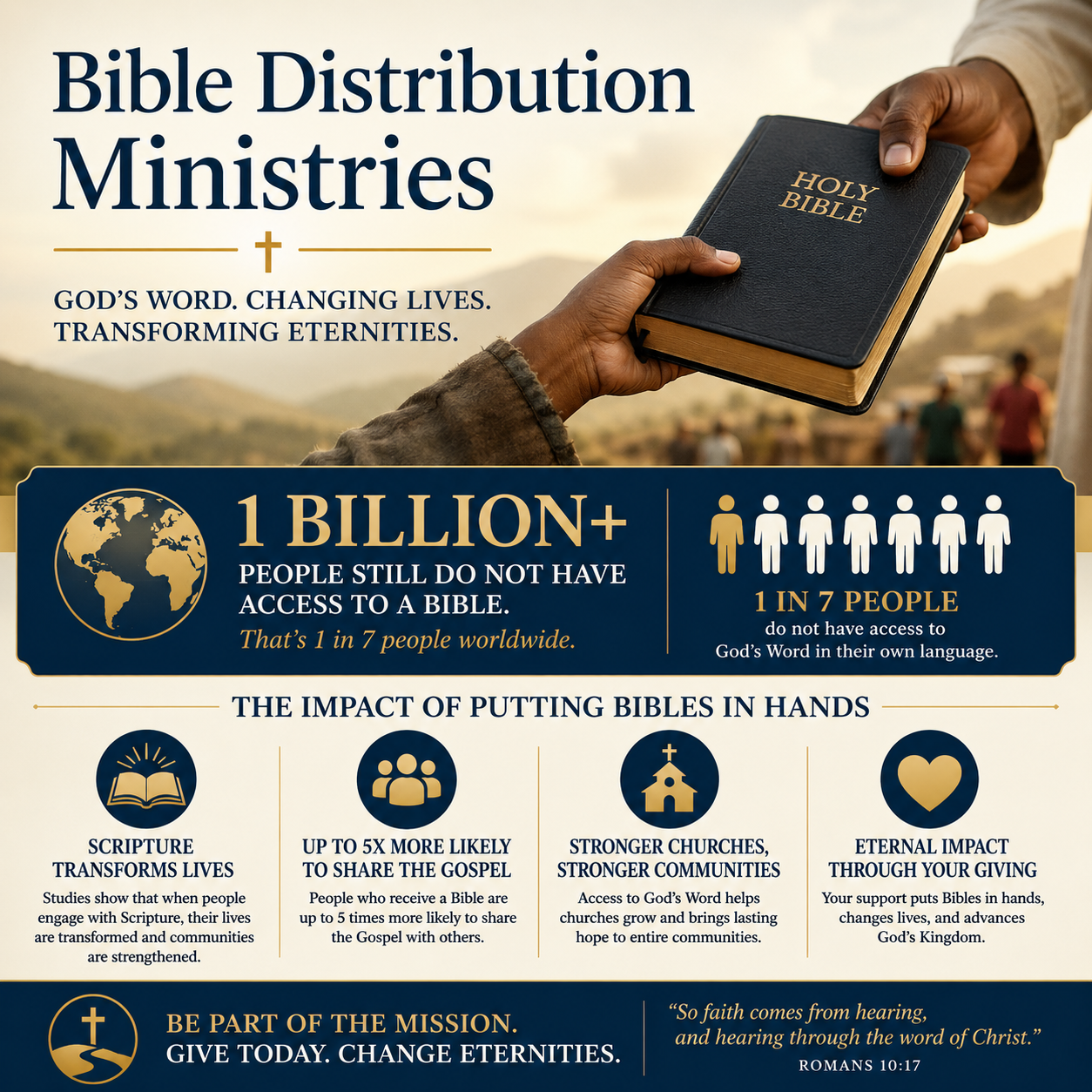
The easiest number to report is “Bibles distributed.” It is also one of the least informative numbers if it is not paired with context: to whom, through whom, at what cost, with what follow-up, and with what evidence of actual use. A ministry that distributes 100,000 Bibles into warehouses, or into communities already saturated, can report impressive volume while achieving little.
We recommend donors press for operational definitions and documentation: What constitutes “distributed”? Is it delivered to a partner, placed into a recipient’s hands, or confirmed in use through a program? Honest ministries will admit where verification is limited and will show what controls they do have.
Local church distortion and dependency
Free imported goods can unintentionally weaken local Christian ecosystems. If a ministry’s model consistently bypasses local publishers, printers, or bookshops, it can hollow out local capacity. If it bypasses pastors, it can weaken the church’s teaching office by shifting spiritual authority to external campaigns. None of this means that free distribution is wrong; it means it should be justified and bounded.
The best ministries can name the trade-offs. They can explain why their approach supports, rather than supplants, local leadership and long-term discipleship.
Security, coercion, and ethical evangelism
In restricted environments, distributing Scripture can endanger recipients and local partners. Donors should treat security as a moral issue, not merely a tactical one. Ministries should be cautious about publishing identifying stories or photographs, and they should understand local law and the likely consequences for believers.
Another ethical question concerns coercion and quid pro quo. Bible distribution should not be used as a tool of manipulation: “Scripture in exchange for attendance,” “Scripture in exchange for a public decision,” or “Scripture in exchange for personal data.” Faith comes by hearing the Word (Romans 10), but Christian witness does not require violating conscience or dignity to produce measurable outcomes.
What strong Bible distribution ministries have in common under The Most Trusted Standard
Donors often ask for a short list of signals that separate trustworthy Bible distribution from mere religious logistics. The Most Trusted Standard is our framework for evaluating Christian nonprofits across 15 criteria in four domains: Faith Foundation, Financial Integrity, Governance and Leadership, and Transparency and Effectiveness. Donors do not need to memorize a framework to give well, but they do need to know what “trustworthy” looks like in practice.
Faith Foundation that is explicit and accountable
Bible distribution ministries should be unambiguous about their doctrinal commitments, their view of Scripture, and the church relationships that anchor their work. Since these ministries handle the text that forms the church, donors should expect clarity about translation philosophy, denominational posture where relevant, and policies on contested issues such as which translations are used and whether study notes are included.
Accountability matters as much as clarity. Healthy ministries are not personality-driven. They can name the boards, church structures, or institutional relationships that meaningfully govern them.
Financial Integrity matched to the realities of publishing and logistics
Printing and distribution can be capital-intensive, and costs vary dramatically by context, paper markets, shipping routes, and local tariffs. Donors should be wary of simplistic cost-per-Bible claims that ignore overhead, spoilage, warehousing, or security. The more credible approach is transparent unit economics: what it costs to produce, transport, store, and deliver Scripture through accountable channels.
We also recommend donors look for audited financials, conflict-of-interest policies, and clear treatment of restricted gifts. Ministries that handle large volumes of inventory should be able to explain their controls for procurement, vendor selection, and inventory tracking.
Governance and Leadership that resists celebrity and concentrates on stewardship
Ministries that distribute Scripture often attract strong donor emotion. That emotion can be a gift, but it can also be exploited. Strong governance creates a sober counterweight: board oversight, executive accountability, documented policies, and a demonstrated willingness to tell donors the truth even when it complicates fundraising.
Where leadership is unusually opaque, where boards are comprised mainly of insiders, or where financial decisions are concentrated in a single founder, donors should slow down. Scripture warns that money tests the heart; governance is one of the protections God has given the church to keep that test from becoming a fall (1 Timothy 3; Titus 1).
Transparency and Effectiveness grounded in verifiable evidence
Effectiveness in Bible distribution is not primarily emotional testimony, even though testimonies matter. It is the disciplined demonstration that Scripture is reaching intended recipients and being used in ways consistent with the ministry’s stated goals: discipleship, church planting support, pastoral training, evangelistic outreach, or Scripture engagement.
In practice, this means ministries should publish more than promotional stories. They should report where they work, with whom, what they do, what it costs, what risks they face, and what they have learned when outcomes fell short. A ministry that never names a limitation is rarely a ministry that sees clearly.
How donors can evaluate a Bible distribution opportunity
Most donors do not have time to conduct a full diligence process for every gift. The goal is not to become suspicious; it is to become appropriately discerning. A short set of questions can reveal whether a ministry is prepared for accountability or primarily prepared for fundraising.
Questions that clarify the ministry model
- What is the specific access problem being addressed? Translation gap, affordability, distribution logistics, persecution constraints, literacy, or training?
- Who are the local partners? Churches, denominations, seminaries, prison ministries, refugee networks, or bookshops? How are partners vetted?
- What happens after distribution? Is there a plan for teaching, group reading, pastoral training, or follow-up that fits the local church?
Questions that test financial stewardship
- Can the ministry explain its cost structure? Printing, shipping, warehousing, local delivery, staff, security, and program support.
- Are financial statements and audits accessible? Donors should not need personal connections to see basic documentation.
- How are restricted gifts handled? Are donor restrictions honored and tracked with integrity?
Questions that probe integrity and impact
- How does the ministry verify distribution? Documentation, partner reporting, spot checks, inventory controls, or third-party validation.
- What outcomes matter besides volume? Scripture engagement, pastoral training completion, church-based discipleship participation, or long-term access through local channels.
- What has the ministry stopped doing? Mature organizations can name programs they revised or discontinued because they were ineffective or harmful.
When donors want an independent assessment rather than relying solely on self-reported claims, Most Trusted exists for precisely that purpose. Our evaluations against The Most Trusted Standard are designed to help donors give with confidence, particularly in categories like Bible distribution where reported numbers can be impressive and still misleading if not carefully defined.
FAQs for Bible Distribution Ministries
Are printed Bibles still necessary when digital access is growing?
In many places, yes. Print remains durable, shareable within households and churches, and usable without connectivity, electricity, or device access. Digital Scripture can be strategic where phones are common and physical distribution is costly or risky, but donors should ask whether the recipient community can reliably and safely access digital Scripture and whether engagement is measured beyond downloads.
How can donors tell whether a ministry is exaggerating impact?
Overstatement often shows up in vague definitions (“reached,” “impacted”) and in metrics that cannot be audited (“millions reached” without geography, partners, or documentation). More credible ministries define “distributed” with precision, provide partner and location specificity appropriate to security constraints, and report both outputs and outcomes, including what they have learned when plans did not work as expected.
Should Bible distribution be paired with discipleship programs?
Often it should, but the form varies by context. In a healthy church network, distribution through pastors may be sufficient because teaching and follow-up are already present. In pioneer contexts, prisons, refugee settings, or low-literacy communities, pairing distribution with oral Scripture engagement, training, or structured small-group reading may be essential. Donors should look for a model that serves the local church’s capacity rather than substituting for it.
A faithful and verifiable approach to Bible distribution
Supporting Bible Distribution Ministries is one of the most direct ways donors can invest in the long obedience of the church: the steady work of hearing, believing, and living the Word of God. The opportunity is large, and so is the responsibility. Wise donors fund ministries that treat Scripture as holy, recipients as dignified, local churches as primary, and donor resources as entrusted for careful stewardship.
When a ministry can show clear theological commitments, accountable governance, transparent finances, and credible evidence that Scripture is reaching people in ways that lead to genuine access and use, donors can give with confidence and without naivete. That combination—faithful purpose joined to verifiable practice—is the standard of trust we should require.