
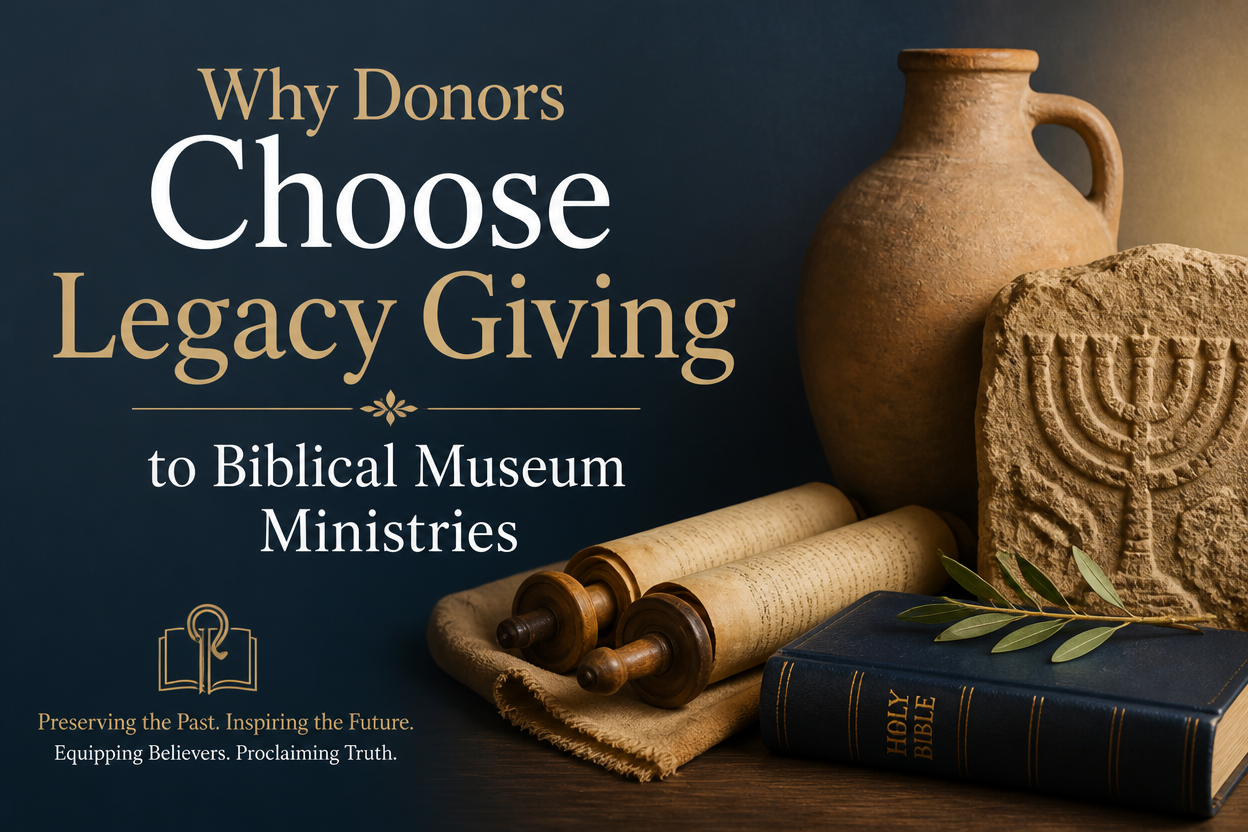
Why donors choose legacy giving to biblical museum ministries is rarely a question of novelty. It is a question of permanence: whether the story God has told in Scripture will be handed on with clarity when the current generation is gone. For many Christian donors, a planned gift to a museum ministry is a way to place their stewardship inside the long horizon of the Church rather than inside a single budget year.
Biblical museums sit at an intersection of education, apologetics, pastoral formation, and public witness. That location brings particular opportunities and particular temptations. A museum can become mere spectacle, or it can become a disciplined act of remembrance that serves the Church and invites the world to attend to what is true. Legacy giving, at its best, strengthens the latter.
Legacy giving aligns with a biblical theology of remembrance
Remembrance is a moral act, not a nostalgic one
Scripture treats memory as covenantal responsibility. Israel is repeatedly commanded to remember what God has done, not as sentiment but as obedience that shapes worship and ethics. The Lord’s Supper is likewise an enacted remembrance that forms the people of God. A biblical museum ministry, when it is faithful to that theological gravity, functions as an institution of disciplined memory: it preserves, interprets, and transmits the material and textual context that helps ordinary Christians read the Bible with greater accuracy and reverence.
Legacy giving fits that calling because it is oriented to what outlasts us. Planned gifts do not merely fund an exhibit; they fund the quiet, long work of conservation, scholarship, and patient interpretation. That kind of work is difficult to sustain through annual appeals alone, especially when donor attention naturally gravitates to urgent human needs. Christian donors often choose a legacy gift precisely because they want to underwrite the slow formation that keeps the Church tethered to the historic faith.
Christian donors sense the stakes of biblical literacy
Many donors are responding to a widely observed erosion of biblical literacy, both inside and outside the church. Evidence suggests that Scripture engagement is not uniform across American life and has shown meaningful change over time. The American Bible Society’s annual report has tracked these patterns, including declines in Bible use in recent years and modest rebounds that vary by segment, underscoring a volatile environment for biblical formation (American Bible Society).
What this means in practice is that ministries serving biblical understanding are not supporting an academic hobby. They are reinforcing conditions under which the Church can hear the Word of God with comprehension. Donors who have watched confusion grow around basic doctrines often see a museum ministry as one modest but concrete instrument of catechesis.
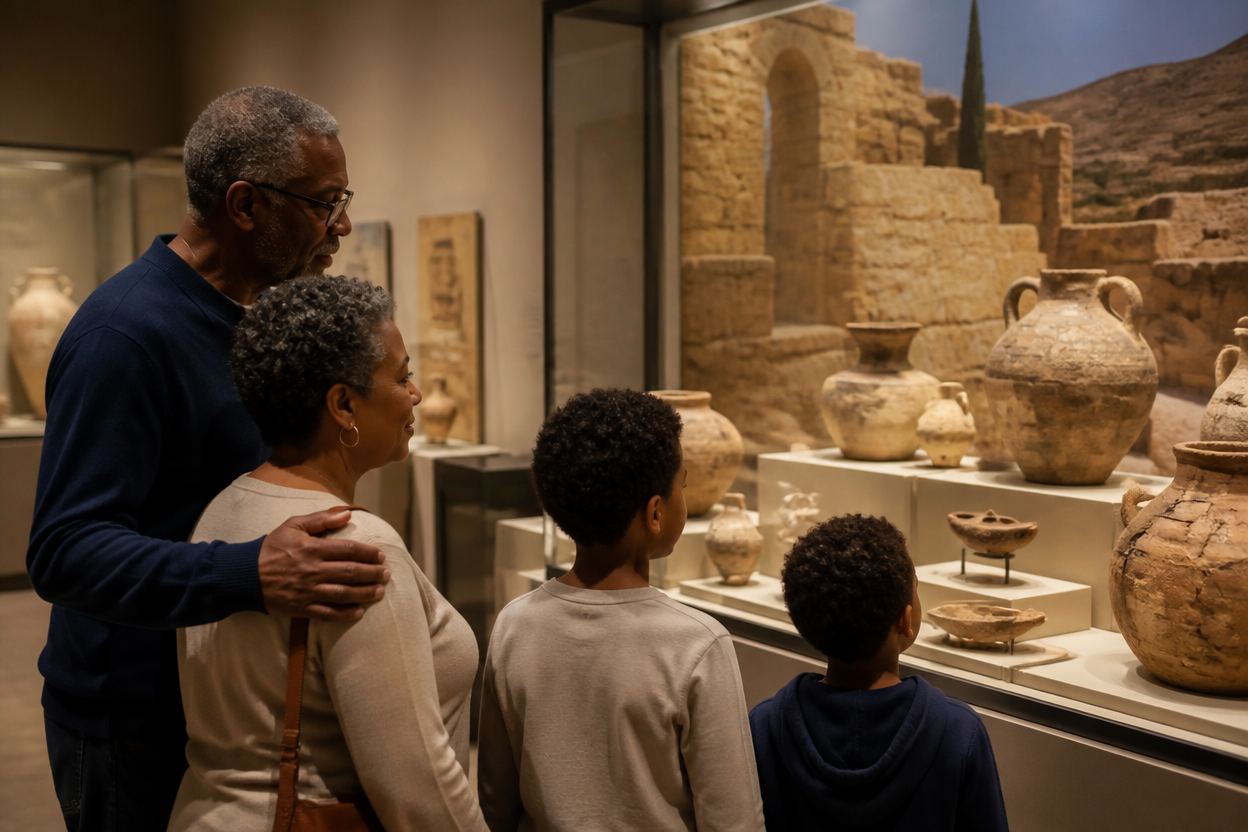
Biblical museum ministries require long-term capital and disciplined governance
Collections and facilities create real obligations
A museum ministry is not simply a teaching ministry with artifacts on display. Collections require conservation standards, environmental controls, storage, security, provenance documentation, and insurance. Facilities require deferred maintenance planning, safety compliance, and staffing patterns that often include specialized roles. Those are not glamorous line items, but they are the difference between stewardship and improvisation.
Legacy giving is well suited to these realities because it can be structured as quasi-endowment, capital renewal funding, or restricted support for conservation and research. Donors often choose planned gifts when they want their generosity to meet obligations that are predictable, long-term, and essential, but not easily “marketed.”
Scale can magnify both impact and risk
The same characteristics that allow a museum ministry to reach broad audiences also amplify governance risk. Major construction projects, ambitious attendance targets, and donor-driven expansions can pressure leaders to overpromise. Christian donors are right to insist that large vision be matched with sober planning, transparent reporting, and accountable oversight.
This is where Most Trusted’s work as an independent verification service can clarify the decision. We evaluate Christian nonprofits against The Most Trusted Standard, a 15-criteria framework that examines Faith Foundation, Financial Integrity, Governance and Leadership, and Transparency and Effectiveness. For a museum ministry, those criteria help donors distinguish between a compelling concept and an institution that can responsibly sustain what it has built.
Donors want intergenerational impact, not just annual programming
Legacy gifts are a form of long obedience
Many donors have funded programs for years and have learned that annual giving is vulnerable to economic cycles, leadership transitions, and the inevitable fatigue that accompanies constant fundraising. A legacy gift can stabilize a ministry’s capacity to serve families, churches, educators, and seekers across decades. It is also a way to bear witness that Christian stewardship is not merely reactive. It is eschatological: we give because we believe Christ will gather a people, and we want to strengthen what is true, good, and enduring for those who come after us.
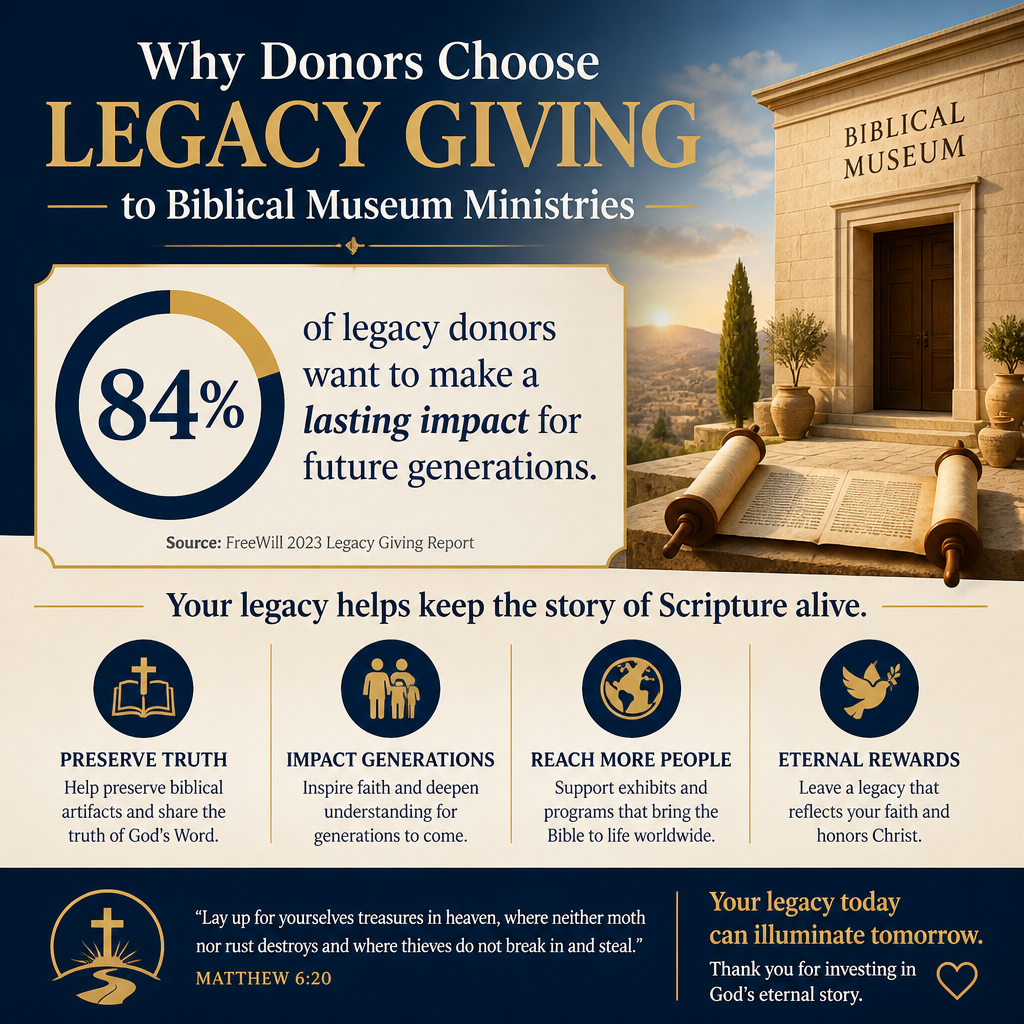
That intergenerational logic resonates with donors who are making decisions about estates, family formation, and the inheritance they intend to leave. They are often asking not only, “What did we accomplish?” but, “What did we protect?” and “What did we hand on?”
Planned giving can match donor intent with ministry capacity
Legacy giving is not one instrument but several. Mature donors tend to choose vehicles that fit both their family obligations and the ministry’s ability to administer restrictions faithfully. In our review work, the healthiest ministries welcome that seriousness because it protects the donor and the organization.
- Bequests that provide flexible support when future needs are not fully predictable
- Restricted gifts for collections care, conservation labs, or research libraries
- Endowment-style funds that generate predictable annual income for core operations
- Gifts of appreciated assets that reduce tax friction and increase charitable yield
- Contingent bequests that care for family first while still expressing charitable priority
Wise restrictions are neither a lack of trust nor a demand for control. They are a way of placing charity inside covenantal commitments: we give with intention, and ministries receive with accountability.
Trust and verification matter because the field has faced real controversies
Christians genuinely disagree about some museum-adjacent claims
Biblical museums operate in a contested environment. Some institutions have faced questions about acquisition practices, the handling of disputed artifacts, and the temptation to make apologetic claims that outrun the evidence. Donors do not help the Church by funding exaggeration. When Christian witness is tethered to claims later shown to be careless, the cost is paid in credibility, and the damage is not limited to one organization.
A serious museum ministry therefore needs more than zeal. It needs transparent scholarship practices, credible advisory structures, and a willingness to correct public errors. Donors choosing legacy gifts often do so because they are seeking institutions with a long view of truth telling, not merely a short view of attendance.
Due diligence is an act of love toward the Church
Some donors fear that due diligence signals cynicism. In Christian moral reasoning, it can be the opposite. To test claims, evaluate governance, and insist on transparent reporting is to honor donors’ stewardship and to protect the vulnerable from downstream harm. The Overhead Myth letter, signed by major charity evaluation organizations, warned donors against simplistic overhead ratios and urged attention to governance, effectiveness, and transparency instead (Charity Navigator).
That counsel applies with particular force to institutions with significant fixed costs. Museums will not look like lean program-only organizations, and they should not pretend to. The harder question is whether the ministry’s spending patterns are truthful, sustainable, and aligned with mission.
For donors considering legacy giving, it is reasonable to ask for the kind of evidence that will still matter in twenty years: audited financials, clear conflict-of-interest policies, board independence, artifact acquisition standards, and a consistent theological posture that does not shift with cultural pressure.
Legacy giving expresses a theology of stewardship shaped by mortality and hope
Planned gifts clarify what we believe about ownership
Estate planning is one of the most practical ways Christians confess that we are not owners but stewards. Scripture’s warnings about treasure and the illusion of control are not abstract. A will forces the question: Who receives what we accumulated, and why? Donors who include biblical museum ministries in their plans often do so because they want their material legacy to testify that the Word of God is more enduring than the wealth that passes through our hands.
What this means in practice is that legacy giving can be a final act of discipleship. It can also be a gift to heirs, who may feel less pressure to interpret their inheritance as a private possession when they see generosity built into the structure of the estate.
Clarity about mission protects against sentimentality
Not every museum that uses biblical language is serving biblical ends. Christian donors are right to ask whether a ministry’s exhibits and educational materials strengthen trust in Scripture, deepen love for Christ, and serve the local church rather than replacing it. The most credible institutions can articulate how they relate to pastors, educators, and scholars, and they can explain how they measure educational outcomes with humility appropriate to spiritual formation.
Donors who want to evaluate the broader landscape of Biblical Museum Ministries often find that the essential questions are not complicated, but they are demanding: Is the ministry theologically serious? Is it financially stable? Does it tell the truth carefully? Does it submit to accountability? Legacy giving tends to follow affirmative answers that have been tested over time.
FAQs for Why donors choose legacy giving to biblical museum ministries
Should a legacy gift to a biblical museum ministry be restricted or unrestricted?
Either can be faithful stewardship, depending on the ministry’s maturity and the donor’s intent. Unrestricted bequests often serve ministries well because future needs are difficult to predict and boards must respond to conditions donors cannot foresee. Restricted gifts can be wise when they fund long-term obligations such as collections care or capital renewal, provided the restriction is clear, administratively realistic, and includes language that allows adjustment if the original purpose becomes impossible or impractical. We generally recommend discussing restrictions with the ministry and confirming that the board has formal policies for administering restricted funds.
How can donors evaluate a biblical museum ministry before including it in an estate plan?
Start with governance and transparency rather than marketing. Review audited financial statements if available, IRS Form 990 where applicable, board composition and independence, conflict-of-interest policies, and clear explanations of how artifacts are acquired and vetted. Ask how the ministry handles disputed claims and whether it has credible scholarly counsel. Donors exploring Legacy and Planned Giving for Biblical Museum Ministries often find it prudent to treat verification as part of the discernment process, especially when a gift will outlive the donor. Most Trusted’s verification work against The Most Trusted Standard is designed to support that kind of careful, confidence-worthy giving.
A legacy gift is a vote for truthful remembrance
Christian donors choose legacy giving to biblical museum ministries because they want the Church’s memory to be governed by truth rather than by fashion. They also understand that institutions capable of careful preservation and public teaching require stable, accountable funding. When a museum ministry is theologically grounded, financially disciplined, and transparent about its claims, a planned gift can serve as a durable act of stewardship that strengthens biblical understanding for generations who will never know the donor’s name, but who may come to know the God whose Word endures.



