
Why orphan care ministries prioritize family reunification is not a public-relations preference. It is a theological and child-development conviction: where it is safe and possible, a child’s best place is within a durable family, not an institution and not an indefinite alternative arrangement. For Christian donors, reunification can feel less emotionally satisfying than supporting a residential home, yet it is often the most faithful and most effective form of care.
Scripture’s commands to defend the fatherless are inseparable from Scripture’s vision of family and community. The church is called to protect children from abandonment and exploitation, but also to pursue restoration where it can be pursued without sentimental denial of risk. Mature orphan care ministries have learned to hold both truths at once: some children cannot return home safely, and many others should not be separated from family simply because a ministry can offer a better building.
Reunification aligns with a biblical vision of restoration
Justice for the vulnerable includes repairing what sin has torn
Christian donors often associate “orphan care” with providing what a child lacks: shelter, school fees, food, medical treatment. Those acts of mercy matter. Yet biblical justice is not only provision; it is protection and restoration. God “executes justice for the fatherless” (Deuteronomy 10:18), and justice in Scripture regularly includes returning what was taken, rebuilding what was broken, and restraining those who harm.
Family reunification, at its best, is a concrete form of that restorative logic. It asks whether separation is necessary, whether it has become habitual, and whether a pathway exists for a child to return to safe kinship care with appropriate safeguards. That is not naïve optimism. It is a refusal to treat family dissolution as the default outcome when a credible alternative exists.
The church’s calling is not to replace families, but to strengthen them
Christian tradition has long honored adoption as a beautiful work of mercy and a living parable of the gospel (Romans 8:15). Yet adoption is not the only faithful response, and it is not always the most appropriate response. The New Testament repeatedly frames the local church as a household, but it does not frame the church as an institution designed to displace existing households. When ministries can help a struggling family become a safe family, they are not choosing the “lesser” ministry. They are pursuing the kind of stability in which children can grow without the additional trauma of unnecessary separation.
This is one reason many of the most careful ministries featured across Orphan Care Ministries treat reunification as a first question, not an afterthought. The goal is not to reduce children to case files. The goal is to pursue the child’s good through the most fitting and least disruptive form of care.

Evidence consistently favors family based care over institutionalization
Institutional care carries documented developmental harms
The modern orphan care movement has had to reckon with a difficult body of evidence: even well-run institutions can produce predictable developmental damage. A major review in The Lancet described elevated risks for children raised in institutions across domains such as attachment and cognitive development, with younger children particularly vulnerable (The Lancet). The point is not that every residential setting is uniformly negligent. The point is that the structure itself often cannot provide what a stable family routinely provides: a small number of consistent caregivers, enduring belonging, and the daily formation of trust.
Donors sometimes ask whether smaller, “family-style” homes avoid these harms. Some do better than large dormitory models. Yet the core question remains: if safe family care is possible, why choose any institutional substitute? Wise ministries treat residential care as time-limited and purpose-specific, not as the ideal endpoint.
Most children in orphanages are not without living family
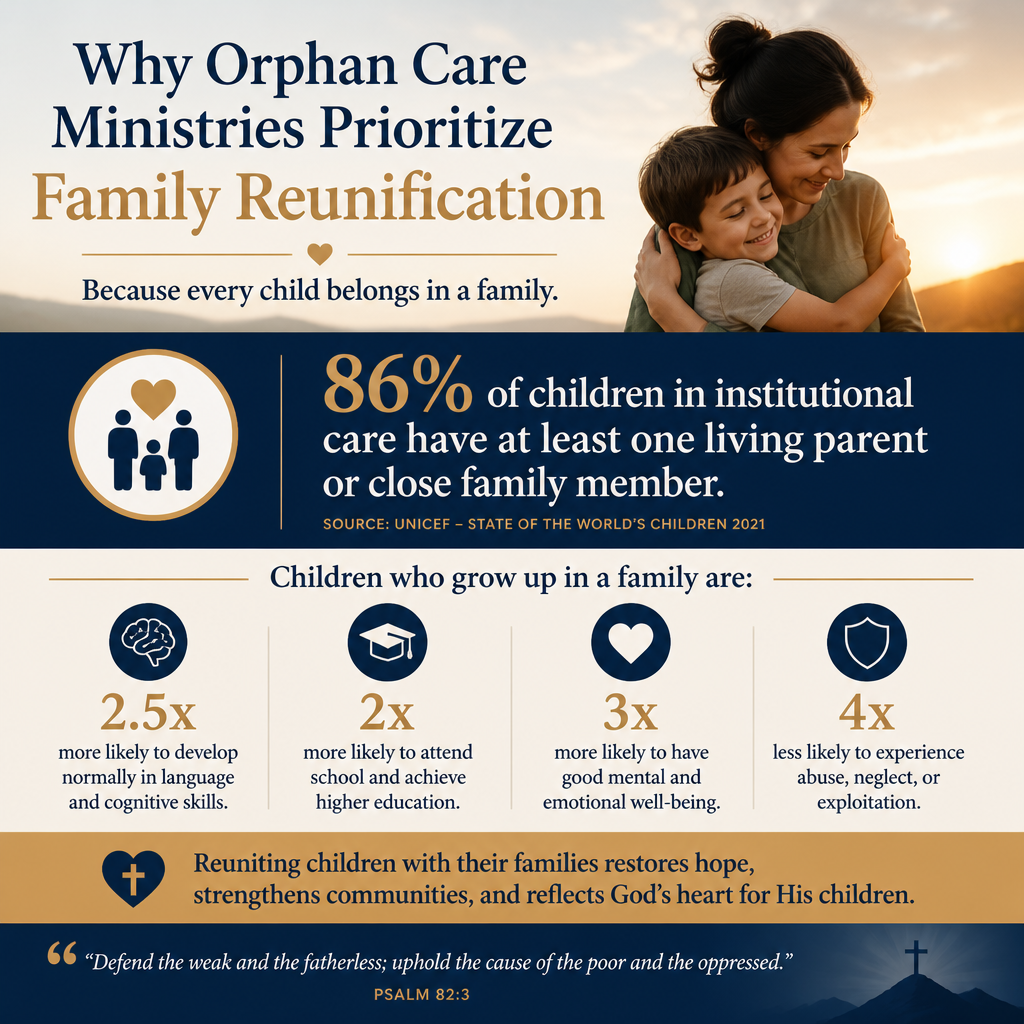
Part of the moral urgency around reunification comes from a simple fact: many children labeled “orphans” have living parents or extended family. UNICEF has stated that the majority of children in orphanages worldwide have at least one living parent (UNICEF). That reality does not automatically mean reunification is appropriate in every case; some parents are dangerous, some are absent, and some families are unsafe in ways that cannot be remedied quickly. It does mean donors should be cautious about funding models that unintentionally reward the separation of children from families who, with support, could keep them safely.
Christian compassion should not be easily manipulated by images of need. It should be disciplined by truth. When a ministry’s operating model depends on full beds, reunification becomes a financial threat. Ministries committed to reunification deliberately build funding structures that do not treat children as revenue.
Reunification is often the most cost effective mercy
Family strengthening addresses root causes rather than symptoms
Many family separations are driven by poverty, disability, untreated trauma, or social isolation rather than by the absence of love. When a ministry provides rent stabilization, food security, parenting support, addiction treatment referrals, school access, or livelihood coaching, it is often addressing the pressures that precipitate placement. This is not romanticizing family hardship. It is naming that “orphanhood” in many contexts is a social condition as much as a legal status.
Thoughtful donors may worry that economic support creates dependency. That concern is legitimate, and the field has learned to treat cash and material assistance with care. The When Helping Hurts framework, articulated by Corbett and Fikkert, has sharpened the conversation by distinguishing relief from rehabilitation and development, and by warning against interventions that displace local agency (When Helping Hurts). A strong reunification program is not an endless subsidy. It is a plan with clear outcomes: safety, stability, and the gradual restoration of family capacity.
The best ministries resist the incentives that keep children separated
Donors often respond generously to visible, immediate needs: a building project, a bed, a photograph of a child receiving a meal. Reunification work is quieter. It funds case management, transportation for family visits, documentation, trauma-informed counseling, and sometimes legal support. These are less photogenic expenses, but they are often the costs that keep children connected to the people who will still be present when donors move on to other causes.
What this means in practice is that donors should look for ministries whose reporting makes reunification measurable and concrete, not merely aspirational. Credible organizations publish their definitions, timeframes, and safeguards. They also disclose what happens when reunification fails and a child must return to care. Transparency on setbacks is a sign of maturity, not weakness.
Reunification requires safeguards and a sober view of risk
Safety is not negotiable, and assessment must be rigorous
Christians genuinely disagree about how quickly ministries should pursue reunification, particularly when a child has experienced abuse or severe neglect. The harder question is how to move with urgency without recklessness. Reunification done well is not a sentimental reunion scene. It is a structured process: background checks where possible, home assessments, evidence of behavior change, ongoing monitoring, and clear thresholds for discontinuing placement if safety deteriorates.
Donors should be wary of ministries that speak about reunification only as a percentage to be maximized. A high reunification rate may signal strong practice, but it can also signal pressure to return children too quickly. The moral measure is not speed. It is the child’s protection and long-term flourishing.
Trauma informed care and spiritual formation must go together
Children separated from family almost always carry trauma, even when the separation was necessary. Reunification adds another layer: the child must interpret a complex story about why they left, why they are returning, and whether the adults can be trusted. Ministries with theological seriousness resist simplistic narratives. They combine clinical wisdom with spiritual care, recognizing that fear, anger, and grief are not failures of faith. They are often the honest human response to loss.
For Christian donors, this is where discernment matters. A ministry may be doctrinally sound yet operationally weak, or operationally competent yet spiritually thin. The work requires both. Children need safety protocols and they also need patient, gospel-shaped communities that can stay present over years, not months.
How donors can evaluate reunification focused ministries with confidence
What we look for through Most Trusted verification
Reunification is one of the areas where donors benefit from independent verification. Most Trusted exists to help donors give with confidence by evaluating Christian nonprofits against The Most Trusted Standard, a 15-criteria framework that examines a ministry’s faith foundation, financial integrity, governance and leadership, and transparency and effectiveness. For reunification work, those domains are not abstract. They determine whether a ministry’s stated commitment to children is matched by operational reality.
Across our verification work, the ministries that meet The Most Trusted Standard tend to show the same patterns: they define success carefully, they disclose risks candidly, and they demonstrate that decisions are made for the child’s good rather than for fundraising momentum. They also avoid the quiet corruption that can enter orphan care when donors reward numbers over prudence.
Questions donors should expect ministries to answer
- How does the ministry define “family reunification,” and what safeguards are required before a child returns?
- What percentage of children have living parents or extended family, and how does the ministry pursue kinship placement?
- How are case plans documented, supervised, and audited for quality?
- What happens when reunification is attempted and fails? How is the child protected and supported?
- How are funding and staff incentives structured so that children are not kept in care to sustain budgets?
Donors can also compare ministries within the broader ecosystem of How Orphan Care Ministries Serve Children and Families. Reunification should not be isolated from prevention, kinship care, foster care where it exists, adoption where appropriate, and transitional care for older youth. Wise giving supports a continuum that reduces unnecessary separation and provides credible alternatives when separation is necessary.
FAQs for Why orphan care ministries prioritize family reunification
Does prioritizing reunification mean adoption is discouraged?
No. Many faithful orphan care ministries honor adoption as a serious Christian calling, especially when a child cannot safely return to birth family and no viable kinship option exists. Prioritizing reunification simply means ministries begin by asking whether the child can remain safely within their family network, and they pursue adoption when reunification is not possible without compromising safety and long-term stability.
How can donors tell if reunification is being done safely and not just quickly?
Safe practice shows up in documentation and governance. Donors should expect clear criteria for reunification, evidence of trained case management, transparent reporting on outcomes over time, and candid disclosure of setbacks. Ministries that are serious about safety will also describe how they handle allegations of abuse, how they monitor families after reunification, and how oversight functions beyond a single charismatic leader.
Reunification is a disciplined form of mercy
Christian donors give to orphan care because Scripture will not allow indifference to vulnerable children. The field’s maturity has clarified that care is not only about compassion; it is about the form compassion takes. Where it is safe and possible, family reunification honors the child’s need for enduring belonging, reduces predictable harms associated with institutionalization, and resists incentives that can quietly separate children from people who love them.
The best ministries pursue reunification without pretending every family can be restored. They do the harder work of assessment, patient support, and long-term accountability. That is disciplined mercy, and it is often the most faithful use of a donor’s gift.



