What volunteers should bring for homeless outreach events is not primarily a question of gear. It is a question of posture, safety, and stewardship. The goal is to serve people made in the image of God without turning a neighbor’s hardship into our project, and without forcing already-stretched ministries to manage preventable risk.
Donors often ask us how to think about volunteering alongside giving. The best outreach teams treat volunteers as part of a coordinated ministry response: spiritually grounded, operationally prepared, and accountable to leadership. That emphasis on accountability is also why Most Trusted exists. We help donors evaluate whether a ministry is prepared to steward both finances and people—including volunteers and guests—through disciplined practices consistent with The Most Trusted Standard.
Bring the essentials that protect dignity and reduce ministry burden
Homeless outreach is frequently conducted in public spaces, during weather extremes, and under unpredictable conditions. Volunteers should bring what allows them to remain calm, attentive, and non-disruptive to the ministry’s plan. Ministries that are well-run typically have clear guidance on what to carry and what not to carry; following it is one of the simplest forms of respect.
Identification and minimal, practical personal supplies
We recommend arriving with a government-issued ID if the ministry requests it, a fully charged phone, and any required waiver information already completed. Keep personal items minimal and secure. Outreach events can draw opportunistic theft, and volunteers who are managing their own preventable problems are not serving well.
Weather readiness and hydration that keeps you present
Bring clothing and footwear suitable for standing and walking, including layers, rain protection, and gloves in cold months. Carry water for yourself. Dehydration and exposure reduce attentiveness, and attentiveness is not optional in environments where guests may be experiencing trauma, withdrawal, or acute mental health symptoms. The U.S. Interagency Council on Homelessness has documented that people experiencing homelessness have markedly higher rates of health vulnerability, which is one reason outreach teams must take basic safety and situational awareness seriously U.S. Interagency Council on Homelessness.

Bring a volunteer mindset shaped by Scripture and wise practice
Christian outreach is never a mere distribution event. It is a form of neighbor-love offered under the lordship of Christ. Scripture gives the Church both urgency and restraint: urgency to show mercy, restraint to avoid doing harm through pride, spectacle, or partiality.
Humility, confidentiality, and a refusal to perform need
We recommend arriving prepared to follow direction, accept correction, and keep confidences. Do not take photos of guests unless the ministry has explicit, written consent procedures; many guests have safety concerns related to trafficking, domestic violence, immigration status, or custody matters. Even when consent is offered casually, mature ministries do not treat an outreach moment as content.
James warns against partiality and performative religion, and Jesus’s teaching in Matthew 25 frames mercy as a mark of discipleship rather than a branding exercise. What this means in practice is that volunteers should aim to be quietly faithful: offering presence, listening, and practical help without trying to control outcomes.
A commitment to listen rather than to diagnose
Outreach volunteers are not clinicians, case managers, or law enforcement. Guests may disclose complex histories. We recommend listening without interrogating, avoiding amateur diagnoses, and referring needs back to the team lead. The aim is not to extract a story; it is to serve a person.
This is also where the field has had to reckon with the risks of well-intentioned help. The “When Helping Hurts” framework, articulated by Steve Corbett and Brian Fikkert, has helped many Christian ministries name how aid can unintentionally reinforce dependency or dignity-loss when it is disconnected from relationships and local leadership When Helping Hurts.
Bring only approved items for guests and avoid common mistakes
Many volunteers want to bring “extra” supplies. The impulse is understandable. Yet uncoordinated giving can undermine a ministry’s policies, create conflict among guests, and expose the ministry to liability. The question is not, “What do we feel would be helpful?” but, “What has the ministry determined is safe, equitable, and appropriate for this context?”
Coordinate distributions with the ministry’s plan
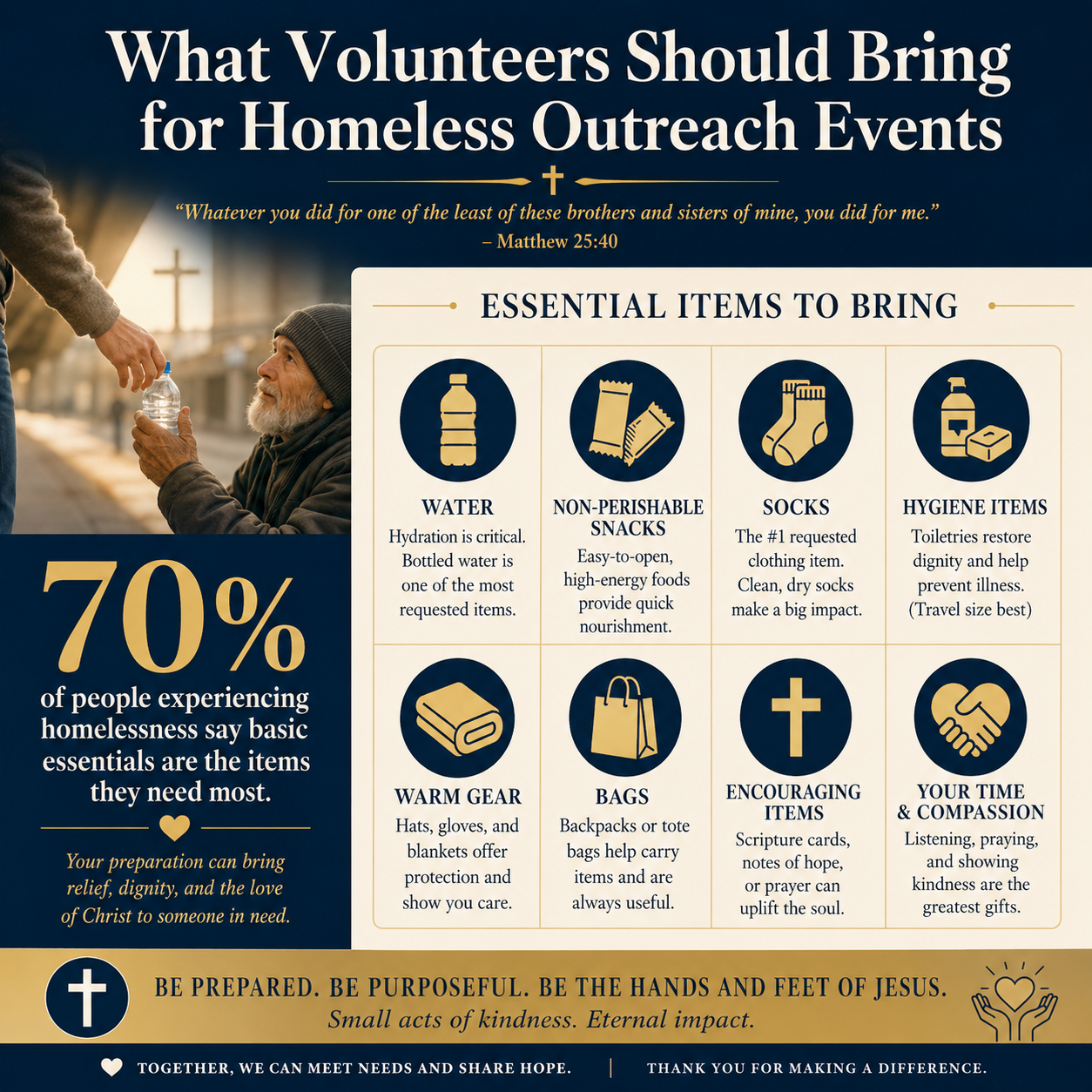
We recommend bringing items only if the ministry asked for them, and in the quantity and form requested. If a rescue mission or street outreach team has chosen a specific kit—socks, hygiene supplies, water, snack bags—there is usually a reason: storage limits, allergy protocols, or a strategy for engaging guests toward services rather than creating a roaming distribution that draws crowds and confusion.
- New socks in standard adult sizes, packaged as requested
- Travel-size hygiene items without aerosol cans
- Sealed, shelf-stable snacks appropriate for common dietary restrictions
- Water bottles if the ministry lacks access onsite
- Seasonal items requested by the team lead, such as hand warmers
Know what not to bring
Do not bring cash for direct handouts unless the ministry instructs it. Cash distribution can quickly create pressure on volunteers and conflict among guests, and it can make volunteers a target. Avoid bringing medications, used clothing (unless specifically requested and screened), weapons of any kind, or homemade food unless the ministry has food-safety procedures that permit it. Many jurisdictions treat food distribution as a regulated activity when conducted at scale; responsible ministries work within local requirements.
Donors sometimes worry that policies like these are “too controlled.” The harder truth is that good mercy is often orderly mercy. Boundaries are not a withdrawal of compassion; they are one way ministries care for the safety of guests, volunteers, and neighborhoods.
Bring awareness of safety, trauma, and the ministry’s chain of command
Street outreach and shelter-based outreach both place volunteers near people facing high levels of instability. That does not mean volunteers should fear guests. It does mean ministries should train volunteers and enforce protocols. Across our verification work, we observe that ministries with consistent governance and leadership tend to be explicit about supervision, reporting, and incident response.
Follow the team lead and stay with the group
We recommend treating the team lead’s direction as non-negotiable. Do not wander off to “check on someone,” enter encampments uninvited, or promise resources you cannot personally deliver. If a guest requests a ride, a hotel room, or help with legal matters, refer it to leadership. A volunteer making independent commitments can create real harm, including unsafe transport situations and broken trust when promises fail.
Basic trauma-informed posture
Trauma affects memory, trust, and emotional regulation. Volunteers should keep their voice calm, avoid sudden touch, and ask permission before stepping closer or handing an item. If someone becomes agitated, do not escalate. Create space and get the team lead. The Substance Abuse and Mental Health Services Administration has summarized how trauma-informed approaches reduce re-traumatization and improve engagement, principles that have become standard across many effective outreach teams SAMHSA.
For donors evaluating ministries, safety protocols are not an optional administrative detail. They are a test of whether a ministry treats people as souls to be loved rather than problems to be managed. Strong governance shows up in the mundane: training, supervision ratios, incident logs, and clear boundaries.
Bring a donor’s discernment about which outreach you are supporting
Volunteering often deepens a donor’s commitment, but it can also expose weaknesses a brochure would never reveal. Some programs are orderly, accountable, and spiritually serious. Others run on charisma, vague storytelling, and untracked distributions. Christian donors should not accept avoidable opacity in the name of compassion.
What a well-governed outreach typically looks like
Programs that merit trust typically have clear volunteer roles, written policies for photography and confidentiality, and a coherent pathway from street contact to services. In the rescue mission world, that might mean a defined process for shelter intake, case management, addiction recovery programming, and church partnerships. It may also include collaboration with local Continuums of Care, which coordinate community homelessness response systems U.S. Department of Housing and Urban Development.
Those who want to understand the broader landscape—how rescue missions differ from mobile outreach, and how faith-based work intersects with public systems—will find helpful context in Rescue Missions and Homeless Outreach.
How Most Trusted fits alongside volunteering
Most Trusted is not a replacement for relationship with a ministry. It is a tool for disciplined stewardship. The ministries that meet The Most Trusted Standard tend to be clear about doctrine and mission, careful with financial practices, governed with accountability, and transparent about results and limitations. Those traits matter for donors precisely because they often correlate with how ministries treat volunteers and guests: with seriousness, clarity, and respect.
For donors who engage hands-on, the most relevant question is often whether an outreach event is integrated into an ongoing ministry strategy or operating as a stand-alone moment. A credible ministry can name what happens after the event: follow-up, referrals, and a pathway toward stability.
Readers who want to see how volunteering roles differ across programs and what responsible volunteer management looks like in practice will find additional related coverage in Volunteering in Homeless Outreach Ministries.
FAQs for What volunteers should bring for homeless outreach events
Should volunteers bring cash or gift cards to hand out directly?
We recommend following the ministry’s policy. Many well-run outreach teams discourage direct cash handouts because they can create conflict, increase pressure on volunteers, and unintentionally reward aggressive behavior. If a ministry uses gift cards, it typically does so in a controlled way tied to case management or a specific referral plan.
Is it appropriate to bring Bibles or tracts to a homeless outreach event?
It can be appropriate when the ministry’s approach is relational and consent-based. A Bible offered respectfully is different from literature used as a substitute for listening or as a condition for help. Mature ministries integrate prayer, Scripture, and gospel witness into outreach without coercion, recognizing that many guests have church wounds and need patient, dignifying engagement.
Practical preparation is part of faithful mercy
What volunteers should bring for homeless outreach events is ultimately whatever allows them to serve under authority, protect dignity, and reduce preventable burden on the ministry. Preparation, restraint, and clear boundaries are not bureaucratic obstacles to compassion. They are part of offering mercy in a way that is truthful, safe, and worthy of the name Christian.