

How orphan care ministries spend donor gifts is not a peripheral concern for Christian donors; it is a stewardship question that touches both the well-being of children and the integrity of our worship. Scripture binds the care of vulnerable children to the character of God himself, and the same Scripture warns that zeal without knowledge can misdirect even sincere generosity.
The modern orphan care movement has also had to reckon with hard realities. Christians genuinely disagree about tactics, especially when images of institutional care move the heart. Yet the field has learned that the shape of funding can shape the shape of care—for good or for harm. Wise giving asks not only, “Is this ministry compassionate?” but also, “Does this ministry’s spending lead toward family, stability, and long-term flourishing?”
Donor gifts shape the care model
Scripture calls for protection, not just provision
The biblical mandate is clear: God defends the fatherless and condemns those who exploit the vulnerable. That moral clarity does not remove prudential complexity. Children who have lost parental care need more than food and schooling; they need durable attachment, safe authority, and a future that is not dependent on an institution’s continued fundraising.
In practice, donor gifts tend to reinforce one of several models: residential care, family-based care (kinship, foster, adoption), or community strengthening designed to prevent family separation. Each model carries trade-offs. Residential settings can provide immediate safety, but they can also entrench dependency if they become a default destination rather than a temporary refuge.
The funding signal ministries receive matters
Many ministries respond—consciously or unconsciously—to the incentives donors create. A donor who funds “beds filled” may unintentionally reward the expansion of institutional capacity. A donor who funds reunification and family strengthening may encourage the harder, slower work of case management, social work partnerships, and long-term follow-up.
A sobering data point helps explain why the incentive structure matters: UNICEF has reported that a large share of children in residential institutions globally are not orphans in the strict sense, but have at least one living parent.UNICEF That does not mean every institution is recruiting children improperly, but it does mean donors should ask whether a ministry’s spending aligns with the priority of family whenever safe and possible.

Where the money typically goes in mature orphan care work
Direct care costs are real, but not the whole picture
In credible orphan care work, donor gifts often support direct services: food, safe housing, trauma-informed caregiving, medical care, school fees, legal documentation, and protection systems. Those costs can be significant, especially in regions where reliable healthcare, nutrition, and safe infrastructure are expensive or scarce.
But mature ministries do not treat a child’s needs as merely material. The deeper expenditures are often less visible to donors: trained caregivers with stable wages, counseling capacity, child protection policies, and consistent supervision that reduces burnout and abuse risk. When these are underfunded, ministries may drift toward a volunteer-heavy model that can feel inspiring to outsiders while leaving children with discontinuity.
Family-based care requires different spending lines
When a ministry prioritizes kinship care, foster care, and family reunification, donor gifts commonly move toward case management and support services that help families stay intact. That can include parenting coaching, emergency rent support, transportation to court appointments, school supplies, and income stabilization efforts paired with accountable follow-up.
The harder question for many donors is why a ministry would spend on social workers, legal processes, and long-term monitoring. Yet these are often the mechanisms that protect a child’s future. Case management is not “overhead” in any meaningful ethical sense; it is frequently the intervention that prevents a child from cycling back into crisis.
What responsible ministries disclose and what donors should ask
Financial clarity without the overhead illusion
Christian donors often want a simple ratio: “How much goes to the children?” The desire is understandable, but the category can be misleading. The sector has broadly recognized that starving administration can starve outcomes. The joint statement commonly known as the Overhead Myth—signed by leading evaluators and accountability organizations—warned that overhead ratios are a poor proxy for impact and can push nonprofits toward unhealthy financial behavior.Charity Navigator
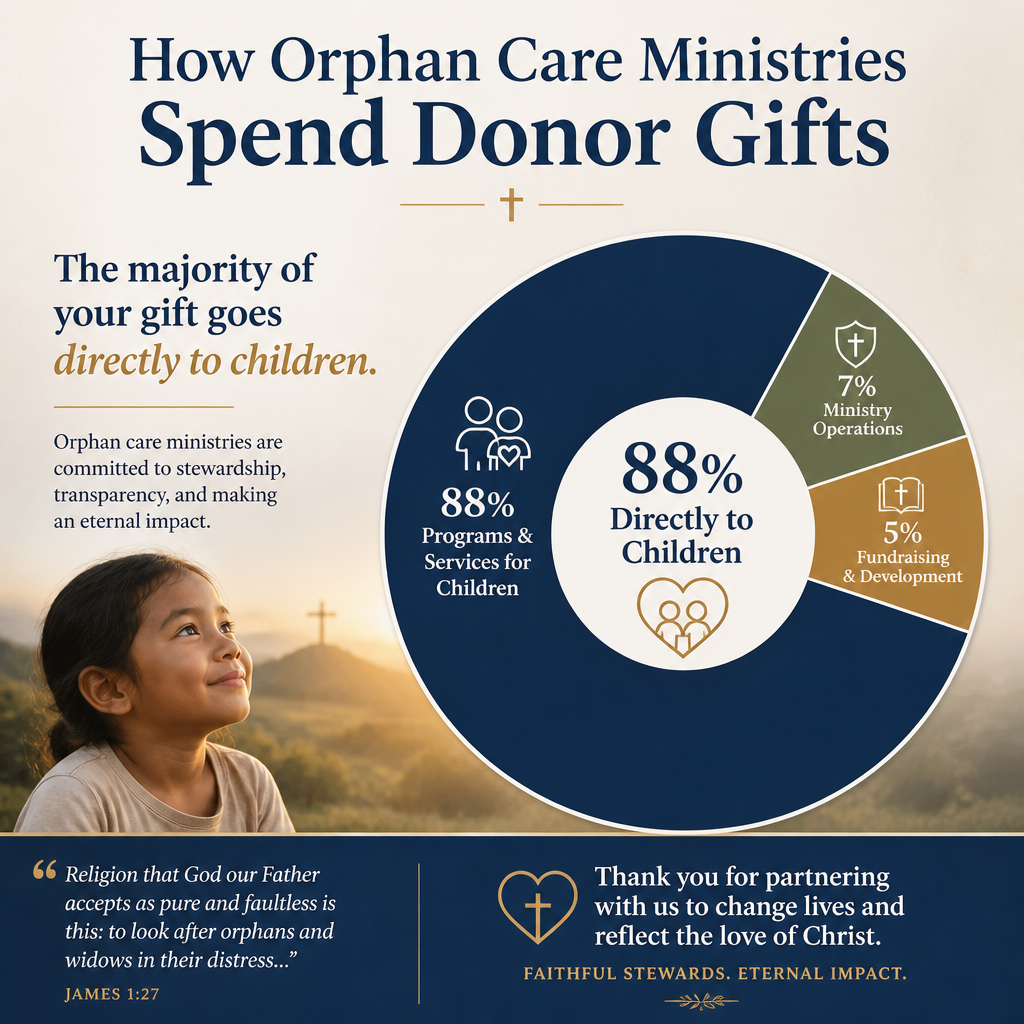
Responsible orphan care ministries still owe donors clarity. They should present audited financials when feasible, explain major program lines in plain language, and show how restricted gifts are tracked. The question is not whether a ministry has administrative costs; the question is whether those costs are governed, transparent, and aligned with child safety and durable outcomes.
Program evidence is more than moving stories
What this means in practice is that donors should ask for evidence that a ministry’s spending supports the outcomes it claims to pursue. In family-based models, credible indicators include reunification rates with documented safety assessments, school retention, placement stability, and long-term follow-up. In residential models, credible indicators include caregiver-to-child ratios, trauma-informed training, verified child protection systems, and demonstrated pathways toward family placement where appropriate.
Ministries that take monitoring seriously often budget for it explicitly. Donors sometimes resist funding “measurement,” but measurement can be a form of moral seriousness: it is the discipline of asking whether our work is truly helping the child, not merely sustaining the institution.
Spending risks that can quietly harm children
Institutional expansion can become a mission drift
Across the field, a recurring danger is that capital projects and expansion campaigns can outpace a ministry’s capacity for long-term caregiving quality. Buildings are visible. Photos of new dormitories raise funds. Yet sustainable care depends on staffing, governance, and safeguarding—costs that donors do not always celebrate but children always experience.
Another risk is that mission statements about “rescue” can inadvertently treat family separation as the default solution to poverty. When donor gifts prioritize extraction over strengthening, ministries may displace the very agency and responsibility that stable families require.
Volunteer-driven models can create attachment wounds
Short-term volunteer engagement is contested terrain among thoughtful Christians. Done poorly, it can expose children to a revolving door of adults, intensifying attachment disruptions and incentivizing institutions to present children as experiences rather than persons. Done carefully, volunteer involvement can support local staff and fund long-term initiatives without placing children in the center of a transient relational economy.
Donors should ask how ministries regulate access to children, train visitors, and prioritize stability. A ministry’s spending will reveal its commitments: budgets for safeguarding training, background checks, professional caregiving staff, and strict visitation policies are often a sign that child protection is not merely a document but a practiced priority.
How Most Trusted evaluates spending through The Most Trusted Standard
We look for integrated integrity, not isolated metrics
Most Trusted exists because donors deserve verifiable confidence when giving in emotionally charged categories such as orphan care. We evaluate Christian nonprofits against The Most Trusted Standard, a 15-criteria framework that assesses faith foundation, financial integrity, governance and leadership, and transparency and effectiveness. The goal is not to reward marketing competence, but to identify ministries whose financial and operational life is coherent with Christian moral claims.
When we examine how a ministry spends donor gifts, we do not treat budgets as neutral spreadsheets. We treat them as moral documents. They tell a story about what a ministry believes will actually protect children: staffing, safeguarding, accountable leadership, and programs that move toward stability rather than perpetual dependency.
Questions we recommend donors bring to an orphan care budget
Christian donors often want a short set of questions that reach beyond sentiment and into stewardship. We recommend asking:
- Does the ministry state a clear preference for family-based care when safe and possible, and can it explain exceptions?
- Are safeguarding systems funded, documented, and governed, including background checks and reporting pathways?
- Does the ministry track outcomes that fit its model, such as reunification stability or placement stability?
- Are audited financials, annual reports, and board oversight practices available and credible?
- Are restricted gifts tracked in a way that honors donor intent and protects program integrity?
For donors seeking broader context on the field, our coverage of Orphan Care Ministries surveys the central models and the moral tensions that make verification necessary. For donors comparing how different programs account for and report their spending, How Orphan Care Ministries Use Donations gathers the patterns we see across responsible organizations.
FAQs for How orphan care ministries spend donor gifts
Should Christian donors avoid orphanages entirely?
Christians genuinely disagree about this, and the best answer is usually more discriminating than a blanket yes or no. Some residential programs function as short-term stabilization with a clear plan toward family placement, strong safeguarding, and accountable oversight. Others become long-term warehouses, especially when funding incentives reward institutional growth. Donors should evaluate whether a ministry’s spending supports safety, stability, and a credible pathway toward family or durable community care.
What is a reasonable percentage for overhead in orphan care giving?
No single percentage is reliably “reasonable” across contexts, and focusing on a target ratio can pressure ministries to underinvest in governance, safeguarding, and qualified staff. The more faithful question is whether administrative and fundraising costs are transparent, governed, and plausibly connected to child protection and program effectiveness. Donors should look for clear financial reporting and evidence that the ministry is resourced to do the work safely.
A faithful gift follows a child toward stability
Orphan care is one of the clearest tests of whether Christian compassion is guided by wisdom. Donor gifts should move beyond sustaining visible activity and toward securing stable, protective care that honors the child as a person made in God’s image. The ministries most worthy of trust tend to spend in ways that are less dramatic but more durable: safeguarding, accountable leadership, measurable outcomes, and a steady commitment to family whenever it can be safely pursued.



