
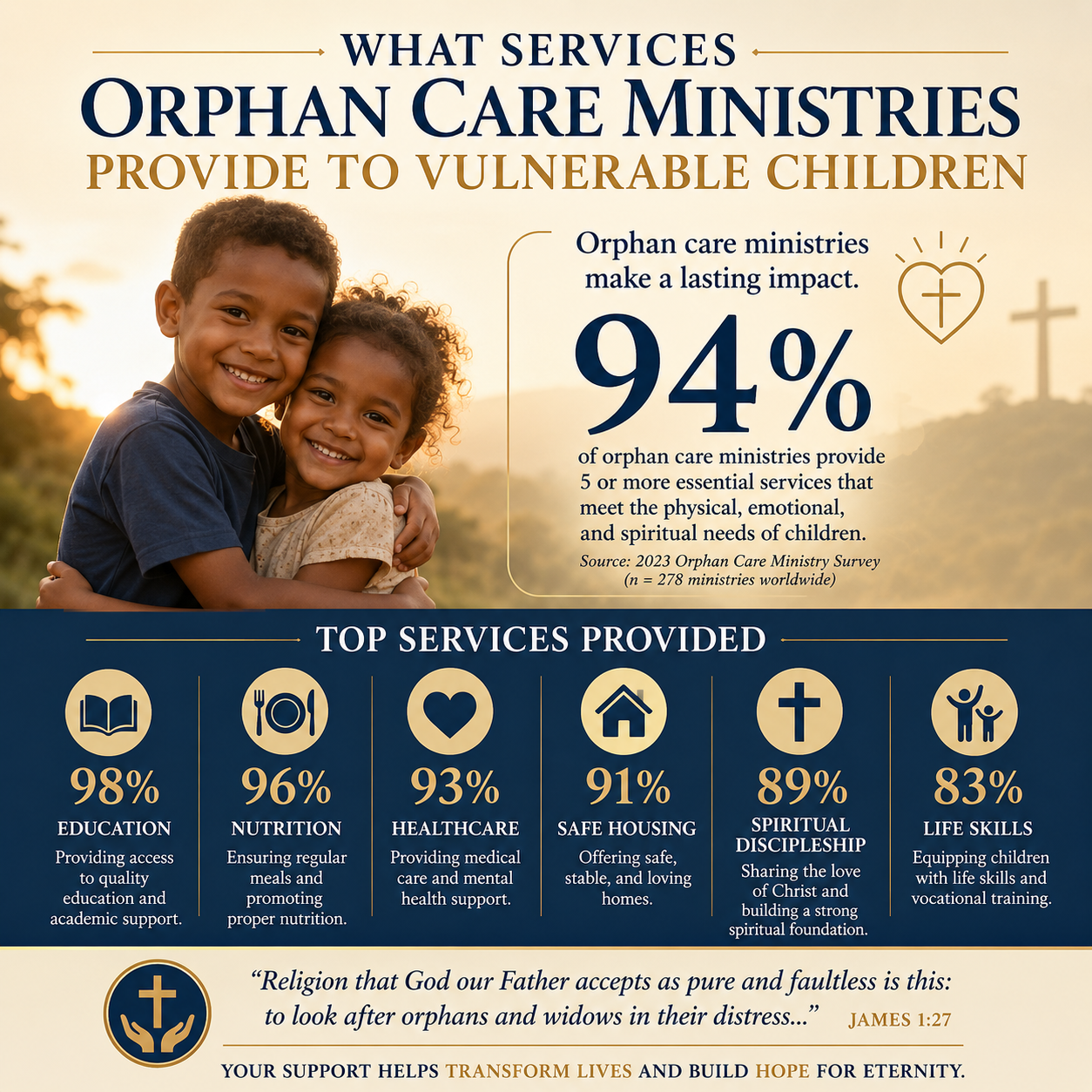
When Christian donors ask what services orphan care ministries provide to vulnerable children, they are rarely asking for a catalog. They are asking whether a ministry’s work moves children toward the stability God intends: belonging, protection, and a future shaped by truth rather than trauma. Scripture’s concern for the fatherless is never sentimental; it is a call to just action and durable care.
That seriousness matters because the modern orphan care movement has had to reckon with uncomfortable realities. Many children commonly described as “orphans” are not parentless in the strict sense, and institutional care can create harms even when staff are sincere and sacrificial. Donors who want to give with confidence need to understand not only what services exist, but which services align with what we know about child development, family preservation, and faithful stewardship.
1. Protection and casework are the foundation of responsible care
Child protection begins with careful assessment, not assumptions
At the most basic level, orphan care ministries provide protective services: safe shelter, supervision, and basic needs when a child faces abandonment, abuse, trafficking risk, or acute family crisis. But protection becomes trustworthy only when it is governed by disciplined casework. That includes verifying identity, mapping family networks, assessing safety risks, and documenting the reasons a child is separated from parents or relatives.
The harder question is what the ministry does before separation becomes “the plan.” Research and practice in child welfare consistently emphasize that children generally do best in safe, stable family settings, not institutions. What this means in practice is that strong ministries treat residential placement as time-limited and outcome-driven whenever safe family care can be restored.
Legal and ethical safeguards are part of the service, not an administrative afterthought
Protection also includes legal compliance and ethics: background checks for staff, incident reporting procedures, boundaries around volunteer access, and clear policies that prevent coercion of families. A ministry can provide food and shelter and still fail a child if it lacks credible safeguards. Christians genuinely disagree about the best policy models across different countries, but there is little disagreement that transparency, documentation, and child-centered decision-making are non-negotiable in the name of Christ.
2. Family strengthening is often the most effective orphan care service
Preventing separation is frequently the highest-impact intervention
Many of the most mature orphan care ministries have shifted resources upstream toward family strengthening: keeping children safely with parents or relatives whenever possible. This can include emergency rent support, food assistance during seasonal unemployment, school fees, access to medical care, and parenting support that reduces neglect driven by exhaustion rather than malice.
Donors sometimes assume orphan care begins only after a child enters an institution. In many contexts, the more faithful and cost-effective service is preventing unnecessary family separation. The U.S. government’s child welfare guidance summarizes a broad consensus: “Children thrive best in families,” and systems should prioritize family-based care when safe and possible. USAID: Children in Adversity
Kinship care and reintegration require patient, skilled work
Reintegration is not a single event. It is a process of preparing the child, preparing caregivers, addressing practical barriers, and monitoring safety after reunification. Strong ministries provide travel support for family visits, counseling, mediation when relationships are fractured, and follow-up home visits. They often partner with local churches because durable reintegration depends on community, not only on professional services.
Across our verification work at Most Trusted, ministries that meet The Most Trusted Standard tend to treat reintegration metrics and documentation as a core integrity issue, not an optional program feature. When reporting is vague, outcomes are difficult to validate, and children bear the cost of donor uncertainty.
3. Foster care and adoption support serve the child best when done with humility
Alternative family care is a service ecosystem, not a single placement
When a child cannot safely remain with biological family, orphan care ministries often provide or support foster care, kinship care, and—more cautiously—adoption services. Healthy foster care programs recruit, train, and support caregivers; provide stipends or material support; and offer case management that protects children from “placement churn.” In countries where government foster systems are limited, ministries may help build the infrastructure that makes family-based care possible.
Adoption support can include home studies, counseling, education for prospective parents, and post-placement services such as trauma-informed therapy referrals and respite care. It also includes ethical guardrails: informed consent, clear documentation, and refusal to treat adoption as a fundraising narrative.
Adoption ethics and best practices remain contested in parts of the field
Christians genuinely disagree about how to weigh adoption’s goods against the risks of coercion, weak documentation, and economic pressure on vulnerable parents. The most credible ministries name these tensions plainly, invest in family preservation first, and submit to strong governance and external accountability.
Donors should be wary of programs that treat international adoption numbers as the primary measure of faithfulness. A ministry’s willingness to slow down, verify consent, and prioritize family-based alternatives is often the more trustworthy indicator of love of neighbor.
4. Holistic care addresses trauma, education, health, and discipleship without reducing children to projects
Trauma-informed care is not a trend but a moral requirement
Children separated from parents commonly carry grief, fear, and disrupted attachment. Orphan care ministries therefore provide counseling, psychosocial support, and caregiver training designed to stabilize behavior and rebuild trust. Trauma-informed care does not excuse sin or eliminate boundaries; it recognizes that a child’s nervous system and relational expectations have been shaped by loss and insecurity.
Decades of research have documented significant developmental harm associated with institutionalization, especially in early childhood, compared to family-based environments. A widely cited paper in The Lancet argued that institutional care is associated with “substantial harm,” and recommended a global shift toward family-based alternatives. The Lancet
Education and health services are often the difference between survival and long-term flourishing
Many ministries provide tutoring, school fee assistance, vocational training, and mentorship that increases employability and reduces exploitation risk. Health services may include nutrition programs, disability screening, immunization coordination, HIV support, and access to surgery or long-term therapies when public systems are inaccessible.
Spiritual care, when faithful, is neither coercive nor performative. It includes age-appropriate biblical teaching, participation in the local church, prayer, and pastoral presence that helps children interpret suffering without being defined by it. The goal is not to produce grateful beneficiaries but to welcome children as image-bearers—full members of a community that tells the truth about sin, hope, and redemption.
5. Responsible ministries measure outcomes and protect donor trust
Outcome clarity distinguishes care from good intentions
Orphan care can be emotionally compelling, which is precisely why donors should insist on clear definitions and verifiable outcomes. What is the ministry’s primary model: family preservation, kinship support, foster care development, reintegration, or residential care as a last resort? How many children were reunified safely? How is safety assessed? What does follow-up look like at six months and two years?
When ministries describe success primarily in terms of inputs—beds provided, meals served, buildings funded—donors should ask what those inputs accomplished. The “Starvation Cycle,” described by Ann Goggins Gregory and Don Howard, explains how chronic underfunding of organizational capacity can produce weak measurement and fragile programs, even among sincere nonprofits. Stanford Social Innovation Review
What donors should look for before funding orphan care work
Because the field includes both exemplary ministries and painful failures, donors need a disciplined way to evaluate trustworthiness. Most Trusted exists to help Christian donors give with confidence by evaluating ministries against The Most Trusted Standard, a 15-criteria framework that examines faith commitments, financial integrity, governance, and evidence of effectiveness.
The questions below are not exhaustive, but they reflect patterns that consistently matter:
- Clear priority on family-based care and prevention of unnecessary separation
- Documented child protection policies, background checks, and incident reporting
- Casework standards for reunification, kinship placement, and follow-up
- Financial reporting that is understandable, timely, and consistent
- Board oversight that is active, independent, and willing to correct course
For donors seeking a broader view of how this field fits within Christian ministry and stewardship, we maintain a central resource on Orphan Care Ministries that frames the major models and risks with sober clarity.
More specific attention to program models—family strengthening, foster care support, reintegration, and residential care—appears in our editorial coverage of How Orphan Care Ministries Serve Children and Families, where donors can compare approaches without reducing children to fundraising categories.
FAQs for What services orphan care ministries provide to vulnerable children
Do orphan care ministries still run orphanages?
Some do, especially where state systems are weak and crises create immediate safety needs. The more important question is whether residential care is treated as temporary and carefully governed, with a plan oriented toward family-based care whenever safe. Donors should look for child protection safeguards, casework documentation, and evidence that the ministry is not incentivizing unnecessary separation.
How can donors tell whether a ministry is helping families or unintentionally pulling children away from them?
Credible ministries can explain, in writing, how children enter care, how family members are located, what criteria govern placement decisions, and what reintegration follow-up looks like. They also report outcomes, not only activities. Ministries willing to disclose policies, financials, and independent oversight signals are generally safer partners for donor stewardship than ministries that rely on emotional storytelling without verifiable detail.
A faithful service is one that moves children toward durable belonging
Orphan care services range from crisis protection to long-term family support, and faithful ministries often provide several at once. The field’s central measure is not how moving the stories are, but whether children are safer, more stable, and more likely to grow within a family and a community of truth. Christian donors honor the God who defends the fatherless by funding ministries that combine compassion with disciplined integrity—and by insisting that love be strong enough to be accountable.



