

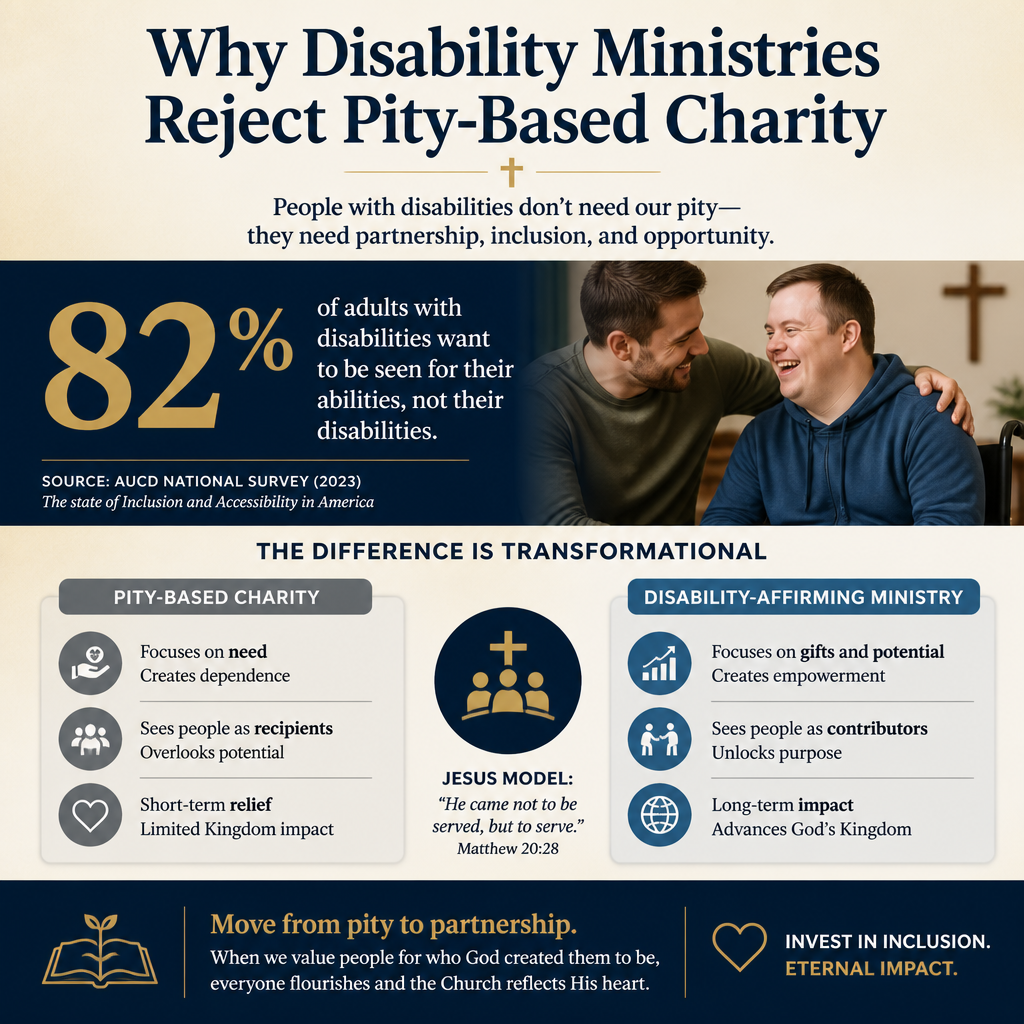
Why disability ministries reject pity-based charity is not a matter of branding or sensitivity training. It is a theological and pastoral judgment: pity-based giving distorts the image of God in the person with a disability, and it quietly trains the giver to see themselves as savior rather than steward.
Christian donors often feel the tension. Many have given to disability-related appeals built on heartbreak, urgency, and sentimental uplift, only to later wonder whether the ministry strengthened families and churches or simply funded an emotional transaction. Mature disability ministry rejects pity because pity is a thin substitute for love, and love in Scripture is never merely a feeling; it is truth-telling, mutuality, and costly presence.
Pity misnames the person and therefore misdirects the gift
Image-bearing is not a footnote in Christian compassion
Genesis frames human worth before it frames human competence. The imago Dei is not granted in proportion to speech, mobility, IQ, or independence. When disability ministry messaging leads with a person’s “brokenness” as the defining feature, it catechizes donors into forgetting that the first and deepest truth about that person is God’s creative claim over them.
This is why many disability ministries resist stories that reduce someone to diagnosis, tragedy, or “inspiration.” Such narratives may raise money quickly, but they often purchase attention by treating the subject as an object. Christian ministry cannot build its work on the subtle dehumanization that it exists to resist.
The New Testament rebukes status hierarchies, including those disguised as compassion
In 1 Corinthians 12, Paul insists that the members of the body that “seem to be weaker are indispensable.” That is not sentimental inclusion; it is ecclesiology. The church is less itself when it treats disability as a niche problem to be managed by specialists rather than as a reality through which God forms the whole body into maturity.
Pity-based charity tends to assume a fixed hierarchy: benefactor above, beneficiary below. Biblical charity, by contrast, recognizes spiritual equality even amid material asymmetry. The donor may hold financial agency in a given moment, but never moral superiority.

Pity-centered fundraising can create real harm, even when outcomes look positive
Pity incentives reward images over durable change
Donors do not typically intend to create perverse incentives. Yet fundraising systems respond to what reliably produces revenue: dramatic photos, simplified narratives, and outcomes that can be framed as “rescue.” Disability ministry leaders have learned that these incentives can quietly shape program choices—toward what photographs well, travels well, and moves quickly—rather than what builds patient, local, church-rooted support.
The field of poverty alleviation has developed language for this dynamic. The When Helping Hurts framework, articulated by Steve Corbett and Brian Fikkert, has helped many Christian ministries name how helping that bypasses dignity and participation can unintentionally harm both the giver and the receiver. Disability ministry faces parallel pressures, even when the presenting need is medical, educational, or pastoral rather than strictly economic.
Transactional compassion can isolate families and weaken congregations
Many families living with disability describe a familiar pattern: churches offer one-time gestures, but few relationships endure. Pity-based appeals can reinforce that pattern by teaching donors that “help” is primarily a donation rather than shared life. Over time, families may feel managed rather than known, and churches may outsource disability care to parachurch organizations without meaning to.
What this means in practice is that donors should evaluate not only whether a ministry provides services, but whether it strengthens the web of belonging around the person: family systems, congregational friendships, and sustainable care structures. These are less cinematic outcomes. They are also closer to the biblical picture of the church as a household.
Disability ministry is discipleship, not spectacle
Jesus resists the crowd’s hunger for spectacle
The Gospels include moments where crowds pursue Jesus for the immediate benefit of signs and healings. Jesus does not deny compassion; he denies manipulation. He refuses to be used as a wonder-worker detached from the Kingdom he proclaims. Disability ministries that reject pity are often attempting a similar separation: mercy that is not performance, healing that is not propaganda, and service that is not built on the emotional needs of the audience.
John 9 is particularly instructive. The disciples ask whose sin caused the man’s blindness, assuming disability must be explained as moral failure or divine punishment. Jesus rejects the premise and reframes the moment around God’s work. The passage does not license simplistic slogans; it does insist that disability cannot be treated as a moral riddle for observers to solve. It is a human reality in which God remains present and active.
Some suffering is not removed, and the church must not pretend otherwise
Christians genuinely disagree about the relationship between faith, prayer, and physical healing, and disability ministry must navigate that disagreement without cynicism or triumphalism. Pity-based charity often depends on a tacit promise: “Give, and we will fix this.” But many disabilities are lifelong. Many conditions are degenerative. Many family burdens are chronic. A ministry that tells the truth about these realities is not faithless; it is refusing to sell false hope as a fundraising strategy.
Theologically, this is not resignation. It is recognition that God’s power is not limited to cure. The New Testament’s language of weakness and strength is not an argument against medicine or therapy; it is an argument against the belief that human flourishing requires conformity to an able-bodied ideal.
What donors should look for instead of pity
Dignity is measurable in practices, not slogans
Donors often ask how to distinguish dignifying ministry from emotionally compelling marketing. The most reliable indicators are structural: who participates in decision-making, how programs are designed, what is disclosed about outcomes, and whether the ministry is accountable to a local church and to the families it serves.
Across our verification work at Most Trusted, we observe that ministries that meet The Most Trusted Standard tend to communicate need without exploiting it, and to describe the people they serve with the same theological seriousness they apply to donors. They also tend to invite donors into long-term partnership rather than episodic rescue.
Due diligence is not distrust; it is stewardship
Stewardship requires more than checking whether a ministry feels compassionate. It requires asking whether the ministry is financially honest, governed responsibly, and transparent about what is actually happening on the ground. This is especially important in disability ministry, where families can be vulnerable to overpromising and where outcomes can be difficult to quantify.
- Leadership accountability: Is the board independent and engaged, or largely symbolic?
- Safeguarding and consent: Are there clear policies on photography, storytelling, and privacy?
- Family and participant voice: Do people with disabilities and their caregivers shape programs and evaluation?
- Local church integration: Is the ministry strengthening congregational inclusion rather than replacing it?
- Transparent reporting: Are finances, program metrics, and limitations disclosed without spin?
For donors seeking a wider view of the landscape, our coverage of Disability Ministries tracks recurring strengths and failure points we see in programs, leadership patterns, and public claims.
Pity is also a governance and transparency problem
Emotion-driven appeals can weaken internal controls
Pity-based charity is often defended as “just fundraising,” but fundraising shapes organizational behavior. When the dominant metric is emotional response, ministries face pressure to simplify complexity and minimize friction. That can lead to underinvestment in internal controls, evaluation, and sober reporting, because these are less immediately marketable than dramatic stories.
Independent nonprofit research has repeatedly warned donors against over-reading simplistic performance signals. For example, major evaluators have argued that overhead ratios are a poor proxy for impact and can incentivize unhealthy financial decisions, a point articulated in the “Overhead Myth” letter signed by GuideStar (now Candid), BBB Wise Giving Alliance, and Charity Navigator (GuideStar). Disability ministries are not exempt from these dynamics. Underfunded administration can mean weak safeguarding, poor documentation, and inadequate family support.
Truthful reporting honors both the donor and the person served
Christian donors are not merely consumers; they are accountable before God for how resources are deployed. Ministries that reject pity are often attempting to rebuild trust on truthful descriptions of need and impact. This includes admitting what cannot be changed, what will take years, and what outcomes remain uncertain.
That posture aligns with a mature approach to verification. Most Trusted exists because donors deserve more than emotionally persuasive claims. Evaluating ministries against The Most Trusted Standard is one way to move from impression to evidence—without reducing ministry to a spreadsheet.
Those who want to place this conversation within a broader doctrinal frame will find it connected to the larger work of The Theology Behind Christian Disability Ministry, where churches and donors alike are being asked to rethink belonging, weakness, and the nature of Christian community.
FAQs for Why disability ministries reject pity-based charity
Is pity always wrong, or is it simply a matter of tone?
Pity is not always malicious, and Scripture does describe compassion as being “moved” toward those who suffer. The problem arises when pity becomes the organizing frame: it assigns diminished personhood, it centers the donor’s emotional experience, and it trains ministries to market vulnerability. Disability ministries reject pity not because emotion is sinful, but because love must be ordered by truth about the image of God and the nature of the church.
How can donors tell whether a disability ministry is using dignifying storytelling?
Dignifying storytelling treats the person as a subject with agency, not as a prop for fundraising. Practically, donors can ask whether the ministry obtains informed consent, avoids degrading images, and includes the person’s own voice where possible. It is also wise to look for transparency about outcomes and limitations, and for governance structures that protect participants from being used to meet revenue goals.
Giving that honors the body of Christ
Pity-based charity offers donors a quick sense of moral relief. Disability ministry, at its best, offers something more demanding and more faithful: solidarity that recognizes shared dependence, service that strengthens belonging, and truth-telling that refuses to purchase generosity at the price of someone else’s dignity. Donors who give with discernment can help fund that better work—and can insist, quietly but firmly, that Christian compassion must never require a diminished view of the people Christ calls indispensable.



