
How buddy ministry works in disability inclusion is ultimately a question about whether the church will practice embodied, relational welcome rather than aspirational language. In many congregations, disability inclusion is affirmed in principle but collapses under the weight of ordinary constraints: volunteer uncertainty, uneven supervision, and a sincere fear of doing harm.
Buddy ministry is one of the most practical responses the church has developed. Done well, it is neither a sentimental gesture nor a substitute for professional care. It is a structured, accountable form of companionship that makes participation possible for a person with a disability while strengthening the congregation’s capacity to serve with wisdom.
Buddy ministry is relational support with defined boundaries
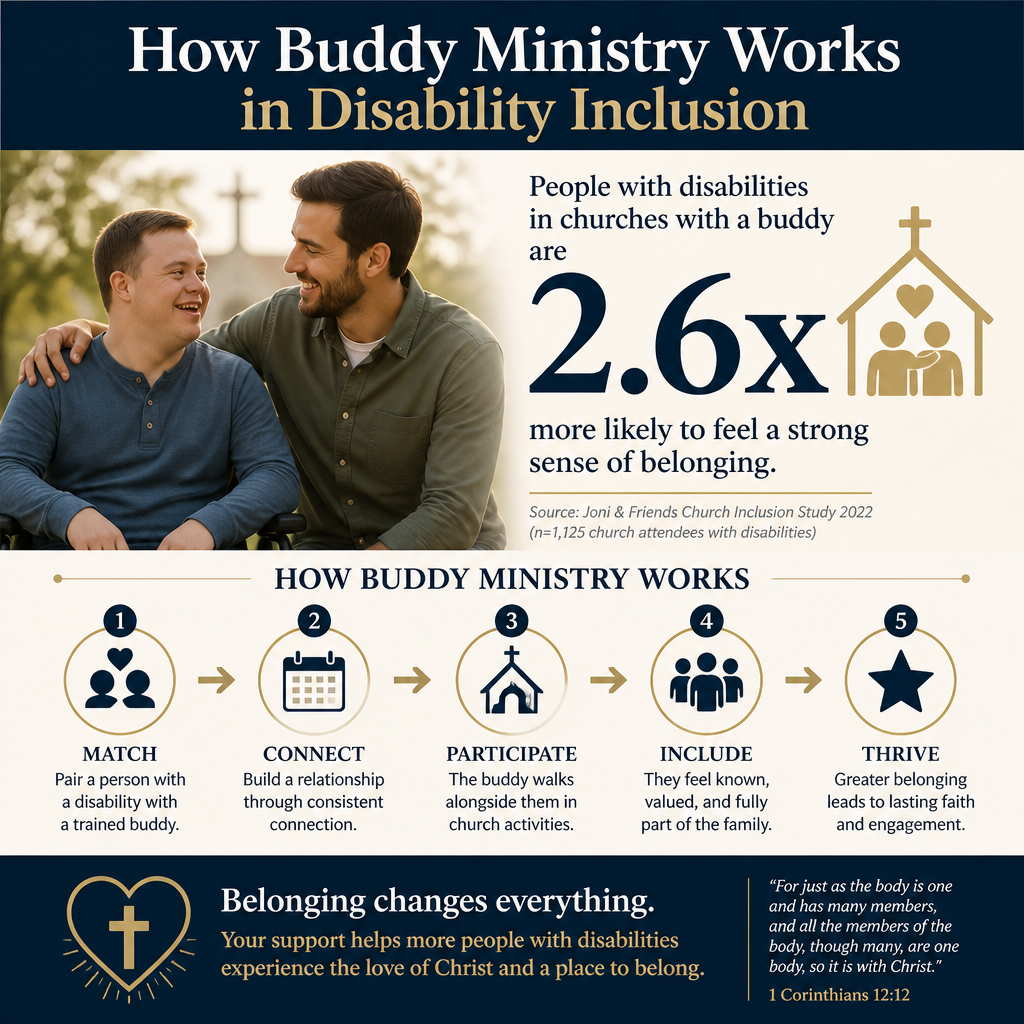
Buddy ministry pairs a trained volunteer with a child, teen, or adult with a disability for the purpose of meaningful participation in church life. The point is not simply presence in a room. The point is access to worship, friendship, formation, and service in ways that respect the person’s dignity and the community’s responsibilities.
In Scripture, the church’s care is never reduced to a program. We are members of one body, and God assigns honor to parts that the world overlooks (1 Corinthians 12:22–26). Buddy ministry expresses that theology in an operational way: a person is not “included” by signage and statements alone, but by concrete support that removes barriers.
What a buddy does
A buddy typically helps with communication, transitions, sensory needs, participation in classroom activities, and safe engagement during worship. In some settings, the buddy accompanies a person to a small group, assists with accessible note-taking, or supports participation in service opportunities. The best buddy ministry is quiet competence: attentive, steady, and unobtrusive.
What a buddy does not do
A buddy is not a therapist, behavior analyst, or medical provider. Churches that blur this line expose families and volunteers to unnecessary risk. Buddy ministry works best when it is honest about competence: volunteers provide supportive presence, not clinical intervention.
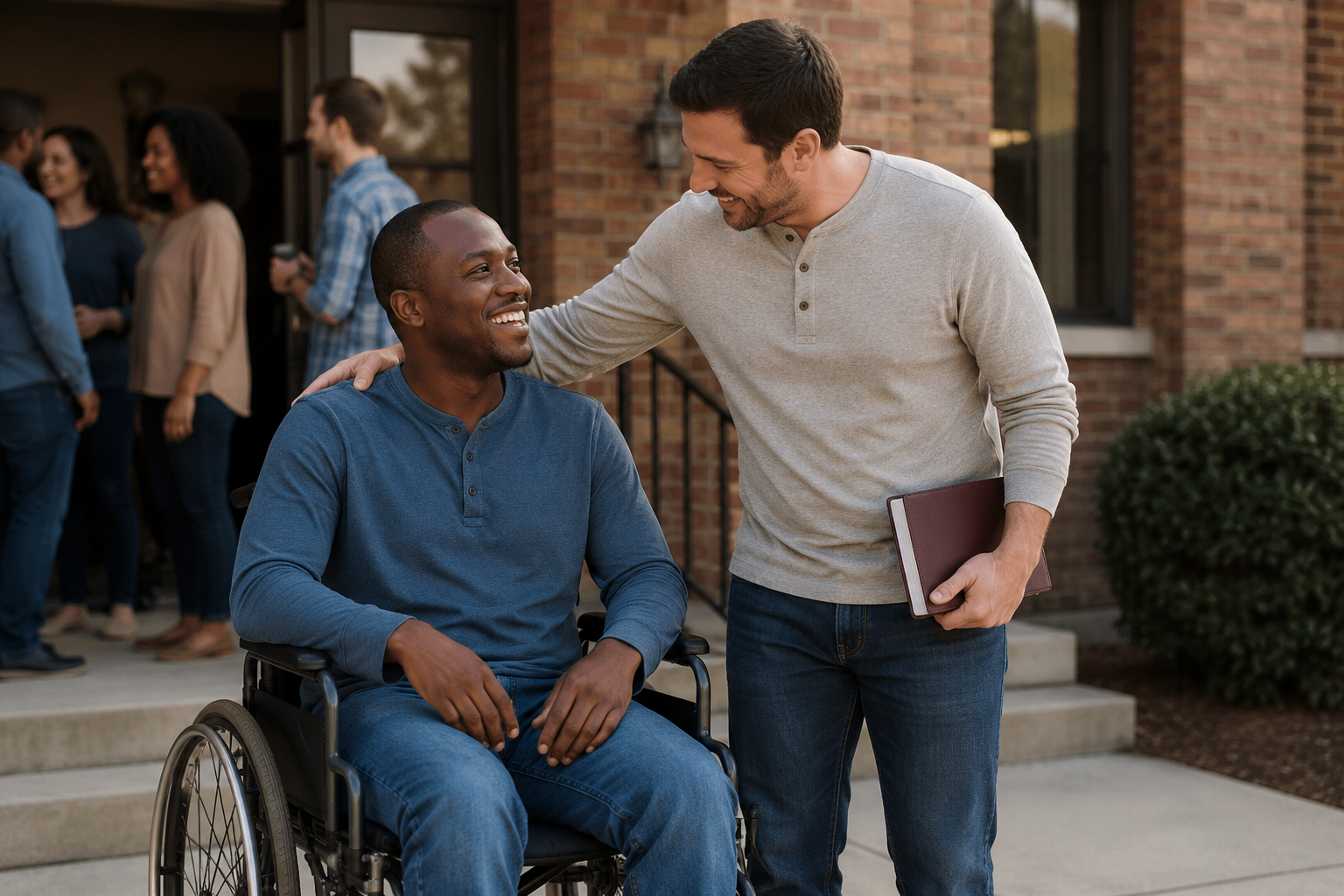
Buddy ministry works because it lowers barriers without isolating people
Many well-intentioned churches create separate disability programs that unintentionally function as parallel congregations. Separate spaces can be appropriate at times, especially for sensory regulation or safety. But separation becomes a spiritual problem when it communicates that certain people belong only on the margins.
Buddy ministry addresses this tension by supporting participation in the ordinary life of the church. The buddy is a bridge, not a gatekeeper. Over time, the goal is not a permanent dyad but a wider web of relationships where the individual is known by multiple people and valued for more than need.
Inclusion has real costs that churches must name
Disability inclusion is not cost-free. It requires screening, training, scheduling, supervision, and appropriate ratios. It requires leaders willing to address difficult moments directly: elopement risk, dysregulation, aggression, self-injury, or a child whose needs outpace what a volunteer team can safely provide.
Wise inclusion is not the same as unlimited inclusion. Donors and church leaders should be wary of ministries that promise “everyone can do everything with no extra support.” The more honest claim is that each person can belong, and participation can be thoughtfully supported in ways that fit the church’s real capacity.
Why this matters for donor-backed disability ministries
Across our verification work at Most Trusted, we observe that the ministries most likely to sustain disability inclusion are those that treat volunteer support as a safety and governance issue, not merely a compassion initiative. When a ministry can articulate how it recruits, vets, trains, and supervises buddies, donors have far better reason to trust that inclusion will endure beyond a single enthusiastic season.
Healthy buddy ministries are built on training, supervision, and family partnership
Buddy ministry rises or falls on adult formation. Many volunteers are willing, but they are not confident. They fear mishandling a behavior episode, violating a boundary, or failing a family. Training does not eliminate risk, but it makes risk manageable and keeps volunteers from improvising in ways that harm trust.
Training must include disability awareness and safeguarding
Competent training covers disability awareness, communication strategies, de-escalation basics, sensory supports, and clear escalation paths. It also covers child protection and adult safeguarding, because the church bears moral and legal responsibilities toward those in its care. A buddy ministry that treats abuse prevention as optional is not ready to scale.
Research on disability and abuse risk underscores why safeguarding matters. Children with disabilities are at significantly higher risk of maltreatment than children without disabilities, which increases the stakes for careful screening and supervision (CDC, child maltreatment and special populations).
Family partnership is not deference but shared expertise
Families carry years of lived knowledge about triggers, calming strategies, communication devices, and medical concerns. Churches should not ask families to educate the entire volunteer corps every week, but they should build a respectful intake process and periodic check-ins that honor that expertise.
What this means in practice is that a buddy ministry should have simple tools: a one-page support plan, a documented allergy and medical protocol, emergency contacts, and permissions around restroom assistance or physical prompting. Clarity is pastoral care. It reduces volunteer anxiety and protects the person receiving support from inconsistent handling.
For donors, buddy ministry is a measurable indicator of ministry maturity
Donors often ask how to distinguish a heartfelt disability initiative from a ministry that is prepared for the long term. Buddy ministry provides unusually concrete signals because it touches finances, leadership, and transparency. A church can make inclusion promises with little accountability; a buddy ministry requires accountable systems.
When we assess ministries against The Most Trusted Standard, we are not looking for perfection. We look for coherent governance, clear safeguarding practices, and honest communication about limits. In disability contexts, that includes the unglamorous details: how volunteers are screened, how incidents are documented, and how families are informed when a support plan needs to change.
Questions donors should expect a credible ministry to answer
- How are buddies recruited, background-checked, and trained before they are placed with a participant?
- What is the supervision structure, and who can remove a volunteer from service if needed?
- How are incidents documented, and how are families informed?
- What ratio guidelines exist for different support levels, and what triggers an escalation?
- How does the ministry serve families spiritually without treating them as perpetual crisis cases?
Transparency protects both families and donors
Some ministries fear that publishing policies will make them look rigid. In practice, the opposite is true. Written policies communicate seriousness. They also reduce the temptation to manage difficult situations through quiet exceptions that leave families and volunteers vulnerable.
Donors are right to ask whether disability ministries report outcomes in ways that respect privacy while demonstrating effectiveness. The goal is not a spreadsheet that reduces people to data points. The goal is honest evidence that the ministry is enabling participation, strengthening family support, and building a congregational culture of belonging.
Disability inclusion requires moral clarity and operational humility
The church’s calling is not merely to welcome those who can easily assimilate. Jesus consistently moved toward those others avoided, and he treated that movement as a mark of fidelity, not an optional virtue (Luke 14:12–23). Disability inclusion is part of the church’s ordinary obedience.
But moral clarity must be joined to operational humility. Churches are not hospitals, and most volunteers are not clinicians. Some situations require professional support, a higher level of staffing, or a partnership with specialized providers. The harder question is whether leaders will acknowledge those limits early, communicate them respectfully, and still refuse to relegate people with disabilities to invisibility.
What churches owe volunteers
Volunteers are not disposable. A buddy ministry that burns out its people through vague expectations and poor supervision will not last. Churches owe volunteers clear roles, predictable schedules, and the freedom to ask for help without shame. When churches invest in training and care for volunteers, inclusion becomes sustainable rather than episodic.
What churches owe people with disabilities
People with disabilities are not objects of ministry. They are fellow disciples and, often, teachers of the church in patience, courage, and perseverance. Inclusion that treats them as a project will eventually fail. Inclusion that recognizes spiritual agency will mature into mutuality: the person supported is also a contributor, a friend, a worshiper, and sometimes a leader.
Those seeking a broader view of how disability ministries function across different models can begin with Disability Ministries, where the field’s common approaches and risks come into clearer focus.
FAQs for How buddy ministry works in disability inclusion
Is buddy ministry primarily for children, or does it work for adults too?
Buddy ministry can serve children, teens, and adults. In children’s ministry, buddies often support attention, transitions, and classroom participation. For adults, buddy roles may focus on navigation, communication, sensory regulation, and social integration in small groups or worship services. The determining factor is not age but the supports needed for meaningful participation and safe care.
What safeguards should a church have before launching a buddy ministry?
At minimum, churches should have volunteer screening appropriate to the role, clear supervision and reporting lines, incident documentation practices, and defined boundaries around physical assistance and restroom support. Training should include disability awareness and de-escalation basics alongside standard child protection and adult safeguarding measures. Many churches will find it helpful to ground these practices in a clear set of expectations like those emphasized in Volunteer Training and Safety in Disability Ministries.
What a faithful buddy ministry makes possible
Buddy ministry works when it becomes an expression of the church’s theology rather than a well-meant add-on. It makes room for families who have learned to expect quiet exclusion, and it forms volunteers into steady servants who know their limits. For donors, it offers a tangible window into whether a ministry’s compassion is matched by governance, safeguarding, and truthfulness.



