
The theology behind Christian disability ministry shapes what donors are actually funding: not a humanitarian add-on to the church’s “real work,” but a visible expression of the gospel’s claims about God, humanity, suffering, and hope. Christian disability ministry is also a test case for whether our generosity is governed by Scripture or by cultural instincts—whether we treat disability as a problem to solve, a burden to manage, or a neighbor to receive with honor.
For donors, the question is not whether disability ministry is “worth supporting” in the abstract. The harder question is whether a ministry’s theology produces practices that protect dignity, tell the truth about suffering, and refuse both sentimental pity and utilitarian efficiency. A ministry can use orthodox language and still operationalize unbiblical assumptions. That is why theological clarity and verifiable accountability belong together.
Imago Dei is not a slogan but a moral boundary
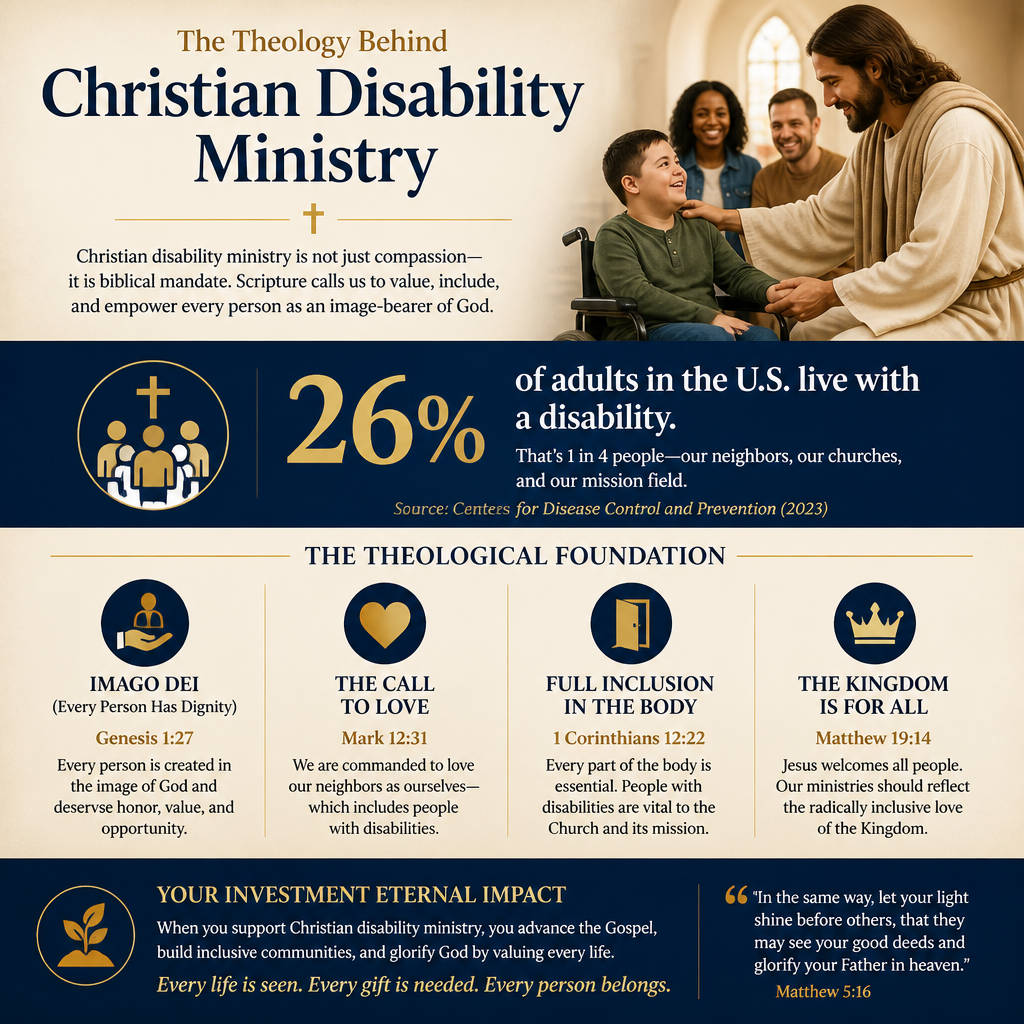
Christian disability ministry begins where Scripture begins: every person is made in the image of God (Genesis 1:26–27). This is not merely a doctrine for theological textbooks. It is a boundary that limits what we may do in the name of “help,” and it is a foundation that establishes what we must do even when it is costly. Dignity is not conferred by capacity, productivity, or independence. It is given by God and cannot be outgrown or outlived.
What this means in practice is that a ministry’s posture matters as much as its programs. Ministries shaped by the imago Dei tend to resist marketing that trades on spectacle, infantilization, or “inspiration” narratives. They avoid turning disabled people into fundraising props. They also reject the quiet assumption that the most valuable outcomes are those that look like typical autonomy.
The church is not a meritocracy
The modern world often treats dependence as failure. Scripture does not. We are creatures, not self-made projects. Christian disability ministry insists that the church is not a meritocracy of the competent but a body where the “weaker” members are indispensable (1 Corinthians 12:22–26). Paul’s language is not sentimental. It is ecclesial architecture. A congregation that cannot imagine leadership, participation, and belonging for people with significant disabilities has not merely missed an opportunity; it has misunderstood what the church is.
This theological claim should press donors toward certain questions. Does the ministry talk about disabled people as recipients only, or as fellow disciples and co-laborers? Is inclusion framed as hospitality offered by the strong, or as mutual belonging under Christ? Funding decisions that ignore these questions can unintentionally reinforce a one-directional charity model that Scripture corrects.
Dignity must survive the budget meeting
Serious donors understand that every ministry eventually expresses its theology in line items. Staffing ratios, training, facility accessibility, transportation, respite support, safeguarding policies, and communication practices all reveal what leadership believes a person is worth. Ministries that honor the image of God tend to budget for the unglamorous work: background checks, volunteer training, adaptive curricula, quiet spaces, and family support. These expenses can look inefficient on a spreadsheet, but they are often the cost of faithful care.
Suffering, healing, and the limits of simplistic narratives
Christians genuinely disagree about how to speak of disability in relation to fallenness, providence, and healing. The field has had to reckon with the harm caused by simplistic narratives: disability as a direct punishment, disability as a spiritual deficiency to overcome, or disability as a mere platform for someone else’s faith. Scripture does not support these reductions. Jesus explicitly rejects the logic that disability must be traced to a specific sin (John 9:1–3). At the same time, Scripture does not deny that the world is disordered and that bodies groan under the weight of mortality (Romans 8:22–23).
Faithful disability ministry names both realities without weaponizing either. It honors the legitimacy of lament and the legitimacy of hope. It prays for healing without making healing a condition for belonging. It refuses to treat prayer as an excuse for neglecting practical care, and it refuses to treat practical care as a replacement for spiritual communion.
The cross teaches us what God does with weakness
The New Testament does not present weakness as an accidental embarrassment for the church to hide. The cross places God’s saving work at the point of apparent failure. Paul’s testimony is particularly important here: “My grace is sufficient for you, for my power is made perfect in weakness” (2 Corinthians 12:9). This is not a romanticization of suffering. It is a reorientation of what counts as strength and what kind of community the gospel creates.
Donors should be alert to ministries that build their identity primarily on dramatic transformation stories. Some lives include striking moments of change; many do not. The ministry shaped by the cross prepares the church to remain present when there is no tidy storyline—when caregiving is long, progress is slow, and the faithful work is simply to keep showing up.
Healing is real, and it is not the whole story
The Gospels portray Jesus healing with authority and compassion. A disability ministry that never prays for healing has likely absorbed a secular assumption that the supernatural is irrelevant. Yet a ministry that treats healing as the proof of faith has crossed into pastoral cruelty. Theologically sound ministries tend to make room for both: earnest prayer and careful pastoral language; expectation and humility; testimony and discretion.
The donor implication is concrete: funding should prioritize ministries that have mature pastoral oversight, not merely enthusiastic programming. Where leaders are untrained, the risk of spiritual manipulation rises—especially for families living with chronic fatigue, medical complexity, or repeated disappointments.
The church’s vocation is belonging, not a separate track of care
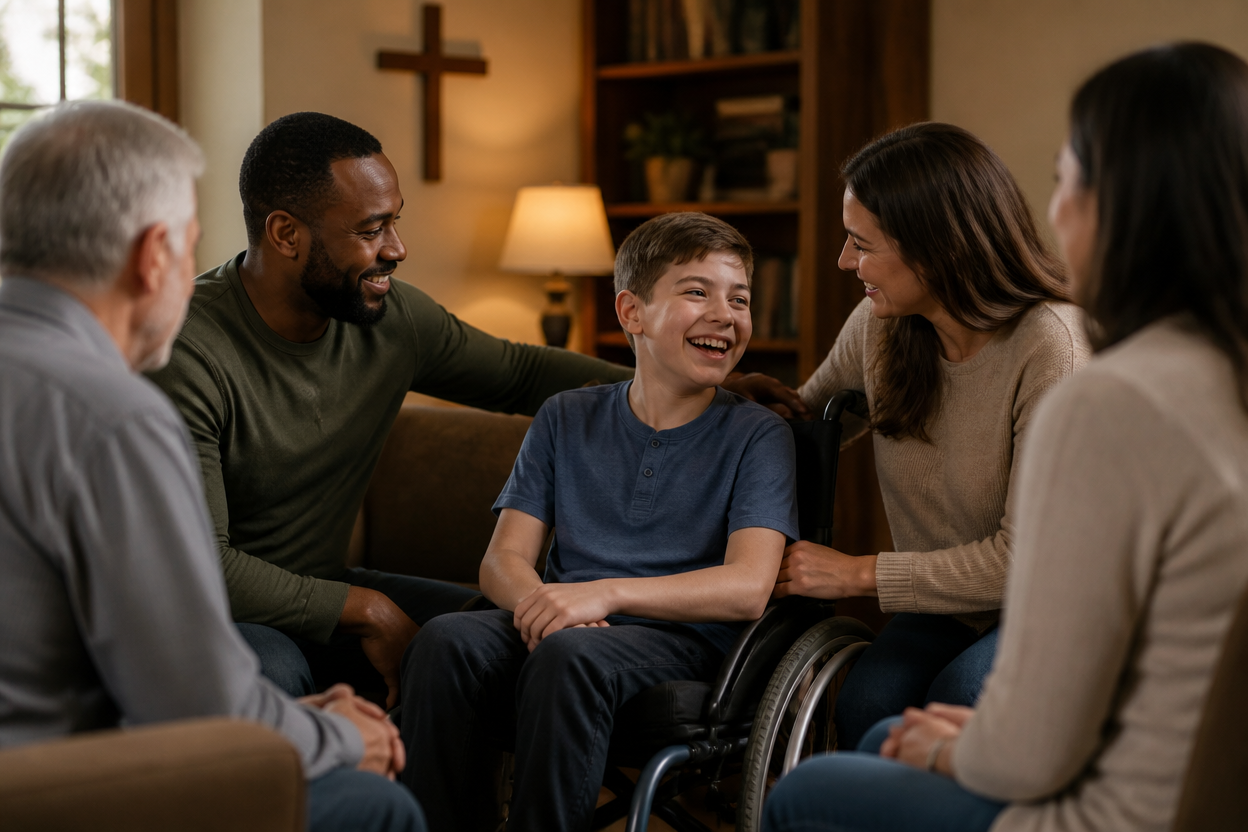
Disability ministry is sometimes framed as a specialized service offered to a small subset of families. Scripture pushes us further. The church’s calling is to be a household where each member is known, welcomed, and equipped for love and good works. The goal is not to create a parallel ministry that keeps disabled people adjacent to the congregation; it is to cultivate a congregation where disabled people and their families are part of “we,” not “they.”
That vocational claim has consequences for what donors fund. It pushes against models that are impressive on a stage but thin in daily discipleship. It also pushes against the false choice between “quality programming” and “true inclusion.” Both matter, and they must serve the same end: ordinary ecclesial life together.
Inclusion is spiritual formation for the whole church
When a church learns to welcome people with disabilities, it is not simply expanding services; it is undergoing formation. Patience, attentiveness, mutual dependence, and humility are not optional virtues in the New Testament. Disability ministry makes those virtues unavoidable. It exposes how quickly congregations default to efficiency as a moral good and how easily we confuse convenience with wisdom.
Donors often ask for measurable outcomes, and the request is reasonable. But some of the most important outcomes are ecclesial rather than programmatic: families who remain connected to worship rather than drifting away; friendships that persist outside scheduled events; a congregation that learns to speak of disability without condescension or avoidance. These are legitimate ministry outcomes even when they do not produce easily comparable metrics.
Families are not a support problem but a pastoral responsibility
Many disability ministries exist because families have carried a weight in isolation for years: navigating therapies, education plans, medical systems, and the chronic spiritual fatigue that can accompany long-term caregiving. A faithful ministry treats parents and siblings not as logistics to manage but as souls to shepherd. It offers respite where possible, but it also offers prayer, teaching, and community that can withstand disappointment.
For donors, this is a reminder that funding “direct services” is not always the most faithful category. Spiritual partnership with families—pastoral care, small groups, accessible discipleship materials, trained volunteers—often produces long-term stability that prevents burnout and keeps households engaged in the life of the church.
What donors should verify when theology becomes operations
The theology behind Christian disability ministry should be visible not only in statements of faith but in governance, safeguarding, and honest communication. Donors have learned across the broader nonprofit sector that sincerity does not substitute for systems. Disability ministry adds additional responsibilities because it often serves people who are medically vulnerable, cognitively impaired, or socially marginalized. Those realities heighten the duty of care.
Across our verification work at Most Trusted, we observe that the ministries most worthy of donor confidence typically combine clear theological commitments with institutional practices that can be examined. This is not skepticism; it is stewardship. Mature Christian giving asks not only “Is the mission good?” but also “Is the work done in a way that protects people and honors Christ?”
Safeguarding and consent are theological issues
Ministries serving children and adults with disabilities should have explicit policies for screening, supervision, incident reporting, and family communication. They should also show careful thought about consent and dignity in photography and storytelling. A ministry’s fundraising language can be a litmus test: if it depends on pity, it is likely cultivating the wrong instincts in donors and volunteers alike.
Verifiable evidence suggests that abuse risk is elevated for people with disabilities, which makes safeguarding non-negotiable. The Centers for Disease Control and Prevention has summarized research indicating children with disabilities are at increased risk for maltreatment compared to children without disabilities, a reality that should shape training and oversight.
Transparency protects the people a ministry serves
Disability ministry can attract intense emotional support, and emotional support can unintentionally lower scrutiny. Transparent ministries welcome scrutiny because they understand the stakes. They publish clear financial information, describe program outcomes without exaggeration, and name limitations candidly. They also make it easy for families to raise concerns without fear of retaliation.
Donors should also be cautious about simplistic fundraising ratios that pressure ministries to underinvest in administrative capacity. The Overhead Myth letter hosted by Candid (GuideStar), signed by major evaluators, argues that overhead percentages are a poor proxy for effectiveness. In disability contexts, training, supervision, and compliance often sit in “overhead,” yet they are core to safe and faithful work.
Outcomes should match a Christian anthropology
Secular disability services often focus understandably on functional gains. Christian ministry may include that, but it must not reduce a person to function. Theologically faithful outcomes include spiritual access (Scripture and worship in forms people can receive), meaningful belonging, and opportunities for contribution. The question is not merely whether someone can attend an event, but whether they are recognized as a member of Christ’s body with gifts to offer.
When donors want to understand how disability ministry fits within wider Christian giving, we point readers to the broader context of Disability Ministries, where the same theological commitments must be tested through governance, financial integrity, and truthful reporting under The Most Trusted Standard.
Funding disability ministry as a work of Christian witness
The theology behind Christian disability ministry is ultimately about what the church proclaims with its life together. When disabled people are present, protected, known, and honored, the church is not merely being kind; it is bearing witness to a Kingdom where worth is not earned and where weakness is not a disqualification. For donors, this is an invitation to give in a way that is both compassionate and disciplined—supporting ministries whose theology is not only stated, but embodied with integrity.



