

Why church donors give to local Christian counseling ministries is not a mystery of marketing. It is a moral and pastoral question: whether the church will meet suffering with competent care that honors both Scripture’s vision of persons and the real clinical realities of trauma, depression, addiction, and family breakdown. Mature donors recognize that counseling is not merely a private service. It is a form of mercy that can steady a household, protect a child, preserve a marriage, and prevent a crisis from becoming a generational pattern.
Local Christian counseling ministries sit near the intersection of soul care and public health. They often receive referrals from pastors, physicians, schools, and courts, and they carry burdens that a single congregation cannot easily sustain. Donors tend to give when they see a ministry offering faithful presence, sound practice, and accountable stewardship rather than spiritualized shortcuts or vague promises.
Donors give because counseling is a work of mercy with theological weight
Suffering is not only a private matter
Scripture refuses to treat human pain as an embarrassment to be managed in isolation. The Psalms give language to anguish without denial. The Gospels show Christ meeting the afflicted with both truth and compassion. Paul’s instruction to “bear one another’s burdens” frames Christian community as a place where weight is carried together, not simply advised from a distance.
What this means in practice is that counseling—when ordered toward truth, repentance, forgiveness, and wise care—fits within the church’s historic commitment to the cure of souls. Donors who have watched families fracture under untreated mental illness or unaddressed trauma understand that the stakes are not theoretical. Counseling can be one of the most concrete ways a church’s compassion becomes durable.
Donors are funding formation, not therapy as a commodity
Christians genuinely disagree about how to describe the relationship between spiritual formation and clinical treatment. Some fear that therapy displaces repentance; others fear that spiritual counsel becomes a substitute for competent clinical care. Wise donors do not reduce the question to slogans. They look for ministries that integrate biblical anthropology with professional standards, recognizing that people are embodied souls whose histories, habits, and neurobiology matter.
Local ministries also allow donors to fund counseling as a form of discipleship-adjacent care. Many counseling centers offer groups, marriage intensives, parenting support, or recovery programs that strengthen the relational infrastructure of a community. When done well, this is not outsourcing pastoral responsibility; it is extending care through qualified hands in cooperation with the church.

Donors give because the need is widespread and pastorally visible
The numbers confirm what pastors already know
Most churches do not need a research report to tell them that anxiety, depression, and family strain are common. Still, credible data can help donors gauge scale. The National Institute of Mental Health reports that an estimated 22.8% of U.S. adults experienced any mental illness in 2021.National Institute of Mental Health That is not a marginal pastoral concern; it is a significant portion of a typical congregation.
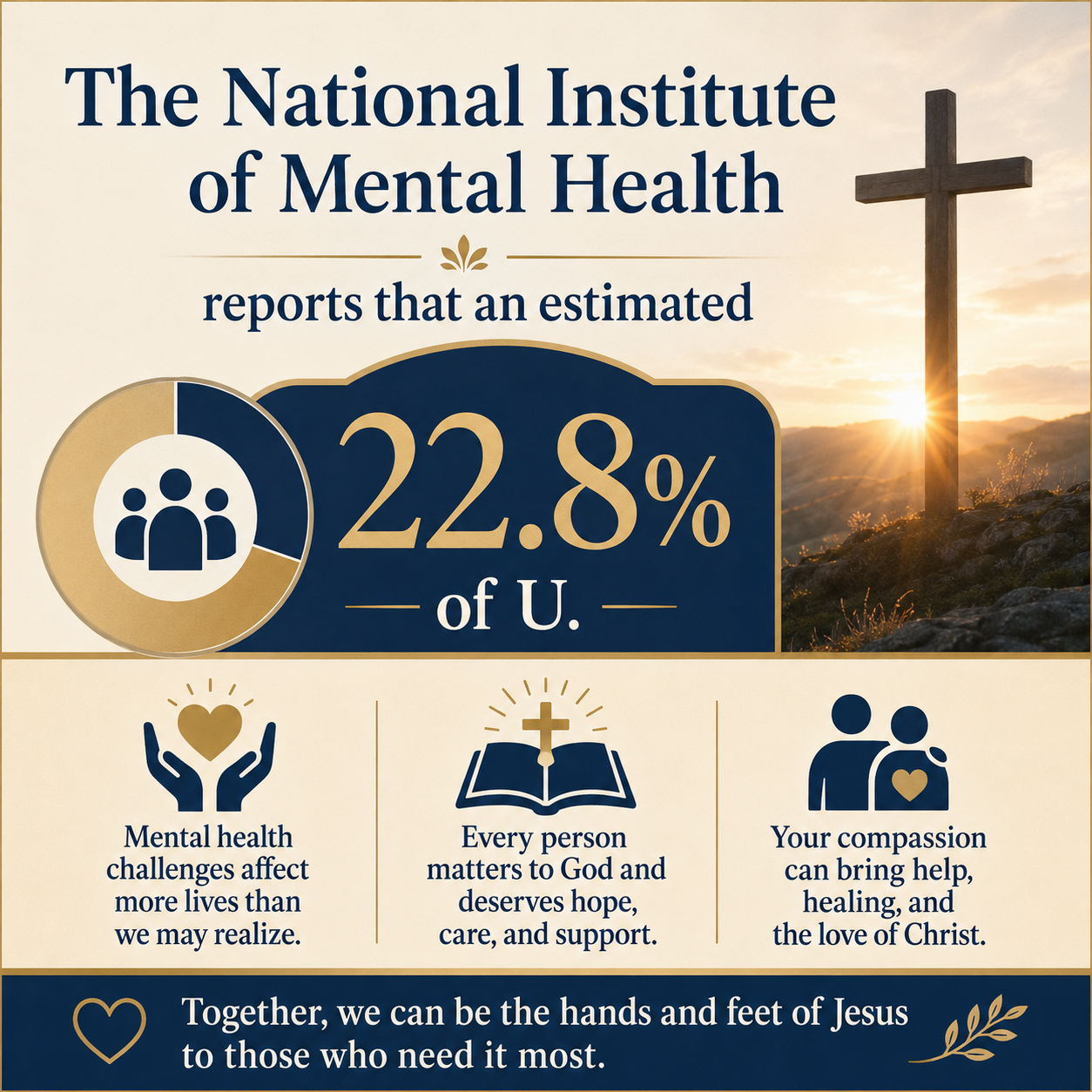
For donors, prevalence matters because it changes the ethics of response. If a fifth to a quarter of adults may be facing meaningful mental health challenges in a given year, the question is less whether counseling ministries are needed and more whether they are accessible, competent, and responsibly governed.
Local access shapes who gets help
Counseling deserts are real: long waitlists, limited providers, and cost barriers can keep people from receiving care when it is most urgent. A local Christian counseling ministry can reduce friction by offering sliding-scale fees, scholarship support, or partnerships with churches that subsidize care for members and neighbors. Donors tend to support what they can see: a person helped, a marriage steadied, a teenager supported before crisis becomes catastrophe.
This is also why church partnerships matter. When a congregation has a trusted local referral relationship, pastoral counsel can be complemented by clinical treatment without confusion over roles. We address these practical dynamics across our coverage of Church Partnerships with Christian Counseling Ministries, where donors often find the operational questions they need to ask.
Donors give because proximity creates accountability and real outcomes
Local ministries can be known, tested, and improved
Local does not automatically mean trustworthy, but it does make scrutiny more feasible. Donors can observe whether a counseling center maintains appropriate policies for confidentiality, mandated reporting, and clinical supervision. They can learn whether counselors are licensed, whether interns are supervised, and whether referrals are handled responsibly when a case exceeds the ministry’s competence.
Proximity also allows feedback loops. Pastors and referring physicians can report patterns: whether a ministry is responsive, whether it communicates appropriately, and whether counselees are being served with dignity. Donors are often willing to fund counseling because they can evaluate the ministry’s culture over time rather than relying only on promotional narratives.
Outcomes can be measured without reducing people to metrics
Christians rightly resist treating people as data points. Yet refusing measurement entirely can become a way of avoiding responsibility. Mature counseling ministries track what can be tracked ethically: attendance, completion rates for groups, wait times, scholarship distribution, client satisfaction, and referral pathways. These are not the same as sanctification, but they are indicators of whether a ministry is functioning competently.
Donors who give thoughtfully often look for a ministry’s willingness to be evaluated. That includes acknowledging limits, reporting setbacks honestly, and demonstrating learning. In our verification work at Most Trusted, the ministries that meet The Most Trusted Standard tend to treat transparency not as a threat but as a discipline of stewardship.
Donors give when ministries honor both theological convictions and professional ethics
Integration requires clarity, not ambiguity
Christian counseling carries inherent tensions. A ministry may affirm biblical sexual ethics while serving clients shaped by secular therapeutic assumptions. A counselor may hold strong convictions about sin and repentance while treating complex trauma where shame is already toxic. The hard question is whether the ministry can articulate a coherent approach that is biblically grounded and clinically responsible, rather than oscillating between harsh moralism and thin sentimentalism.
Donors tend to fund ministries that name their commitments plainly: a statement of faith, a clear counseling philosophy, and practical boundaries about what the ministry will and will not provide. Clarity protects counselees from surprise and protects the church from confusion.
Safety, confidentiality, and governance are not optional
Because counseling involves vulnerability, it is also a context where harm can occur if a ministry lacks strong safeguards. Donors who have followed high-profile failures in Christian institutions are understandably cautious. They should be. Good intentions do not substitute for appropriate policies, training, and oversight.
Responsible donor due diligence often includes asking for evidence in areas such as:
- Licensure and supervision practices for clinical staff
- Clear safeguarding policies for minors and vulnerable adults
- Written protocols for mandated reporting and crisis response
- Financial controls and scholarship accounting
- Board oversight that is active rather than ceremonial
These questions are not distractions from ministry. They are part of loving neighbors with competence. Most Trusted’s verification lens is designed to help donors assess these concerns consistently across ministries, with criteria spanning Faith Foundation, Financial Integrity, Governance and Leadership, and Transparency and Effectiveness within The Most Trusted Standard.
Donors give because counseling ministries can strengthen the whole church, not only individuals
Healthy care reduces hidden downstream costs
Churches often carry the downstream effects of untreated mental health challenges: pastoral crises, marital breakdown, child instability, addiction relapse, and burnout among lay leaders who try to fill clinical gaps. Funding a counseling ministry can be a form of preventive care for the church’s common life. It can also protect pastors from being expected to practice beyond their competence, which can create risk for both counselees and the church.
Some donors hesitate here, concerned that professional counseling will “medicalize” spiritual problems. That concern deserves a serious hearing. Yet the opposite error is also common: treating complex conditions as if prayer and willpower alone are the only faithful responses. The church’s best tradition has been both/and: prayer and prudence, spiritual counsel and skilled care, repentance and appropriate treatment.
Local ministries can foster referral networks that honor the body of Christ
When counseling ministries operate well, they become hubs of trusted collaboration: with pastors, small-group leaders, medical providers, schools, and recovery communities. This does not erase denominational distinctives. It does, however, create a practical expression of Christian unity around mercy.
Donors often prefer to fund this kind of connective tissue. It is less glamorous than a building campaign and harder to photograph than a missions trip. Yet it is precisely the sort of quiet faithfulness that can keep a congregation steady over decades. For donors seeking a broader view of the field, our ongoing work on Christian Counseling Ministries reflects the patterns we see across credible organizations.
FAQs for Why church donors give to local Christian counseling ministries
Should donors prioritize church-based counseling or independent Christian counseling centers?
Both models can serve well. Church-based counseling may offer tighter pastoral integration and easier access for members, while independent centers may provide greater clinical depth, broader referral capacity, and stronger infrastructure for supervision and compliance. Donors should evaluate the specific ministry’s theology, licensure practices, safeguarding, governance, and financial transparency rather than assuming one structure is automatically superior.
What is a reasonable way to evaluate a counseling ministry without violating confidentiality?
Donors do not need private client information to assess integrity and competence. They can review publicly available policies, counselor credentials, governance documents, audited or reviewed financials where applicable, and aggregate operational metrics such as wait times, scholarship distribution, and completion rates for programs. A trustworthy ministry can explain its clinical supervision, crisis protocols, and safeguarding practices in a way that is clear and appropriately bounded.
Giving that matches the weight of the work
Church donors give to local Christian counseling ministries because they recognize a form of mercy that is both deeply personal and unmistakably communal. Counseling is not a substitute for the church’s spiritual calling; it can be one of the ways the church’s calling becomes credible under pressure. The donors who give with confidence tend to support ministries that unite theological clarity with professional ethics, and that welcome accountable scrutiny as part of faithful stewardship.



