

What churches should ask Christian counseling ministries before partnering is not a procedural question; it is a stewardship question with pastoral consequences. For donors who underwrite church care systems and counseling scholarships, the integrity of a partnership determines whether generosity becomes durable healing or quietly subsidizes harm.
Churches are not clinical institutions, and Christian counseling ministries are not congregations. The difference is not a problem to solve but a reality to govern well. Scripture holds together both compassion and accountability: shepherds are charged to “pay careful attention” to the flock (Acts 20:28), and wisdom is commended as protection for the vulnerable (Proverbs 4:6–7). In practice, that means asking questions that test theology, competence, and governance—not merely warmth, charisma, or shared vocabulary.
Begin with a clear theology of care and a bounded role for counseling
What gospel assumptions shape their model of change
Many ministries describe their work as “biblical counseling,” “Christian counseling,” “Christ-centered therapy,” or “integrated counseling.” Those terms are not interchangeable, and Christians genuinely disagree about how Scripture, church tradition, and the clinical sciences should relate. A wise church partnership clarifies what the ministry believes about the nature of the human person, the dynamics of sanctification, and the place of common grace in psychological research.
Specific questions belong on the front end: What does the ministry believe Scripture requires in counseling? Where does it believe Scripture gives freedom? How does it speak about sin, suffering, trauma, and psychiatric illness without collapsing them into a single category? A ministry that can articulate these distinctions usually has the maturity to handle complex cases with humility.
How they protect the church from becoming a referral machine
A partnership should serve pastoral care, not displace it. Churches should ask how the counseling ministry expects to relate to pastors and elders: what information will be shared, how spiritual care is coordinated, and how the church remains responsible for shepherding while respecting client confidentiality and professional boundaries. Donors tend to appreciate ministries that are explicit about what they will not do—such as becoming an alternative authority structure over members.
For additional context on how ministries define and deliver care, we maintain coverage of Christian Counseling Ministries.

Insist on clinical competence without drifting into technocracy
Licensure, supervision, and scope of practice
A church does not need to become a credentialing board, but it must ask whether the ministry is practicing within lawful and ethical boundaries. A partnership should clarify who provides counseling (licensed clinicians, supervised interns, lay counselors), what supervision structure exists, and how the ministry decides which cases it can appropriately serve. Competence is partly a matter of credentials and partly a matter of governance: Who reviews cases? Who sets clinical policies? Who is accountable when a counselor’s judgment is poor?
Churches should also ask how the ministry handles high-acuity situations: suicidal ideation, domestic violence, child abuse allegations, active psychosis, and substance use crises. Mature ministries have a documented protocol for risk assessment, mandated reporting, safety planning, and referral to emergency services when necessary. The question is not whether every counselor has the same approach; it is whether the organization has a coherent standard of care.
Evidence, outcomes, and intellectual honesty
Some ministries overpromise: “We can resolve trauma quickly,” or “Depression is always spiritual.” Others swing the opposite direction, speaking as though Christian distinctives are only branding. Churches should look for intellectual honesty. Does the ministry acknowledge what is contested in the field? Does it name limitations and refer out when a different modality or higher level of care is needed?
Given the prevalence of mental health strain, churches should not assume demand equals quality. The U.S. adult population continues to report substantial symptoms of anxiety and depression in national surveillance, which shapes the counseling landscape and the pressure on faith-based providers (Centers for Disease Control and Prevention, National Center for Health Statistics).
Examine governance, accountability, and safeguarding as spiritual duties
Board oversight and conflicts of interest
When a church refers members to a ministry, it is lending moral authority. Donors understand that reputational lending is not neutral; it is a form of stewardship. Churches should ask about board composition, independence, and decision rights. Is the board primarily family and friends, or does it include independent members with financial, legal, and clinical competence? Are there conflict-of-interest disclosures and a process for recusals?
These are not “business questions” in opposition to spiritual work. Scripture repeatedly warns against partiality and the abuse of power. Good governance is one of the ways a ministry refuses temptation and protects the vulnerable.
Safeguarding policies for adults and minors
Counseling is a high-trust environment. The ministry should have clear policies on boundaries, dual relationships, and appropriate communication (including texting and social media). If minors are counseled, policies should address parental consent, session structure, documentation, and mandated reporting. If counseling occurs on church premises, responsibilities must be explicit: room visibility, scheduling controls, and incident reporting channels.
Churches should ask whether the ministry conducts background checks, maintains professional liability coverage, and trains staff on abuse prevention. For donors, these questions are not administrative details; they are protections for people made in the image of God.
Follow the money without adopting the overhead reflex
Pricing, scholarships, and the ethics of access
Counseling ministries often operate with a mixed revenue model: client fees, church subsidies, donor gifts, and grants. Churches should ask how fees are set, what “sliding scale” means in practice, and whether scholarships are allocated consistently rather than informally. A partnership that funds counseling for the poor should clarify eligibility standards, documentation requirements, and the safeguards that prevent favoritism.
Donors frequently ask about “low overhead.” That instinct is understandable, but it can distort good judgment. The sector has long cautioned against equating low administrative spending with effectiveness; the joint letter commonly known as the Overhead Myth urged donors to evaluate governance, outcomes, and transparency rather than a single ratio (Charity Navigator). Churches should apply the same maturity here: competent supervision, careful recordkeeping, and safeguarding infrastructure cost money, and underfunding them is rarely compassionate.
Financial controls and transparency appropriate to a counseling context
Because counseling includes sensitive client information, not every operational detail can be public. Yet donors and churches can still expect meaningful transparency: clear financial statements, a coherent budget, and an explanation of how restricted gifts are managed. Churches should ask who has signing authority, how expenses are approved, and whether the ministry conducts an independent financial review or audit when scale warrants it.
Across our verification work at Most Trusted, ministries that meet The Most Trusted Standard tend to treat financial controls as an extension of discipleship: truthful reporting, clear restrictions, and consistent board oversight. That culture is difficult to fake over time.
Define the partnership in writing and measure what faithfulness looks like
A referral relationship is not a blank check
Many church partnerships begin informally: a pastor meets a counselor, stories are shared, referrals start. Informality is often where risk accumulates. Churches should ask for a written memorandum of understanding that addresses scope of services, eligibility, communication pathways, crisis protocols, and expectations for spiritual care coordination. If the ministry uses the church’s facilities, the agreement should include facility policies, insurance requirements, and incident reporting.
Clarity does not signal distrust; it signals love of neighbor. It reduces confusion for counselees and protects counselors from being asked to do what they cannot do.
What churches should ask before the first referral
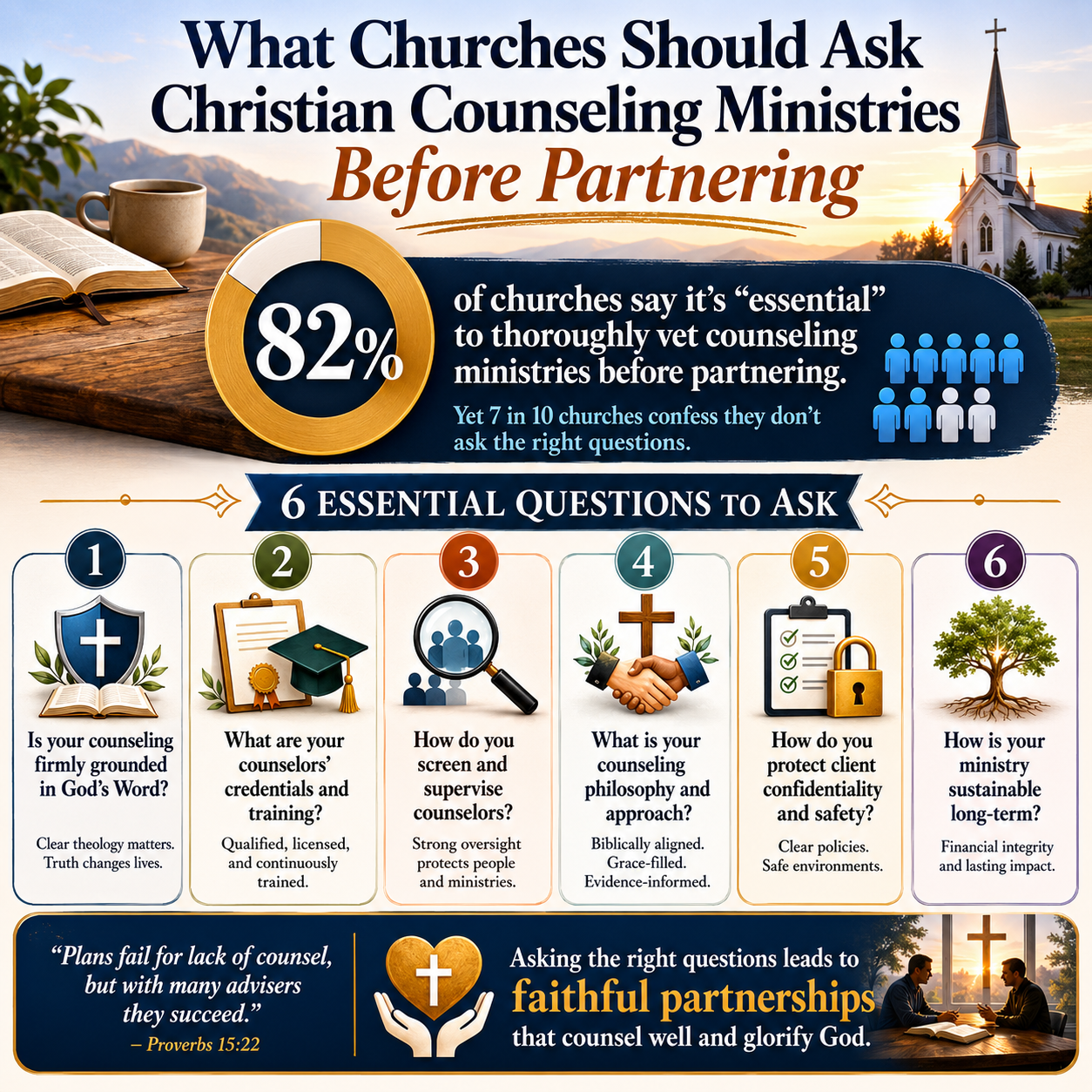
Before sending members to a counseling ministry, churches can ask a focused set of questions that reveal maturity without demanding unnecessary disclosure. We recommend asking for direct answers to the following:
- What is your stated counseling model, and how does it relate to Scripture and clinical practice?
- Who provides counseling, what are their credentials, and what supervision structure is in place?
- How do you handle high-risk situations such as suicidality, abuse allegations, and severe mental illness?
- What safeguarding policies govern boundaries, documentation, and communication with clients?
- What financial controls ensure that fees, scholarships, and donor-restricted gifts are handled faithfully?
- How will you coordinate with pastors while preserving confidentiality and professional ethics?
If a church wants a broader view of how these partnerships typically function and where they break down, we also publish work on Church Partnerships with Christian Counseling Ministries.
Finally, churches should ask what success looks like and how it will be assessed. Counseling outcomes are not always measurable in the same way as program outputs, and a ministry should not be pressured into simplistic metrics. Yet it should be able to describe how it evaluates quality: client feedback mechanisms, clinical review processes, counselor continuing education, and a pattern of learning from failures. The goal is not data for its own sake; it is a disciplined commitment to truth.
FAQs for What churches should ask Christian counseling ministries before partnering
Should churches only partner with licensed clinicians
Not necessarily. Some churches partner well with ministries that include lay counseling, pastoral counseling, or supervised interns, provided the ministry is transparent about scope of practice, supervision, and referral thresholds. The non-negotiable is competence with accountability: a structure that prevents isolated counselors from operating without oversight, especially in high-acuity cases.
How can donors evaluate a counseling ministry when confidentiality limits transparency
Confidentiality should constrain disclosure of client-level information, not organizational accountability. Donors can still look for verifiable indicators: clear governance, written safeguarding policies, documented financial controls, and honest descriptions of how quality is reviewed. At Most Trusted, our work against The Most Trusted Standard is designed to evaluate these organizational markers without pressuring ministries to compromise pastoral or clinical confidentiality.
Partnership is a form of pastoral stewardship
A church that partners with a Christian counseling ministry is doing more than expanding services; it is directing vulnerable people toward a particular authority, a particular set of practices, and a particular ethical framework. The questions churches ask at the beginning are often the questions that prevent crisis later. For donors who care about faithful outcomes, the best partnerships are those where theology, competence, governance, and transparency reinforce one another over time.



