
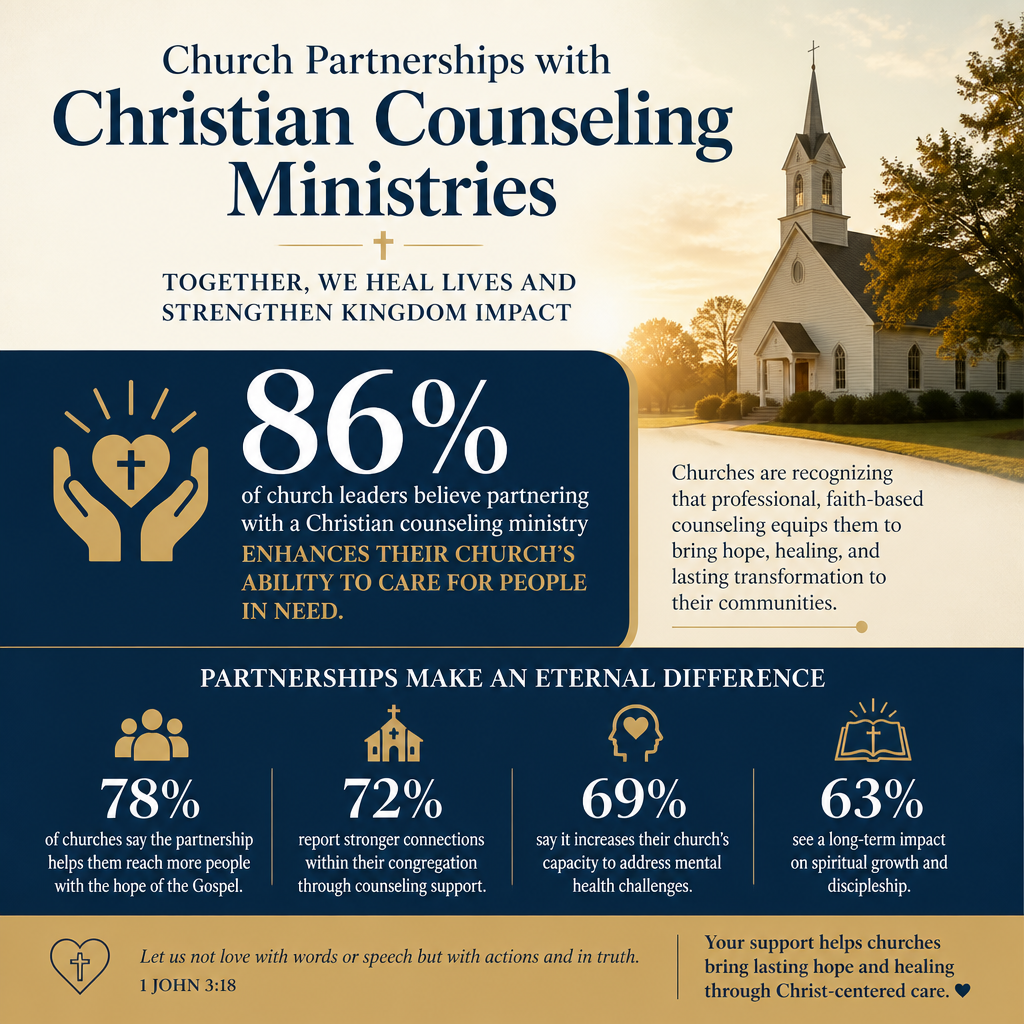
Church partnerships with Christian counseling ministries are one of the most consequential decisions donors can underwrite in local congregational life. When they are healthy, they extend the church’s care beyond the limits of volunteer capacity and pastoral training, helping believers receive clinically competent, theologically grounded support. When they are poorly designed, they can confuse spiritual authority with clinical authority, mishandle risk, and create quiet pressure on vulnerable people to accept care that is not actually safe or appropriate.
Christian donors often sense the need before they can name it. Pastors are asked to carry crisis after crisis. Small groups become informal triage centers. And people who need skilled trauma care, psychiatric evaluation, or specialized marriage therapy receive well-meant counsel that cannot substitute for treatment. The question is not whether the church should care for the suffering. Scripture is explicit that we must (Galatians 6:2). The question is how churches can partner with Christian counseling ministries in ways that protect people, honor the church’s spiritual responsibilities, and steward donor funds with integrity.
Why these partnerships matter for donor stewardship
Most churches are not staffed as mental health organizations, even when they are spiritually mature and pastorally attentive. A pastor may preach faithfully, visit the sick, and shepherd with wisdom, yet still be unqualified to diagnose depression, manage suicidal ideation, or treat post-traumatic stress. A Christian counseling ministry can fill that gap, but only if the partnership is framed honestly: the church provides spiritual care and community; the counseling ministry provides clinical assessment and therapeutic care within a Christian worldview.
Donors are often drawn to counseling partnerships because the needs are immediate and personal. Unlike distant projects, mental health needs show up in pews and youth groups. Yet that proximity can also distort discernment. When need is close, donors are tempted to equate urgency with suitability. Mature stewardship slows down long enough to ask whether the ministry’s clinical model, governance, and theological commitments can bear the weight of a church-wide referral relationship.
Care is not only compassion but competence
Christians sometimes speak as if compassion alone is the decisive ingredient in care. Compassion is necessary, but it is not sufficient. Competence is also a moral category when vulnerable people are involved. Proverbs commends skill and diligence, not merely good intentions (Proverbs 22:29). In counseling, competence includes clinical training, adherence to professional ethics, appropriate supervision, and clear boundaries between counseling and pastoral authority.
It also includes knowing what the ministry is not. Many faithful Christian counseling ministries are not equipped for inpatient-level crises, intensive substance abuse treatment, or certain psychiatric presentations. A partnership becomes dangerous when a church assumes that a “Christian counselor” equals comprehensive mental health capacity.
Donors often fund the invisible infrastructure
Some of the most important elements of counseling partnerships are not dramatic: written referral protocols, data privacy practices, liability coverage, supervision structures, and agreements that clarify what the church may and may not expect from counselors. Donors frequently prefer to fund sessions or scholarships, and those are worthy. Yet scholarship funding without infrastructure can create a fragile system that depends on heroic individuals rather than durable, accountable operations.
This is one place where Most Trusted’s verification lens is useful. Across our verification work, we observe that ministries that meet The Most Trusted Standard tend to treat “back office” functions as part of their pastoral responsibility to the public: financial controls, leadership accountability, and transparent reporting are not distractions from mission; they are part of love of neighbor expressed institutionally.
What healthy partnerships look like in practice
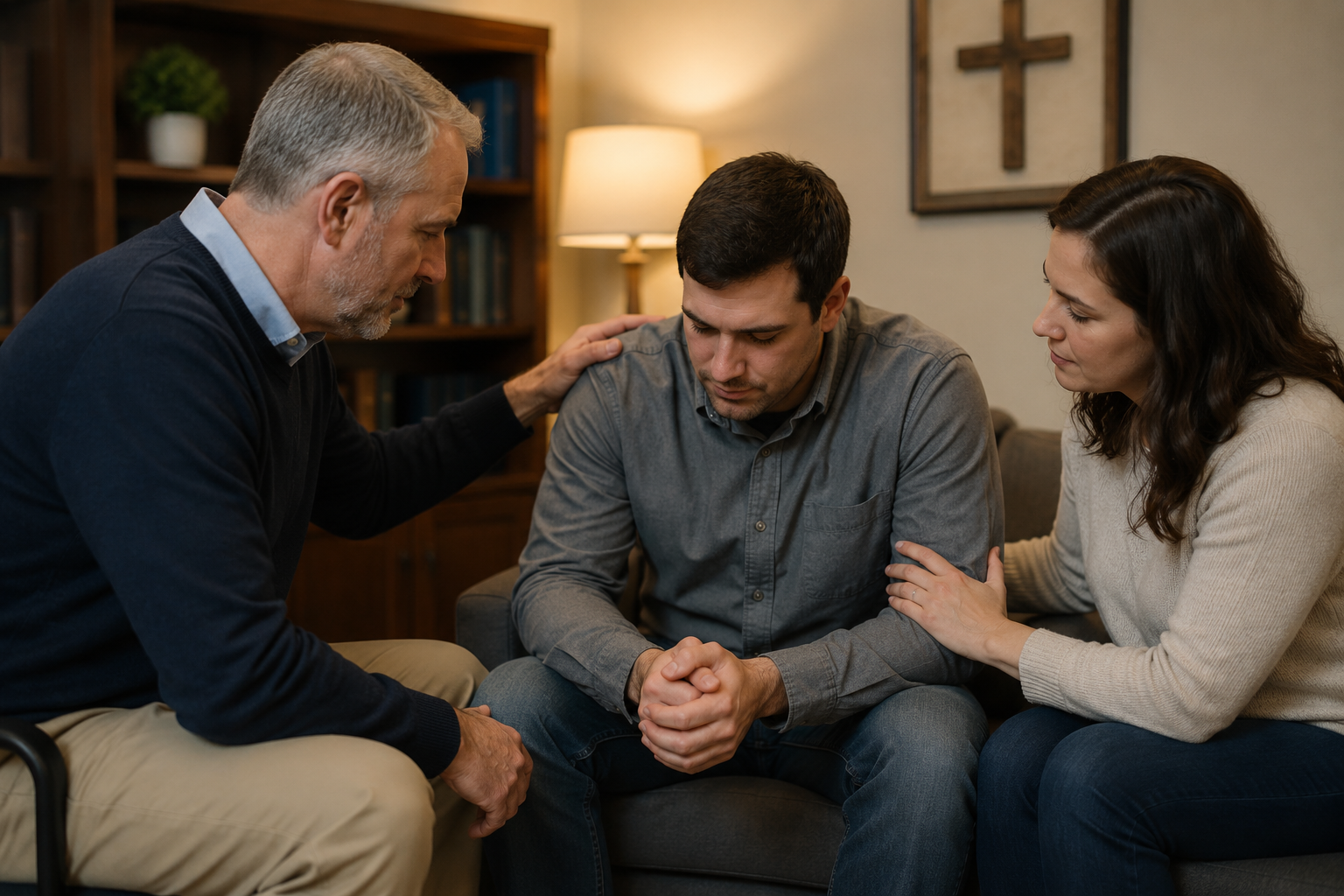
The strongest church partnerships with Christian counseling ministries are explicit about roles, careful about boundaries, and realistic about capacity. They do not ask counselors to function as outsourced pastors. They also do not ask pastors to function as unlicensed clinicians. They create a bridge, not a blur.
Clear referral pathways with informed consent
A responsible partnership begins with a clear referral pathway: how pastors, staff, and lay leaders refer; what information is shared; what happens in emergencies; and how the counselee’s consent is documented. Donors should expect written policies rather than informal habits. If a ministry cannot articulate how it handles confidentiality and releases of information, that is not a minor administrative gap. It is a patient safety and trust issue.
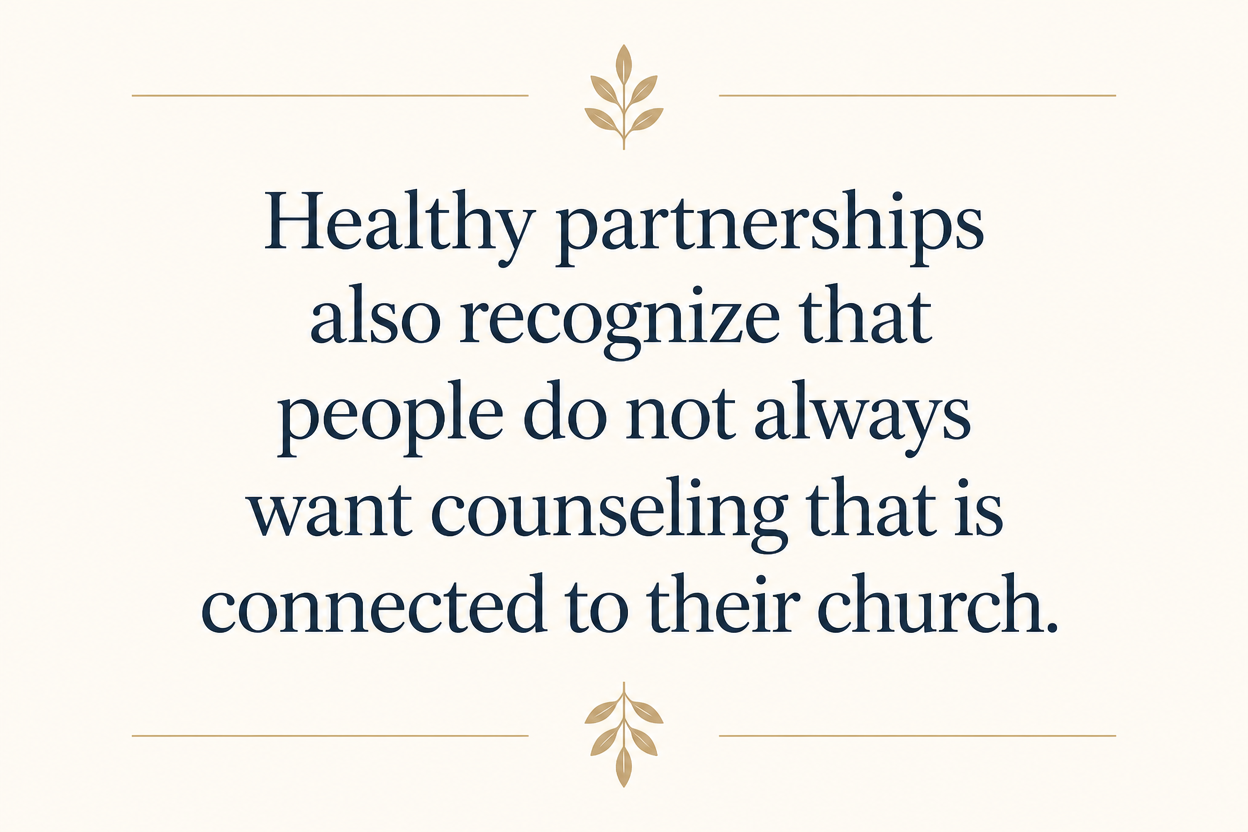
Healthy partnerships also recognize that people do not always want counseling that is connected to their church. Some prefer a provider outside their immediate community because of privacy concerns. A wise referral system respects that preference and keeps the church from unintentionally coercing care.
Clinical excellence and theological clarity without coercion
Christian counseling is contested terrain. Christians genuinely disagree about the integration of psychological frameworks with pastoral theology, and about how to weigh categories like sin, suffering, trauma, and diagnosis. A sound partnership does not pretend those disagreements do not exist. It names the counseling ministry’s approach clearly and avoids pressuring counselees to accept a single model as the only faithful Christian option.
At its best, Christian counseling is neither a replacement for discipleship nor a secular therapy brand with Bible verses attached. It is a disciplined effort to care for whole persons before God, drawing on clinical insight while treating Scripture as true and authoritative for faith and life. Donors should listen for a ministry’s willingness to honor both realities: clinical competence and theological conviction.
Church training that elevates lay care without overreach
Many counseling ministries serve churches by training pastors and lay leaders in triage, referral, and basic care skills. This is often a high-leverage use of donor dollars: it prevents common errors, improves early intervention, and reduces the burden on a small number of church staff. The goal is not to turn small group leaders into therapists. The goal is to help them recognize warning signs, respond with wisdom, and connect people to appropriate care.
When training is done well, it also addresses spiritualized shortcuts. Some problems are not solved by telling someone to pray more. Prayer is never irrelevant, but it is sometimes insufficient as an immediate response to clinical crisis. A partnership should equip churches to act decisively when safety is at stake.
What donors should ask before they fund a partnership
Donors do not need to become licensing experts, but donors should be willing to ask the kinds of questions a prudent elder board would ask. These questions protect counselees, churches, and the counseling ministry itself.
Licensure, supervision, and clinical scope
First, ask who provides counseling and under what credentials. Are counselors licensed in their state? If interns are used, what supervision model is in place, and who carries legal responsibility? What populations and presenting issues does the ministry treat, and what does it refer out? These are not suspicious questions. They are standard due diligence.
It is also reasonable to ask how the ministry handles high-risk scenarios, including suicidality, domestic violence, child abuse reporting, and psychiatric emergencies. A partnership that cannot explain its crisis protocols is asking the church to carry risk it does not understand.
Financial integrity and the ethics of subsidized care
Many partnerships involve donor-funded counseling scholarships or a “counseling fund” administered by the church or the counseling ministry. The ethical aim is clear: reduce financial barriers so people can receive care. The harder question is how funds are governed. Who qualifies, who approves, how is privacy protected, and how is misuse prevented?
Donors should also be cautious about simplistic assumptions regarding overhead. The counseling field requires supervision, compliance, secure record systems, and continuing education. Underfunding those functions can lead to staff burnout and compromised care. The broader nonprofit sector has recognized that the fixation on minimizing overhead can be harmful; Charity Navigator has addressed this directly in its writing on why overhead ratios are a poor standalone measure of impact (Charity Navigator).
Across our verification work at Most Trusted, we find that ministries that meet The Most Trusted Standard typically have clear financial policies around restricted gifts, scholarship eligibility, and reporting. Donors should expect to see documentation, not only assurances.
Governance and accountability in a sensitive ministry
Counseling ministries can be unusually vulnerable to reputational and operational risk because they work with private pain. That makes governance more important, not less. Ask about board oversight, conflict-of-interest policies, and mechanisms for complaints. If a church is referring congregants, it is effectively endorsing the counseling ministry’s practices. That endorsement should rest on more than personal relationships.
It is also wise to ask how the ministry evaluates quality and outcomes. Counseling outcomes are complex; not all change is easily measurable. Still, ministries can demonstrate seriousness through client satisfaction processes, clinical supervision records, retention and completion rates (handled responsibly), and clear program goals that are not inflated into guarantees.
How to support these partnerships without undermining the church
Donors sometimes worry that funding counseling partnerships will “medicalize” spiritual problems or sideline pastors. That concern deserves respect. The church is called to proclaim repentance and forgiveness of sins, to disciple believers, and to administer the means of grace. A counseling partnership should serve that mission, not replace it.
Fund access to care and the church’s capacity to accompany
One of the most constructive donor postures is to fund both access to counseling and the church’s ability to accompany people in non-clinical ways: caregiver support groups, benevolence that stabilizes families, training for lay leaders, and pastoral time for follow-up. Counseling can address symptoms and patterns; the church offers sustained belonging, worship, prayer, and friendship through seasons of suffering.
Scripture consistently binds care to community. The New Testament envisions a people who “admonish the idle, encourage the fainthearted, help the weak, be patient with them all” (1 Thessalonians 5:14). Counseling can be part of that ecosystem, but it cannot be the whole of it.
Insist on transparency that honors confidentiality
Some donors want proof of impact in the form of detailed stories. In counseling, that can become exploitative. Responsible ministries protect client confidentiality, even when it costs them fundraising material. Donors should view that restraint as a mark of integrity.
Transparency still matters. A counseling ministry can report aggregate data, budget allocation, scholarship totals, waitlist practices, staff credentials, and partnerships with churches. What it must not do is trade private pain for public credibility.
Choose partnerships that fit the church’s theology and the community’s needs
Not every church should partner with the same kind of counseling ministry. An urban church with many immigrants may need multilingual care and trauma-informed services. A rural church may need telehealth capacity and referral relationships with regional providers. A church with a large youth population should ask specifically about child and adolescent specialization.
Theologically, donors should encourage churches to articulate what they mean by “Christian counseling.” Some ministries are explicitly confessional; others are broadly evangelical; others serve a wider public while maintaining a Christian ethos among staff. None of those models is automatically disqualifying, but lack of clarity is a problem. Strong partnerships begin with clear commitments and a sober awareness of the stakes.
Giving that strengthens the church’s witness
Church partnerships with Christian counseling ministries can be a quiet but powerful form of witness: the church refusing both stigma and naïveté, offering compassionate care that is worthy of trust. Donors play a decisive role when they fund not only sessions, but the accountable structures that keep care safe.
For donors seeking to evaluate ministries in this space, our broader work on Christian Counseling Ministries reflects what we look for across The Most Trusted Standard: faithfulness to the gospel, credible governance, financial integrity, and transparent evidence that a ministry’s care is as responsible as it is compassionate.



