

Why Christian anti-trafficking ministries train youth leaders is ultimately a question of stewardship: where prevention is possible, Christians should not wait until harm is entrenched. Trafficking thrives in secrecy, coercion, and isolation, and adolescents are often navigating the very vulnerabilities traffickers exploit—online access, unstable relationships, and a hunger to belong.
For Christian donors, this emphasis on youth leaders can feel less tangible than rescue stories. Yet the ministries that commit to prevention are often pursuing the hardest form of faithfulness: forming communities where exploitation has fewer entry points, and where the church becomes a place of clear-eyed protection rather than naïve trust.
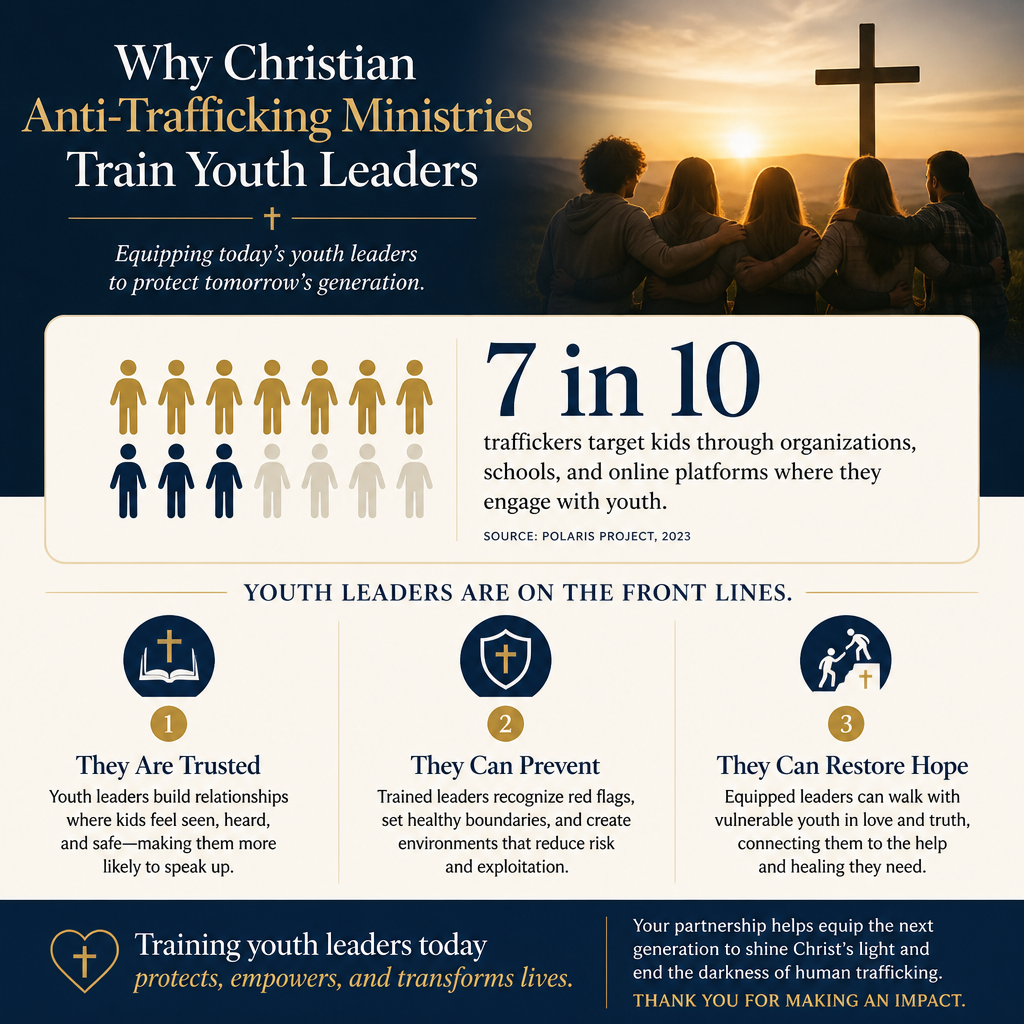
Youth leaders sit at a strategic point of trust and access
Most anti-trafficking interventions happen after a pattern has already formed. Youth leaders, by contrast, are often present at the earlier moments: a teen’s first secretive online relationship, a sudden shift in mood, a new “older friend,” a run of absences, or a home situation that makes a couch at someone else’s house feel safer than their own bed.
That proximity creates both opportunity and responsibility. When ministries train youth leaders, they are not merely transferring information; they are shaping pastoral judgment at the places where a young person’s life is still pliable, and where the church can respond before coercion becomes captivity.
Prevention fits the patterns traffickers actually use
Trafficking is frequently misimagined as an abduction narrative. In many cases it is grooming—gradual manipulation, often mediated by technology. The U.S. Department of Justice has documented that traffickers increasingly use online platforms to recruit and advertise victims, a reality that pushes prevention closer to the ordinary lives of young people and the adults who supervise them.U.S. Department of Justice
What this means in practice is that youth leaders—who are often the adults with consistent, non-parental access to teens—are positioned to notice what parents and schools may miss. Training helps them distinguish between typical adolescent secrecy and patterns that indicate grooming, isolation, or control.
The church is already a “youth-serving organization”
Congregations do not need to become something new in order to be relevant here. The church already operates youth groups, camps, mentorship, missions trips, and pastoral counseling. That reality carries risk if leaders are untrained, but it carries tremendous protective potential when leaders are formed and supervised well.
We have learned across the broader landscape of child safety failures—both inside and outside the church—that good intentions are not a safeguard. Competence, boundaries, and accountability are safeguards.

Training turns concern into competent action
Many donors have watched churches swing between two errors: denial that exploitation could touch “our kids,” and reactive alarm that treats every adolescent struggle as trafficking. Training exists to cultivate a third way: serious, calm, evidence-informed care that honors both the complexity of adolescent life and the reality of exploitation.
Christian anti-trafficking ministries often design training precisely because youth leaders are not investigators, and they should not be. They are responsible adults who need to know what to observe, how to document, how to respond without escalating harm, and when to involve parents, mandated reporters, or law enforcement.
What effective training typically includes
While program design varies, strong training tends to be concrete rather than sensational. It prepares leaders to act within their role and within the law.
- Recognizing grooming dynamics and coercive control
- Safe disclosure response that avoids blame, interrogation, or spiritualized pressure
- Clear reporting pathways, including mandated reporting obligations where applicable
- Digital safety and social media risk patterns
- Referral networks for trauma-informed counseling and victim services
The goal is not to create amateur specialists. It is to create adults who can keep a young person from being further isolated, and who can connect them to the right help quickly.
Training must also address the ministry’s own boundaries
Trafficking prevention is not only about “out there.” It requires disciplined internal practices. Youth leaders need policies about one-on-one meetings, transportation, communications, and overnight events. They need permission to say no. They need supervision and documentation that protect teens and protect the integrity of the church.
This is one place where donors should resist funding “passion” without infrastructure. Prevention that lacks guardrails can become a stage for savior narratives, mishandled disclosures, and deepened trauma.
Christian theology demands both protection and truth-telling
Scripture does not treat the exploitation of the vulnerable as a marginal concern. The prophets repeatedly condemn those who “sell the righteous for silver, and the needy for a pair of sandals” (Amos 2:6), naming the way power and profit feed on the weak. Jesus’ warnings about causing little ones to stumble are severe, not sentimental (Matthew 18:6). Training youth leaders is one way the church practices that seriousness with competence.
At the same time, Christian anti-trafficking work must resist the temptation to form its identity around fear. Fear produces vigilance without wisdom. The aim is love ordered by truth: communities that are alert without becoming suspicious, and compassionate without becoming permissive.
Protection requires formation, not only information
Adolescents are not protected merely by knowing the right facts. They are protected by belonging to a community where adult attention is healthy, consistent, and accountable, and where secrecy loses its power. Many trafficking situations begin where loneliness, shame, and unmet needs create a vacuum. Youth ministry is often the place where those needs surface first.
Training therefore includes spiritual and moral formation for leaders themselves: how to honor a teenager’s agency without romanticizing their choices, how to speak about sexuality without either crudeness or silence, and how to address pornography and digital exploitation as pastoral realities rather than private embarrassments.
The harder question is how churches speak without harming
Christians genuinely disagree about the best tone and content for prevention education. Some fear that explicit conversations sexualize children. Others fear that silence leaves teens defenseless. Wise ministries work with parents, set age-appropriate boundaries, and avoid sensationalized imagery or manipulation.
Donors should ask whether a ministry’s training is grounded in credible child development practice and trauma-informed care, and whether it respects parental responsibilities rather than bypassing them.
Prevention also protects the credibility of Christian witness
When the church mishandles abuse disclosures, covers wrongdoing, or fails to report, the harm extends beyond the immediate victim. It damages trust in Christian witness and creates a chilling effect: teens learn that spiritual language can be used to silence them. In that sense, training youth leaders is not merely a programmatic choice; it is a confession that the church must be worthy of trust.
Many donors already know this, because they have watched the long aftermath of institutional failure in multiple denominations and Christian organizations. Prevention training is one way ministries take responsibility for building cultures that make concealment difficult and care more likely.
Training should align with credible safeguarding standards
In well-governed ministries, youth leader training is paired with written child protection policies, background checks, incident documentation protocols, and board-level oversight. Donors should not assume these exist because a ministry has a strong mission statement. They must be verified.
For donors following Prevention and Education in Christian Anti-Trafficking Ministries, this is a key distinction: education that is detached from governance can unintentionally create risk. The stronger organizations treat prevention as a system, not an event.
Trauma care requires partnerships the church does not always have
Even well-trained youth leaders cannot replace professional services. Effective ministries build referral relationships with licensed counselors, victim advocates, and local agencies. This is not a lack of faith; it is an expression of wisdom. The body of Christ includes specialized callings, and the common good often requires collaboration.
Donors can rightly ask: does the ministry train youth leaders to stay in their lane, or does it encourage them to function as rescuers and therapists?
What donors should evaluate before funding youth leader training
Christian donors often want to know whether prevention is “working.” Measuring prevented harm is inherently difficult; the absence of exploitation does not produce clean metrics. That does not excuse vagueness, but it does call for sober expectations. The best ministries report what they can responsibly know: training reach, policy adoption, referral pathways, leader competency assessments, and documented changes in organizational practice.
Across our verification work at Most Trusted, we observe that ministries with durable prevention programs tend to pair training content with operational discipline. They do not ask donors to choose between “heart” and “systems.” They insist on both.
Questions that align with The Most Trusted Standard
We recommend donors evaluate prevention-focused anti-trafficking ministries with the same seriousness they would apply to any complex pastoral and social intervention. Under The Most Trusted Standard, several questions become especially relevant:
- Is the ministry’s approach rooted in a clear Christian theological vision rather than political or sensational narratives?
- Are finances and program costs transparent enough to understand what training actually includes?
- Is there governance oversight of safeguarding policies and incident response?
- Does training reflect credible best practices, including mandated reporting guidance and trauma-informed care?
- Are outcomes described with precision, avoiding exaggerated claims about “ending trafficking”?
These questions protect donors from funding work that is emotionally compelling but structurally fragile.
Rescue stories can obscure prevention failures
The field has had to reckon with a troubling pattern: some anti-trafficking messaging relies on inflated or misleading claims because dramatic narratives raise money. Donors should not punish ministries for refusing that approach. They should reward clarity, modesty about what can be measured, and honesty about limits.
In that spirit, a ministry that trains youth leaders well may sound less cinematic than a raid narrative, but it can be more faithful to the church’s calling to protect the vulnerable before the wound becomes a life story.
FAQs for Why Christian anti-trafficking ministries train youth leaders
Does youth leader training replace parent responsibility?
No. Healthy training reinforces parental authority and encourages transparent communication with families, while also recognizing that some teens will disclose first to a trusted non-parent adult. The goal is not to bypass parents but to ensure that if a disclosure occurs, the first response is calm, lawful, and protective rather than panicked or dismissive.
How can donors tell whether a training program is credible rather than fear-based?
Credible programs avoid sensational statistics, provide clear guidance on reporting and referrals, and are integrated with written safeguarding policies and oversight. They speak about grooming and coercion with precision, acknowledge uncertainty where it exists, and show how leaders are supervised after training rather than treated as “certified” once they attend a session.
Why this emphasis is worthy of Christian generosity
Training youth leaders is one of the clearest ways Christian anti-trafficking ministries strengthen the church’s protective capacity where it already stands closest to teenagers. It is preventative, it is measurable in concrete practices even when outcomes are hard to quantify, and it is consistent with Scripture’s demand that God’s people defend the vulnerable with truth and integrity.
For donors seeking confidence, this is also a domain where verification matters. The ministries most worthy of support will not only teach youth leaders what to do; they will show, in governance, finances, and transparent reporting, that they are building organizations worthy of trust. For broader context on the field, see Christian Anti-Trafficking Ministries.



