
What warning signs Christian anti-trafficking ministries teach is not a peripheral question for donors; it is part of the moral seriousness required when the vulnerable are at stake. Scripture’s concern for those harmed by the strong is not abstract. The prophets condemn those who “sell the righteous for silver, and the needy for a pair of sandals” (Amos 2:6). Jesus identifies himself with the oppressed and wronged (Matthew 25:40). When a ministry claims to confront trafficking, its public teaching becomes one of its primary tools—and one of its primary points of risk.
The field has had to reckon with a hard reality: awareness campaigns can either clarify the nature of exploitation or amplify fear, misinformation, and unhelpful “rescuer” narratives. Christian donors often want to fund urgent action, but urgency is precisely what traffickers manipulate and what bad actors exploit. Discernment is not cynicism; it is love ordered by truth.
Warning signs are meant to reduce harm, not heighten fear
Trafficking is real, but it is frequently misunderstood. A credible ministry teaches warning signs that help ordinary people make safer choices, strengthen community protection, and refer concerns appropriately. A questionable ministry often teaches warning signs that leave people anxious, suspicious of strangers, and convinced that trafficking is primarily a matter of dramatic abduction attempts in public spaces.
Sound teaching distinguishes trafficking from adjacent harms
Ministries serving vulnerable people often encounter overlapping realities: domestic violence, sexual abuse, child sexual exploitation, homelessness, addiction, and labor abuses. Trafficking can include some of these, but not all exploitation is legally or practically “trafficking.” The best training names these distinctions without minimizing harm, because appropriate responses depend on accurate categories.
In U.S. federal law, sex trafficking of a minor does not require proof of force, fraud, or coercion, while adult sex trafficking does; labor trafficking requires force, fraud, or coercion. Ministries that present a single, simplified template for every case often end up offering the wrong kind of help, at the wrong moment, to the wrong person. Donors should listen for that precision in how warning signs are explained and how referrals are framed. The legal definitions themselves are accessible through the U.S. Department of State.
Healthy programs teach actions, not just alerts
Warning signs without clear, safe next steps can create “vigilance” that turns into profiling, false reporting, or public confrontations that place victims at greater risk. Responsible trainings explain what to do when someone suspects trafficking: document concerns carefully, avoid direct confrontation, and connect with local experts. In the United States, credible ministries regularly include the National Human Trafficking Hotline as a referral option, making clear what it is and what it is not. The hotline’s purpose and limitations are described by Polaris.
What this means in practice is that donors should evaluate not only whether a ministry teaches warning signs, but whether it teaches a path to action that is trauma-informed, lawful, and coordinated with community services.

The most reliable warning signs are relational and contextual
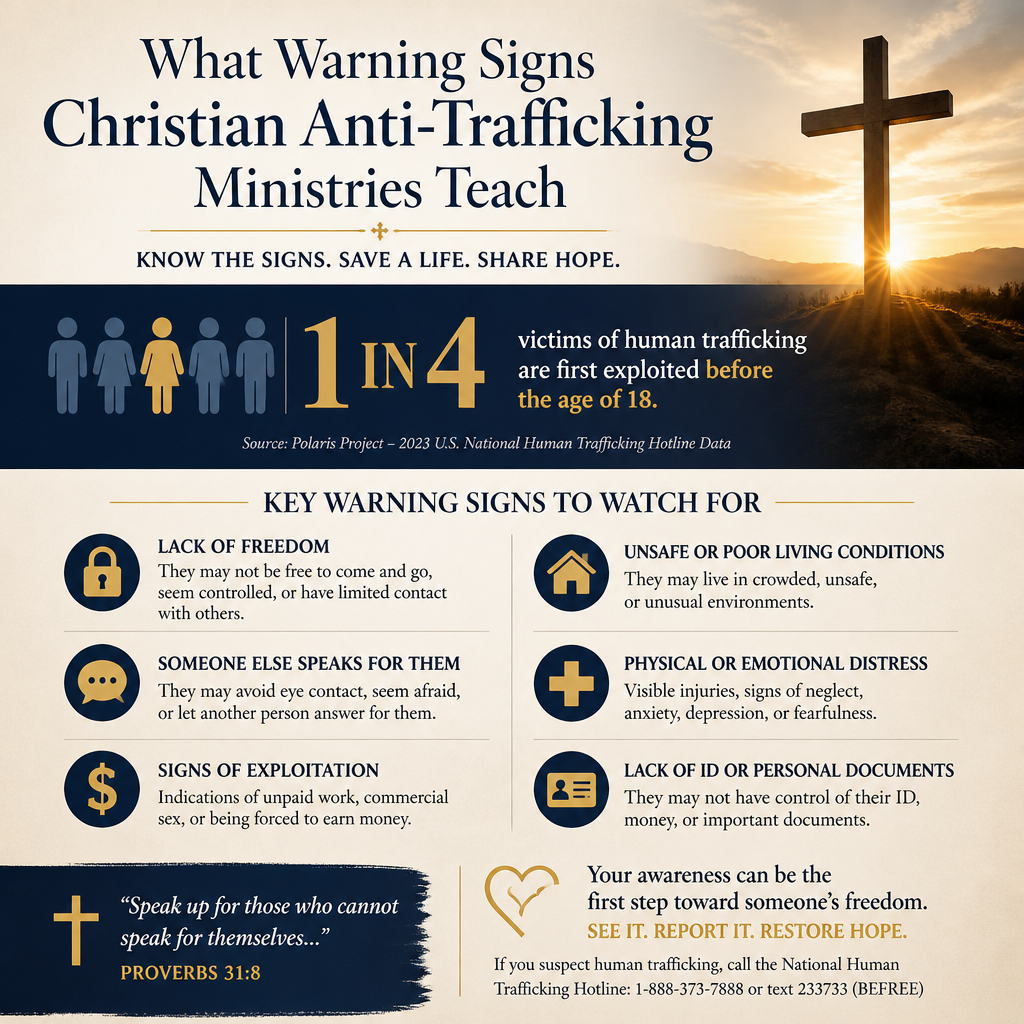
Trafficking is typically sustained through control, isolation, and dependency. Accordingly, the warning signs most worth teaching are less cinematic and more relational: patterns of coercion, restricted communication, inconsistent personal narratives, sudden changes in behavior, and someone else speaking for the person in ways that indicate control.
Overconfidence in visual checklists is a predictable failure mode
Some trainings imply that trafficking can be detected through surface cues alone—tattoos, a particular style of dress, a certain kind of luggage, “looking scared,” or traveling with an older companion. These cues may sometimes appear, but they are not reliable on their own, and they can easily devolve into racial profiling or misidentifying consensual relationships as trafficking. Christian ministries should be especially cautious here, because a culture of suspicion can damage community trust and harm the very people we are trying to protect.
The most credible ministries teach warning signs with local referral pathways
Good training is concrete about who is available locally: victim advocates, domestic violence shelters, child welfare professionals, law enforcement units trained in trafficking, and medical providers with forensic expertise. When a ministry’s warning-sign teaching operates as if the organization itself is the default solution, donors should pause. Anti-trafficking work is rarely effective in isolation.
Across our verification work at Most Trusted, we observe that ministries with mature prevention programs typically demonstrate durable partnerships and clear referral protocols. They can name the boundaries of their competence, and they avoid implying that a concerned church member should “rescue” anyone.
When ministries teach warning signs, donors should also watch for ministry-level warning signs
Donors often ask what to look for in a training. A parallel question is what to look for in the organization offering it. Some of the most consequential warning signs are not in the content of a slide deck, but in the ministry’s posture toward evidence, accountability, and the people it claims to serve.
Inflated claims and unverifiable impact
Trafficking work is difficult to measure. That is not an excuse for vague or dramatic claims. When a ministry regularly cites “rescues” without definitions, corroboration, or safeguarding detail, donors should ask what those numbers mean and how they are verified. In many contexts, publicizing operational details can endanger victims and compromise investigations; credible ministries explain that tension and still provide meaningful accountability through audited financials, independent boards, third-party evaluations where feasible, and clear program descriptions.
Teaching that centers the rescuer more than the survivor
Christian compassion can be subtly redirected into self-referential storytelling: the heroic team, the dangerous mission, the dramatic raid. A ministry that consistently centers its own risk and bravery often underinvests in long-term survivor care: safe housing, trauma therapy, legal advocacy, job readiness, and family reunification when appropriate. The biblical pattern is different. Love “does not insist on its own way” (1 Corinthians 13:5). In anti-trafficking work, that includes resisting narratives that treat survivors as props in a donor’s moral drama.
- Public fundraising built on graphic details or sensational “near-abduction” stories
- Impact language focused on raids and rescues with little mention of long-term care
- Training that encourages direct confrontation rather than safe reporting
- Minimal disclosure about governance, finances, and safeguarding policies
- Dismissal of critique as “lack of faith” instead of engaging evidence and peer standards
Christian donors have legitimate reasons to prefer ministries that explicitly name Christ. Yet theological clarity does not substitute for operational integrity. The ministries that meet The Most Trusted Standard tend to take both seriously: doctrine and duty, confession and competence.
Better warning-sign teaching is grounded in trauma-informed care and child protection
Many churches first engage trafficking through youth protection training or missions partnerships. That is appropriate, because trafficking risk often overlaps with other vulnerabilities: running away, family conflict, prior abuse, and unstable housing. But this also means trafficking education must be woven into broader safeguarding frameworks rather than treated as a standalone fascination.
Trauma-informed language is not ideological fashion
Trauma-informed practice recognizes that survivors may appear inconsistent, resistant, or attached to exploiters, and that disclosure is often gradual. A ministry that teaches warning signs should not shame survivors for “choices,” nor present simple compliance as the primary indicator of health. Wise training frames exploitation in terms of coercion, survival strategies, and complex trauma, and it cautions volunteers against interrogating people or demanding disclosures.
Church-based training should respect mandatory reporting and professional boundaries
In many jurisdictions, pastors, teachers, and certain volunteers are mandatory reporters for suspected abuse of minors. Training should help church leaders understand those obligations and coordinate with local child advocacy resources. It should also discourage amateur investigation. The more a ministry suggests that untrained congregants should gather evidence, conduct surveillance, or “extract” a person from an exploiter, the more likely it is to cause harm.
For donors seeking to understand the wider landscape of Christian work in this area, the broader context matters: prevention intersects with discipleship, family stability, ethical employment, immigration realities, and child protection. That fuller perspective is central to responsible giving in Christian Anti-Trafficking Ministries.
How donors can evaluate prevention teaching with confidence
Donors cannot sit in every training or audit every partnership. But donors can adopt a posture of structured discernment: asking the same kinds of questions in trafficking work that we already consider normal in financial stewardship and governance.
Ask for evidence of safeguarding and accountability
Training content is only one signal. Donors should ask for child protection policies, staff screening practices, incident reporting protocols, and partnerships with qualified providers. A ministry that teaches warning signs should also model them organizationally: transparency about who has access to vulnerable people, how boundaries are enforced, and how allegations are handled.
Use independent verification rather than charisma
Because trafficking evokes strong emotions, donors can become vulnerable to compelling storytelling. Independent verification exists precisely to counterbalance that dynamic. At Most Trusted, we evaluate Christian nonprofits against The Most Trusted Standard, a 15-criteria framework covering faith commitments, financial integrity, governance and leadership, and transparency and effectiveness. In anti-trafficking work, that evaluation helps donors distinguish ministries that are earnest but immature from those that are both compassionate and competent.
Prevention and education are often less dramatic than rescue narratives, but they are frequently where long-term protection is built. Donors who want to support that work can sharpen their giving by focusing on program clarity, measured claims, and community partnership within Prevention and Education in Christian Anti-Trafficking Ministries.
FAQs for What warning signs Christian anti-trafficking ministries teach
Should Christian anti-trafficking ministries teach the public to watch for attempted abductions?
Public safety matters, and attempted abductions do occur. Yet most trafficking situations are not initiated by stranger abduction; they more often involve grooming, coercion, and exploitation within existing relationships or through economic vulnerability. Credible ministries teach warning signs that reflect that reality and emphasize safe reporting and referral rather than vigilant confrontation. Donors should be cautious of trainings that primarily trade in fear-based scenarios.
What should a donor ask for before funding a ministry that offers trafficking awareness training?
Donors should ask to see the curriculum outline, the qualifications of trainers, the referral protocols used when concerns arise, and the safeguarding policies for anyone interacting with minors or survivors. It is also reasonable to request audited financials and clear descriptions of how education outcomes are assessed. Ministries doing this work responsibly welcome these questions because they share the conviction that truth and accountability serve the vulnerable.
Discernment is a form of protection
Christian anti-trafficking work is most faithful when it is both courageous and careful—resisting exploitation without creating new harm. Warning signs should lead communities toward wise action: strengthening families, reducing isolation, improving reporting pathways, and supporting long-term restoration. Donors can honor the dignity of survivors by funding ministries whose teaching is sober, evidence-aware, and accountable, because love of neighbor requires more than urgency; it requires truthfulness and competence.



