

How Christian anti-trafficking ministries fund trauma counseling is not a minor operational question; it is one of the clearest tests of whether rescue language is matched by long-term, credible care. Trauma counseling is expensive, clinically complex, and difficult to support with the kind of dramatic fundraising narratives that often dominate anti-trafficking appeals.
For Christian donors, the question is also spiritual. Scripture’s commands are not limited to extracting someone from danger; they extend to binding wounds, restoring dignity, and pursuing justice with integrity. The Good Samaritan did not only intervene at the roadside; he paid for ongoing care and pledged more if needed. That is the moral architecture of sustainable survivor care.
Trauma counseling is not an accessory to rescue
Trauma is predictable, but healing is not linear
Most anti-trafficking ministries now acknowledge what clinicians have long insisted: trauma symptoms are not a sign of spiritual failure or ingratitude but a normal response to prolonged coercion and violence. Yet the funding models behind ministries often still assume a neat arc: rescue, quick stabilization, then independence. The harder truth is that survivors may cycle through progress and setback for years, and counseling needs shift across time: crisis stabilization, trauma processing, relapse prevention, family systems work, and sometimes long-term psychiatric care.
Christian donors can unintentionally reinforce the wrong incentives when funding is tied to short timelines and easily reported outputs. The field has had to reckon with this tension: donors want measurable outcomes, while trauma recovery resists simplistic measurement. Verifiable evidence suggests that responsible ministries invest in clinical supervision, clear referral pathways, and survivor-centered pacing rather than forcing a timetable that satisfies a grant report but harms a person.
Spiritual care and clinical care are distinct, not competing
Christians genuinely disagree about where “ministry” ends and “therapy” begins, especially when the counseling is delivered by licensed professionals using evidence-based modalities. The best ministries do not treat that as a threat. They recognize that prayer, discipleship, and the healing work of the church can coexist with clinically competent trauma treatment, and that conflating the two can pressure survivors toward premature “forgiveness performances” rather than honest healing.
Most Trusted’s work in verification repeatedly surfaces a basic marker of maturity: ministries that respect survivors tend to distinguish pastoral care from clinical therapy, define boundaries, and document referral standards. This is not secular drift; it is an application of Christian truthfulness and neighbor-love to a complicated reality.

The main funding streams ministries combine to pay for counseling
Philanthropy remains primary, but it must be structured
In the United States, individual and household giving comprises the largest share of charitable giving, which means many ministries lean heavily on donor support rather than government reimbursement or earned revenue. The most cited national estimate is that individuals account for the majority of charitable giving in a given year, as reported by Giving USA and the Lilly Family School of Philanthropy at Indiana University: Giving USA.
What this means in practice is that trauma counseling is often funded through a mix of general donations and restricted gifts. General support pays for the unglamorous core: therapist salaries, clinical supervision, case management coordination, facilities, and the administrative capacity that keeps survivors from falling through cracks. Restricted support can help launch a counseling program, underwrite a clinical director role, or seed a counseling fund that covers uninsured sessions.
Grants, contracts, and Medicaid vary widely by state and program design
Some ministries pursue government or foundation grants tied to victim services, behavioral health, or housing stability. This can be an appropriate path, but it introduces compliance requirements, reporting burden, and limits on explicitly religious activities in the funded scope. In many cases, the ministry’s faith identity remains intact because it is the organization, not the funding stream, that embodies the faith foundation—while services funded by public dollars are delivered without coercion and with clear client choice.
In certain models, counseling is partially reimbursed through Medicaid or other insurance mechanisms when services are delivered by credentialed clinicians in eligible settings. That can expand access, but it often pressures organizations toward billing complexity and rigid documentation practices. Ministries must decide whether their infrastructure can support it without compromising trauma-informed care.
What responsible budgets for counseling usually include
Therapist compensation is only the visible line item
Donors sometimes assume “counseling” is a per-session cost. In reality, a responsible counseling program includes the system around the session: intake, risk assessment, safety planning, clinical consultation, coordination with advocates and housing staff, and continuity when a survivor misses appointments or relocates.
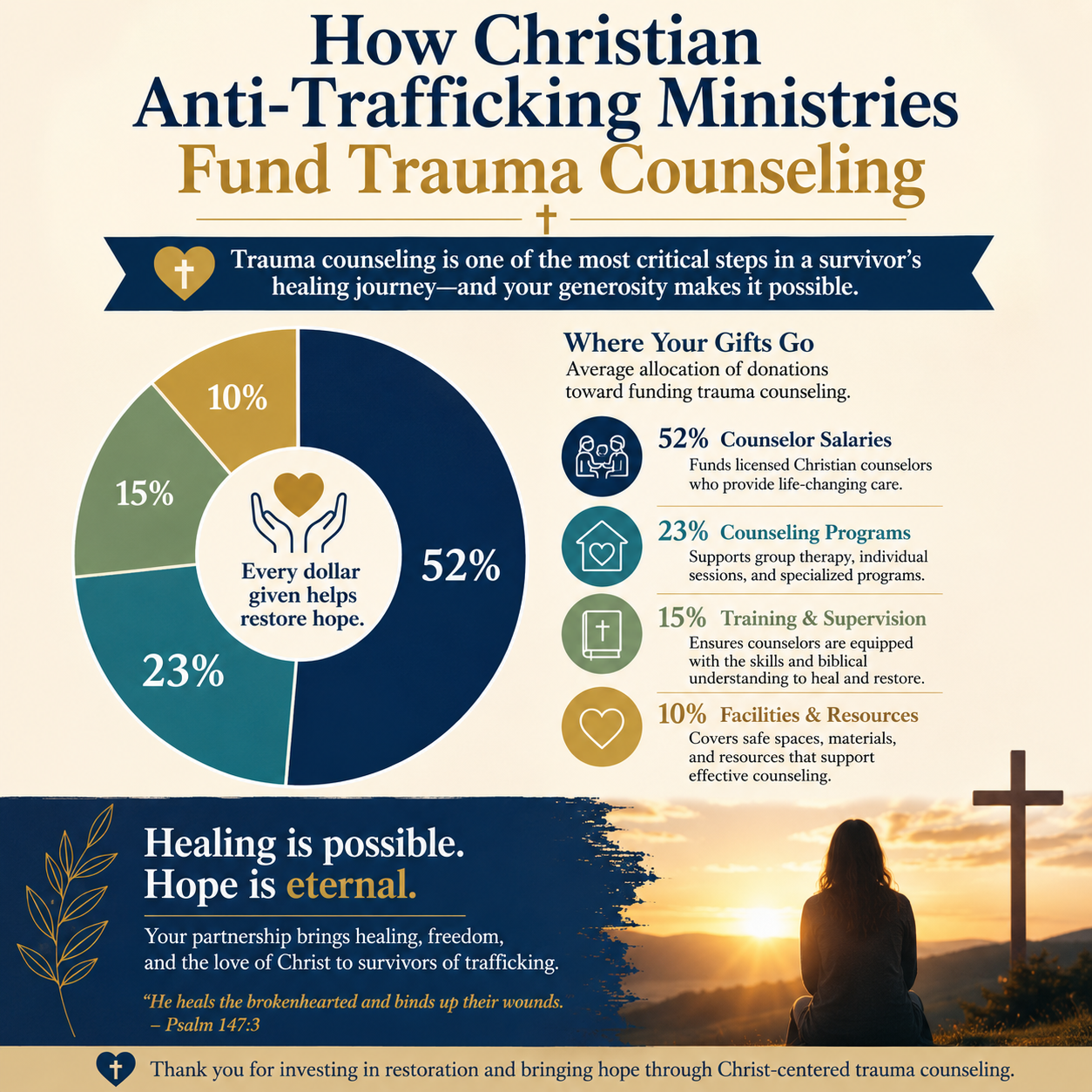
Across our verification work, we observe that ministries meeting The Most Trusted Standard tend to document these cost drivers plainly rather than hiding them under vague categories. That clarity is not administrative pride; it is a form of honesty about what it takes to care for people made in God’s image.
Clinical quality requires supervision, training, and ethical safeguards
Trauma counseling that is effective and safe requires ongoing clinical supervision and continuing education, especially when serving survivors with complex trauma, dissociation, substance use disorders, or co-occurring mental health diagnoses. Programs also need clear policies for mandated reporting, confidentiality, informed consent, and boundaries between staff and participants.
A single budget line for “counseling” can conceal either excellence or risk. Mature ministries typically separate out clinical supervision, training, and evaluation so boards and donors can see whether quality is funded or assumed.
- Licensed clinician time, including documentation and care coordination
- Clinical supervision and case consultation
- Trauma-informed training for all direct-service staff
- Translation services and culturally competent care supports
- Emergency coverage and referral partnerships for higher levels of care
Donor expectations can help or quietly harm survivor care
Outputs are necessary, but they are not the same as outcomes
Many donors want clear metrics: number of sessions, graduation rates, employment placements. Responsible ministries do track outputs, but the field has learned that trauma recovery is not well captured by a single success indicator. Some survivors need fewer sessions because they are stable and supported; others need more because their situation is more complex. Treating higher session counts as failure misunderstands trauma care.
What donors can ask instead is whether the ministry has coherent clinical goals, an assessment process, and a plan for measuring progress without coercion. Credible organizations often use validated screening tools and structured treatment planning, while avoiding reductionism that turns a person into a dashboard.
The overhead myth still distorts counseling funding
Many Christian donors have been formed by a suspicion of “overhead,” and some fundraising reinforces the idea that low administrative costs automatically signal faithfulness. But the modern nonprofit sector has publicly challenged this assumption for more than a decade. Charity Navigator, Candid’s GuideStar, and the BBB Wise Giving Alliance jointly argued that overhead ratios are a poor measure of nonprofit performance and can push organizations into underinvesting in capacity: Charity Navigator.
Trauma counseling is a domain where underinvestment has moral consequences. If administrative capacity is too thin, clinical documentation fails, safeguards erode, staff burn out, and survivors experience discontinuity. Christian generosity should not be trained to applaud fragility.
How to evaluate whether counseling is funded with integrity
Transparency should include the counseling model, not only the budget
Donors often receive financial statements but little clarity on what kind of counseling is provided and under what safeguards. A ministry may mean well and still deliver inconsistent care if it lacks a coherent clinical model. We recommend asking whether counseling is provided by licensed professionals, how supervision is handled, and whether the ministry has written referral protocols for specialized needs such as psychiatric evaluation, inpatient treatment, or complex PTSD presentations.
Within Christian Anti-Trafficking Ministries, the strongest organizations typically present counseling as part of an integrated continuum of care, not as an isolated program detached from housing, legal advocacy, and long-term support.
Governance and leadership must be capable of overseeing clinical risk
Clinical programs carry clinical risk. Boards that oversee survivor services should understand enough to ask informed questions: Who holds clinical authority? What are the boundaries between spiritual programming and therapy? How are critical incidents handled? Is there insurance coverage appropriate to clinical practice? Responsible leadership protects survivors and staff by treating these as governance questions, not internal details best left unexamined.
Most Trusted exists because donors should not have to guess. Our evaluations against The Most Trusted Standard examine the kinds of documentation, governance practices, and transparency that make survivor care more credible, including how ministries present program outcomes without manipulating survivor stories.
Donors focused specifically on care models will often find helpful distinctions and expectations reflected in Survivor Care in Christian Anti-Trafficking Ministries, where the practical demands of long-term restoration are harder to romanticize and easier to evaluate.
FAQs for How Christian anti-trafficking ministries fund trauma counseling
Is it appropriate for Christian donors to fund licensed clinical therapy instead of only spiritual care?
Yes, when the ministry maintains theological clarity and ethical boundaries. Scripture calls Christians to truthfulness, mercy, and justice in tangible forms, and trauma therapy is often a necessary means of care for survivors whose bodies and minds have been shaped by sustained violence. Mature ministries distinguish pastoral care from clinical treatment, ensure client choice, and avoid spiritual pressure within therapy.
What should donors look for to know counseling funds are used well?
Donors can look for licensed clinicians or formal partnerships with reputable providers, documented clinical supervision, clear safeguarding and confidentiality policies, and transparent reporting that does not sensationalize survivor stories. Financial clarity also matters: budgets should show that counseling is supported by the staff, training, and administration required for quality, not treated as a thin line item with hidden assumptions.
A durable form of Christian generosity
Trauma counseling is one of the least glamorous and most necessary expenditures in anti-trafficking work. It rarely produces instant stories, but it often determines whether a survivor experiences stability, agency, and long-term freedom. Christian donors who fund counseling with patience and discernment participate in a form of mercy that resembles the Samaritan’s care: costly, concrete, and committed to the neighbor’s restoration rather than the donor’s emotional reward.



