
Prevention and education in Christian anti-trafficking ministries often receive less donor attention than rescue narratives, yet they may be the most strategic form of long-term protection. The question for Christian donors is not whether prevention matters, but which prevention efforts are faithful, competent, and measurably connected to reduced vulnerability rather than heightened fear.
Trafficking is not a single crime with a single solution. It is a set of abuses that thrives where vulnerability is high, oversight is weak, and buyers face little social cost. Christian ministries that take prevention seriously work upstream: strengthening families, increasing trustworthy information, and equipping institutions that routinely encounter risk—churches, schools, and youth-serving organizations. Done well, prevention is not alarmism; it is discipleship applied to power, sexuality, money, and human dignity.
Prevention is formation, not just awareness
Many donors have seen awareness campaigns that are emotionally compelling and operationally thin. The field has had to reckon with the difference between publicity and prevention. Some awareness materials exaggerate stranger-abduction scenarios, flatten trafficking into a single storyline, or train people to see trafficking everywhere. That approach may increase tips, but it can also increase false reports, misdirect attention from the most common patterns of exploitation, and erode trust with communities the church is called to serve.
Christian prevention is better understood as formation: shaping communities to tell the truth about exploitation and to practice costly love for neighbors at risk. Scripture treats truth-telling as moral action, not mere accuracy. “Speak the truth with one another; render in your gates judgments that are true and make for peace” (Zechariah 8:16). Ministries that honor this principle resist sensationalism, even when it would raise more money.
What credible prevention attempts to change
Effective prevention programs aim at specific, observable risk factors: homelessness and runaway episodes; family instability; online sexual grooming; economic coercion; prior abuse; addiction; social isolation; and unaccountable authority structures. For donors, the evaluative question becomes concrete: which risk factors does this ministry target, and how does its work plausibly reduce them?
Within the United States, prevention work often intersects with the reality that many exploited minors are first identified through child welfare or runaway and homeless youth services. For context on the scale of youth homelessness that increases vulnerability, the U.S. Department of Housing and Urban Development’s annual Point-in-Time reporting provides a baseline picture of homelessness across the country, including unaccompanied youth counts, even with known limitations of street-based measurement HUD.
Why the church’s role is distinctive
The church is not a replacement for law enforcement, social services, or trauma-specialized clinicians. Its distinctive capacity is moral and communal: forming conscience, providing belonging, and building networks of care that make exploitation harder. Traffickers isolate; the church gathers. Traffickers commodify; the church insists that every person bears the image of God (Genesis 1:27). Prevention is not merely a program; it is a community ethic expressed in wise policies and practiced mercy.

Education must be accurate, trauma-informed, and institutionally accountable
Education in anti-trafficking ministry lives or dies on credibility. Donors should not assume that “training” is inherently good; education can harm when it is inaccurate, stigmatizing, or negligent about trauma. The goal is not to turn every congregant into an investigator. The goal is to help the church fulfill its responsibilities with competence: to protect children, to respond well when someone discloses abuse, and to partner appropriately with professionals.
What Christian anti-trafficking education should teach churches
Strong training for churches tends to include four elements. First, a clear account of trafficking definitions and local patterns, including the difference between sex trafficking, labor trafficking, and other forms of exploitation. Second, realistic grooming dynamics: coercion, debt, threats, emotional dependence, and the role of technology. Third, a trauma-informed response: how to listen without interrogation, preserve dignity, and avoid “rescuing” that replaces one controlling relationship with another. Fourth, mandated reporting and safeguarding policies that protect victims and protect the church from the moral catastrophe of mishandled disclosure.
In the United States, the National Human Trafficking Hotline provides an accessible window into how complex cases are and how frequently trafficking intersects with other forms of violence and exploitation Polaris. Donors do not need to treat hotline data as comprehensive prevalence measurement, but it can help ministries and churches resist simplistic narratives.
Warning signs training should be anchored to next steps
Many well-meaning materials list “warning signs” with no disciplined pathway for response. This can produce two distortions: congregations either over-report benign situations or under-report because they fear being wrong. Credible ministries train churches to treat warning signs as indicators for pastoral care and appropriate referral, not as grounds for confrontation.
Responsible next steps are specific: what to do if the at-risk person is a minor; when to contact child protective services; when to contact law enforcement; how to document concerns; and how to refer to local service providers without exposing the person to retaliation. The most careful ministries also teach what not to do—no amateur sting operations, no public social media “exposés,” no untrained counseling, and no pressuring someone into a story that fits a donor-friendly frame.
Why training youth leaders is a high-leverage priority
Youth leaders sit at a pastoral intersection where vulnerability can become visible. They also oversee environments where boundary violations can occur if authority is not accountable. A ministry that trains youth leaders well will emphasize: two-adult rules, clear communication policies, transportation boundaries, background checks, and supervision that is real rather than symbolic.
This is where prevention and ecclesiology meet. The church is a body with responsibilities, not merely a crowd. When we teach youth leaders to treat safeguarding as discipleship, we cultivate communities where predators face friction and where teens have trusted adults who will act wisely when something is wrong.
Prevention programs should address both vulnerability and demand
Christian donors often face a tension: should prevention focus on “at-risk victims” or on the choices of buyers and exploiters? The field genuinely disagrees about emphasis. Yet prevention that ignores demand is incomplete. Exploitation persists because someone profits—financially, sexually, or socially. At the same time, demand-focused strategies can become performative if they rely on shame without accountability, or if they fail to address the spiritual and relational patterns that underwrite abuse.
Upstream care for families is anti-trafficking work
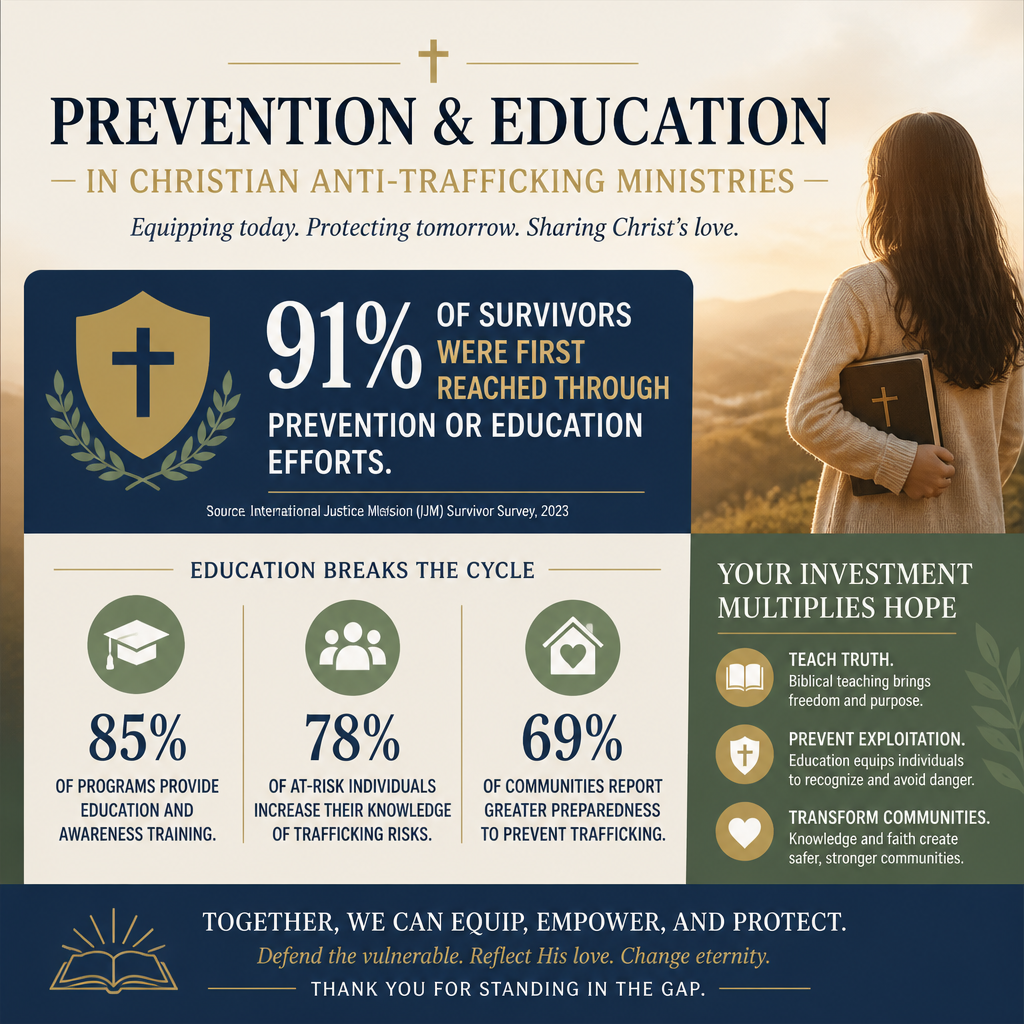
Some of the most faithful prevention efforts look unglamorous: stabilizing housing, providing job readiness, offering childcare, mentoring, and strengthening family systems. In practice, these programs reduce vulnerability to coercion by increasing legitimate options. They also align with the biblical pattern of neighbor love that is concrete: “Let us not love in word or talk but in deed and in truth” (1 John 3:18).
Donors sometimes ask whether this is “really” anti-trafficking, or simply poverty alleviation. The answer is that trafficking is often the exploitation of poverty, addiction, homelessness, and social isolation. Preventing trafficking commonly requires addressing those conditions without confusing material assistance with spiritual redemption. The When Helping Hurts framework, articulated by Steve Corbett and Brian Fikkert, has helped Christian ministries recognize how aid can unintentionally foster dependency or erode local agency if it is not designed with humility and reciprocity.
Demand reduction requires moral clarity and practical pathways
Demand reduction in Christian settings often includes education on pornography, commercial sexual exploitation, and the spiritual formation of desire. The connection between pornography and trafficking is frequently overstated in simplistic ways, and donors should be cautious about claims that one directly causes the other in every case. Still, the moral logic is not difficult: commodified sexuality shapes expectations and can habituate a consumer posture toward other people.
Serious demand reduction efforts pair moral teaching with accountable discipleship: pastoral care for repentance, referral to qualified counseling when addiction or compulsive behavior is present, and church discipline practices that are neither lax nor cruel. They also acknowledge that labor trafficking demand can arise from businesses that exploit migrant workers through recruitment debt or threats. Here prevention may involve ethical employment practices, supply-chain diligence, and partnerships with specialized legal service organizations.
Awareness events should be measured by outcomes, not attendance
Churches often host anti-trafficking awareness events. Done well, these can be a meaningful catalyst for training volunteers, funding local services, and building referral networks. Done poorly, they can become spectacle: heavy on emotional imagery, light on actionable steps and safeguarding.
Donors should ask what an event produces beyond a moment: Are volunteers trained for a specific role? Are church policies updated? Are partnerships established with vetted local providers? Are survivors protected from being placed onstage as living illustrations? Ministries with mature ethics will refuse to use survivors as fundraising instruments, even when invitations and platforms would be easy to accept.
How donors can evaluate prevention and education ministries with confidence
For donors committed to serious stewardship, prevention and education ministries present a particular challenge: their success is partly invisible. We notice tragedies; we rarely notice the harm that did not happen because a young person had a safe adult, a family had rent support, or a church had a clear reporting pathway. That is why donor diligence must focus on the integrity of methods and the accountability of institutions.
Most Trusted exists to help donors give with confidence by evaluating Christian nonprofits against The Most Trusted Standard, a 15-criteria framework spanning Faith Foundation, Financial Integrity, Governance and Leadership, and Transparency and Effectiveness. In prevention and education work especially, donors should resist being persuaded by compelling stories alone and look for verifiable evidence that a ministry’s approach is both faithful and responsible.
Questions that distinguish mature prevention work
- Are claims sober and specific? Credible ministries name what they can and cannot measure, and they avoid inflated prevalence statements they cannot support.
- Is training aligned with professional standards? Trauma-informed practice, mandated reporting requirements, and safeguarding policies should be clear and current.
- Do they partner well? Prevention ministries should know when to refer to specialized services rather than acting as a one-stop solution.
- Are survivors treated with dignity? Survivors should not be used to generate donations, and their privacy and agency should be protected.
- Is the church equipped for long obedience? Sustainable prevention is built through policy, supervision, and ongoing formation, not one-time events.
What transparency should look like in education programs
Education ministries can drift into brand protection: refusing critique, hiding curricula, or measuring “impact” only by counting attendees. Donors should look for curriculum summaries, learning objectives, trainer qualifications, and clear boundaries around what trainers do not provide (for example, clinical counseling). Financial transparency matters as well; prevention work can be staff-intensive, and donors should see a coherent budget narrative rather than vague appeals.
When we assess ministries, we also watch for governance practices that reduce the likelihood of misconduct: independent board oversight, documented safeguarding policies, grievance mechanisms, and appropriate separation of duties. Prevention ministries cannot credibly teach churches about accountability while operating without it.
For donors wanting broader context on how prevention and education fit within the wider landscape, we encourage engagement with Christian Anti-Trafficking Ministries through a lens of both compassion and verification.
Prevention that honors the image of God is worth funding
Christian donors are not choosing between mercy and wisdom; Scripture calls for both. Prevention and education in Christian anti-trafficking ministries are strongest when they refuse spectacle, tell the truth about risk, and build institutions capable of protecting the vulnerable over time. The ministries most worthy of support treat safeguarding as discipleship, partnerships as humility, and evidence as a form of love for neighbor.
The goal is not to purchase reassurance through dramatic stories. The goal is to fund work that makes exploitation harder, strengthens communities where the vulnerable can flourish, and reflects the character of God who “executes justice for the oppressed” (Psalm 146:7) without ever compromising truth to do it.



