
Monthly donor support is not a sentimental add-on for Christian adoption ministries. It is one of the most practical ways to sustain lawful, ethical, child-centered work that honors the biblical mandate to care for the fatherless without creating new harms in the process. Christian donors often feel the tension here: adoption is deeply personal, yet adoption ministry requires systems, safeguards, and long obedience rather than one-time bursts of generosity.
What makes this category distinctive is that many of the costs that protect children and families are not visible to donors. Background checks, trauma-informed training, legal compliance, post-placement support, and careful partner vetting rarely produce dramatic photos or viral stories. They do, however, prevent preventable failures. Monthly giving underwrites the quiet work that keeps a ministry faithful, accountable, and durable.
Monthly giving aligns with the long arc of adoption
Adoption is a covenant-shaped commitment, not a transaction
Scripture’s adoption language is never casual. Paul describes salvation itself as adoption, with real belonging, real inheritance, and real perseverance (Romans 8:15–17). Christian adoption ministries operate in that same moral universe. Families do not stop needing support when paperwork clears or when an airport welcome is complete; children and parents often begin their most demanding work after placement, when attachment, schooling, identity, grief, and trauma surface in ordinary life.
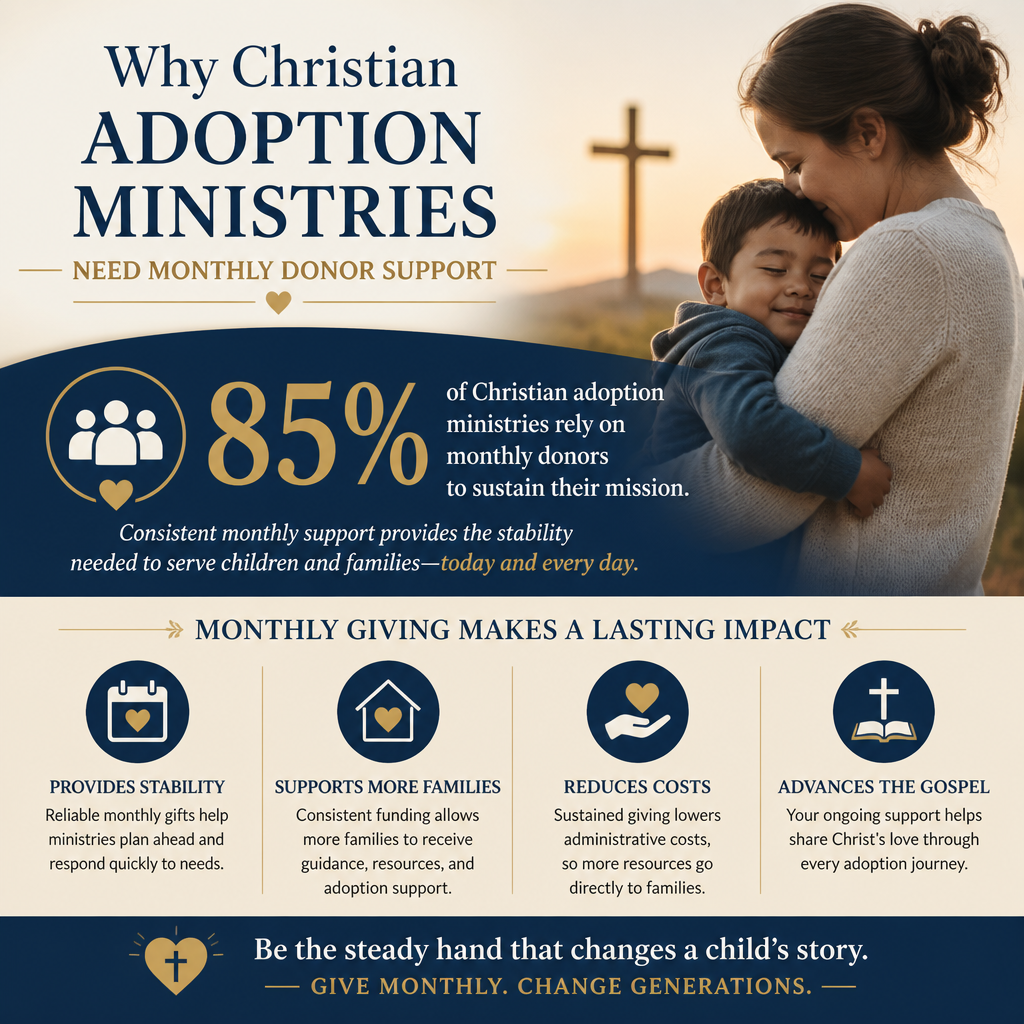
Monthly donor support matches that reality. One-time gifts can help a family cross a financial threshold, and those gifts can be a genuine mercy. But steady support is what allows a ministry to remain present for years, especially when needs intensify after the public attention fades.
Stability reduces the pressure to fundraise from crisis to crisis
Most mature adoption ministries have learned that crisis-driven fundraising can distort priorities. When a ministry must constantly search for the next emergency to narrate, it can unintentionally reward volatility over steadiness. Monthly support provides a more stable base, allowing leaders to plan, staff appropriately, and resist the temptation to chase emotionally compelling but programmatically disruptive campaigns.
This is one reason Christian donors who value formation and stewardship often prefer recurring giving. It is not only about convenience; it is about shaping a ministry’s incentives toward patient, high-integrity care.

Adoption ministry costs are front-loaded and back-loaded
Compliance and safeguarding are ongoing expenses
In adoption, the costs that most protect a child are often administrative. That word can sound cold, but it names real moral work: verifying qualifications, ensuring legal compliance, maintaining confidentiality, documenting decisions, and supervising casework standards. These requirements are not optional. In the United States, for example, the Adoption and Safe Families Act established timelines and standards intended to move children toward permanency while prioritizing safety; its framework continues to shape the child welfare ecosystem that many ministries operate within or alongside. U.S. Department of Health and Human Services, Administration for Children and Families
Monthly donors fund this safeguarding posture. They make it more feasible to retain trained staff, invest in secure systems, and maintain the documentation culture that good governance requires.
Post-placement support is essential and often underfunded
Christians genuinely disagree about how much of adoption ministry should focus on enabling adoptions versus strengthening families to prevent unnecessary family separation. What is not contested is that adoption, once pursued, should be supported with seriousness. Disruption and dissolution are not merely administrative outcomes; they are ruptures in a child’s already-fragile sense of belonging.
Here the research is sobering. Studies have found measurable rates of adoption disruption and dissolution, with higher risk in some populations and contexts; the patterns vary by age at placement and other factors. U.S. Department of Health and Human Services, Office of the Assistant Secretary for Planning and Evaluation Monthly funding allows ministries to offer parenting coaching, counseling referrals, support groups, respite coordination, and crisis response without waiting for a special appeal.
Recurring support protects integrity in a complex field
Child welfare incentives can be distorted without careful guardrails
Orphan and vulnerable children work has had to reckon with the reality that funding incentives can produce harm: recruiting children into institutions, separating families unnecessarily, or treating children as a means to donor engagement. Adoption ministry is not immune to these pressures, especially where international partnerships, intermediaries, and legal regimes differ widely. A healthy funding base makes it more realistic to say “no” to questionable referrals, to pause when documentation is inconsistent, and to invest in due diligence rather than rushing to meet fundraising goals.
Monthly donors contribute to the ministry’s independence. They help leaders maintain a posture of restraint and verification even when restraint costs money.
Verification and transparency require real investment
Christian donors should not have to choose between compassion and scrutiny. At Most Trusted, we evaluate nonprofits against The Most Trusted Standard, a 15-criteria framework across faith foundation, financial integrity, governance and leadership, and transparency and effectiveness. The ministries that meet these expectations tend to treat transparency as a discipline, not as a marketing activity. That discipline costs money: audited financials when appropriate, competent finance functions, board governance, clear outcome reporting, and ethical storytelling policies.
The “Overhead Myth” consensus statement—signed by major nonprofit evaluators—argues that simplistic overhead ratios can mislead donors and punish healthy investment in systems and staff. Candid GuideStar Monthly donors are often the ones who make these healthy investments possible, because recurring revenue is less restricted and more predictable.
Monthly donors help ministries serve families, not just process cases
The work includes prevention, reunification, and kinship support
Many Christian adoption ministries now operate with a broader theology of care: we pursue adoption when it is necessary and right, and we also support kinship care, family preservation, and reunification when those paths protect the child and honor God’s concern for justice. Donors sometimes assume “adoption ministry” means only placement. In practice, responsible ministries often allocate significant effort toward supporting vulnerable families so that adoption is not pursued as the default solution.
This broader approach is consistent with field learning. The When Helping Hurts framework, articulated by Steve Corbett and Brian Fikkert, has helped many Christian organizations recognize how good intentions can reinforce dependency or displace local responsibility if help is not carefully designed. When Helping Hurts Monthly support gives a ministry the flexibility to fund what is right, not only what is easy to narrate.
Recurring giving sustains the “unseen” forms of care
Across our verification work, we observe that the strongest ministries can describe, in plain terms, what ongoing care looks like after a child enters a family. They budget for it. They train for it. They measure it with appropriate humility. Monthly donors allow ministries to sustain a service posture that includes:
- Trauma-informed training for adoptive and foster families
- Screening and supervision practices that protect children
- Post-placement check-ins and crisis response capacity
- Referral networks for counseling and specialized services
- Support groups and peer mentoring that reduce isolation
These are not peripheral to the mission. They are part of what it means to love our neighbor with competence.
How to discern whether monthly support is well placed
Ask whether the ministry can explain its model with moral clarity
Christian donors are right to ask hard questions. Not every organization that uses adoption language deserves recurring support, and not every sincere ministry has the internal controls required for a sensitive field. A ministry worth monthly partnership should be able to explain its theory of care: how it prioritizes the child’s best interests, how it avoids perverse incentives, how it works with local churches and licensed professionals, and how it handles contested questions such as family preservation versus adoption without caricature.
When donors want to understand the broader landscape, many begin with the topic context at Christian Adoption Ministries. A mature understanding of the category protects both generosity and discernment.
Look for financial integrity and truthful reporting, not polished storytelling
Monthly giving is relational; it is a form of ongoing trust. That trust should rest on verifiable practices. Donors should expect clear financial reporting, conflict-of-interest policies, independent governance, and a truthful account of outcomes and limitations. The question is not whether every metric is flattering, but whether the ministry is candid about what it can and cannot claim.
For donors who want to see how ministries deploy gifts in concrete program categories—casework, family support, partner oversight, and accountable operations—our editorial coverage of How Christian Adoption Ministries Use Donations provides a practical starting point.
FAQs for Why Christian adoption ministries need monthly donor support
Is monthly giving better than sponsoring a specific adoption?
Not always, but it is often more structurally helpful. Designated gifts can meet a real need for a particular family, and many ministries administer them responsibly. The limitation is that adoption ministry also requires capacity that cannot be tied to one case: compliance, training, post-placement support, and partner vetting. Monthly support strengthens the shared infrastructure that protects every child served.
How can we give monthly without rewarding inefficiency?
We can insist on measurable integrity rather than simplistic cost ratios. Healthy ministries invest in competent staff, safeguarding systems, and accountable governance—costs that some donors mistakenly label as waste. The better discipline is to ask whether the ministry provides transparent financial statements, demonstrates responsible oversight, and reports outcomes with truthfulness and appropriate restraint. Recurring support belongs with organizations that can bear the weight of ongoing trust.
Monthly support is a form of steadfast stewardship
Christian adoption ministries need monthly donor support because their calling is sustained, morally weighty work in a field where good intentions can do damage. Recurring giving funds the safeguards that protect children, the support that strengthens families after placement, and the integrity that resists distorted incentives. For donors who want their generosity to be both compassionate and accountable, monthly partnership is often the most faithful way to underwrite what is steady, costly, and necessary.



