
Asking what share of donations funds direct adoption services is not a shallow “overhead ratio” question. For Christian donors, it is a stewardship question about whether giving is actually bearing the kind of fruit Scripture commends: truthfulness, justice, and costly love for vulnerable neighbors, including children and families navigating adoption.
The difficulty is that “direct adoption services” is not a standardized accounting category. Two faithful, effective ministries can report very different percentages because they define “direct” differently, are operating in different legal jurisdictions, or are supporting different points on the adoption continuum. The goal is not a single ideal number; the goal is credible evidence that dollars are being governed well and deployed for real service.
Why the percentage is harder to interpret than donors expect
Direct services is not a uniform line item
In adoption work, “direct services” can mean home studies, counseling, birth parent support, post-adoption care, matching services, legal coordination, or family preservation support that prevents unnecessary separation. Some of these costs are program expenses; others can appear as administration depending on how a ministry allocates staff time and shared costs. A case manager’s salary may be “program,” while the compliance system that keeps that case manager’s work lawful and ethical may be classified as “admin,” even though it protects children.
Christians genuinely disagree about what should be counted as “direct” when the work is inherently relational and regulated. Adoption is not a shipment of goods where “program” is easily separated from “operations.” It is a covenantal kind of service in a world of trauma, coercion risks, and complex law.
Adoption is unusually compliance-heavy for moral reasons
Healthy adoption ministries spend real money on background checks, safeguarding policies, documentation, and legal oversight. These functions do not feel like “helping a child,” but they are precisely the structures that keep ministries from becoming careless with the vulnerable. The desire for a high direct-service percentage can unintentionally pressure organizations toward underinvesting in safeguards.
That tension is one reason many charity evaluators have warned donors not to treat overhead ratios as a primary measure of effectiveness. In the broader nonprofit field, the “Overhead Myth” statement argues that focusing on overhead can reward underinvestment in the systems that sustain strong outcomes and accountability. Charity Navigator discusses this concern directly on its “Overhead Myth” page (Charity Navigator).

What a faithful definition of direct adoption services should include
Services that touch children and families in concrete ways
For donor purposes, “direct adoption services” should ordinarily mean services that are delivered to children, birth families, adoptive families, or kin networks as the ministry’s mission output. In practice this can include:
- Home studies and adoptive family preparation
- Birth parent counseling and material support where appropriate
- Case management and matching support
- Post-adoption counseling, trauma-informed care referrals, and support groups
- Family preservation supports that reduce preventable separations
It may also include certain necessary “wraparound” costs when they are inseparable from service delivery. For example, interpreter services for counseling, trauma training for staff, and supervised visitation logistics can be essential parts of providing ethically sound adoption-related care.
Services that prevent harm belong in the moral accounting
Scripture’s insistence on justice and honest weights and measures does not permit ministries to confuse speed with faithfulness. “Righteousness and justice are the foundation of your throne” (Psalm 89:14). In adoption work, guardrails are not optional; they are part of righteous practice. If a ministry spends more on screening, documentation, and safeguarding than a donor expects, that may be evidence of seriousness rather than waste—provided it is transparent and proportionate.
What this means in practice is that donors should ask not only “How much went to direct services?” but also “How does this ministry define direct services, and does that definition reflect the actual moral demands of adoption work?”
Benchmarks can mislead without context
Why there is no universal faithful percentage
Some donors look for a single target such as “80 percent to programs.” For adoption ministries, that can be an unreliable yardstick. A ministry that provides counseling and post-adoption support may carry higher staffing costs than a grantmaking fund that primarily re-grants to local partners. An organization operating internationally may have higher legal and compliance costs than a domestic program. A ministry funding post-adoption services might legitimately invest more in clinical oversight than a matching-focused agency.
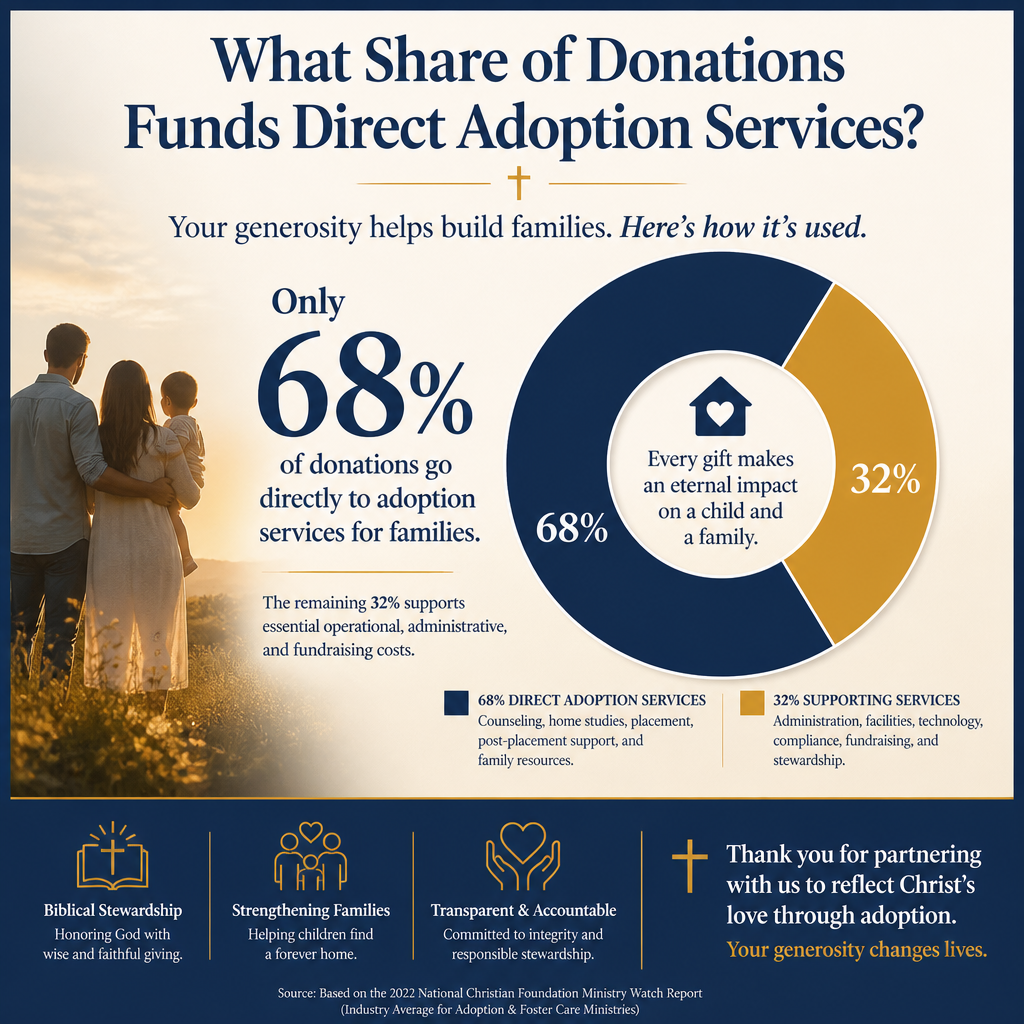
Across our verification work at Most Trusted, the more credible pattern is not a specific ratio but a consistent relationship between three things: clear program definitions, transparent allocation methods, and outcomes that correspond to mission claims. Ministries that meet The Most Trusted Standard tend to be able to explain their numbers without defensiveness and without marketing gloss.
Donors should test for “starvation cycle” risk
Nonprofit researchers have described how pressure to minimize overhead can create a “starvation cycle,” where organizations underinvest in infrastructure, staff development, and evaluation in order to satisfy donor expectations, weakening their long-term effectiveness. Stanford Social Innovation Review has addressed this dynamic through the concept commonly described as the nonprofit starvation cycle (Stanford Social Innovation Review).
The harder question is whether an adoption ministry is adequately resourced to do the work responsibly. Underfunded case management can produce rushed decisions and avoidable errors, while underfunded post-adoption care leaves families isolated when trauma surfaces. A high “direct service” percentage is not automatically a virtue if it is achieved by underpaying qualified staff or skimping on safeguarding.
What we recommend donors examine instead of a single percentage
Start with the audited financials and the narrative that matches them
A credible ministry can show how program spending connects to actual services delivered. Donors should ask for audited financial statements (or reviewed statements for smaller ministries) and compare them to the annual report narrative. When the story is hopeful but the financials are opaque, caution is warranted.
When a ministry publishes IRS Form 990 (where applicable), donors should read it as a governance document as much as a financial one. It reveals related-party transactions, compensation governance, and the way the organization describes its mission and accomplishments in its own words.
Look for transparency about allocation, not just the outcome
Two ministries may each report “75 percent program,” yet one may allocate shared costs thoughtfully while the other uses rough estimates that flatter the program figure. Donors should ask:
- How does the ministry allocate shared staff time between program, administration, and fundraising?
- Are safeguarding and compliance costs described clearly?
- Does the ministry report both outputs and outcomes where appropriate?
- Are restricted gifts tracked and honored with documentation?
These questions align closely with what we assess through Most Trusted’s evaluation against The Most Trusted Standard, especially in the areas of financial integrity, governance, and transparency. The aim is not to punish complexity but to require clarity.
Donors who want to situate these questions within the wider landscape of Christian Adoption Ministries should pay attention to how ministries describe the ethical risks they are actively mitigating. Serious organizations acknowledge where adoption has been abused historically and how their policies reduce coercion and protect birth families and children.
How direct service spending should connect to outcomes and ethical safeguards
Evidence of effectiveness should be commensurate with claims
Adoption ministry outcomes are difficult to quantify without reducing people to metrics. Still, a ministry can responsibly report indicators that correspond to its work: number of families served through counseling, completion rates for training, post-adoption support participation, and documented safeguarding compliance. The strongest organizations also report learning—what has changed in their practice as they discovered gaps or unintended harms.
When donors ask “what share,” we recommend also asking “what changed,” and “how do you know.” Ministries may cite internal evaluation, third-party program reviews, or partnership standards required by licensing bodies. The form of evidence will vary, but the presence of disciplined accountability is not optional.
Guardrails protect the vulnerable and the donor’s intent
Christian donors are often motivated by James 1:27, which ties care for orphans and widows to moral integrity. That integrity includes refusing to let financial pressure distort practice. A ministry that appears to “do more with less” may be operating with insufficient safeguards, or it may be shifting costs onto families in ways that require moral scrutiny.
It is also appropriate to ask how a ministry addresses common adoption ethics concerns: informed consent, avoidance of financial coercion, respect for family preservation when safe, and post-placement support. Donors should expect policies, training, and oversight—costly things that rarely show up as emotionally satisfying line items.
For donors focused on how funds are categorized and reported, the most useful context is found in How Christian Adoption Ministries Use Donations. The purpose is not to enforce a simplistic percentage, but to understand whether reporting reflects reality and whether reality reflects Christian moral seriousness.
FAQs for What share of donations funds direct adoption services
Is a higher direct-service percentage always better for an adoption ministry?
No. Adoption work requires strong compliance, safeguarding, and trained staff. A ministry reporting an unusually high program percentage may be underinvesting in oversight or misallocating shared costs. The better question is whether the ministry can explain its definitions, allocation methods, and ethical safeguards with documentary clarity.
What should we ask an adoption ministry if we want our gift to fund direct services?
Ask how the ministry defines “direct adoption services,” whether it can restrict your gift to a specific program area, and how it documents the use of restricted funds. Request the most recent audited financials or reviewed statements and look for consistency between the financial reports and the ministry’s program descriptions.
A stewardship question with a moral horizon
What share of donations funds direct adoption services matters because Christian giving is never only about efficiency; it is about faithful action under God. A credible adoption ministry will not merely advertise a percentage. It will show, with transparent reporting and disciplined governance, how resources support lawful, ethical, child-centered services—and how it is resisting the subtle temptations that can turn orphan care into a marketplace. That is the kind of clarity Most Trusted exists to strengthen, so donors can give with confidence and without naivete.



