

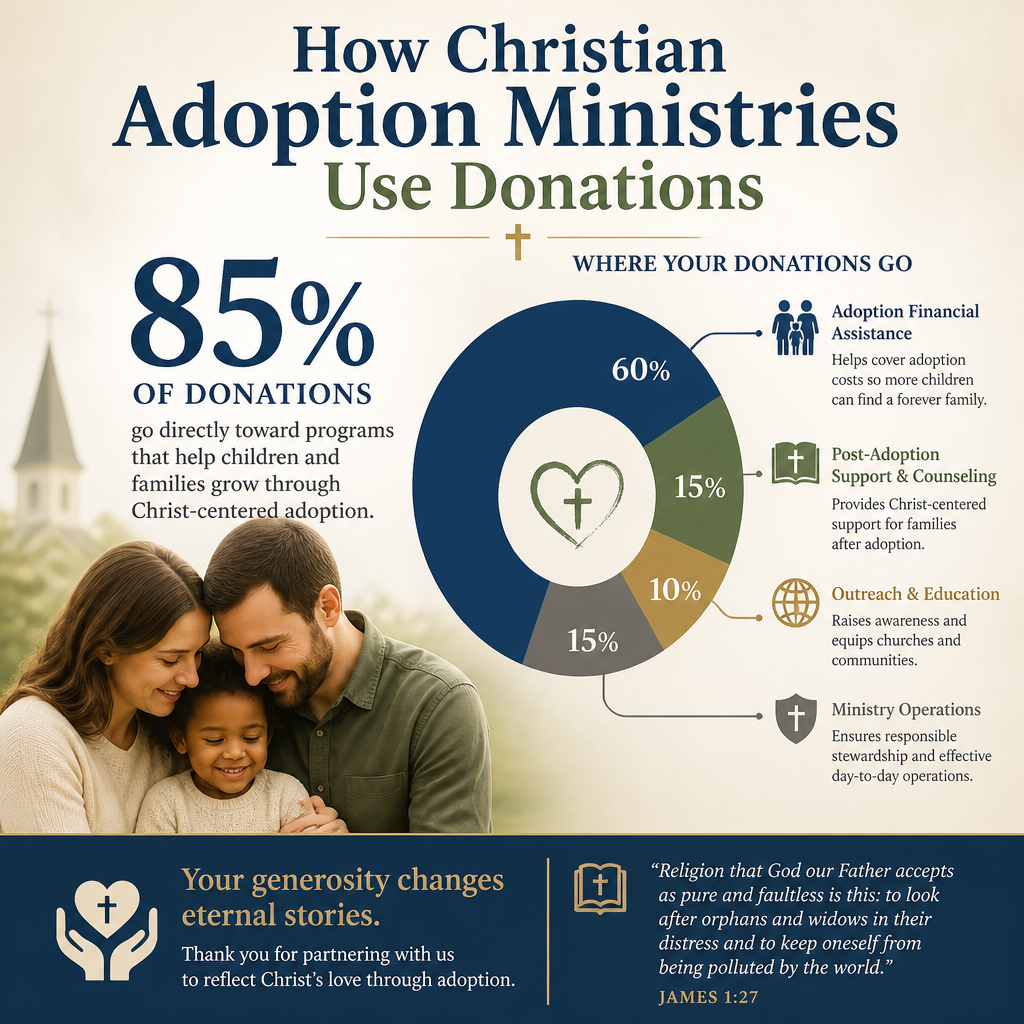
How Christian adoption ministries use donations is not a secondary concern for Christian donors; it is a stewardship question with moral weight. The same Scriptures that command care for the fatherless also warn that money can distort judgment, reward appearances, and even incentivize harm if accountability is weak.
Adoption and adoption support sit at the intersection of vulnerable children, complex laws, trauma, and high costs. Christians genuinely disagree about the best models, the most ethical funding mechanisms, and the proper boundaries between “adoption,” “orphan care,” and “family preservation.” A mature donor posture does not avoid these tensions. It asks where funds go, what practices they reinforce, and whether the ministry’s work reflects the character of the God who “executes justice for the fatherless” (Deuteronomy 10:18).
Donations fund both the visible work and the costly infrastructure behind it
When donors picture adoption ministry, they often picture the culminating moment: a child welcomed into a family. Yet adoption ministries are sustained by long sequences of work that happen long before placement and long after. Some of that work is direct service; some is governance, compliance, and donor-funded capacity that determines whether direct service is safe and ethical.
Responsible ministries often have higher “administrative” costs than donors expect, not because they are inefficient, but because adoption work is regulated, documentation-heavy, and exposure to legal and safeguarding failures is severe. The most credible question is not whether a ministry has overhead. It is whether its overhead is appropriately sized for risk, properly controlled, and honestly reported.
Core spending categories in adoption ministry budgets
Across adoption ministries, donations commonly support a mix of the following:
- Adoption services and casework: intake, matching support, home study facilitation (where legally permitted), parent education, and coordination with licensed partners.
- Child and family support: counseling, trauma-informed care referrals, post-placement support, respite care, and support groups.
- Family preservation and kinship support: material aid, parenting classes, crisis intervention, and connection to local services—especially in contexts where separation is driven by poverty rather than abuse.
- Safeguarding and compliance: background checks, training, reporting systems, and internal controls.
- Program evaluation and reporting: outcome tracking, donor reporting, and independent audits or financial reviews where appropriate.
- Fundraising and donor care: communications, development staff, and giving infrastructure.
Some of these categories make donors uneasy, particularly fundraising and administration. But the sector has long had to reckon with what Charity Navigator, GuideStar, and the BBB Wise Giving Alliance called the “overhead myth”—the mistaken belief that low overhead is the primary indicator of effectiveness Charity Navigator. For adoption ministries, the real danger is under-investing in safeguards, training, and competent leadership, because the consequences fall on children and families.
Why “direct services” is not a simple line item
Adoption ministry is unusually sensitive to how donors define impact. Some donors want their gifts to fund a specific family’s placement costs. Others want their giving to strengthen a ministry’s capacity to serve many families well. Both instincts can be faithful, but they are not interchangeable. A designated gift that reduces a family’s immediate burden is tangible; a gift that funds professional supervision, trauma training, or case management systems is less visible but can be decisive for long-term outcomes.
What this means in practice is that strong ministries explain how they classify expenses, why those classifications make sense, and how their cost structure protects children. When reporting is vague or defensive, donors should slow down.

Ethical adoption ministry spending protects children from perverse incentives
Christian donors care about outcomes, but they also care about the moral logic a ministry’s funding creates. The hardest questions are often not about whether good is happening somewhere, but whether the model unintentionally rewards harmful behavior—especially in cross-border or high-demand contexts.
The modern orphan care movement has learned that institutional incentives can recruit children away from families, elevate speed over discernment, and treat children as means rather than neighbors. Many adoption ministries have responded by strengthening child safeguarding, insisting on legal compliance, and investing in family preservation where possible.
Where funding can go wrong
The field has had to reckon with several recurring vulnerabilities:
- Child-finding pressure: when financial sustainability depends on a pipeline of placements, ministries can face implicit pressure to prioritize volume over prudence.
- Weak verification of “orphanship” and relinquishment: inadequate documentation, poor translation, and corrupt intermediaries can enable trafficking under humanitarian language.
- Donor-driven storytelling: fundraising that relies on extreme narratives can distort decision-making and erode truthfulness.
- Short-term voluntourism: programs that center donor experience over child stability can intensify attachment disruptions.
These are not theoretical. The United States government has repeatedly warned that intercountry adoption can be vulnerable to fraud and coercion when systems are weak U.S. Department of State. Responsible ministries treat that reality as a call to greater rigor, not as an insult.
What better spending looks like
When ministries allocate donations toward ethics and safeguarding, donors may see fewer dramatic numbers and more unglamorous controls. That trade-off is often healthy. Better spending tends to include:
- Clear separation of roles: decision-making authority distributed so that fundraising needs cannot quietly override case decisions.
- Independent financial review: credible audits, conflict-of-interest controls, and transparent related-party disclosures.
- Safeguarding systems: training, reporting pathways, and documented responses to allegations.
- Family preservation partnerships: support for keeping children safely with relatives when feasible, rather than defaulting to separation as the most “fundable” outcome.
The theology here matters. Scripture’s concern is not only that we do something that feels compassionate, but that we love “in deed and in truth” (1 John 3:18). In adoption ministry, truth includes paperwork, lawful process, and hard refusals when a situation is not clean.
Donors should expect rigorous transparency, not merely inspiring narratives
Christian donors often give because they have been moved by a child’s story or a family’s courage. Stories can rightly awaken love. But they are not accountability. The ministries most worthy of trust pair testimony with verifiable reporting that respects privacy, tells the truth about costs, and does not hide setbacks.
Across our verification work at Most Trusted, we observe that mature ministries do not treat transparency as a marketing strategy. They treat it as a form of neighbor-love toward donors and families, because hidden information creates power imbalances and invites misuse.
Financial transparency donors can reasonably request
For U.S.-based ministries, donors can often review Form 990s and audited financial statements (where available). The goal is not amateur policing; it is basic stewardship. Donors should be able to identify:
- Revenue mix: how dependent the ministry is on a small set of donors, events, or restricted gifts.
- Program descriptions that match reality: whether program claims on public materials align with filed documents.
- Fundraising efficiency: whether fundraising costs seem proportionate to fundraising strategy and maturity.
- Related-party transactions: payments to insiders or affiliated entities disclosed clearly and governed properly.
It is also reasonable to ask how designated gifts are handled. Restricted giving can be a blessing when it aligns with the ministry’s strategy; it can also create brittleness when most funds cannot be used where need is greatest. The best ministries explain their restricted-fund policy plainly and follow it consistently.
Outcome reporting that respects the nature of adoption work
Adoption outcomes are difficult to measure with the neatness donors sometimes want. Not every “success” is immediate; not every adoption disruption is a sign of negligence; not every family preservation effort is visible to donors as an “outcome.” Still, ministries can report meaningful indicators such as:
- Post-placement supports provided: counseling referrals, support groups, crisis response, and respite.
- Training delivered: trauma-informed parenting education and ongoing formation for families.
- Safeguarding actions: training compliance, incident reporting, and policy updates.
- Family preservation services: assistance that keeps children safely with family when possible.
Where donors are offered simplistic metrics—“X adoptions completed” without context on legality, child welfare standards, or post-placement supports—discernment is warranted. The work is too consequential for numbers that function as fundraising counters.
What trustworthy ministries tend to share and how Most Trusted evaluates it
Because donors cannot personally inspect every case file or governance decision, trustworthy giving depends on credible signals. The ministries that meet The Most Trusted Standard tend to communicate clearly about their faith commitments, their financial practices, their governance safeguards, and their real-world effectiveness.
Our verification work is designed to serve donors who want more than sentiment and less than cynicism: a disciplined approach to giving that honors both compassion and truth. When a ministry invites scrutiny, answers direct questions, and publishes consistent documentation over time, it is generally demonstrating the kind of integrity that can sustain long-term trust.
Questions donors can ask without adversarial posture
- How do you prevent financial incentives from shaping adoption decisions? Look for role separation, written policies, and external accountability.
- What proportion of your work is adoption placement, and what proportion is post-adoption support and family preservation? Clarity here reveals whether the ministry’s public identity matches its actual operations.
- How do you define success? The best answers include child well-being, family stability, and ethical process, not only completed placements.
- What do you do when something goes wrong? A credible ministry can describe incident response, learning, and governance oversight without violating confidentiality.
- How do you safeguard children in programs that involve volunteers, travel, or international partners? Expect written safeguarding policies, training, and reporting pathways.
How to interpret monthly giving and designated gifts
Monthly donor support often funds what families need most but rarely sponsor directly: consistent casework, post-placement counseling partnerships, staff training, and the patient work of coordination with churches and local service providers. Some donors hesitate because monthly giving feels less connected to a specific story. Yet adoption ministry’s stability depends on predictable capacity more than on dramatic spikes of generosity.
Designated gifts can be appropriate when they do not pressure the ministry to promise outcomes it cannot control. The risk increases when gifts are tied to timelines, placements, or public storytelling that compromises truthfulness. Wise ministries accept designated gifts with care, communicate limitations, and refuse donor demands that would place children at risk.
For donors seeking ministries that have been evaluated against consistent criteria, our work at Most Trusted exists to reduce information asymmetry without reducing the moral seriousness of the decision. Many donors begin by orienting themselves to the broader landscape of Christian Adoption Ministries and then applying a disciplined set of questions to any ministry they consider supporting.
Stewardship in adoption giving is measured in truthfulness, safeguards, and long-term care
Christian adoption ministries use donations for far more than a single moment of placement. Funds sustain casework, training, safeguarding, compliance, post-adoption support, and—when done well—efforts that keep children safely with family when possible. The aim is not to minimize cost, but to ensure that every dollar reinforces practices consistent with the justice and mercy Scripture requires.
For Christian donors, the question is not simply whether a ministry can tell a moving story. The question is whether its financial choices protect the vulnerable, resist perverse incentives, and remain accountable in the light. That is the kind of giving that honors both the child and the Giver of every good gift.



