

How matching gifts work for Christian adoption ministries is not primarily a fundraising trick; it is a stewardship question. When a donor’s gift is multiplied through an employer match, the ministry can serve more families—yet the conditions attached to matching, the timing of cash flow, and the way outcomes are reported can either strengthen or distort the work.
Christian donors often approach adoption and orphan care with deep moral clarity: God is “Father of the fatherless” (Psalm 68:5), and the church is called to “look after orphans and widows” (James 1:27). Those convictions should shape not only whether we give, but how we evaluate the mechanisms that fund the work. Matching gifts can be a genuine good when they reinforce integrity and effectiveness rather than pressuring ministries toward volume, speed, or marketing claims that outpace reality.
Matching gifts are employer funded and rules driven
What a matching gift is and what it is not
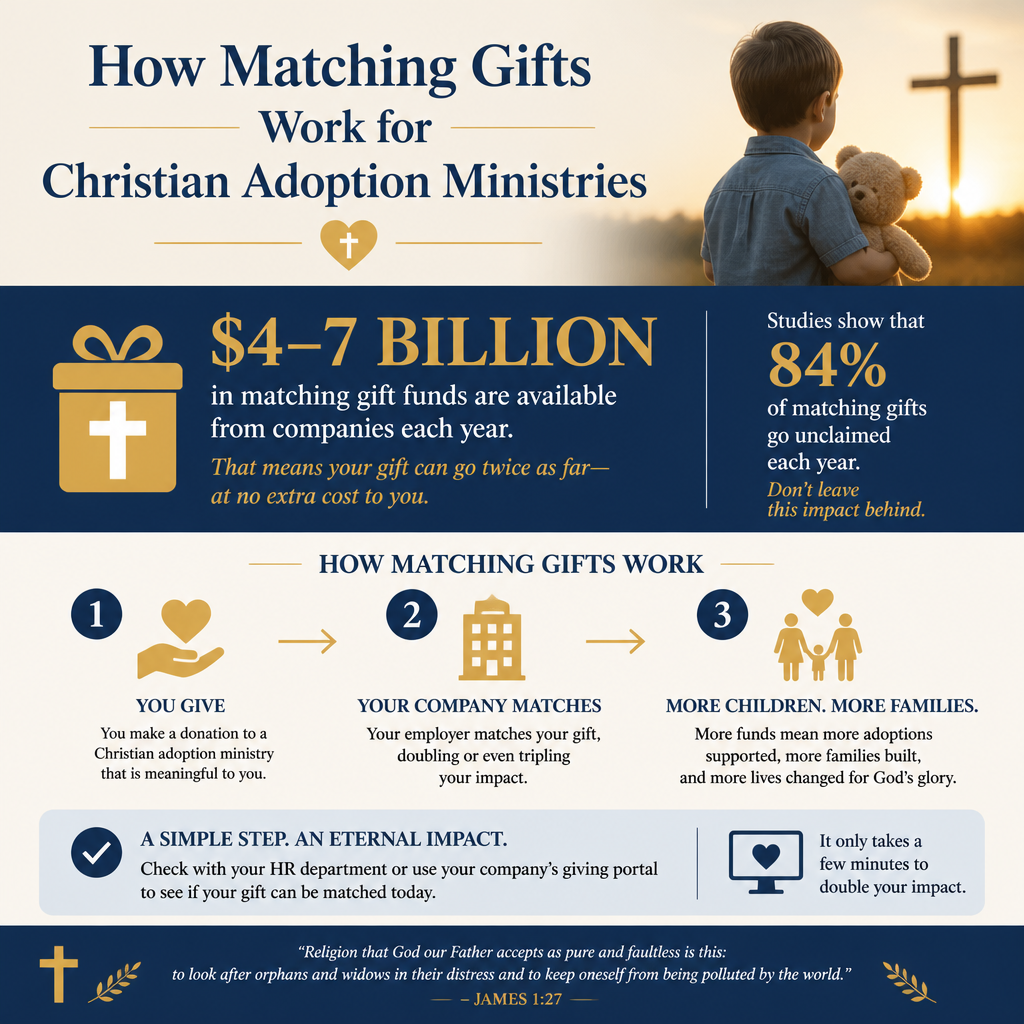
A matching gift is a contribution made by an employer (or sometimes a corporate foundation) that matches an employee’s charitable gift to an eligible nonprofit. The donor gives once; the employer gives a second time. Most programs require the employee to initiate a request, and most employers reserve the right to approve or deny the match under their published guidelines.
It matters to name what matching gifts are not. They are not “free money” detached from accountability. They are not a pledge from the donor. They are not immediate cash unless and until the employer processes the request. And they are not always available for every type of Christian ministry, because many corporate policies exclude overtly religious activities or require that services be provided without religious requirement.
Where corporate policies can collide with Christian mission
Christians genuinely disagree about how to engage employer matching programs when eligibility criteria appear to constrain explicitly Christian ministry. Some ministries can accept matches because their adoption services are offered without requiring religious participation, even while the ministry’s identity remains Christian. Others are excluded because their programs are directly evangelistic or catechetical by design. This tension is not solved by slogans. It is addressed by clear policies, transparent communication, and careful alignment between a ministry’s stated faith commitments and the funding it pursues.

The matching gift process has predictable friction points
The typical sequence from donor to employer to ministry
In practice, the matching gift process usually follows a consistent pattern: a donor gives, the donor submits a match request through an employer portal, the nonprofit verifies the donation and its eligibility, and the employer remits funds—often weeks or months later. The ministry’s development team must track this pipeline carefully, because a “matched” gift is frequently a gift in process rather than a gift in hand.
For Christian adoption ministries, this timing matters. Many ministries carry real-time costs: case management, home studies, birth parent counseling, post-placement support, or grants to adoptive families. A match that arrives 90 days later may not fund the urgent moment that inspired the original donor. Wise donors treat matching as an additional gift that strengthens the ministry’s overall capacity, not as a guarantee that a specific child or family need is fully funded on a specific timeline.
Why some matches fail to materialize
Matching gifts can be lost for reasons that have nothing to do with a ministry’s integrity: missed submission deadlines, employer program caps, incomplete verification, changes in employment status, or an employer’s exclusion of certain types of nonprofits. Some employers also require that the organization be registered in their preferred database, which can introduce administrative delay.
For this reason, the most responsible ministries avoid promising donors that “your gift will be doubled” unless the match is already confirmed. They may encourage matching as a stewardship opportunity while still communicating that matches are contingent and cannot be booked as revenue until received.
Matching gifts can strengthen adoption work when measured honestly
The difference between multiplication and distortion
Multiplying a gift is morally straightforward; multiplying a claim is not. Adoption ministry is both spiritually significant and operationally complex. If matching campaigns push ministries toward overconfident messaging—implying that a doubled donation automatically results in a doubled number of placements—donors should pause. The work involves legal processes, trauma-informed care, long timelines, and, in many cases, contested public policy terrain.
What this means in practice is that the best use of matched funds is often to stabilize the ecosystem around children and families: counseling, training, post-adoption supports, and the administrative competence required to do hard work consistently. The research on child well-being has long underscored that stable, nurturing family environments are decisive for children’s development, which is one reason modern orphan care has increasingly prioritized family-based care rather than institutionalization. The National Institutes of Health notes that children raised in institutional settings face elevated risks across developmental domains compared to family care, a finding consistent with decades of attachment and development research National Institutes of Health.
How mature ministries report impact
Across our verification work at Most Trusted, we observe that the ministries that meet The Most Trusted Standard tend to report impact with sobriety. They distinguish outputs (home studies completed, families trained, post-placement visits delivered) from outcomes (stability, disruption rates, family strengthening) and they name limitations in their data. They resist the temptation to turn children into fundraising metrics.
Donors should favor adoption ministries that can articulate how matching funds support a coherent strategy—especially one that protects children, honors birth parents, and provides meaningful post-adoption care rather than treating placement as the finish line.
What donors should verify before giving a matchable gift
Eligibility, restrictions, and how funds are recorded
Matching gifts raise concrete diligence questions. A donor’s employer may require that the receiving nonprofit be a 501(c)(3) with specific documentation, may exclude “religious instruction,” or may limit matches to certain program types. The ministry should be able to answer these questions clearly without improvisation.
Donors should also understand that accounting standards generally require conditional contributions to be recognized only when the conditions are substantially met. While practices vary with auditors and specific facts, responsible financial reporting does not treat “expected matches” as spendable revenue until received. A ministry’s willingness to be candid here is a useful indicator of governance culture.
A short diligence checklist for Christian donors
- Confirm eligibility: Ask whether the ministry has received matches from major employers and whether any faith-related restrictions apply.
- Clarify designation practices: If you designate to a specific fund, ask whether matched dollars will follow your designation or be applied where most needed.
- Ask about timing: Request the ministry’s typical match processing timeline and how they follow up on pending matches.
- Review financial transparency: Look for audited financials, clear revenue categories, and plain-English explanations of restricted funds.
- Evaluate child and family safeguards: Ask about trauma-informed training, ethics in birth family engagement, and post-adoption support.
For donors who want a broader view of how adoption ministries should be evaluated, we address these themes across Christian Adoption Ministries, with particular attention to safeguards that protect children and keep churches from confusing urgency with wisdom.
Matching campaigns should serve the mission, not the other way around
Campaign design that protects integrity
Matching campaigns can be structured in ways that either promote transparency or encourage pressure. Healthy campaigns disclose the nature of the match (employer match versus a major donor match), the time window, and any caps. They avoid emotional manipulation and do not treat a child’s story as a marketing asset. They also protect staff from unhealthy fundraising incentives that could compromise casework standards.
For Christian adoption ministries, integrity includes the humility to say what funding can and cannot accomplish. A match can expand counseling capacity, underwrite training, or build a reserve that allows careful decision-making. It cannot guarantee the outcome of legal proceedings, erase trauma, or remove the complexity that surrounds adoption across domestic and international contexts.
How donors can align matching with faithful stewardship
Christian stewardship is not merely efficiency; it is faithfulness with entrusted resources (Luke 16:10–12). For donors with matching opportunities, the best practice is often to give as you normally would—then treat the match as a providential reinforcement of that gift rather than the central reason for giving. When matching becomes the primary driver, donors can drift into a transactional posture that measures generosity by multiplication rather than by discernment.
We also recommend resisting the false dichotomy between “impact” and “overhead.” Adoption work is inherently relational and compliance-heavy; safeguards, training, and competent administration are not distractions from mission. The sector’s broader conversation has increasingly rejected simplistic overhead ratios as a proxy for effectiveness, reflected in the public statement often referred to as the Overhead Myth, signed by organizations including GuideStar and BBB Wise Giving Alliance GuideStar.
Within How to Give Wisely to Christian Adoption Ministries, we press for this kind of disciplined generosity: giving that honors Scripture’s concern for the vulnerable while insisting on verifiable integrity in how ministries operate.
FAQs for How matching gifts work for Christian adoption ministries
Can a matching gift be restricted to a specific adoptive family or program?
Sometimes, but it depends on both the employer’s policy and the ministry’s own gift acceptance practices. Many employer matching programs do not honor fine-grained donor restrictions and will send funds as unrestricted or broadly restricted support. Responsible ministries will explain whether matched dollars can follow a donor’s designation and, if not, how they will be applied transparently to advance the mission.
Should donors wait to give until a matching campaign or match opportunity is available?
Not usually. Employer matching is often available year-round, and campaign-based matching can introduce timing pressure that is not always aligned with a ministry’s real needs. A steady pattern of giving tends to serve adoption ministries well because their costs and casework demands are ongoing. When a match is available, it is wise to pursue it, but not to let matching mechanics replace discernment about ministry integrity and child-centered practice.
A matched gift is still a moral decision
Matching gifts can be a meaningful way to increase support for Christian adoption ministries, but they do not relieve donors of the responsibility to evaluate mission alignment, safeguards, governance, and truthful reporting. When matching is integrated into a mature stewardship posture—one that seeks the good of children, honors families, and insists on verifiable integrity—it can strengthen work that reflects the heart of God for the vulnerable.



