

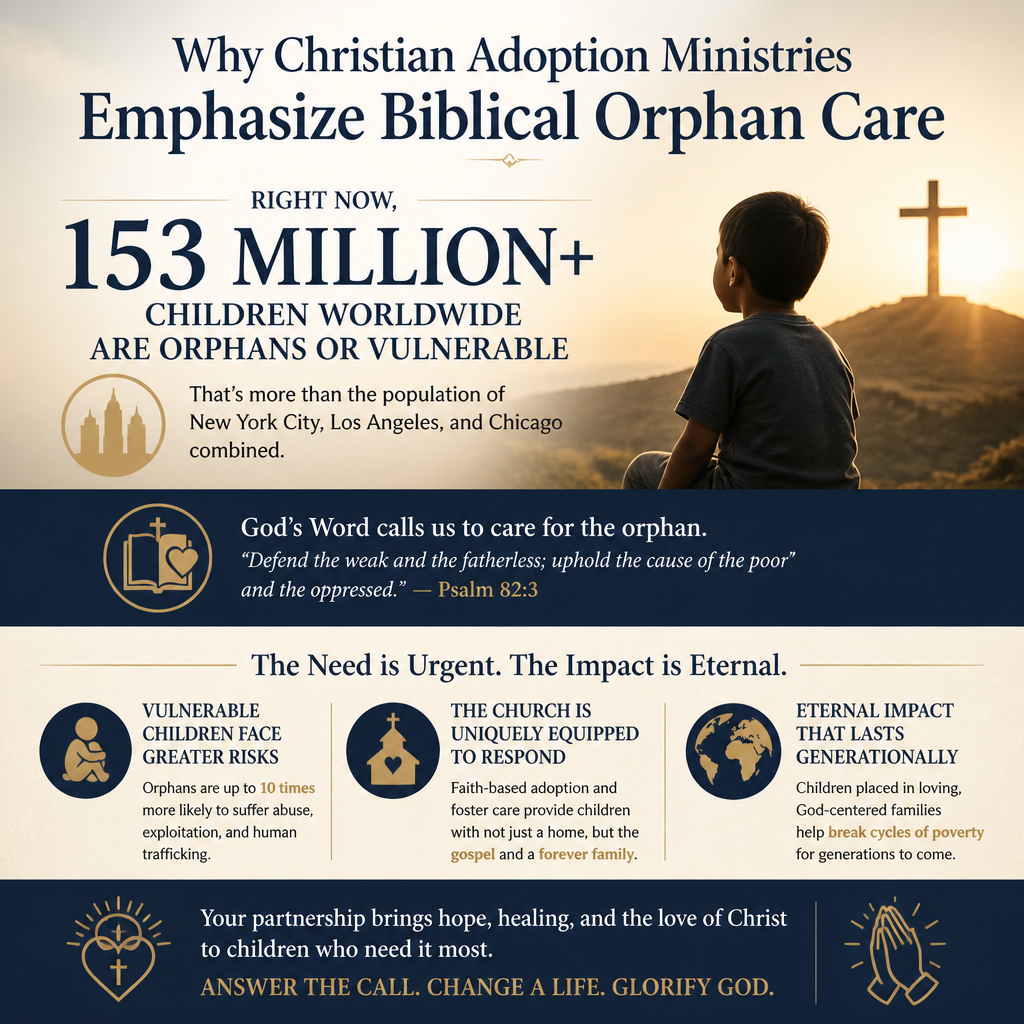
Why Christian adoption ministries emphasize biblical orphan care is ultimately a question of discipleship and witness. Scripture does not treat children without protection as a peripheral concern, and Christian donors sense that adoption and family-based care sit close to the heart of God.
Yet the modern orphan care movement has also learned that sincere compassion can drift into coercion, family separation, or poorly governed institutions if donors do not ask hard questions. The opportunity for donors is to fund ministries that keep biblical conviction and verifiable safeguards together.
Scripture frames orphan care as covenant faithfulness
Orphan care is not an optional ministry interest
The Bible’s language about the fatherless is not sentimental. God identifies himself as “Father of the fatherless” and “defender of widows” (Psalm 68:5), linking his character to protection for those without social power. James is even more direct: “Religion that God our Father accepts as pure and faultless is this: to look after orphans and widows in their distress” (James 1:27). For Christian adoption ministries, these texts function as moral architecture, not decoration.
In that frame, adoption becomes more than a private family decision. It becomes a visible sign of God’s welcome to the vulnerable and God’s judgment on neglect. This is why many ministries speak of “orphan care” rather than “adoption services” alone. The aim is not merely to complete legal processes but to express a public obedience that is consistent with the gospel.
Spiritual adoption informs practical adoption
Christian ministries also draw meaning from the New Testament’s adoption language. Paul describes believers receiving “adoption to sonship” (Romans 8:15) and God’s purpose as “adoption to sonship through Jesus Christ” (Ephesians 1:5). The analogy does not erase the differences between theological and legal adoption, but it does supply a pattern: God moves toward those who cannot secure their own status, pays real cost, and gives full belonging.
That pattern produces a distinctive insistence that children are not projects. They are image-bearers to be honored with permanence, identity, and love. Ministries that keep this theological center tend to resist approaches that treat children as fundraising tools or treat adoption as a simplistic rescue narrative.

The field has learned that good intentions can cause harm
Institutionalization carries measurable developmental costs
Many Christian adoption ministries emphasize biblical orphan care precisely because they want to move children toward family-based care rather than long-term institutional settings. The research on institutionalization is sobering. The American Academy of Pediatrics concluded that young children in institutions are at increased risk for problems in physical growth, cognitive development, and attachment, and it urged policies that prioritize stable family care over institutional placements (American Academy of Pediatrics).
Donors do not need to become child development specialists to respond faithfully, but we do need to recognize that funding models shape care models. When giving primarily sustains beds in an institution, the incentives can drift away from reunification, kinship care, foster care, or adoption. Ministries that emphasize biblical orphan care often do so because they are trying to keep the moral urgency of Scripture aligned with what is known about child wellbeing.
Christians genuinely disagree about what faithfulness requires
There is not a single Christian consensus on every question in adoption and orphan care. Christians differ on the role of international adoption, on transracial adoption practices, on how to balance reunification and permanency, and on the relationship between evangelism and social service. Those disagreements are not always a sign of compromise; they are often the result of real trade-offs between goods we should not casually pit against one another.
What this means in practice is that donors should be wary of ministries that speak with moral certainty while providing little evidence of safeguards. Biblical conviction should make ministries more accountable, not less. When a ministry claims to serve “the least of these,” it should be willing to show how it protects children, supports birth families, and resists financial and relational pressures that can distort decision-making.
Biblical orphan care now means strengthening families, not bypassing them
The best ministries start upstream
In many regions, the deepest driver of family separation is not the absence of love but the presence of crisis: poverty, illness, disability stigma, lack of access to schooling, or social isolation. Mature Christian adoption ministries increasingly define orphan care to include family preservation, reunification, and kinship support where safe and possible. This is not a retreat from adoption; it is a refusal to treat adoption as the only faithful response.
The global community has also moved away from routine institutionalization as a default. The United Nations issued guidance urging that children should grow up in families and that institutionalization should be a last resort, not a standard solution (United Nations). Christian ministries sometimes cite this not as a replacement for biblical authority, but as corroboration that family-based care is consistent with what is best for children.
Adoption remains necessary, but it should be ethically disciplined
There are cases where reunification is not safe, where kinship care is not available, or where legal permanence is required for a child to flourish. Adoption in those cases can be a profound mercy. Still, ethical discipline matters. The history of international adoption includes documented instances of fraud, coercion, and improper financial inducements. A ministry can be deeply pro-adoption and still insist on strict controls: transparent fees, independent oversight, careful documentation of consent, and a bias toward reunification when it is safe.
Donors who want to understand this landscape more fully often begin with the broader category of Christian Adoption Ministries, where the central question is not “Who tells the most compelling story?” but “Who can demonstrate faithful, child-centered practice?”
What Christian donors should examine before funding adoption and orphan care
Charity evaluation must match the moral weight of the work
Adoption and orphan care involves vulnerable children, complicated legal systems, cross-cultural dynamics, and intense emotional appeal. That combination creates risk. Christian donors should not treat due diligence as suspicion; it is a form of love for children and families, and it is an act of stewardship before God.
At Most Trusted, we exist to help donors give with confidence by evaluating ministries against The Most Trusted Standard, a 15-criteria framework that tests whether a nonprofit’s theology, finances, governance, and public accountability align with responsible Christian stewardship. The ministries that meet The Most Trusted Standard tend to welcome scrutiny because their mission depends on trustworthiness, not merely urgency.
A short set of donor questions that reveal real quality
Before supporting a ministry that emphasizes biblical orphan care, we recommend asking questions that surface incentives and protections rather than marketing claims:
- Does the ministry prioritize family preservation and reunification when safe, with clear criteria for when adoption becomes appropriate?
- Are fees and financial flows transparent, especially where payments could create pressure on birth families or local intermediaries?
- What independent safeguards exist for consent, documentation, and child status verification?
- How does the ministry measure outcomes beyond placements, such as stability, post-adoption support, and child wellbeing?
- Is governance strong enough to resist founder-centric decision-making and conflicts of interest?
Some donors hesitate to press these questions because they fear slowing “good work.” The harder truth is that haste can be a moral failure when children bear the consequences. A ministry’s willingness to answer concretely is often the clearest indicator that its biblical language corresponds to actual practice.
How biblical orphan care connects to transparency, governance, and effectiveness
Stewardship is a spiritual discipline, not administrative overhead
Scripture’s insistence on honest weights and measures is not antiquated economics; it is a demand for integrity in any system where people can be exploited. Adoption and orphan care ministries handle money, paperwork, and power across borders and bureaucracies. The biblical warning against partiality and corruption applies directly to those systems.
For donors, this is where verification becomes pastoral. Strong financial controls, competent boards, conflict-of-interest policies, and accurate reporting are not distractions from orphan care; they are protections for it. A ministry that cannot describe how it prevents fraud, how it audits partners, or how it responds to allegations is asking donors to fund risk they have not acknowledged.
Effectiveness must be defined carefully in child welfare
In child welfare, “success” cannot be reduced to counts of adoptions or the speed of placement. Stability, trauma-informed care, and long-term support matter. Ministries that emphasize biblical orphan care at a mature level usually invest in post-adoption services, counseling referrals, parent training, and church-based support networks, because permanence without support can become another form of abandonment.
Donors exploring this wider ecosystem often benefit from understanding The Christian Mission Behind Adoption Ministries, where the central theme is that faithfulness requires both compassionate action and institutional integrity.
FAQs for Why Christian adoption ministries emphasize biblical orphan care
Is emphasizing orphan care the same as promoting adoption as the first option?
No. Biblically grounded orphan care includes protecting children, strengthening families, and pursuing safe permanency. In many situations, the most faithful outcome is family preservation or reunification. Adoption becomes appropriate when a child cannot safely remain with or return to family, and when legal permanence serves the child’s long-term wellbeing.
How can donors avoid unintentionally funding harmful incentives in orphan care?
Donors can prioritize ministries that are transparent about finances, document consent and child status carefully, and demonstrate a commitment to family-based care. It also helps to fund post-adoption support and family preservation efforts, not only placement activities. Independent verification against a clear framework such as The Most Trusted Standard can further reduce risk by testing governance, financial integrity, and public accountability alongside stated mission.
Giving that honors Scripture and protects children
Christian adoption ministries emphasize biblical orphan care because Scripture places the fatherless within the center of God’s concern, and because the gospel trains the church to move toward the vulnerable at real cost. The same Bible that commands mercy also commands integrity. Donors best honor that unity by supporting ministries whose theology is matched by governance, transparent practice, and child-centered outcomes.



