
The Christian mission behind adoption ministries is not primarily a humanitarian impulse, as worthy as that impulse can be. It is a theological claim about God’s character and God’s people: that the Father adopts, that the Son enters our condition, and that the Spirit forms a family marked by costly mercy. Donors often sense this intuitively. The harder question is how to support adoption work that is both biblically serious and ethically disciplined in a field where incentives, trauma, and power imbalances can quietly distort good intentions.
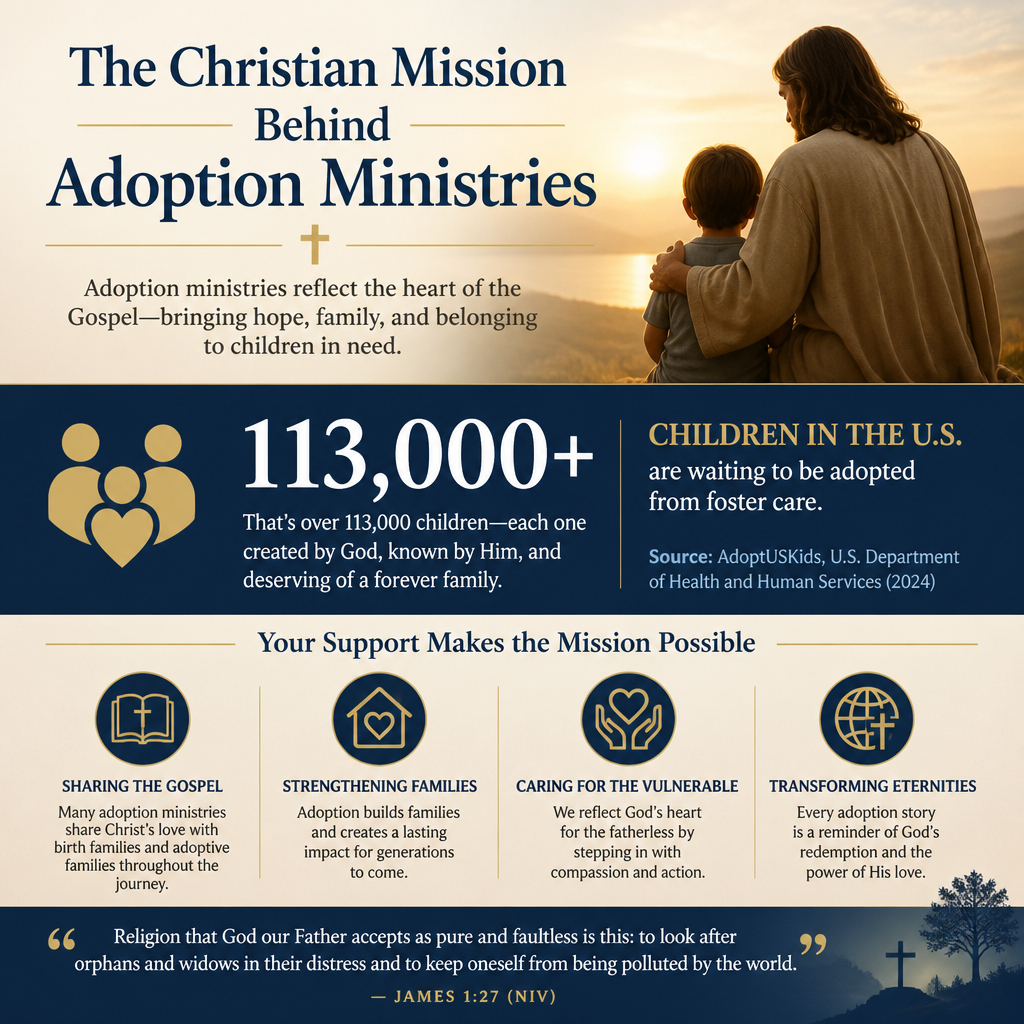
Scripture’s language is not ambiguous. God identifies himself as “Father of the fatherless” (Psalm 68), and James names care for orphans and widows as “pure and undefiled religion” (James 1:27). Yet Scripture also insists on honest weights and measures, the protection of the vulnerable from exploitation, and leadership accountable before God. Christian adoption ministries sit at the intersection of compassion and governance, tenderness and policy, pastoral care and compliance. Mature giving recognizes that the mission is not only to bring children into families, but to pursue justice for children, birth parents, and communities.
For donors seeking to give with confidence, the question becomes not whether orphan care matters, but which forms of adoption-related work are faithful, lawful, transparent, and genuinely healing. At Most Trusted, our verification work is designed to help donors distinguish between ministries with compelling stories and ministries with verifiable strength against The Most Trusted Standard, a 15-criteria framework across Faith Foundation, Financial Integrity, Governance and Leadership, and Transparency and Effectiveness.
The theological center of adoption ministry
Christian adoption ministry draws its deepest meaning from the gospel’s own adoption language. Paul teaches that believers receive “adoption as sons” through Christ (Romans 8; Galatians 4). This is not a sentimental metaphor. It is a covenantal reality: God takes responsibility for those who cannot secure their own standing, and he does so at real cost. When a ministry frames adoption as participation in that divine adoption, it should also display the moral contours of that doctrine—humility, truth-telling, protection of the powerless, and endurance when costs rise.
Adoption is a gospel sign, not a private achievement
Christian donors often hear adoption discussed as a heroic act. The better frame is witness rather than heroism. Adoption can embody the welcome of the stranger and the protection of the vulnerable, but it cannot be reduced to a personal narrative of fulfillment. Ministries that treat children as props for adult meaning are already drifting from a Christian anthropology. Children are not projects. They are image-bearers with histories, grief, and rights.
The mission includes birth parents and extended family
In Scripture, the care of the vulnerable regularly includes restoring what has been broken, not simply relocating those who suffer. Many adoption situations involve complex stories: poverty, lack of access to services, family instability, domestic violence, addiction, or coercion. Christians genuinely disagree about some policy questions, but most agree on this: truthfulness and voluntariness matter. Ethical adoption work refuses to pressure a mother in crisis, refuses to treat poverty as consent, and refuses to interpret “pro-life” as indifference to what happens after birth.
Orphan care is broader than adoption alone
Some of the most strategic ministries do not begin with adoption paperwork. They begin with family preservation, kinship care, safe reunification, and prevention—because the most humane outcome for many children is a safe family of origin. In the United States, child welfare data consistently shows that the foster care system is not primarily an “orphan” system; it is largely a system of temporary care and attempted reunification. In recent years, the majority of children who exit foster care do so through reunification with parents or living with relatives, rather than adoption, according to the U.S. Department of Health and Human Services, Administration for Children and Families.

The field’s moral hazards and why donors should face them directly
Adoption ministries often operate in environments shaped by strong emotions and urgent needs. That combination can create a market for simplistic narratives: “rescued from an orphanage,” “saved from trafficking,” “chosen by God for our family.” The Christian mission behind adoption ministries cannot be sustained by narrative alone. It must be anchored in verifiable practices that protect children from harm and protect donors from inadvertently funding coercive systems.
Incentives can distort vulnerable decisions
When funding is tied to the number of adoptions completed, per-child “fees,” or overseas institutional care, the temptation is to interpret every situation through the lens that keeps the system running. This is not a theoretical concern. The broader orphan care movement has had to reckon with documented patterns of institutionalization driven by external funding and volunteer demand. Donors do not need to assume malice to take these risks seriously. Good people can be swept into bad incentives.
Children carry trauma, and love must be trauma-informed
Even in the best ethical circumstances, adoption involves loss: separation from a first family, disruption of familiar language or culture, and the uncertainty of new attachment. Trauma-informed care is not a secular add-on; it is a Christian discipline of truthfulness about suffering. Ministries that serve adoptive families well tend to provide training on attachment and felt safety, counsel parents against public exposure of children’s histories, and partner with qualified clinicians when needed. Donors should expect to see evidence of safeguarding, competency, and humility—especially when ministries speak about “healing.”
Transparency is a child-protection issue
In adoption and foster care, opacity is not merely a reporting weakness; it can become a vulnerability that harms families. Mature ministries are clear about what they do and do not do, who oversees decision-making, how finances flow, and how complaints are handled. They avoid vague language that sounds spiritual but obscures operational reality. Donors should not have to guess whether funds support counseling for birth mothers, trauma training for parents, legal assistance, or general overhead. Clarity is part of truth-telling.
What strong adoption ministries tend to do well
Healthy Christian adoption ministries typically share a common profile: they are rooted in the church’s pro-life ethic, oriented toward the long horizon of discipleship, and structured with safeguards that assume human fallibility. They honor the dignity of birth parents, respect the complexity of children’s stories, and resist the temptation to promise quick outcomes. They also understand that generosity should be paired with discernment.
Support before, during, and after placement
Some ministries focus on the immediate crisis and under-invest in the slow work that follows. Yet the period after placement is often where families most need help: attachment challenges, school advocacy, medical needs, disability services, and marital strain. Ministries that serve well tend to treat post-adoption support as core mission rather than an optional add-on. They cultivate local networks of counseling, respite care, and church-based community so adoptive parents are not isolated.
Care for birth mothers that is concrete and non-coercive
Support for birth mothers is a defining test of integrity. The question is not whether a ministry prefers adoption outcomes, but whether it safeguards voluntariness, provides real alternatives, and offers ongoing care regardless of a mother’s decision. Ministries that meet higher ethical standards often provide counseling by licensed professionals or trained advocates, practical support such as housing referrals or medical access, and clear separation between services and any adoption placement process. Donors should be cautious when “support” is framed as persuasion.
Church partnership that is accountable rather than performative
Because adoption ministry touches family life, discipleship, and long-term care, it should not operate as a standalone brand. Strong ministries generally partner with local churches for wraparound support while maintaining professional boundaries and child-safety standards. They train churches to serve without voyeurism, to protect confidentiality, and to show up over years, not weeks. What this means in practice is that donors may see fewer dramatic stories and more ordinary faithfulness—training sessions, counseling scholarships, parent support groups, and careful casework.
Donors who want to situate their giving within the wider ecosystem often benefit from understanding how different ministries relate to each other across Christian Adoption Ministries. Some organizations primarily provide financial grants for adoption expenses; others do birth mother support; others do foster care recruitment; others focus on post-adoption counseling. The Christian mission is consistent, but the operational risks and success measures differ by model.
How donors can evaluate adoption ministries with confidence
Adoption ministry invites deep compassion, and compassion can be manipulated. Discernment is not cynicism; it is a form of love for children and families. Donors typically ask, “Is this ministry doing good?” A more protective question is, “Is this ministry structured to keep doing good when pressure, money, and strong emotions converge?” That is the kind of question verification exists to answer.
Ask what is measured and what is hidden
Counting adoptions completed is easy. Measuring stability, child well-being, and long-term family health is harder. Mature ministries define outcomes that reflect the actual mission: prevention of unnecessary family separation, safe reunifications where possible, placement stability, access to trauma-informed services, and sustained support for birth families. Donors should expect clear reporting that does not trade on confidentiality as an excuse for vagueness. Privacy can be honored without withholding operational data.
Insist on governance and safeguarding, not only compassion
Because adoption-related work can involve payments, legal processes, and vulnerable people, governance is not secondary. Donors should look for an independent board, documented conflict-of-interest policies, and evidence that leadership is accountable. Safeguarding policies should be explicit: background checks, child protection training, guidelines for photography and storytelling, and clear reporting pathways for concerns. This is also where financial integrity matters: transparent audited statements where appropriate, clear program allocation, and fundraising practices that resist exaggeration.
Give in ways that strengthen long-term ministry health
Some donors assume the most faithful gift is restricted to a single family or a single placement. In some cases, that is appropriate. But adoption ministries often need stable funding for staff training, counseling subsidies, legal compliance, and post-placement support—work that is less visible but central to faithful care. The “Overhead Myth” letter signed by GuideStar (now Candid), Charity Navigator, and the BBB Wise Giving Alliance explains why simplistic overhead ratios can mislead donors and underfund the very capacities that prevent harm and improve outcomes (Candid/GuideStar). Donors who care about integrity should be willing to fund integrity.
At Most Trusted, we evaluate ministries against The Most Trusted Standard precisely because adoption work is too consequential for guesswork. When ministries demonstrate a coherent faith foundation, clean financial practices, accountable leadership, and transparent effectiveness, donors can give more freely—without outsourcing discernment to emotion or branding.
Stewardship that honors the child, the mother, and the gospel
The Christian mission behind adoption ministries is ultimately about faithful witness: God’s people reflecting God’s adoptive love in ways that protect the vulnerable and tell the truth. The field has learned that good intentions are not enough; structures, incentives, and trauma realities must be faced with sobriety. Donors serve children best when generosity is paired with verification, when stories are tested by policies, and when compassion is disciplined by accountability under God.



