
Accountability and transparency in Bible distribution ministries are not peripheral concerns for Christian donors. They are stewardship questions that touch truthfulness, governance, and the credibility of the gospel we want to see proclaimed. Scripture treats honesty with money as a matter of discipleship, not merely administration: “Moreover, it is required of stewards that they be found faithful” (1 Corinthians 4:2).
Bible distribution also carries distinctive pressures. The work is often international, frequently conducted in sensitive environments, and reliant on logistics partners, translation teams, and local church networks. Those realities create real constraints on what can be published publicly. They do not remove the obligation to provide donors with verifiable evidence, meaningful oversight, and truthful reporting. Mature donors should expect both pastoral seriousness and professional accountability.
Most Trusted exists to help donors give with confidence by evaluating ministries against The Most Trusted Standard, a 15-criteria framework across Faith Foundation, Financial Integrity, Governance and Leadership, and Transparency and Effectiveness. What follows are the accountability signals that tend to distinguish ministries that deserve sustained trust from ministries that rely on sentiment, urgency, or selective storytelling.
Why accountability in Bible distribution is a theological and fiduciary obligation
Bible distribution is motivated by a holy end: that people might hear God’s voice in Scripture. Yet Scripture does not permit holy ends to excuse careless means. Paul’s ministry model combined spiritual integrity with visible financial prudence: “We take this course so that no one should blame us about this generous gift that is being administered by us, for we aim at what is honorable not only in the Lord’s sight but also in the sight of man” (2 Corinthians 8:20–21). The point is not suspicion; it is foresight.
Donors also carry a fiduciary responsibility. Many Christian donors are stewards of family resources, donor-advised funds, business proceeds, or multi-generational giving plans. Those funds are often intended for long-term Kingdom purposes. When a ministry refuses basic disclosure, evades governance questions, or reports “impact” without evidence, the risk is not merely financial. The risk is moral: we can unintentionally subsidize practices that misrepresent the gospel, exploit the poor, or crowd out healthier local church witness.
Secrecy and security are real, but they are not a blank check
Some Bible distribution happens in places where public disclosure could endanger believers or partners. That is legitimate. But “security” is sometimes used to avoid ordinary accountability: no audited statements, no board list, no program metrics, no explanation of related-party transactions. A credible ministry distinguishes between information that must be withheld publicly and information that can be shared privately with serious donors, auditors, and qualified evaluators under appropriate safeguards.
The overhead debate does not remove the duty to report clearly
Christian donors often ask what “percentage goes to Bibles,” and ministries sometimes reinforce that single-metric thinking. The broader nonprofit field has pushed back against simplistic overhead ratios, including a widely cited joint statement from Charity Navigator, GuideStar (now Candid), and the BBB Wise Giving Alliance cautioning donors against using overhead alone as a proxy for effectiveness (Charity Navigator). The point is not that administration is irrelevant. The point is that financial reporting must be intelligible enough to evaluate whether spending patterns match the mission, whether controls are strong, and whether claims are credible.

What financial transparency should look like in Bible distribution ministries
Financial transparency is not a marketing exercise. It is the ministry’s willingness to let outsiders test whether resources are handled honestly, competently, and in alignment with stated priorities. For many donors, the first layer is documentation: audited financial statements, Form 990 filings where applicable, annual reports, and clear explanations of revenue sources and expense categories.
Audits, Form 990s, and the difference between “available” and “understandable”
Making documents technically available is not the same as making them usable. Mature transparency includes: (1) an independent audit by a reputable firm when scale warrants it, (2) timely posting of key documents, and (3) plain-language interpretation that helps donors understand major expense movements, reserve policies, and unusual items. If a ministry raises restricted funds for Bible printing or translation, it should be able to explain restriction handling and demonstrate that restricted gifts are honored.
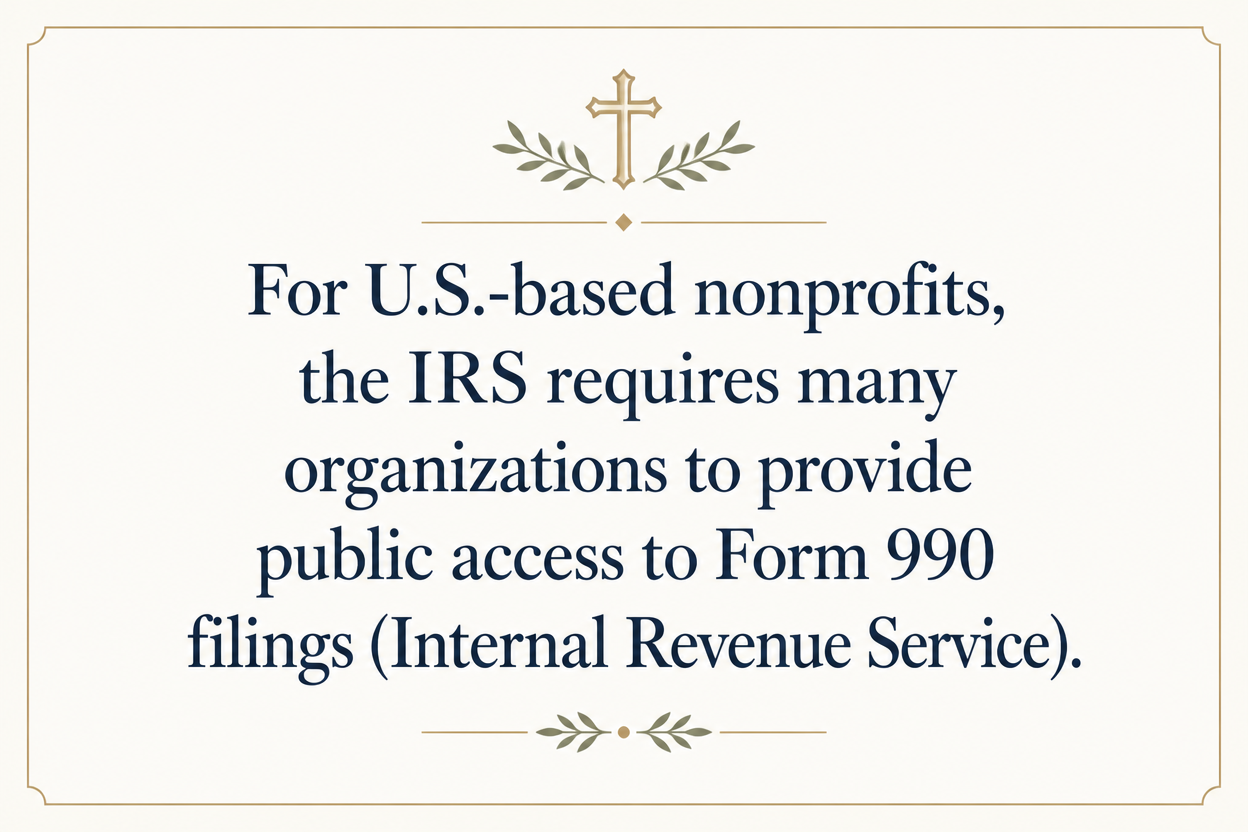
For U.S.-based nonprofits, the IRS requires many organizations to provide public access to Form 990 filings (Internal Revenue Service). Donors should not have to plead for basic compliance documents. If a ministry is not required to file a 990 (for example, certain churches or church-integrated entities), it can still practice donor-grade transparency through audited statements, governance disclosures, and clear reporting norms.
How to interpret “cost per Bible” and similar unit metrics
Unit metrics can be helpful, but only if defined carefully. “Cost per Bible” may include printing, shipping, warehousing, customs, local distribution, training for Scripture engagement, and security measures. Or it may refer only to the printing invoice. A responsible ministry defines what is and is not included, reports the range across regions, and explains volatility drivers such as paper prices, freight spikes, and currency shifts.
Donors should also watch for category games. If “program” includes a large share of fundraising mail, or if overseas partners are functionally controlled but reported as independent grants without appropriate disclosure, the financial picture can be distorted. These are not merely technicalities. They affect whether the ministry’s public claims accurately represent what donor funds accomplish.
Fundraising practices and the dignity of the donor
Fundraising integrity is part of transparency. Christian donors should expect truthful appeals that avoid manipulation: no inflated urgency, no guaranteed conversions, no selective photos that imply consent where there is none, and no claims that cannot be substantiated. The harder question is whether the ministry’s culture treats donors as partners in stewardship or as revenue sources to be managed. Ministries that meet The Most Trusted Standard tend to communicate with restraint and clarity, because their confidence rests on verifiable work rather than rhetorical pressure.
Governance and leadership signals that protect donor intent
Governance is where accountability becomes durable. An honest founder can still build an unaccountable system; a competent board can prevent that. For Bible distribution ministries, governance quality often predicts whether the organization can scale without compromising ethics, whether it can withstand external pressure, and whether it can correct course when impact reporting reveals weaknesses.
A real board, not a ceremonial one
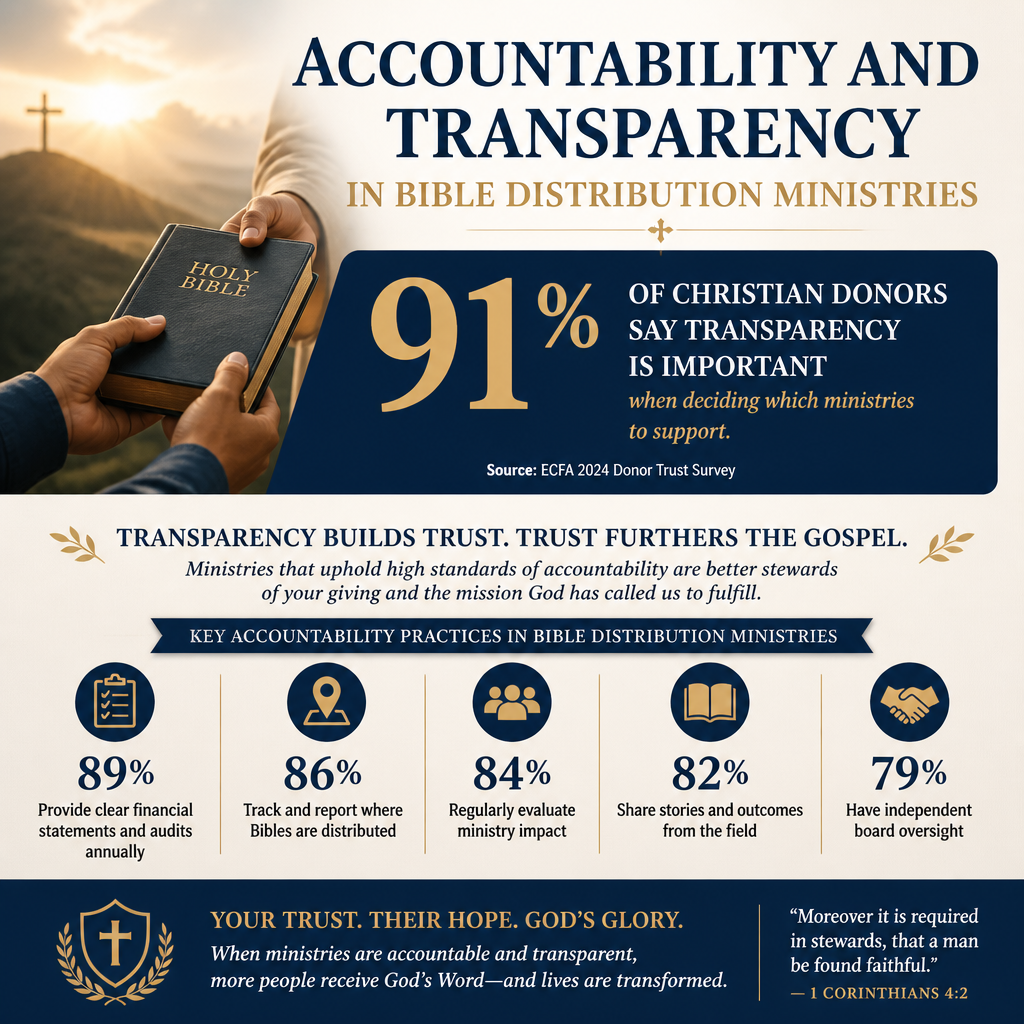
Serious accountability requires a board that is independent enough to supervise leadership, set policy, and demand accurate reporting. Warning signs include boards dominated by employees, family members, or close financial dependents; vague or missing board information; and an absence of documented oversight practices such as conflict-of-interest policies and minutes that reflect real deliberation.
Donors can ask directly: Who is on the board? How often do they meet? What committees exist for finance and audit oversight? How are executive compensation and related-party transactions reviewed? These are ordinary governance questions, not adversarial ones. Ministries that are worthy of trust can answer without defensiveness.
Related-party transactions and the discipline of disclosure
Bible distribution ministries sometimes rely on vendors for printing, logistics, and technology. In some cases, those vendors are connected to leaders or board members. Such arrangements are not automatically wrong, but they require heightened scrutiny: competitive bidding or clear market comparisons, documented board approval, and transparent disclosure. The issue is whether decisions are made for mission effectiveness and stewardship, or for private benefit.
International partnerships and the problem of “downstream opacity”
Many Bible distribution models depend on local partners: churches, networks, or indigenous ministries. This can be a strength when it honors local agency and reduces paternalism. It can also create “downstream opacity,” where a U.S. donor receives confident impact claims without any credible mechanism for verifying what happened after funds were transferred. Responsible ministries address this with written partner agreements, controls for cash handling, third-party monitoring where appropriate, and clear documentation of how partner selection and accountability function.
Those seeking broader context on how Bible distribution work commonly operates can reference Bible Distribution Ministries as a starting point for comparing models, risks, and reporting norms.
Impact reporting that is honest about what can and cannot be measured
Donors rightly want to know whether Bibles are getting into hands, being read, and bearing fruit. The desire is sound. But impact reporting in Bible distribution is contested terrain. Christians genuinely disagree about which outcomes should be emphasized, how directly they can be attributed, and where spiritual fruit resists quantification. Mature transparency does not pretend that every distribution equals discipleship. It reports what is known, how it is known, and what remains uncertain.
Outputs, outcomes, and the temptation to overclaim
Outputs are countable activities: Bibles printed, shipped, distributed, languages translated. Outcomes are effects: increased Scripture engagement, sustained reading habits, church planting support, strengthened local leaders. Both matter, and they are not interchangeable. A ministry can distribute large quantities and still fail to reach intended recipients, or distribute effectively but without durable engagement.
Responsible ministries separate these categories in reporting and avoid implying that distribution numbers prove spiritual transformation. They may include testimonies, but testimonies should not replace measurement; they should illustrate, not certify.
What “gospel impact” can responsibly mean
In Bible distribution, “gospel impact” is often used loosely. A careful ministry defines the term and ties it to observable indicators: partner church follow-up, Scripture engagement program participation, small group formation, literacy support where needed, and longitudinal sampling that checks whether materials are still present and used months later. None of these indicators are perfect; they are still more honest than relying on impressions.
Where data collection could endanger believers, ministries should say so plainly and explain what alternative verification methods they use. Security constraints can limit public disclosure, but they should not eliminate internal measurement, board-level oversight, or donor-grade accountability provided under appropriate confidentiality.
Fundraising red flags donors should not ignore
Across our verification work, several patterns regularly correlate with weak transparency. Ministries may promise implausibly low costs, present “100% to the field” language without clarifying what pays for fundraising and administration, or report impact in round numbers that never change across years. Others emphasize the charisma of a leader while discouraging questions about controls, audits, or governance.
Donors should also be cautious when ministries refuse to answer straightforward questions: How are restricted gifts tracked? What is the policy for reserves? What happens when a shipment is delayed or seized? How are partners vetted? How does the board respond to a whistleblower complaint? The goal is not to find fault. The goal is to ensure that generosity is anchored to truth.
Accountability that strengthens trust and advances the mission
Accountability and transparency in Bible distribution ministries ultimately serve the same end as the ministry itself: faithful witness. When reporting is clear, governance is competent, and impact claims are restrained by evidence, donors can give without anxiety and ministries can correct course without shame. The work of putting Scripture into the hands of people who need it deserves that kind of seriousness.
Most Trusted’s role is to bring independent verification to a field where sincerity is common but documentation varies widely. Donors should insist on ministries that welcome scrutiny, explain their numbers, and tell the truth about outcomes. That is not cynicism. It is stewardship worthy of the gospel we seek to honor.



