
Trauma-informed care shapes Christian adoption ministry because adoption is almost always preceded by loss, and loss has consequences in the body, the brain, and the spiritual imagination. Christian donors often feel the weight of James 1:27 and the urgency of family-based care, yet the field has learned that good intentions can deepen wounds when ministry practices ignore trauma dynamics. The question is not whether we will “care,” but whether our care will be wisely ordered toward healing and permanence.
Across Christian adoption work, we also see a persistent tension: donors rightly want a child to be safe and cherished, but the path to safety is rarely linear. Trauma-informed practice does not replace the gospel; it clarifies what love requires when a child’s nervous system has been trained by fear, unpredictability, and rupture. Ministries that treat trauma as a side issue tend to drift toward quick fixes and mismatched expectations, which can harm families and undermine long-term outcomes.
Trauma-informed is not a branding term but a moral and theological claim
What trauma-informed care actually means
“Trauma-informed” is sometimes used loosely, but its core premise is straightforward: past trauma shapes present behavior, and caregivers should respond in ways that promote safety, agency, and connection rather than escalation and shame. A widely used framework comes from the Substance Abuse and Mental Health Services Administration, which defines a trauma-informed approach through principles such as safety, trustworthiness, peer support, collaboration, empowerment, and attention to cultural and historical factors (SAMHSA). For Christian adoption ministries, these principles matter because they translate compassion into concrete practice.
What this means in practice is that a child’s defiance, withdrawal, food-hoarding, or controlling behavior is not first interpreted as “badness” to be corrected, but as communication shaped by survival strategies. Discipline still matters, but trauma-informed discipline begins with regulation and relationship. It asks what the child’s body is saying before it demands what the child’s will must do.
How Christian theology strengthens rather than competes with trauma science
Christians do not need to baptize every psychological construct. Yet Scripture’s moral realism about suffering, fear, and the heart’s formation gives donors a sturdy framework for understanding trauma without reductionism. The Psalms give language for dysregulation and dread; the Gospels show Jesus attending to embodied persons, not disembodied problems; and the New Testament repeatedly frames maturity as something formed over time through patient endurance.
Trauma-informed care also guards against a subtle theological error that adoption ministries sometimes encounter: treating family placement as a complete solution rather than a context for sanctified healing. Adoption can be a profound gift, but it does not erase history. Christian hope is not denial; it is confident truth-telling under God.

Adoption begins with loss, and ministries must name that loss
Loss is part of the story even in the best-case scenario
Christians genuinely disagree about how to describe the adoption narrative in donor communications. Some emphasize redemption and belonging; others emphasize grief and complexity. A trauma-informed posture insists that we can speak of both without contradiction. A child may be truly loved by adoptive parents and still grieve birth family, language, culture, and early attachments.
Research on adverse childhood experiences has helped the broader child welfare field name how early adversity correlates with later health and behavioral challenges. The original ACE study by Felitti and colleagues documented graded associations between childhood adversity and later outcomes, shaping how many clinicians and child welfare leaders think about risk and resilience (CDC). Donors do not need to turn adoption into a medicalized problem, but they should expect ministries to be literate about risk factors and protective factors.
Attachment is not automatic, and disappointment can become spiritualized
One of the most painful moments for adoptive families is realizing that affection and trust are not guaranteed simply because parents are committed. A trauma-informed ministry prepares families for attachment work that can take years, not weeks. It refuses the cruel logic that if love is sincere, the child should respond quickly.
This is where donors can unintentionally pressure ministries. When fundraising narratives imply that adoption is a clean before-and-after story, families may feel isolated when the “after” includes rage, regression, and fear. Trauma-informed care shapes not only training and clinical partnerships, but the moral honesty of donor-facing communication.
Trauma-informed ministry requires different program design and different metrics
From placement activity to post-placement endurance
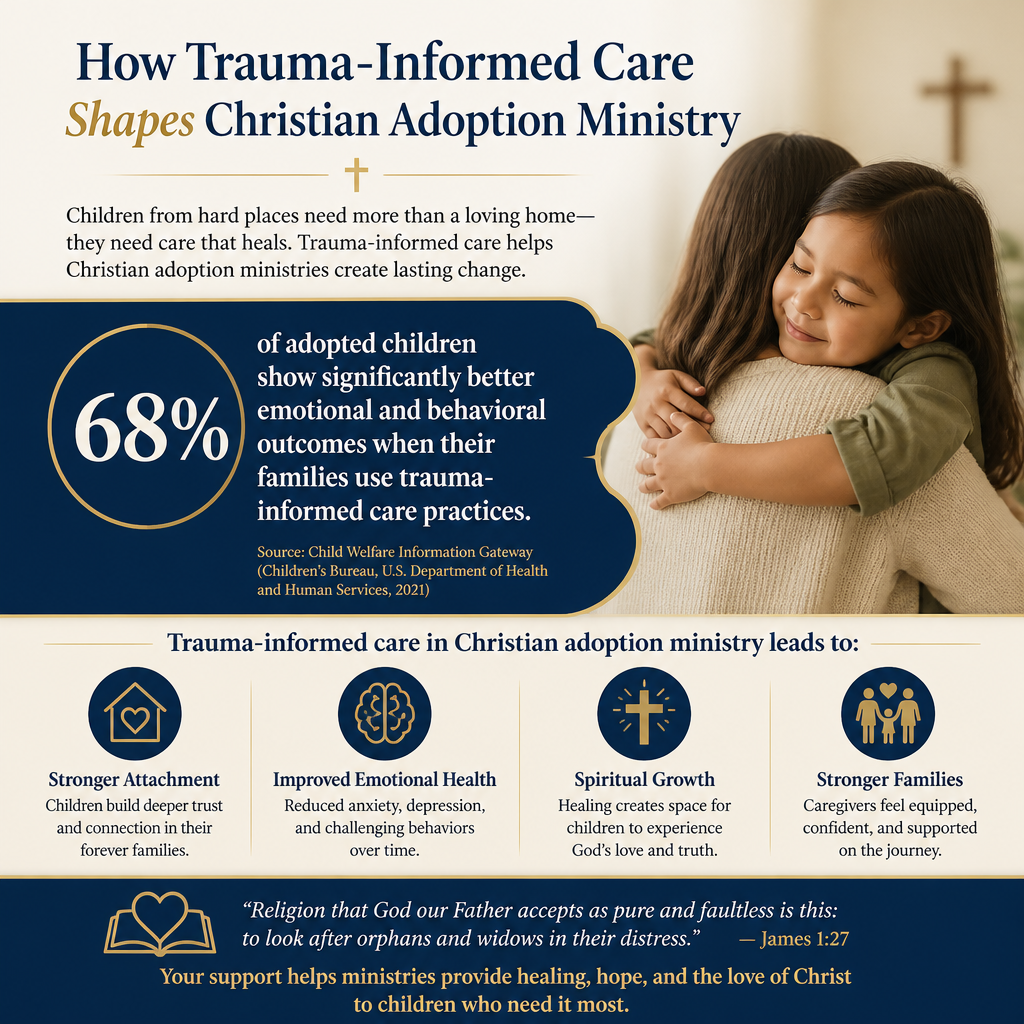
Adoption ministries have historically been evaluated by activity measures: home studies completed, placements made, fees reduced, dossiers processed. Those measures can matter, but they are not sufficient. Trauma-informed design puts weight on what happens after placement: parent coaching, respite coordination, referral networks for trauma-competent therapy, and pathways for children who need higher levels of care.
Here the field has learned from painful examples outside adoption as well. The “When Helping Hurts” framework, articulated by Corbett and Fikkert, helped many Christian donors recognize that assistance can unintentionally reinforce dependency or disempower local agency. Adoption ministry can fall into a similar pattern if it treats families as recipients of a transaction rather than stewards of a long, costly vocation. Trauma-informed care resists transactional thinking by designing for formation over time.
What mature ministries track and what they refuse to promise
Because each child’s story is unique, serious ministries are cautious about simplistic outcome claims. Still, they can track meaningful indicators without sensationalism: stability of placements, family support utilization, caregiver retention in training programs, and timely access to qualified clinical services. They can also publish clear boundaries: what they do, what they do not do, and where they refer out.
Donors looking for ministry depth should expect to find careful language about disruption and dissolution risk, as well as honest reporting on how the organization responds when placements destabilize. A trauma-informed ministry does not hide suffering to protect its image; it treats truthfulness as part of care.
What donors should look for when evaluating trauma-informed adoption ministries
Governance and operational signals that care is truly trauma-informed
Christian donors often ask how to distinguish sincere rhetoric from practiced competence. Across our verification work at Most Trusted, we find that ministries aligned with The Christian Mission Behind Adoption Ministries tend to show trauma-informed commitments in governance, staffing, and financial decisions, not only in program brochures. Trauma-informed care costs money: training, supervision, clinical partnerships, and post-placement supports are not incidental expenses.
What this means in practice is that donor diligence should include questions that reach beyond the heartwarming narrative. Does the organization have a written safeguarding policy? Do staff and volunteer roles have clear boundaries? Are adoptive parents prepared for secondary trauma and caregiver burnout? Are there referral relationships with clinicians trained in evidence-informed trauma therapies, and are those relationships accessible across socioeconomic lines?
A short donor checklist for serious due diligence
- Clear, public commitments to child safety, trauma-aware practice, and ethical storytelling, including how photos and testimonies are used
- Required training for staff and families that addresses attachment, grief, and behavioral support, not only adoption logistics
- Post-placement supports with defined cadence and escalation pathways, including respite options and crisis planning
- Transparent financial practices, including how fees, grants, and designated gifts relate to actual program costs
- Governance structures that demonstrate accountability, including independent oversight and conflict-of-interest safeguards
When donors want a consistent framework for evaluation, our work at Most Trusted applies The Most Trusted Standard, a 15-criteria framework across Faith Foundation, Financial Integrity, Governance and Leadership, and Transparency and Effectiveness. The point is not to reduce ministry to a scorecard, but to help donors give with confidence by identifying organizations where compassion is matched by disciplined stewardship.
Trauma-informed care reshapes how ministries speak about birth families and power
Ethical adoption requires moral clarity about coercion and poverty
The field has had to reckon with hard realities: not every adoption system is immune to coercion, and not every family separation is unavoidable. Christian donors often want to prevent child trafficking and ensure ethical practice, but the mechanisms of harm can be subtle—financial pressure, misinformation, lack of legal representation, and cultural dynamics that silence vulnerable parents. Trauma-informed care widens the lens beyond the child’s trauma to include family systems and power.
One reason donors should take this seriously is that child welfare decisions are frequently intertwined with poverty. In the United States, the U.S. Department of Health and Human Services reports that neglect is the most common type of maltreatment in substantiated cases, a category that can intersect with material hardship and inadequate supports (Administration for Children and Families). This does not minimize real abuse; it clarifies why ethical ministries invest in prevention and family preservation when safe and appropriate.
Trauma-informed communication refuses savior narratives
Christian adoption is often described with the language of rescue. Scripture does speak of salvation, deliverance, and God’s adopting love. Yet trauma-informed ministry is careful with “rescue” as a donor-facing frame, because it can obscure the dignity of birth families, simplify complex legal realities, and set adoptive parents up for unrealistic expectations of gratitude and quick attachment.
Ministries that communicate with integrity will honor children and families as image-bearers rather than props for fundraising. They will avoid sharing identifiable details that compromise privacy or expose a child’s story for public consumption. Donors should treat ethical storytelling as a spiritual matter: truth spoken without exploitation.
FAQs for How trauma-informed care shapes Christian adoption ministry
Is trauma-informed care compatible with a biblical view of sin and responsibility?
Yes, when it is practiced with theological clarity. Trauma-informed care explains how fear, loss, and early adversity can shape behavior and relational patterns; it does not remove moral agency from children or parents. Christian ministry can affirm responsibility while also recognizing developmental capacity, the need for safety, and the slow work of formation. Wise ministries integrate trauma awareness with discipleship, boundaries, and restorative practices rather than replacing them.
What should donors fund if they want to strengthen trauma-informed adoption outcomes?
Donors can prioritize organizations that fund what families actually need after placement: training, clinical referral access, respite care, crisis response, and long-term coaching. It is also prudent to support ministries that invest in ethical practice upstream, including counseling for expectant parents, legal integrity, and family preservation supports when safe and appropriate. Donors who want added confidence can consult Christian Adoption Ministries and look for ministries whose governance, finances, and reporting align with serious verification expectations.
A more faithful adoption ministry is a more trauma-literate one
Trauma-informed care is not an optional specialty for Christian adoption ministry; it is a concrete expression of love of neighbor when the neighbor is a child carrying grief, fear, and confusion into a new home. Donors do not serve these families well by funding speed and sentiment. We serve them by strengthening ministries that tell the truth, safeguard the vulnerable, and sustain families for the long obedience of healing.



