
Why Christian addiction recovery requires long-term discipleship is not a marketing preference or a programmatic flourish. It is a theological and pastoral claim: addiction is rarely only a behavior to be interrupted, but a captivity that often entangles the whole person, including habits of worship, patterns of relationship, and the stories people tell themselves about God and their own worth.
Donors tend to fund what can be counted—beds, meals, counseling sessions, graduation rates—and those measures have their place. But the church has always understood that the deepest change is formation over time: “we all…are being transformed into the same image from one degree of glory to another” (2 Corinthians 3:18). Recovery ministries that treat discipleship as a short on-ramp rather than a long road often see the same cycle repeat: initial stabilization followed by isolation, relapse, shame, and disengagement from community.
Addiction is not merely a crisis of self control but of worship and belonging
Discipleship names the spiritual reality without denying the clinical one
Christians genuinely disagree about how to describe addiction: disease, disorder, sin, trauma response, or some combination. The most faithful ministries do not reduce the person to a single explanatory frame. They acknowledge that substance use disorders have well-documented neurobiological components and powerful environmental drivers, while also taking Scripture seriously when it speaks of bondage and freedom.
Paul’s language in Romans 6 is not clinical, but it is precise about moral captivity: “you are slaves of the one you obey” (Romans 6:16). Long-term discipleship matters because it addresses the whole field of obedience—what people love, fear, hope for, and cling to when pain presses. That work rarely happens in a brief program window. It is learned in community, reinforced through repeated practice, and sustained by a credible gospel that can bear the weight of suffering without offering false promises.
Recovery requires a new community with durable commitments
Addiction thrives in isolation, and isolation is not merely physical. It can be relational (burned bridges), spiritual (alienation from God), and practical (unstable housing and employment). A short-term intervention can interrupt harm, but it often cannot rebuild a life.
In the United States, overdose death rates remain a sobering indicator of the scale and lethality of substance misuse, with more than 100,000 drug overdose deaths annually in recent years according to the CDC’s National Center for Health Statistics (CDC NCHS). That reality does not prove that every ministry must run multi-year programs, but it does argue against simplistic timelines. When risk is that high, the church should not be surprised that lasting change often requires long-term care.

Short-term stabilization is necessary but rarely sufficient
Detox and early sobriety address acute danger, not settled patterns
Many donors rightly prioritize immediate, life-preserving work: detox referrals, emergency shelter, medical coordination, and crisis counseling. These are acts of mercy. Yet early sobriety is often a season of intense volatility—sleep disruption, emotional dysregulation, fractured relationships, and exposure to old triggers. Stabilization deals with the emergency; discipleship deals with the person who will still wake up tomorrow with a history, cravings, and an environment that may not have changed.
What this means in practice is that a ministry can have a “successful” short-term outcome and still fail its people. If someone completes a 30- or 90-day program and returns to the same isolating context with minimal spiritual and relational scaffolding, the program may have delivered services without building endurance.
Formation takes time because the body learns as well as the mind
Christian discipleship is not only instruction; it is apprenticeship. Scripture repeatedly assumes that habits are formed through repeated practice: prayer learned by praying, confession learned by confessing, reconciliation learned by doing the hard work of repair. Recovery adds another layer: the body has learned to expect chemical relief, and that expectation is reinforced through repetition and memory.

Research on relapse underscores how persistent vulnerability can be even after treatment. The National Institute on Drug Abuse has long emphasized that addiction is a chronic condition and that relapse rates for substance use disorders are comparable to other chronic illnesses, while also noting that relapse does not mean treatment has failed (National Institute on Drug Abuse). A long-term discipleship model fits that reality: it normalizes persistence, creates processes for repair after failure, and refuses to equate a setback with the end of belonging.
Long-term discipleship aligns with the church’s doctrine of sanctification
Sanctification is gradual, communal, and often costly
Christian donors sometimes feel a tension: we want measurable impact, yet the New Testament describes growth as progressive and uneven. Sanctification is not an event; it is a life. The Gospel of John uses the language of abiding—remaining, dwelling, continuing—not completing a course (John 15:4–5). For many struggling with addiction, “abiding” first looks like staying in the light when shame urges concealment.
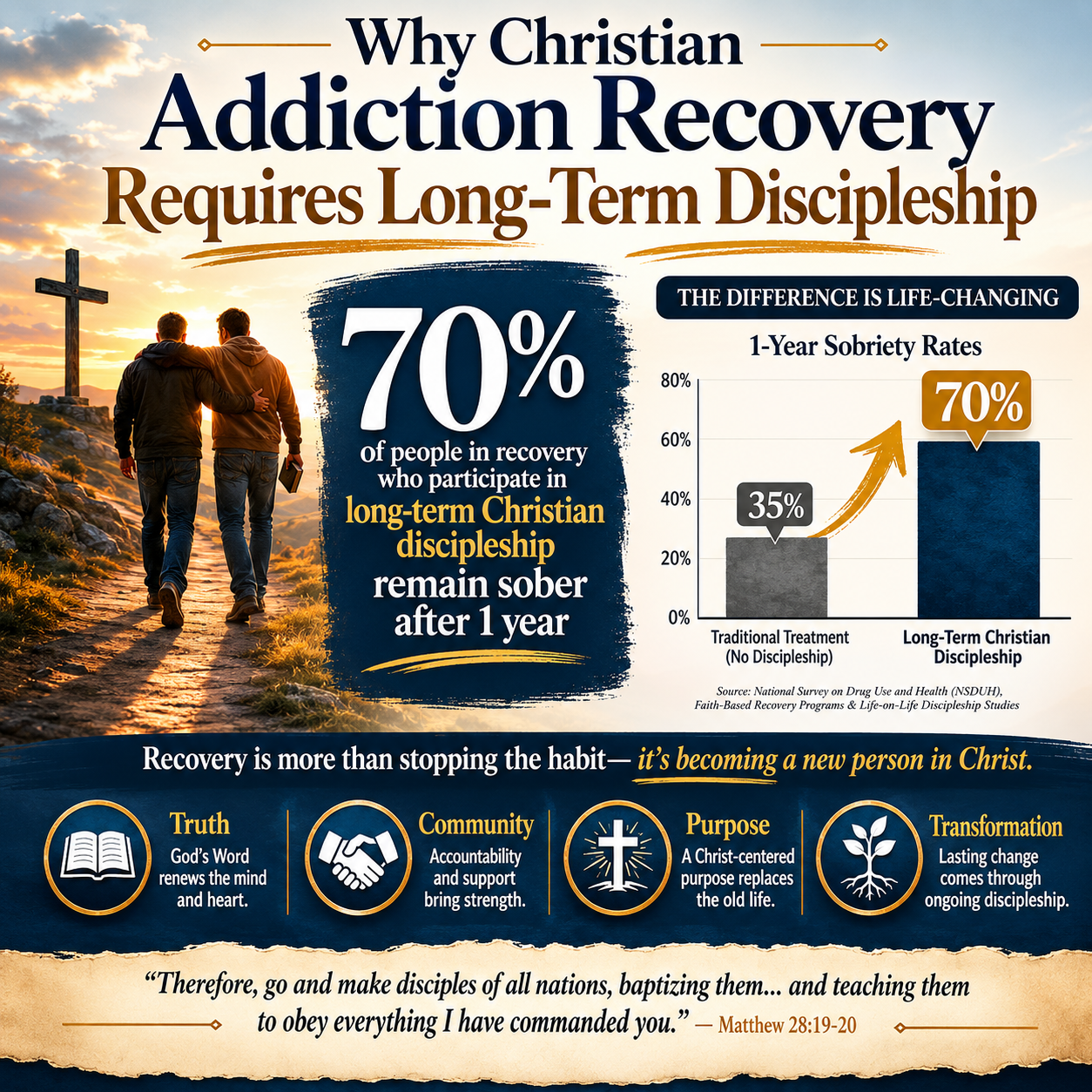
Ministries that treat recovery as a discipleship question tend to build pathways that last beyond the first win: mentorship, small groups, church integration, vocational support, and ongoing counseling. These are not add-ons to the “real” work. They are the work, because they create the relational and spiritual context in which new obedience can take root.
Discipleship safeguards the gospel from becoming mere self-improvement
One of the risks in the recovery space is that Christian language can be used to baptize therapeutic self-optimization. Discipline, accountability, and habit change matter. But without the gospel, the center of gravity shifts toward performance and away from grace. That shift is especially dangerous for people already fluent in shame.
Long-term discipleship keeps the ministry anchored to a different story: forgiveness that is real, adoption that is secure, and power that is made perfect in weakness (2 Corinthians 12:9). A program can teach coping skills quickly. It takes longer to trust that God’s love is not suspended during struggle.
What discerning donors should look for in recovery ministries
Program design that makes room for time, not just intensity
Not every ministry can offer multi-year residential care, and not every participant needs the same level of structure. The question is whether the ministry’s model assumes that discipleship is long-term even when a particular intervention is short-term. In our coverage of Christian Addiction Recovery Ministries, we see the strongest organizations build continuity: clear next steps, ongoing pastoral care, and explicit partnerships with local churches and clinicians.
The harder question is how to recognize depth without mistaking complexity for quality. A ministry can have many components and still lack theological and organizational integrity. Donors should ask whether the ministry’s approach is coherent: do its spiritual claims match its practices, and do its practices match what is known about addiction and trauma?
Signals of credibility under The Most Trusted Standard
At Most Trusted, we evaluate Christian nonprofits against The Most Trusted Standard, a 15-criteria framework spanning Faith Foundation, Financial Integrity, Governance and Leadership, and Transparency and Effectiveness. In recovery work, these categories are not bureaucratic hurdles; they protect vulnerable people and the donors who support them.
As donors consider a recovery ministry, several indicators are particularly consequential:
- Clear discipleship pathway that extends beyond a single program phase and includes church integration rather than parallel “ministry-only” community.
- Appropriate clinical partnership when medical detox, psychiatric care, or medication-assisted treatment is relevant, with clarity about what the ministry provides directly.
- Safeguards for participants, including trauma-informed practices, background checks for mentors, and transparent grievance processes.
- Financial transparency that explains how residential, counseling, and follow-up costs are sustained without manipulative fundraising.
- Outcome humility that reports what can be verified and resists spiritualized claims that imply guaranteed results.
Many donors have been trained to focus on overhead ratios. The nonprofit sector has repeatedly warned that this can distort decisions and harm effectiveness; Charity Navigator, Candid, and the BBB Wise Giving Alliance jointly cautioned against overemphasizing overhead as a proxy for performance (Charity Navigator). Recovery discipleship is labor-intensive by nature. If a ministry’s numbers appear unusually “lean,” donors should ask what is being underfunded: supervision, follow-up, staff care, or participant safeguards.
Long-term discipleship raises hard questions and ministries should answer them plainly
What about relapse, medication, and the complexity of change
Christians genuinely disagree about some disputed questions in recovery ministry, and serious organizations do not pretend those debates do not exist. Medication-assisted treatment, for example, is embraced by many clinicians and some faith-based programs, questioned by others, and often misunderstood by the public. A donor does not need to adjudicate every clinical detail, but donors should expect ministries to state their convictions clearly and to show that their approach is both pastorally responsible and medically informed.
Relapse is another pressure point. A ministry that promises linear progress may attract donors, but it will often fail participants. Long-term discipleship creates a context where repentance can be practiced without exile, where consequences can be upheld without severing relationship, and where truth-telling is treated as a step toward light rather than a trigger for rejection.
How ministries protect participants from dependence on the program
There is also a legitimate concern about prolonged programs: the possibility of fostering dependency on the institution rather than maturity in Christ and rootedness in a local church. A long horizon is not automatically virtuous. Duration can become a substitute for clarity, and structure can become control.
The healthiest models treat the ministry as scaffolding, not as a permanent identity. They aim for increasing responsibility, transferable spiritual practices, and sustained relationships that do not rely on residential status. For donors comparing models, it is wise to consider whether the ministry’s leadership has articulated a theology of the church and a practical plan for helping people belong within it. Our work reviewing How Christian Addiction Recovery Programs Work repeatedly shows that handoffs to local churches are one of the most fragile points in a recovery journey, and also one of the most decisive.
FAQs for Why Christian addiction recovery requires long-term discipleship
Is long-term discipleship the same as long-term residential treatment?
No. Long-term discipleship refers to sustained spiritual formation in community, often extending well beyond a residential phase. Some people need extended residential structure; many do not. What matters is whether the ministry has a credible plan for ongoing pastoral care, accountability, and belonging after the initial stabilization period.
What outcomes should Christian donors expect from discipleship-centered recovery ministries?
Donors should expect ministries to report outcomes with humility and clarity: retention, participation in follow-up care, employment or education progress where relevant, reconnection with family when appropriate, and evidence of church integration. Donors should be wary of ministries that imply guaranteed sobriety or that treat relapse as proof of spiritual failure rather than as a signal for renewed care and accountability.
A faithful recovery ministry plans for years because it serves whole lives
Why Christian addiction recovery requires long-term discipleship is ultimately a question about what the church believes people are: not problems to be managed, but image-bearers to be restored. The gospel forms men and women over time, through ordinary means of grace, in the company of other sinners being remade. Donors serve that work well when they fund ministries that tell the truth about addiction’s complexity, provide sustained community, and submit their spiritual ambition to verifiable integrity.



