

How Christian addiction recovery ministries report impact is not a secondary administrative concern; it is a spiritual and moral question about truth-telling. Donors who fund recovery work are underwriting moments of profound vulnerability, and Scripture consistently treats integrity in speech and practice as a matter of discipleship, not marketing.
Addiction recovery is also unusually difficult to measure well. Relapse can be part of the story without being the end of it. Spiritual formation can be real without being reducible to a numeric outcome. Yet complexity is not an excuse for vagueness. Christian donors need ministries to report impact in ways that are both theologically coherent and empirically responsible.
Impact reporting begins with a faithful definition of success
Recovery is more than abstinence and less than a testimony moment
Most ministries in this space hold several goods together: sobriety, mental and physical health, restored relationships, steady work, and reconciliation with God. Those goods are not interchangeable, and they do not always move in a straight line. A ministry can be faithful and still have participants who relapse; a ministry can be busy and still fail to produce durable change. Christian impact reporting should not collapse into either triumphalism or cynicism.
A credible report defines what the ministry aims to change and for whom, using terms that can be observed. “Discipleship” can be part of the aim, but it should be articulated as practices and markers the ministry actually pursues: church connection, participation in Scripture and prayer, accountability relationships, and a theology of repentance and ongoing sanctification. James’s warning against a faith that is only verbal is not a mandate for performative metrics, but it does require that claims about fruit have substance (James 2:17).
Time horizons should match the realities of addiction
Addiction recovery rarely conforms to donor reporting cycles. Many programs responsibly report outcomes at discharge, then again at 3, 6, or 12 months. That is not because funders like dashboards; it is because durability matters. When a ministry reports only what happened during a 30- or 90-day stay, donors should ask what is known about outcomes after participants return to work, family stress, and temptation.
National research illustrates why time horizon matters. The National Institute on Drug Abuse has summarized evidence that relapse rates for substance use disorders are comparable to rates for other chronic illnesses, underscoring the need to think in long-term trajectories rather than single moments of change National Institute on Drug Abuse.

Better numbers come from better systems, not better storytelling
Programs should distinguish outputs, outcomes, and transformation claims
Outputs are what a ministry does: beds provided, counseling hours, group meetings, mentoring sessions, job-readiness classes, transportation rides. Outputs matter because they show whether a program is active and accessible. Outcomes are what changes: sustained sobriety, employment, stable housing, reduced emergency room utilization, family reunification, church engagement. Christian ministries may also speak of transformation, but transformation claims should be tethered to observable outcomes and clearly described spiritual practices.
The ministries that report impact well usually have a basic measurement architecture: intake assessment, ongoing documentation, discharge planning, and follow-up. They also know what they can and cannot claim. If follow-up contact rates are low, a responsible report says so rather than implying comprehensive knowledge.
Standard tools can help, but they must be used with care
Some ministries use validated screening and assessment tools for substance use severity, depression, trauma symptoms, or readiness for change. Others track drug test results, attendance, and treatment engagement. The point is not to imitate clinical research; it is to avoid the common failure mode of claiming results without evidence. Donors should welcome ministries that use tools appropriate to their setting and staff competence, and that protect dignity and confidentiality.
There is also a theological boundary here. Data gathering must not become surveillance. Recovery ministry involves confession, shame, and the slow work of trust; measurement practices should reinforce safety, not undermine it. A mature organization can explain why it collects what it collects, and why it refuses to collect what would be intrusive.
Christian donors should expect transparency about attribution and limits
Not every good outcome can be credited to the ministry
Recovery outcomes are affected by family systems, mental health care access, medication, local labor markets, criminal justice involvement, and the presence or absence of a healthy church. Ministries that treat themselves as the sole cause of every success do not understand their own field. By contrast, ministries with credibility often describe their work as one part of an ecosystem and report what they can reasonably attribute to their program activities.
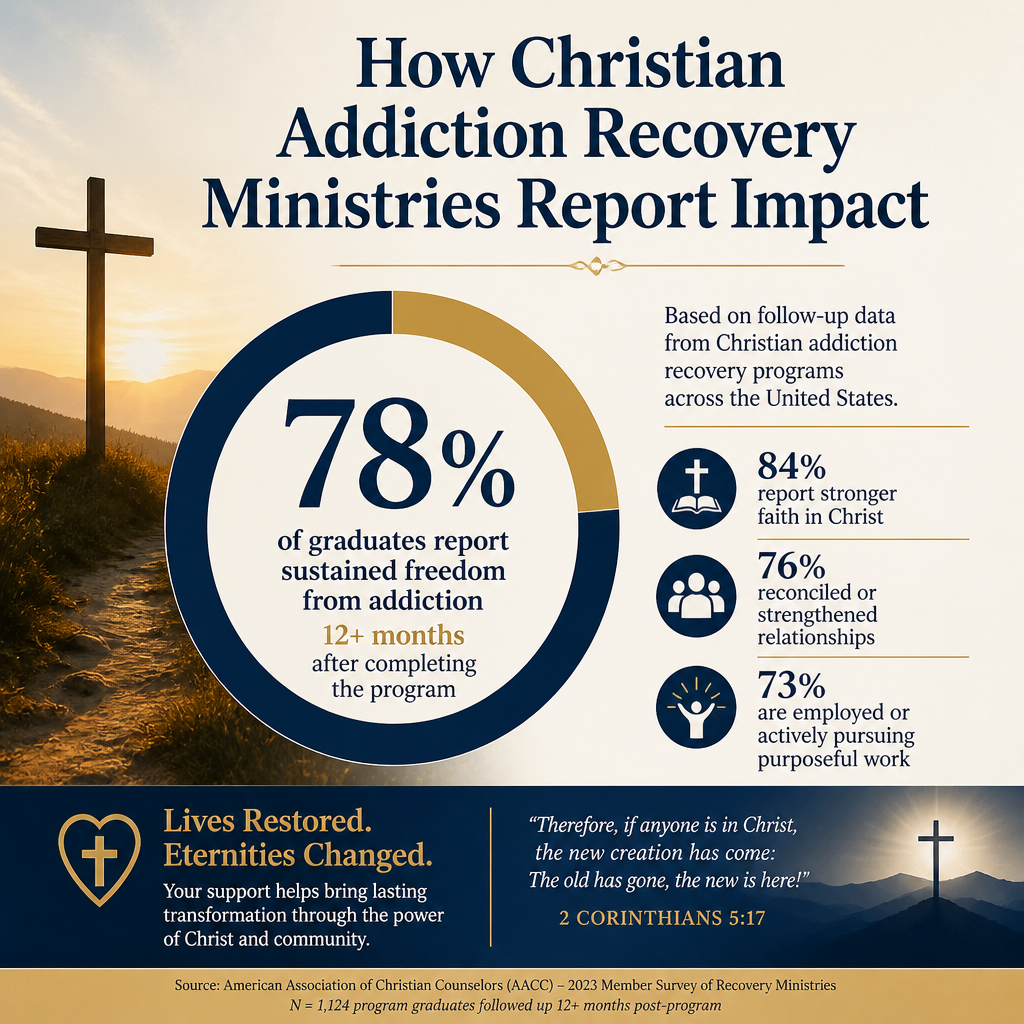
That posture is not a retreat from faith. Christians believe God acts. But Christian humility also recognizes that God’s providence includes many means, and that boasting in outcomes we did not produce is a form of falsehood. Impact reporting should sound like truth, not like a fundraising pitch.
Follow-up rates and missing data should be disclosed
Some programs lose contact with graduates. People relocate. Phone numbers change. Shame keeps some from returning calls. A ministry does not become untrustworthy because follow-up is hard; it becomes untrustworthy when it hides that reality. Donors can interpret results only if they know how many former participants were reached and what definitions were used.
When donors want a deeper view of how organizations in this field handle public disclosure, we encourage reviewing How to Give Wisely to Christian Addiction Recovery Ministries as a reference point for the kinds of transparency practices that tend to withstand scrutiny.
What strong impact reporting usually includes in practice
A short list of elements donors can ask for
Across our verification work at Most Trusted, the reporting that best serves donors and beneficiaries is rarely flashy. It is consistent, defined, and honest about trade-offs. It typically includes:
- Clear definitions for key terms such as “graduate,” “completed,” “relapse,” and “aftercare engaged.”
- Outcome measures that extend beyond program completion, including follow-up intervals.
- Contextual information on participant population and risk level at intake.
- Disclosure of follow-up contact rates and known limitations of the data.
- A description of the program model and how outcomes logically connect to activities.
Financial and governance transparency are part of impact credibility
Impact claims do not stand alone. They sit inside an organization’s financial integrity, governance, and disclosure culture. A ministry that cannot provide timely financial statements, that treats its board as ceremonial, or that resists basic questions about safeguarding and accountability is not positioned to make trustworthy outcome claims.
The charitable sector has had to reckon with misguided pressure to judge effectiveness by low overhead alone. The widely-circulated “Overhead Myth” letter urged donors to stop using overhead ratios as the primary measure of performance and to consider results, governance, and transparency instead Candid GuideStar. Recovery ministries often require intensive staffing and aftercare; underfunding administration can hollow out the very systems that make outcomes measurable and care safe.
How The Most Trusted Standard approaches effectiveness in recovery ministries
Verification is not suspicion, and trust is not gullibility
Christian donors often feel the tension between charity and due diligence. Scripture commands generosity, and it also condemns false weights and measures. The Christian tradition has never treated careful stewardship as cold-hearted. It is one way we love neighbors we may never meet, including program participants whose stories should not be used as props.
Most Trusted evaluates ministries against The Most Trusted Standard, a 15-criteria framework that examines faith commitments, finances, governance, and public transparency. For addiction recovery organizations, the effectiveness dimension is not a demand for perfect outcomes; it is a demand for honest definitions, credible measurement practices, and reporting that matches what can reasonably be known.
What we look for when ministries report impact
The ministries that meet The Most Trusted Standard tend to do several things consistently. They state a coherent ministry model, explain how participants are served across time, and provide outcomes with enough methodological clarity that donors can interpret them. They disclose limitations without defensiveness. They also show how spiritual care is offered without coercion, respecting that many participants arrive with complex histories of trauma and institutional harm.
Donors who want to compare organizations across the field may find it helpful to start with Christian Addiction Recovery Ministries, then examine each ministry’s public reporting and the specifics of its program model, aftercare plan, and safeguarding practices.
FAQs for How Christian addiction recovery ministries report impact
Should a Christian recovery ministry report relapse rates?
When a ministry has credible follow-up, relapse data can be an important part of honest reporting, provided definitions are clear and follow-up rates are disclosed. Donors should be wary of ministries that imply relapse never happens, and also wary of ministries that report a single relapse figure without explaining the time horizon, population served, or how relapse was identified. The aim is not to shame participants but to tell the truth about durability and to improve care.
What if a ministry reports mostly spiritual outcomes and very few measurable results?
Spiritual outcomes belong in Christian reporting, but they should be described concretely and paired with observable indicators of stability and care. A ministry can report church connection, participation in discipleship practices, and testimonies with appropriate consent, while also reporting housing stability, employment, engagement in counseling, and aftercare participation. When only spiritual language is offered, donors should ask what the program actually does, what changes it expects, and how it knows those changes are occurring.
A faithful donor response to impact claims
Christian addiction recovery ministries work in a domain where suffering is real, progress is often uneven, and triumphal narratives can do damage. Donors serve the church and the vulnerable best when they ask for impact reporting that is defined, transparent, and anchored in truth. Ministries worthy of support generally welcome those questions, because they understand that stewardship and love of neighbor belong together.



