
How Christian addiction recovery programs work is not primarily a question of techniques, buildings, or bed counts. It is a question of what kind of healing we believe God gives, what kind of change we expect over time, and how a ministry orders its life to support repentance, repair, and durable freedom. Donors can fund good intentions for years without ever funding a coherent pathway to transformation.
In most programs, the field has learned to hold two truths together. Addiction is profoundly spiritual in its slavery and idolatry, and it is also embodied, patterned, and often intertwined with trauma, mental illness, and family systems. Serious Christian recovery ministries refuse the false choice between “it is only sin” and “it is only disease.” They treat addiction as a complex bondage that requires both mercy and truth, both discipleship and disciplined care.
Christian recovery begins with a theological diagnosis and a pastoral posture
The best ministries start with a clear account of the human person. Scripture frames addiction in the language of slavery and freedom: “Everyone who practices sin is a slave to sin” (John 8:34), and yet the gospel promises liberation that is not merely forensic but lived. That theological center matters because it determines whether a program treats people as projects, patients, criminals, or image-bearers.
Most Christian recovery programs build their approach around repentance and faith, but mature programs do not confuse repentance with mere remorse or crisis-driven resolve. They assume relapse is possible, patterns are deep, and change is often slow. Their posture is pastoral: firm boundaries without contempt, and compassion without enabling. That combination tends to be costly to administer and difficult to explain in a fundraising appeal, which is one reason donors should pay attention.
What “Christ-centered” means when it is operational
Many ministries say they are Christ-centered. The more important question is whether that confession is operational. In practice, it shows up in a program’s daily liturgy of life: regular Scripture, prayer, confession, communal worship, and pastoral care that addresses both outward behavior and inward loves. It also shows up in a disciplined understanding of sin and grace: consequences are real, but no one is treated as disposable.
Donors should listen for plain theological clarity. A ministry can affirm orthodox doctrine and still drift into functional moralism (“try harder”) or functional therapeutic deism (“God wants you to feel better”). Programs that work tend to speak about regeneration, sanctification, and the means of grace with specificity, because they actually build the program around those convictions.
How ministries handle co-occurring disorders without surrendering the gospel
Co-occurring mental health conditions are common in recovery populations, and they complicate care planning. The research consensus is that substance use disorders frequently co-occur with mental illness, which means ministries often need partnerships, clinical referral pathways, or licensed staff when appropriate. The National Institute of Mental Health summarizes this overlap and the importance of integrated treatment on its site at NIMH.
Christians genuinely disagree about where to draw boundaries between pastoral care and clinical therapy. A credible ministry names those boundaries, documents referral relationships, and avoids spiritualizing symptoms that require medical attention. At the same time, it refuses a truncated anthropology that treats the human heart as a chemical machine. The gospel addresses the whole person.

Programs work through a formed pathway rather than a single moment
Effective recovery is rarely a single altar call followed by automatic stability. Most programs that endure have a structured pathway: an intake process, a stabilization phase, a period of intensive formation, and a plan for reintegration with ongoing accountability. The details differ, but the logic is similar: people need time in a rightly ordered community to learn new habits of honesty, work, worship, and relationships.
This is where donors can misread what they are funding. The visible elements—classes, chapel, counseling, job readiness—are often the means by which a deeper reality is pursued: a life re-centered on God and re-embedded in the body of Christ. Programs that cannot articulate their pathway tend to drift toward either perpetual crisis management or superficial graduation metrics.
Intake, assessment, and the first weeks of stabilization
Most residential and intensive outpatient ministries begin with a frank assessment: substance history, medical risks, legal constraints, family situation, employment history, trauma exposure, and spiritual background. Some ministries use standardized tools; others rely on clinical interviews and pastoral discernment. Either way, early clarity protects both the participant and the community.
Stabilization includes basic rhythms: sleep, nutrition, work responsibilities, restricted phone access, and clear rules about honesty. Donors sometimes perceive these boundaries as “too strict,” but boundaries are often the first concrete form of love a participant has experienced in years. The goal is not institutional control; it is safety and the rebuilding of trust.
Discipleship, counseling, and the formation of new practices
Christian recovery programs commonly combine biblical teaching, group process, individual counseling, and structured accountability. Some use a 12-step framework with explicitly Christian discipleship; others use Celebrate Recovery or similar models. The framework matters less than whether the ministry builds a coherent culture of confession, truth-telling, restitution when possible, and patient perseverance.
A frequent donor question is whether “faith-based” programs work as well as secular ones. The evidence base varies by population and methodology, and the field has had to reckon with selection effects (who chooses which program) and uneven follow-up data. The point for donors is more basic: ministries should not make inflated claims. They should define what they mean by success and show verifiable evidence that their practices support it.
Relapse, restoration, and hard decisions
Relapse is not inevitable, but it is common enough that responsible ministries plan for it. Some programs have step-down consequences and restoration plans; others require re-entry after a period away. What matters is that relapse is neither excused nor treated as final defeat. Programs that respond with either naïve permissiveness or reflexive expulsion tend to harm participants and staff alike.
Donors should ask how a ministry balances grace with community safety. Residential homes in particular must protect vulnerable residents from active substance use. A trustworthy program explains its policies in writing and applies them consistently, because inconsistency breeds manipulation and resentment.
Christian recovery is sustained by community, not merely programming
Many recovery ministries can run excellent classes and still fail at the deeper work: cultivating a community where truth can be spoken, temptation can be confessed early, and belonging does not depend on performance. Addiction thrives in secrecy and isolation. Recovery requires durable relationships that can bear the weight of relapse risk, shame, and slow growth.
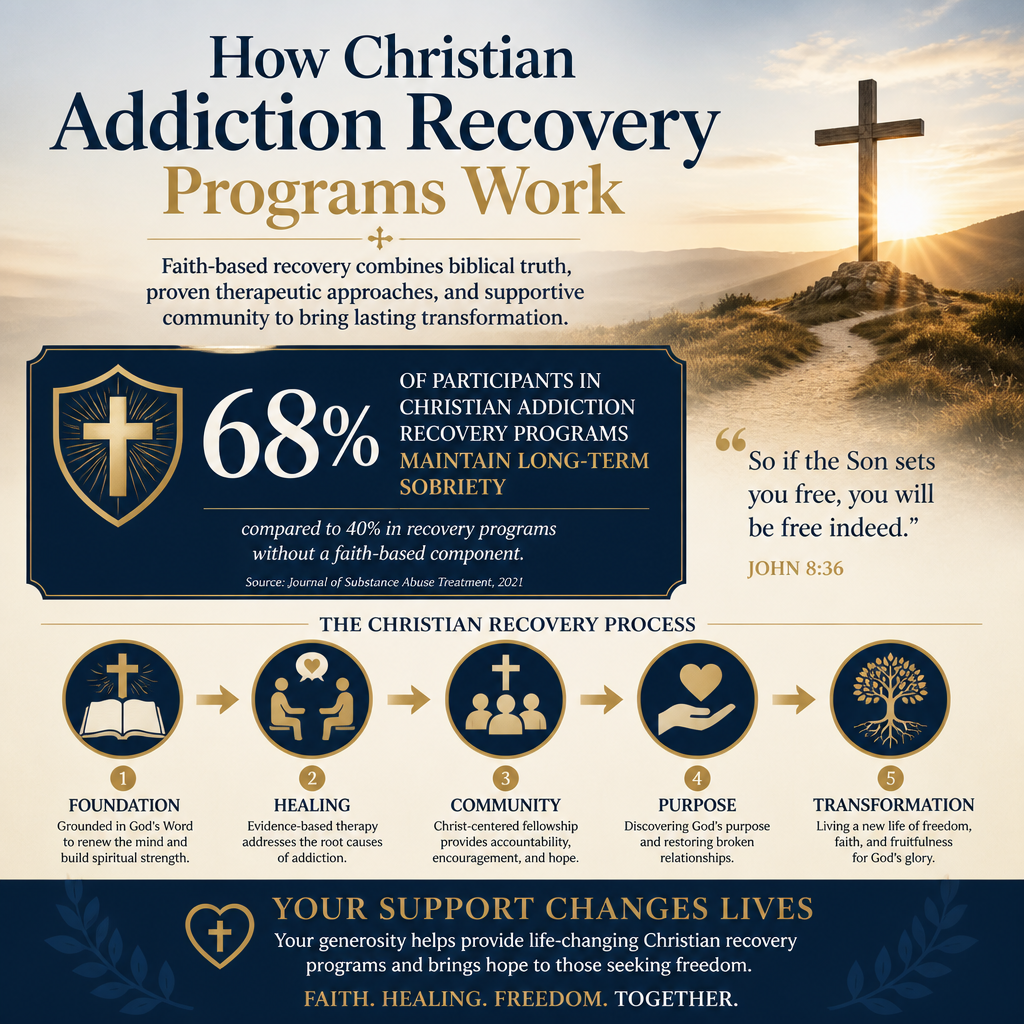
Scripture’s vision is not solitary transformation but incorporation into a people. James instructs believers to “confess your sins to one another and pray for one another, that you may be healed” (James 5:16). That is not a therapeutic slogan; it is ecclesial wisdom. Programs that treat the local church as optional often struggle at the exact point where long-term stability is won.
The role of the local church and why reintegration is fragile
Reintegration is where many outcomes are decided. A participant who leaves a structured environment returns to ordinary pressures: work stress, family conflict, old contacts, loneliness, and the spiritual fatigue that follows early enthusiasm. Ministries that prepare people only for graduation, not for ordinary faithfulness, are often setting them up for discouragement.
Donors should pay attention to whether a ministry has relationships with local congregations, clear expectations for church involvement, and practical bridges into community: transportation, mentoring, small groups, and pastoral follow-up. The strongest ministries treat church connection as part of the program, not a hope for later.
Sober living and the long middle of sanctification
Sober living homes and transitional programs exist because the “long middle” is real. A person may be genuinely converted, sincerely repentant, and still unprepared for full independence. Housing stability, employment, and relational accountability are ordinary means through which God often preserves people.
Donors sometimes underfund this stage because it is less dramatic than rescue. Yet transitional stability can be the difference between a resilient new life and an early unraveling. Ministries that can articulate their continuum of care—residential, transitional, alumni support—tend to make wiser use of donor dollars over time.
What donors should verify before funding a recovery ministry
Christian donors are not only funding services; they are entrusting vulnerable people to an institution. That moral weight should shape due diligence. Across our verification work at Most Trusted, we observe that strong outcomes are usually paired with strong governance, financial discipline, and honest reporting. Weak governance routinely surfaces as spiritualized chaos, not merely administrative inefficiency.
Our evaluations are built around The Most Trusted Standard, a 15-criteria framework that examines faith commitments, financial integrity, governance and leadership, and transparency and effectiveness. Donors do not need to become specialists in nonprofit compliance, but we do need to insist that ministries operate in the light.
Faith foundation and program integrity
Verify that the ministry’s statement of faith is not ornamental. It should be reflected in teaching content, pastoral oversight, safeguarding practices, and partnerships. Ask whether the program is explicitly gospel-centered in its counseling and discipleship, and whether staff are trained to apply Scripture with care rather than with slogans.
Also verify what the ministry will not do. Does it claim to “cure addiction” quickly? Does it disparage medical care categorically? Does it promise outcomes it cannot responsibly measure? Mature ministries speak plainly about limits and refer out when needed.
Financial integrity and the real costs donors underwrite
Residential recovery is expensive: staffing coverage, food, housing, utilities, transportation, insurance, and sometimes clinical services. When donors demand unrealistically low overhead, ministries can drift into the starvation cycle described by Ann Goggins Gregory and Don Howard in Stanford Social Innovation Review, where chronic underinvestment damages capacity and results (Stanford Social Innovation Review).
Financial integrity is not merely frugality. It is truthful budgeting, disciplined controls, and clear explanations of what a “bed” or “program slot” actually costs. Donors should expect audited financials or, at minimum, reviewed statements for larger ministries, and governing boards that understand fiduciary responsibility.
Transparency, safeguarding, and measuring success with honesty
Recovery ministries handle people in crisis, often with histories of abuse, criminal justice involvement, and acute vulnerability. Safeguarding policies are not optional: background checks, incident reporting, supervision rules, and clear grievance processes. A ministry that spiritualizes away these safeguards is exposing participants and the gospel itself to scandal.
Measuring success requires humility. Ministries should define metrics that match their mission—completion, sobriety markers, church engagement, employment stability, family reunification when appropriate—and then report results without manipulation. The harder question is whether they track outcomes after exit. When a ministry can show follow-up rates and explain losses to follow-up, it is usually a sign of seriousness rather than marketing.
For donors looking for a broader frame for wise Christian helping, the When Helping Hurts framework articulated by Steve Corbett and Brian Fikkert has reshaped how many ministries think about dignity, dependency, and wise compassion (When Helping Hurts).
Giving that strengthens the work God is doing
Christian addiction recovery programs work when they hold together theological clarity, disciplined structure, and a community capable of telling the truth in love over time. They are most faithful when they treat addiction as real bondage and treat the person as an image-bearer for whom Christ died, worthy of patience, boundaries, and hope.
Donors serve this work best by funding not only the moment of rescue but the long path of formation: staffing, safeguarding, transitional support, and honest measurement. For those discerning where to give within Christian Addiction Recovery Ministries, verification is not suspicion; it is stewardship exercised in the light, for the good of vulnerable neighbors and the credibility of Christian witness.



