

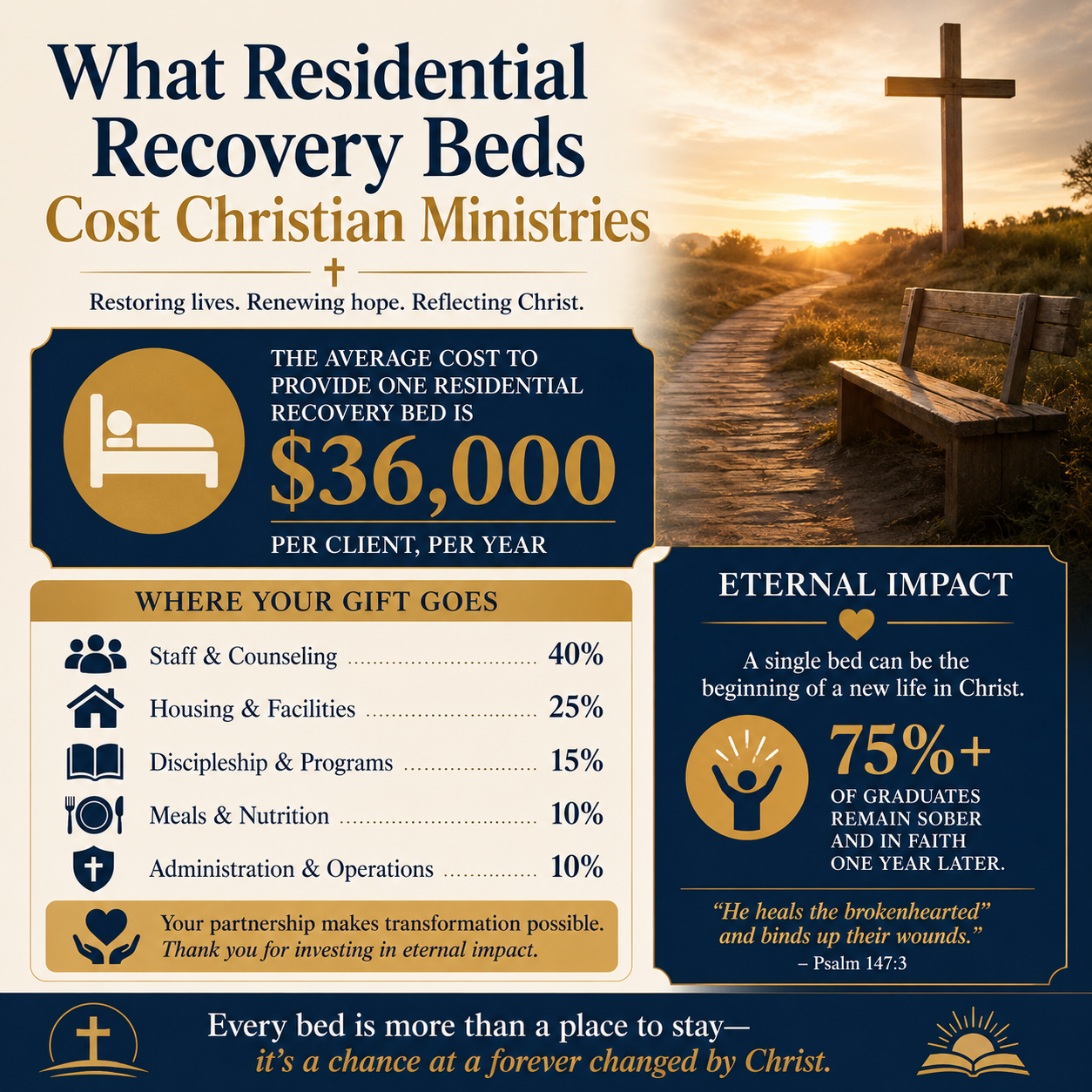
What residential recovery beds cost Christian ministries is rarely a simple question of rent and groceries. A “bed” is a bundle of fixed overhead, clinical competence, pastoral care, trauma-informed supervision, and a duty of protection to people who are often at their most vulnerable. Donors who want to fund real transformation need a more mature picture of what ministries are actually paying for—and what gets quietly cut when budgets are squeezed.
Across our verification work at Most Trusted, we see a consistent pattern: programs that sustain healthy residential care are not the cheapest, and the cheapest programs are not always the safest. Christian donors have legitimate concerns about stewardship, but stewardship is not identical to minimizing cost. Scripture commends diligent oversight and truthful weights, not unrealistic pricing that pushes the burden onto staff, residents, or unreported risk.
1. A residential bed is a ministry promise with legal and moral weight
Why the “bed” is more than a line item
When a ministry offers residential recovery, it is promising more than a place to sleep. It is committing to supervision, a structured environment, crisis response, and safeguards against predictable harms: relapse, self-harm, violence, exploitation, overdose, and medical complications. Those realities shape cost because they determine staffing ratios, training requirements, facility standards, and the program’s ability to respond when something goes wrong.
Many donors are familiar with the “overhead debate.” The sector has rightly criticized simplistic overhead ratios as a proxy for effectiveness. Charity Navigator, Candid (GuideStar), and the BBB Wise Giving Alliance publicly warned donors against using overhead percentages as the primary measure of nonprofit quality in their joint statement on the “Overhead Myth.” https://www.candid.org/ That warning does not excuse waste; it clarifies that responsible administration can be a necessary condition for safe, faithful ministry.
Residential settings concentrate risk and therefore require governance
Residential programs also concentrate risk in ways outpatient models do not. A meal served improperly, a medication stored without controls, or an unvetted volunteer given access to residents can become an immediate crisis. For donors, the question is not merely whether a ministry “cares,” but whether its leadership and board exercise accountable oversight—clear policies, incident reporting, compliance where required, and transparency when outcomes are difficult.
Because residential recovery is inherently pastoral and practical, we encourage donors to keep the larger frame in view through Christian Addiction Recovery Ministries. The bed is one element of a long discipleship-and-care continuum, and cost should be interpreted in that context rather than as a stand-alone price tag.

2. The major drivers of cost in residential recovery beds
Personnel is the central cost because people are the intervention
For most ministries, staffing is the primary driver. Even programs that rely heavily on peer support and volunteer involvement still require paid leadership, case management, night supervision, food service, facilities maintenance, and administrative controls. If clinical services are provided—licensed counseling, medication management, or withdrawal support—cost rises quickly, and so does the level of liability.
The U.S. Bureau of Labor Statistics places substance abuse, behavioral disorder, and mental health counselor roles within a regulated labor market with wage expectations that have risen over time. https://www.bls.gov/ Ministries that attempt to “solve” budget pressure by chronically underpaying staff often pay later in turnover, inconsistent care, and resident instability—costs that are spiritual and operational at once.
Facility and compliance costs are often invisible to donors
The facility itself includes rent or mortgage, utilities, repairs, and capital replacement (roofing, HVAC, appliances, vehicles). Donors frequently underestimate what it takes to keep a residential property safe and dignified, especially when buildings are older or when a ministry serves people with complex needs. Insurance is another quiet driver: general liability, property coverage, auto, workers’ compensation, and often professional liability depending on the services offered.
Food, transportation, and basic supplies are not minor, either. The USDA’s food-cost benchmarks illustrate how quickly per-person food expenses add up, even before accounting for dietary needs and the cost volatility ministries have experienced in recent years. https://www.usda.gov/ A “free bed” still consumes real dollars weekly.
3. Why low-cost beds can signal either efficiency or hidden fragility
When lower cost reflects genuine stewardship
Some ministries keep per-bed costs lower for good reasons: donated property, volunteer labor that is properly supervised, partnerships with churches providing meals, or local employers underwriting workforce programs. Those models can be strong when governance is strong and when the ministry is honest about what is donated versus what is sustainably funded.
In our assessment work against The Most Trusted Standard, healthy cost discipline usually shows up as clarity, not concealment: budgets that separate restricted and unrestricted revenue, board minutes that demonstrate oversight, and financial statements that match the operational story the ministry tells donors.
When low cost reflects understaffing, poor controls, or misaligned theology
Christians genuinely disagree about the degree to which addiction recovery should be “clinical” versus “discipleship-driven.” That disagreement is not inherently unhealthy. The danger is when a ministry uses theological language to rationalize avoidable risk—such as minimal supervision, unclear boundaries, or the absence of professional referral pathways for mental illness and trauma.
Low reported cost can also be a product of the starvation cycle described in nonprofit research: organizations adapt to donor pressure by underinvesting in administration, staff development, and evaluation, then struggle to sustain quality. Stanford Social Innovation Review has documented how this dynamic harms organizations and outcomes. https://ssir.org/ For residential recovery, the stakes are unusually high because harm can be immediate and personal.
4. What donors should look for when funding residential recovery beds
Questions that reveal whether the bed is truly supported
Funding a bed well means funding what supports the bed: supervision, formation, safety, and consistent care. Donors can ask direct questions without treating ministry leaders as suspects. Serious leaders welcome serious questions, because residential care is too consequential to run on sentiment.
- What staffing coverage exists overnight and on weekends, and what training do direct-care staff receive?
- How does the ministry handle relapse, including safety protocols and re-entry criteria?
- What is the referral plan for residents with co-occurring mental health conditions or medical needs?
- How are incident reports handled, reviewed by leadership, and communicated to the board?
- What portion of the “cost per bed” depends on in-kind donations, and what happens if those gifts end?
Signals of integrity under The Most Trusted Standard
Most Trusted exists to help donors give with confidence by evaluating ministries against The Most Trusted Standard: a 15-criteria framework across Faith Foundation, Financial Integrity, Governance and Leadership, and Transparency and Effectiveness. In residential recovery, these domains converge. A ministry can preach sound doctrine and still lack adequate internal controls; it can be financially disciplined and still neglect a coherent theology of human dignity and restoration.
Donors should not demand a single “right” model. They should require verifiable evidence of faithful practice: clear safeguarding policies, credible financial reporting, board-level accountability, and outcomes that are described with honesty rather than marketing. For donors seeking a broader view of program models and how they function, How Christian Addiction Recovery Programs Work provides the needed context to interpret bed costs without reducing the work to a number.
5. Paying for beds in a way that strengthens the ministry rather than distorting it
Restricted gifts can help or harm depending on design
Many donors prefer to restrict gifts to “a bed” or “a person.” The impulse is understandable: it feels concrete and compassionate. Yet restrictions can unintentionally starve the very infrastructure that keeps residents safe: training, compliance, background checks, systems for documentation, and qualified supervision. A wise restriction either includes an appropriate share of indirect costs or is paired with unrestricted support that allows leadership to govern responsibly.
Theological seriousness requires facing this trade-off directly. Christian giving is not merely almsgiving; it is stewardship before God. Scripture condemns dishonest scales and commends faithful oversight. When donors require unrealistically low costs, ministries can feel compelled to promise more than they can safely deliver.
Multi-year commitments often protect both residents and staff
Residential recovery is not a short project. Even when a program’s length of stay is measured in months, the organization’s obligations are ongoing: staff retention, facility maintenance, and crisis capacity cannot be assembled only when designated gifts arrive. Donors who are able to provide multi-year funding—especially for staffing and infrastructure—often do more to protect residents than donors who fund a higher volume of short-term “bed scholarships.”
This is also where transparent reporting matters. A ministry that can state its cost structure plainly, acknowledge uncertainty, and report outcomes with integrity is better positioned for sustainable growth than one that must constantly defend itself through inflated success stories or compressed budgets.
FAQs for What residential recovery beds cost Christian ministries
Is there a reasonable cost per residential recovery bed donors should expect?
There is no single benchmark that applies across locations and program types. Costs vary with real estate markets, staffing model, licensing requirements, clinical integration, and length of stay. A more reliable approach is to fund a credible budget: adequate staffing coverage, clear safeguarding, appropriate insurance, and transparent financial statements that show how the bed is supported.
Should donors prefer ministries that report very low overhead for residential programs?
Not as a rule. Residential recovery requires administration that is directly tied to safety and accountability—training, policies, documentation, supervision, and financial controls. Sector leaders have warned donors against using overhead ratios as a primary measure of quality because underinvestment can harm outcomes and increase risk. https://www.candid.org/
Funding beds with mature Christian stewardship
What residential recovery beds cost Christian ministries is ultimately a question about what donors believe a ministry owes to the people it serves. A bed is not a symbol; it is a lived environment where suffering, temptation, and hope are concentrated. Christian donors best serve this work when they fund residential care with clear-eyed seriousness: supporting the people, systems, and governance that make restoration not only sincere, but safe.



