

Why child sponsorship ministries use monthly giving models is not primarily a marketing question. It is a ministry design question: how to fund long-horizon commitments to children and families without turning compassion into volatility. When sponsorship is done with integrity, the promise implied in the word “sponsor” is pastoral as much as financial: a child should not experience the church’s care as intermittent.
Christian donors often feel two tensions at once. We want personal connection and clear outcomes, and we also want to avoid approaches that unintentionally commodify children or pressure families. Monthly giving sits at the center of that tension. It can underwrite stable, relational work. It can also become a mechanism for oversimplified storytelling if a ministry treats the donor relationship as the product rather than the child’s wellbeing as the priority.
Monthly giving matches the moral shape of sponsorship commitments
Child sponsorship rests on an implicit covenant: a donor is invited to share in a child’s flourishing over time, not merely to fund a one-time need. Monthly giving models align with that moral logic because most of what helps children thrive is not episodic. It is steady: food security, school attendance, health checkups, safe water, caregiver support, and protection systems that prevent harm.
Scripture regularly frames faithfulness in terms of endurance rather than intensity. Paul’s instruction to “not grow weary of doing good” assumes that doing good is often repetitive, unseen, and measured in seasons, not moments (Galatians 6:9). A monthly model can serve that biblical posture when it is structured as a disciplined form of generosity rather than a transactional subscription.
Programs are monthly even when stories feel momentary
Donor communications often highlight singular events: a new well, a school term, a medical intervention. Yet the underlying work is administrative and relational, and it happens every week. Staff salaries, local partner grants, child protection training, and monitoring are not “special projects”; they are the scaffolding that keeps children safe and services consistent.
The stronger ministries we evaluate are explicit about this. They describe what is continuous, what is episodic, and what is contingent on local realities. They avoid implying that a child’s life is funded by a single dramatic moment.
Consistency reduces program harm caused by funding whiplash
In lower-income settings, service interruptions are not neutral. If tutoring disappears mid-term, or medical support becomes sporadic, families experience instability as one more reason to distrust institutions. Monthly revenue helps ministries avoid the pattern of starting programs with enthusiasm and then retreating when a campaign ends.
This is one reason many sponsorship organizations prioritize recurring giving: not because it is easier for the ministry, but because it is less disruptive for the children and communities the ministry serves.

Recurring revenue helps ministries plan, hire, and safeguard
Child-focused work carries particular responsibilities: safeguarding policies, background checks, staff training, secure data handling, and careful supervision of any contact between adults and children. Those systems are neither optional nor cheap. Ministries that rely heavily on one-time gifts often struggle to maintain them during lean seasons.
Across our verification work at Most Trusted, we observe that ministries that meet The Most Trusted Standard tend to treat financial predictability as an ethical issue. They do not use recurring giving to inflate operations; they use it to prevent fragility, reduce reactive decision-making, and fund the boring but essential work of governance and protection.
Planning cycles require predictable cash flow
Schools have academic calendars. Clinics have staffing rosters. Local partners sign agreements that assume funds will arrive on time. Monthly giving aligns with the cadence of these planning cycles. It also supports reserves and cash management that keep commitments intact when there is an economic shock or a seasonal drop in donations.
The goal is not financial comfort. The goal is to be able to say “yes” with integrity when a ministry invites a donor into a long-term commitment.
Staffing is discipleship work as well as administration
The Western donor imagination can undervalue staffing, yet much of child sponsorship is pastoral and developmental labor: mentoring, case management, family support, and coordination with local churches. Consistent revenue allows ministries to retain qualified staff rather than cycling through short-term hires who cannot build trust with families.
When donors ask whether monthly models “go to overhead,” the honest answer is that some of it does, because safeguarding, monitoring, and competent leadership are not distractions from mission. They are part of what makes mission trustworthy.
Monthly sponsorship is shaped by donor behavior and nonprofit economics
Monthly giving models are also a response to how donors give. Many households budget monthly, not annually. Recurring giving makes generosity predictable for the donor as well as for the ministry, particularly when families are already committed to local church giving and other obligations.
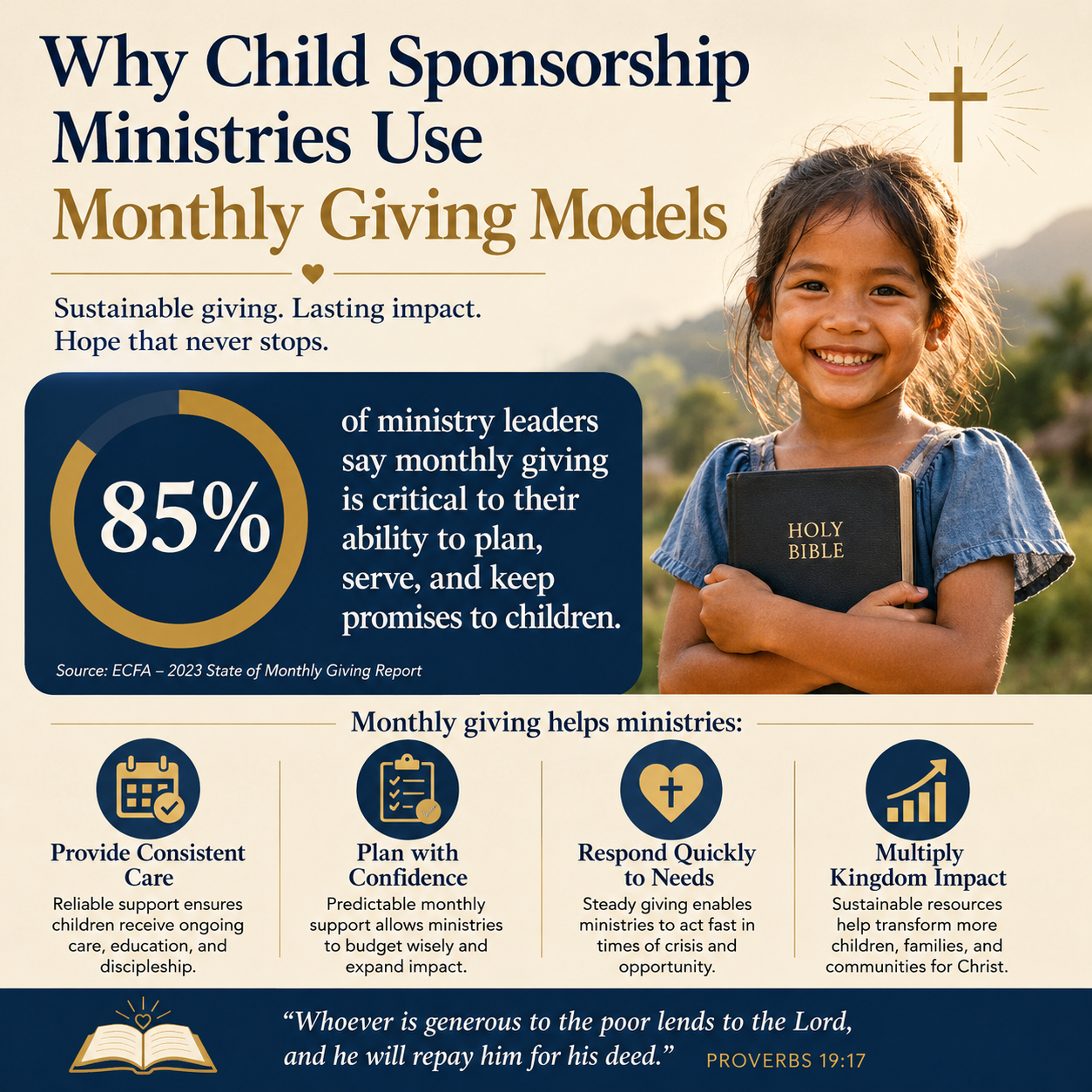
The broader nonprofit sector has steadily emphasized recurring gifts because retention is a central driver of long-term impact. The fundraising literature is not Scripture, but it does describe real economic dynamics. The question is whether a ministry uses those dynamics to serve children faithfully, or to maximize revenue with minimal accountability.
Retention is a sustainability issue, not just a fundraising metric
Recurring giving tends to lower the likelihood that a child’s support is disrupted by donor forgetfulness or seasonal attention. While public statistics vary by subsector and methodology, the sector’s consistent finding is that keeping donors is more stable than constantly replacing them. The Fundraising Effectiveness Project has documented persistent challenges in donor retention across the charitable sector, including the difficulty of retaining donors year over year (Association of Fundraising Professionals, Fundraising Effectiveness Project).
For child sponsorship, this matters because continuity is not merely an organizational preference. It affects case plans and expectations with families.
Recurring models can reduce pressure to sensationalize
One underappreciated benefit of stable monthly support is that it can reduce reliance on constant emergency-style appeals. Appeals will always be part of Christian compassion, but the field has learned that perpetual crisis messaging can distort how donors perceive communities and can incentivize misleading simplicity.
When a ministry’s core programs are funded through recurring support, it has more freedom to communicate with sobriety: celebrating progress, naming setbacks, and describing structural constraints without needing every story to function as a short-term fundraising engine.
The harder questions are about integrity, not cadence
Christians genuinely disagree about whether sponsorship should be “child-to-donor” or “community-based with child-focused communication,” and there are faithful arguments on both sides. The sharper ethical questions are not resolved by monthly giving alone. They are resolved by governance, transparency, and the ministry’s willingness to tell the truth about how sponsorship actually works.
For donors who want to evaluate a sponsorship ministry carefully, it helps to read with eyes open to both the promise and the pitfalls. A monthly model can be a signal of long-term intent, but it can also mask unclear accounting if a ministry does not explain where funds go and how decisions are made.
What donors should expect a credible ministry to disclose
In our work, we encourage donors to look for clear, plain disclosures that match the moral weight of the appeal. In child sponsorship, that typically includes:
- Whether sponsorship funds are restricted to a particular child or pooled for child-focused programs
- How long the commitment is expected to last and what happens if a donor stops giving
- How child privacy is protected in photos, letters, and online systems
- What safeguarding policies govern staff, volunteers, and any donor-child interaction
- How the ministry measures outcomes beyond anecdotal stories
These are not adversarial questions. They are stewardship questions, and serious ministries should welcome them.
Monthly giving should never substitute for accountability
Some donors assume that recurring gifts entitle them to a direct relationship with a child. That expectation can pressure ministries to facilitate communication that is not in the child’s best interest, or that creates false intimacy across distance and power. Wise ministries set boundaries: supervised correspondence, appropriate language, and no private contact.
Those guardrails can disappoint donors who want a simpler narrative. Yet they reflect a more mature ethic: children are image-bearers to be protected, not protagonists in a donor’s spiritual experience.
How Most Trusted evaluates sponsorship ministries that use monthly models
Monthly giving is common in child sponsorship, but donors still need a way to distinguish between ministries that are merely effective fundraisers and ministries that are verifiably trustworthy. That is where independent verification becomes practical. Most Trusted evaluates Christian nonprofits against The Most Trusted Standard, a 15-criteria framework that examines a ministry’s faith commitments, financial integrity, governance and leadership, and transparency and effectiveness.
What this means in practice is that we pay attention to the places where recurring models can drift: unclear restrictions, selective reporting, weak boards, inadequate safeguarding, and communications that imply more than the program can honestly deliver. We also pay attention to strengths that recurring support can enable: stable local partnerships, durable child protection systems, and consistent outcome measurement.
Questions we recommend donors bring to any sponsorship appeal
Donors do not need to become auditors to give wisely, but they should expect clarity proportionate to the emotional weight of child-focused fundraising. We recommend asking:
- How does the ministry define “sponsorship” in operational terms?
- Where are audited financials and key governance disclosures available?
- What child safeguarding standards are in place, and how are they enforced?
- How does the ministry report outcomes, and what is considered success?
These questions fit within a broader approach to evaluating Child Sponsorship Ministries with both compassion and rigor.
Monthly giving can be wise stewardship when it is ordered toward faithfulness
The New Testament does not prescribe a donation cadence, but it does require integrity: “it is required that those who have been given a trust must prove faithful” (1 Corinthians 4:2). For ministries, that trust includes children, donor funds, and the witness of the church. For donors, that trust includes discernment and a refusal to let sentiment replace accountability.
A monthly sponsorship gift can be one of the most meaningful forms of long-term generosity a household undertakes, especially when it is paired with informed expectations and a commitment to truth.
FAQs for Why child sponsorship ministries use monthly giving models
Is monthly sponsorship better than giving a one-time gift?
Monthly sponsorship is not morally superior to a one-time gift, but it often fits the ongoing nature of child and family development programs. Recurring support can reduce service interruptions and enable staffing and safeguarding systems that require consistent funding. One-time gifts can be excellent for time-bound needs, but donors should confirm how the ministry plans for continuity when the gift is spent.
Does my monthly sponsorship gift go directly to one child?
It depends on the ministry’s program design and accounting practices. Some organizations pool sponsorship revenue to fund child-focused services across a community while still connecting donors with a particular child for correspondence and reporting. Others restrict funds more tightly. A trustworthy ministry will explain this plainly, in writing, and will disclose what happens if sponsorship exceeds or falls short of a child’s direct expenses. For donor guidance shaped by stewardship and accountability, see How to Give Wisely to Child Sponsorship Ministries.
Monthly models are a means, not the mission
Why child sponsorship ministries use monthly giving models comes down to continuity: children’s needs and protection requirements do not arrive in quarterly installments. Recurring support can underwrite faithful presence, careful safeguarding, and honest long-term planning. Yet the cadence of giving cannot bear the weight of trust by itself. Trust must be earned through transparent practices, sound governance, and a demonstrated willingness to protect children above every fundraising incentive.



