
How to give wisely to child sponsorship ministries is ultimately a stewardship question: how to join Christ’s care for children without funding harm, distortion, or dependency. Child sponsorship sits at the intersection of tender compassion and complex development realities, and Christian donors are right to ask for evidence, safeguards, and theological coherence rather than sentiment alone.
Scripture is unambiguous about God’s concern for the vulnerable. The same Bible that commands generosity also warns against partiality, exploitation, and empty words. Wise sponsorship giving therefore requires more than a compelling story. It calls for ministries that can demonstrate faithful practice in discipleship, financial integrity, governance, and measurable care for children and their families.
Begin with a biblical theology of children, poverty, and power
Child sponsorship ministries often speak the language of “rescue,” and sometimes rescue is real. Yet the dominant biblical frame is not a Western savior arriving from outside, but God establishing justice, strengthening households, and gathering the marginalized into a covenant community. Christians give most wisely when sponsorship aligns with that frame: dignifying families, reinforcing local churches, and pursuing long-term restoration rather than short-term relief.
Christian development practitioners have repeatedly shown that good intentions can still cause damage when power is unexamined. The “When Helping Hurts” framework articulated by Steve Corbett and Brian Fikkert has shaped a generation of Christian relief and development by naming how pity, superiority, and control distort both giver and receiver. That is not an argument against sponsorship; it is an argument for sponsorship models that treat local communities as agents rather than objects.
Ask what the ministry believes about the local church
Many sponsorship programs operate alongside local congregations; fewer are structurally accountable to them. The difference matters. A ministry’s relationship to indigenous churches often reveals whether discipleship is central or merely supportive language for donor audiences. We recommend asking whether local pastors have meaningful authority in child selection, pastoral care, safeguarding, and program design, and whether the ministry’s reporting reflects local priorities rather than donor preferences.
Distinguish compassion from control
Sponsorship can unintentionally re-center the donor as the primary actor: the one who chooses, provides, directs, and evaluates. That posture is spiritually dangerous and practically corrosive. Wise giving looks for ministries that resist performative dependence on the donor’s attention and instead pursue accountable, locally led change—especially when those choices are less marketable.
Hold urgency together with formation
Children’s needs are urgent. But urgency should not become a justification for bypassing due diligence or ignoring unintended effects. The Christian calling is not only to “do something,” but to do what is faithful, truthful, and durable. Ministries that mature well tend to invest in staff formation, community relationships, and difficult safeguards that slow growth but protect children.

Evaluate whether the sponsorship model protects children and strengthens families
Wise sponsorship giving begins with a simple question: what exactly is being funded? Some programs are essentially school-fee support; others combine education with nutrition, medical care, spiritual formation, and household economic strengthening. The more comprehensive the claims, the greater the need for clear program logic and credible evidence.
The field has also had to reckon with the harms of institutionalization and family separation. Research over decades has demonstrated that large-scale institutional care is associated with poorer outcomes for children compared to family-based care, even when material conditions appear adequate. A widely cited multi-country study found that children in institutional settings showed substantial deficits in physical growth, cognition, and social-emotional development relative to family care; see the Bucharest Early Intervention Project work summarized by Harvard University.
Child selection and “the market pressure” problem
Christian donors should be candid about a tension in the model: sponsorship programs can create incentives to “find” sponsorable children in ways that do not match a community’s actual vulnerability. The ethical question is not whether a child’s story is moving; it is whether the selection process is fair, protective, and aligned with the ministry’s stated criteria. We recommend asking whether the ministry uses community-based vulnerability assessments, whether local leaders have a voice, and whether there is an appeals process when families disagree with a child’s inclusion or public story.
Safeguarding is not optional administration
Any ministry working with children should have rigorous child safeguarding policies, training, and reporting mechanisms. Mature programs implement background checks where legally possible, clear codes of conduct, restrictions on one-on-one interactions, and mandatory reporting pathways. Donors should ask whether the ministry follows recognized safeguarding standards, conducts third-party audits or evaluations when feasible, and can explain how allegations are handled across jurisdictions.
Sponsorship benefits should not hinge on the child’s performance
Wise sponsorship programs avoid conditioning care on a child’s correspondence, religious responses, or academic outcomes. Tying benefits to performance invites shame, manipulation, and distorted family dynamics. We recommend giving to ministries that explicitly state that a child’s access to services does not depend on writing letters, making a profession of faith, or producing sponsor-pleasing milestones.
Insist on financial integrity, truthful communication, and accountable leadership
Child sponsorship is especially vulnerable to donor-facing exaggeration because it trades in personal stories and direct emotional connection. That makes truthfulness in communication a theological issue, not merely a marketing preference. The question is whether the ministry’s reporting, photography, and fundraising claims match reality on the ground and are subject to governance oversight.
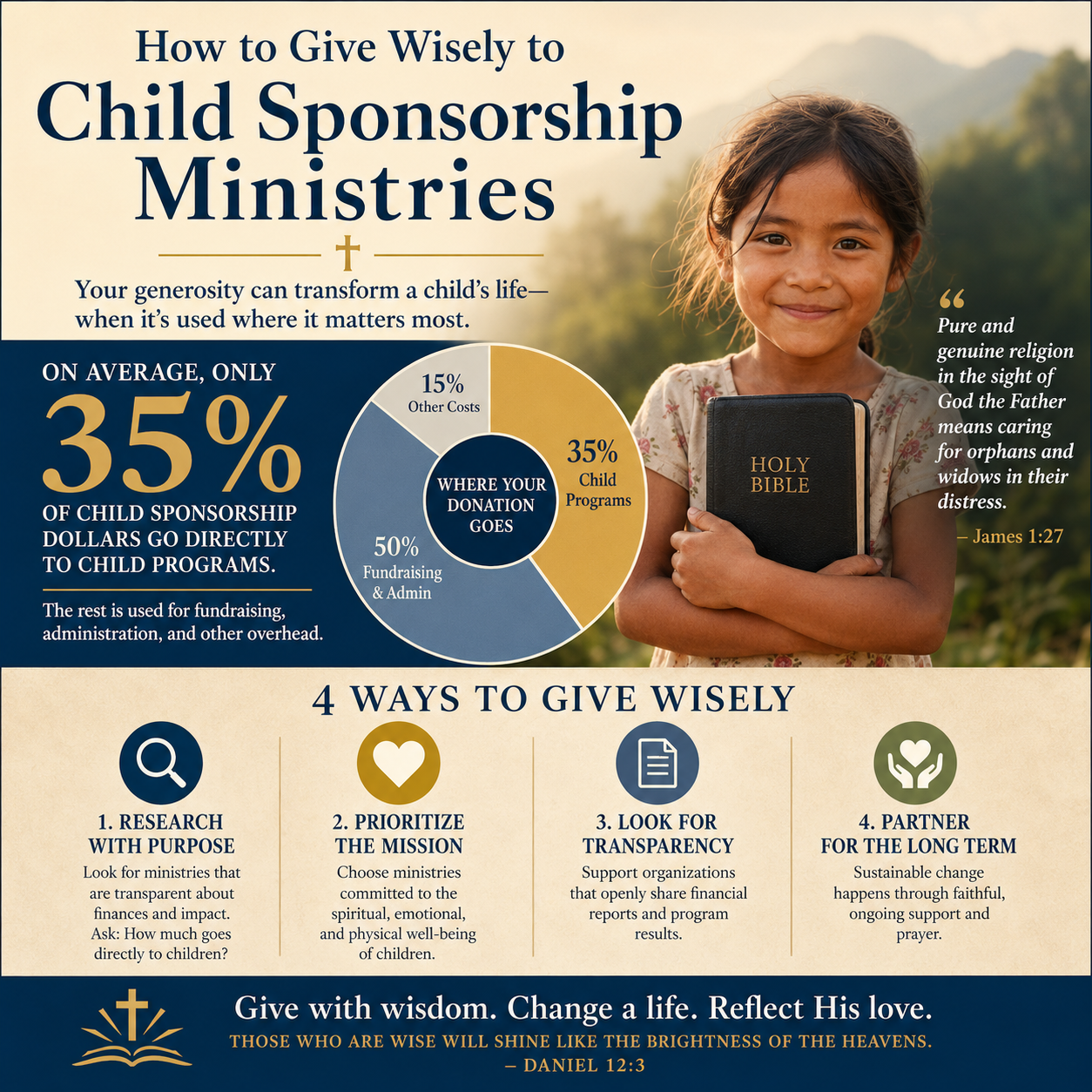
We also caution against simplistic “overhead” reasoning. Some donors still attempt to judge health primarily by administrative ratios, but the sector’s leading evaluators have rejected that approach as a misleading proxy for effectiveness. Charity Navigator, Candid (formerly GuideStar), and the BBB Wise Giving Alliance jointly warned that overhead ratios can pressure nonprofits to underinvest in systems that protect beneficiaries and measure results; see their statement hosted by Charity Navigator.
Monthly giving can be wise, but it must be honest
Many sponsorship ministries rely on monthly giving because predictability supports staffing, school calendars, and long-term accompaniment. That is often prudent. The ethical challenge is making sure monthly commitments are presented truthfully: the donor is not “paying for” a single child in a one-to-one transactional sense as much as joining a program budget designed to serve children in a community. The strongest ministries state this clearly, avoid false precision, and show how sponsorship revenue integrates with other funding sources.
Governance should be more than a board list
A credible board provides oversight that is independent enough to correct leadership when incentives drift. Donors should look for boards that meet regularly, document decisions, manage conflicts of interest, and oversee safeguarding and financial controls—not boards that function primarily as supporters or fundraisers. Where operations occur across borders, governance should include meaningful local input, not only North American representation.
Transparency must extend beyond audited statements
External audits matter, and we favor them when an organization’s size makes them appropriate. Yet transparency includes program disclosures, safeguarding reporting, and candid discussion of limitations. Ministries that are mature tend to publish clear program descriptions, explain how child data is protected, disclose how images and stories are gathered, and provide donor-facing materials that do not pressure children to perform gratitude.
Use a verification framework and make peace with informed limits
Christian donors often want a decisive answer: “Is this sponsorship ministry good or bad?” The more responsible posture is to ask whether the ministry meets a defensible standard of faithfulness and evidence. Sponsorship is delivered through complex chains—local partners, staff, schools, churches, and households. A wise donor therefore looks for verifiable indicators rather than perfect certainty.
At Most Trusted, we evaluate Christian nonprofits against The Most Trusted Standard, a 15-criteria framework covering Faith Foundation, Financial Integrity, Governance and Leadership, and Transparency and Effectiveness. In practice, that means we look for doctrinal clarity without manipulation, financial controls that can withstand scrutiny, leadership structures that resist celebrity dynamics, and transparent reporting that respects children rather than commodifying them. The ministries that meet The Most Trusted Standard tend to welcome difficult questions because their internal discipline is already built for accountability.
For donors seeking a broader view of the field, we maintain ongoing coverage of Child Sponsorship Ministries, including the common points of failure and the practices most associated with durable impact.
Questions we recommend asking before committing
- What safeguards protect children’s privacy, especially in photos, profiles, and correspondence?
- How are children selected, and how does the ministry prevent perverse incentives to separate children from families?
- What portion of sponsorship funds supports community-level programs versus individualized benefits, and how is that explained to donors?
- How does the ministry define spiritual formation, and what role do local churches play in discipleship and care?
- What evidence does the ministry use to evaluate outcomes, and what limitations does it acknowledge publicly?
- What governance practices prevent conflicts of interest and ensure independent oversight?
Red flags that deserve pause
- Promises that sponsorship will “guarantee” outcomes (graduation, conversion, employment) without acknowledging uncertainty and context.
- Child profiles and fundraising copy that imply the donor is the sole provider, minimizing the family and local community.
- Heavy pressure to fund “emergencies” with minimal documentation, especially when tied to a specific child’s story.
- Unclear safeguarding procedures or evasive answers about allegations, reporting, and accountability.
- Financial reporting that is technically available but practically opaque, with limited program clarity.
Wise sponsorship giving is faithful, careful, and durable
The Christian impulse to sponsor a child often arises from a holy instinct: to see a child as fully human, made in God’s image, and worthy of concrete love. Wise giving does not suppress that instinct; it disciplines it. When donors insist on safeguarding, truthful communication, accountable governance, and evidence that families are strengthened rather than displaced, sponsorship becomes less sentimental but more faithful.
The goal is not merely to feel close to a need, but to support ministries whose work can endure scrutiny and whose care for children reflects the character of God: truthful, protective, and committed for the long haul.



