
When Christian donors ask what to look for in child sponsorship ministry governance, they are rarely asking a technical question. They are asking whether a ministry has the moral and organizational capacity to keep faith with children, families, and local churches when incentives, complexity, and emotion collide.
Child sponsorship is uniquely vulnerable to governance failure because the product is relational. Donors fund a named child, often pray for that child, and receive letters that feel personal. That tenderness can be holy. It can also create pressure to simplify what is not simple: cross-cultural poverty, safeguarding, community dynamics, and financial accountability across borders. Governance is the mechanism that keeps ministry truthful under that pressure.
1. Governance begins with theological clarity and moral seriousness
Some boards treat doctrine as a statement on a website and governance as a compliance exercise. In child sponsorship, both approaches are inadequate. The children are not line items. They bear the image of God, and a Christian ministry’s authority to represent them publicly is a moral trust, not a marketing asset.
Doctrine should shape practices donors can verify
We look for governance that is explicitly ordered to Christian ends: truthfulness, protection of the vulnerable, and respect for the local church. James 1:27’s call to care for orphans and widows is not sentimental; it is a test of integrity. Boards that take Scripture seriously ask hard questions about how the organization portrays children, uses stories, and handles power.
In practice, that means asking whether sponsorship communications are accurate and dignifying, whether gifts are framed as partnership rather than saviorism, and whether the ministry’s posture toward local leadership is humble rather than extractive.
Boards should name the tensions the field has had to reckon with
Christians genuinely disagree about models of sponsorship and the best ways to connect donors to outcomes. Yet the field has learned that certain practices can cause harm when they are poorly governed: unvetted access to children, performative photo opportunities, and incentives that reward growth over truth.
The ministries that meet The Most Trusted Standard tend to demonstrate moral clarity about those risks and can describe the controls they use to prevent them.

2. A credible board is independent, competent, and appropriately close
A board’s first obligation is not to protect institutional reputation. It is to provide accountable oversight before problems become scandals. In cross-border child programs, oversight must be both structurally independent and operationally informed.
Independence is a measurable governance condition
Donors should expect a board with meaningful independence from the CEO and from related-party interests. Family-dominated governance, insider-controlled voting, or opaque related-party transactions are not merely “how this ministry has always worked.” They are predictable pathways to compromised judgment.
In our verification work at Most Trusted, we look for documented conflict-of-interest policies, regular disclosures, and a clear record of recusals when a matter touches a board member’s personal interests. These are not signs of distrust; they are normal protections for stewardship.
Competence includes the ability to govern cross-cultural risk
A sponsorship ministry does not need a board full of celebrities or pastors with public platforms. It needs members who can govern finance, safeguarding, program evaluation, and international operations with sober attention. The harder question is whether the board is competent to interpret what it is seeing from the field, not merely whether it meets periodically.
Useful indicators include active committee work, regular executive sessions without staff, and evidence the board can disagree with management without fracturing into factions.
3. Safeguarding governance is not optional and not merely legal
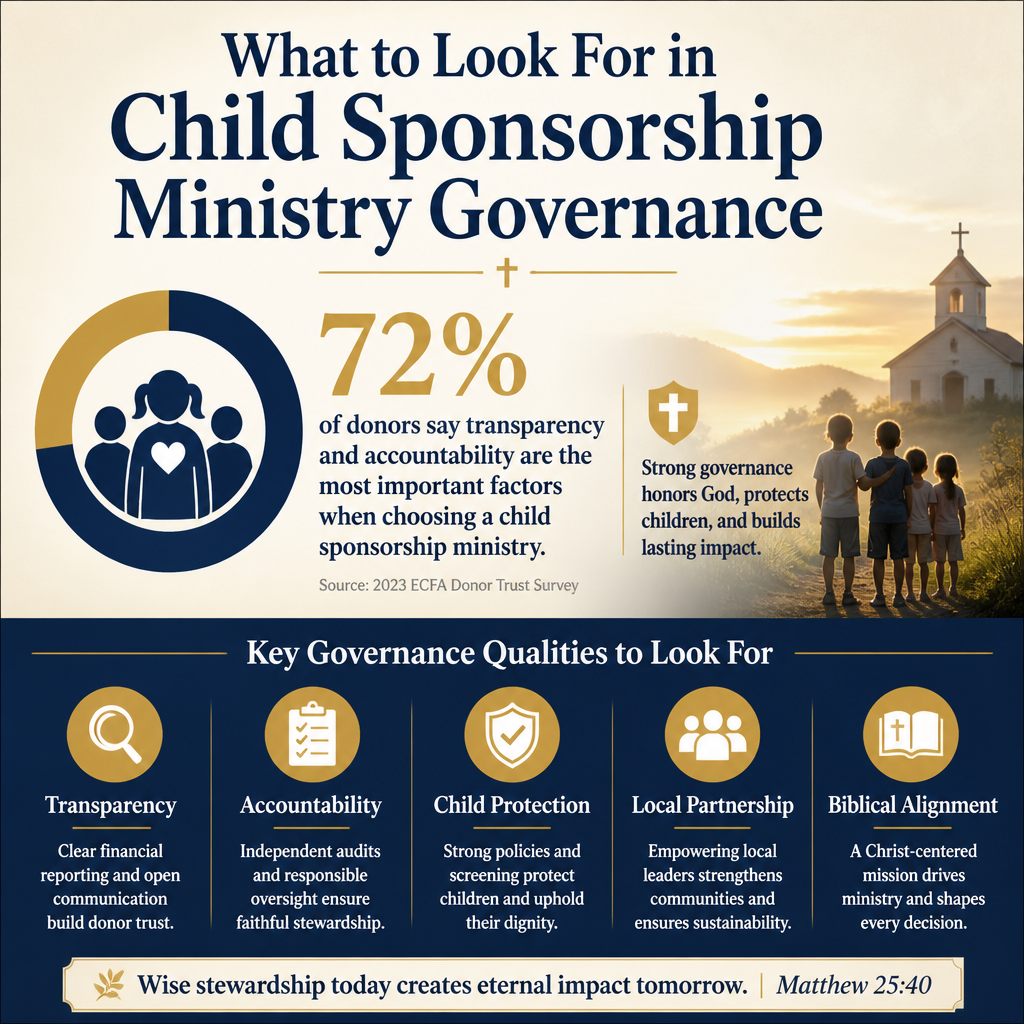
Child sponsorship governance is first a question of protection. The organization is arranging access—sometimes physical, always informational—to minors. That should trigger a governance mindset shaped by Jesus’ severity about causing little ones to stumble (Matthew 18:6). The board’s role is to ensure the ministry’s systems are strong enough to restrain human sin and negligence.
Policies are necessary, but enforcement is the governance test
Many ministries can produce a child protection policy. Fewer can show that the policy is operational: background screening appropriate to each country context, mandatory training, clear codes of conduct, and a functioning incident reporting pathway that does not route everything through the same leader who might feel pressure to minimize bad news.
Donors should ask whether the board receives regular safeguarding reports, including incident trends and lessons learned, and whether external expertise is engaged when allegations arise.
Data privacy is part of child protection
Sponsorship depends on information—names, photos, letters, sometimes school and community details. Governance should limit what is collected, restrict who can access it, and prevent digital sharing that exposes children to avoidable risk. This includes clear rules for donor trips, photography, and social media.
The American Academy of Pediatrics has warned that sharing children’s personal information online can create lasting privacy and safety harms, a concern that applies with even greater force in vulnerable communities. American Academy of Pediatrics
4. Financial governance must match the claims sponsorship makes
Child sponsorship creates a distinctive stewardship question: donors often assume their monthly gift directly supports the named child. Some programs are designed that way; others pool funds to strengthen community services that benefit the child and many others. Both can be legitimate, but governance must ensure the ministry’s public promises match its financial reality.
Clarity about restricted and unrestricted funds protects trust
Boards should ensure the ministry clearly distinguishes between restricted sponsorship funds and other giving, and that accounting practices honor donor intent. Where sponsorship is community-based, governance should ensure communications do not imply a one-to-one transfer when funds are actually pooled for shared outcomes.
Good governance also anticipates legitimate donor questions about what happens when a child exits a program, relocates, or is no longer eligible. The answer should be written, consistent, and humane, not improvised by customer service.
Overhead ratios are not enough, but accountability still matters
Christian donors sometimes fixate on administrative cost percentages. The modern nonprofit sector has widely criticized that as an incomplete measure of effectiveness, including in the joint “Overhead Myth” statement by major evaluators. GuideStar
What this means in practice is that boards should govern for honest reporting and sustainable capacity: internal controls, qualified finance staff, clean audits when appropriate, and budgeting that does not starve safeguarding, monitoring, or local staff formation.
- Clear definitions of how sponsorship funds are allocated and reported
- Documented internal controls for cash handling and disbursements in field locations
- Independent audit or review appropriate to the organization’s size and complexity
- Board oversight of fraud risk and whistleblower processes
- Transparent treatment of foreign exchange, banking fees, and in-country partner costs
5. Program governance should measure truth, not merely growth
The most persistent temptation in sponsorship is to treat expansion as synonymous with faithfulness. Growth can be evidence of blessing. It can also be evidence of effective fundraising divorced from real outcomes. Governance is responsible for ensuring the ministry’s claimed impact is defensible.
Boards should require evidence that is appropriate to the program model
Some ministries are positioned to measure child-level outcomes such as school attendance, grade completion, or health indicators. Others operate in contexts where such data are unreliable or ethically sensitive. In either case, a mature governance approach asks for a credible theory of change and for monitoring that is honest about limits.
The research on child sponsorship outcomes is debated, and donors should not demand a level of causal proof that a ministry cannot deliver without distorting its work. At the same time, donors have a right to expect more than testimonials. For example, an analysis published by the National Bureau of Economic Research examined long-term outcomes associated with a large child sponsorship program, illustrating that rigorous evaluation is possible in some settings. National Bureau of Economic Research
Local church partnership should be governed, not assumed
Many sponsorship ministries state that they work through local churches. Governance should define what that means: who sets priorities, who controls funds, how theological alignment is assessed, and how power is shared. Without governance, “partnership” can become a rhetorical cover for donor-facing narratives that do not reflect on-the-ground realities.
Donors who want to go deeper into the broader landscape of evaluating ministries in this space can review Child Sponsorship Ministries as a starting point for the categories of risk and strength that commonly emerge.
FAQs for What to look for in child sponsorship ministry governance
Is it a red flag if sponsorship funds are pooled rather than given directly to the sponsored child?
Not necessarily. Community-based models can be both ethical and effective when they are governed with transparency and when communications are accurate about how benefits reach the child. It is a red flag when the ministry implies a direct transfer to the child while actually using funds in ways the donor would not reasonably infer. Governance should ensure donor intent and program design are aligned and clearly disclosed.
What governance documents should a serious child sponsorship ministry be willing to share?
At minimum, donors can reasonably expect to see a board roster and leadership information, a conflict-of-interest policy, a child safeguarding policy, recent financial statements (and an audit if appropriate), and a clear description of how sponsorship funds are allocated. Ministries that align with The Most Trusted Standard tend to treat these disclosures as part of Christian accountability, not as adversarial demands. For more donor-facing guidance in this area, see How to Give Wisely to Child Sponsorship Ministries.
Governance is how a ministry keeps faith with children and donors
Child sponsorship can be a faithful expression of Christian love when it is governed for truth, protection, and long-term responsibility. The question is not whether a ministry’s stories are moving; it is whether the board has built a structure that resists manipulation, corrects error, and prefers the child’s welfare over institutional convenience. That is the kind of stewardship mature Christian donors should expect, and the kind of accountability Most Trusted exists to verify.



