
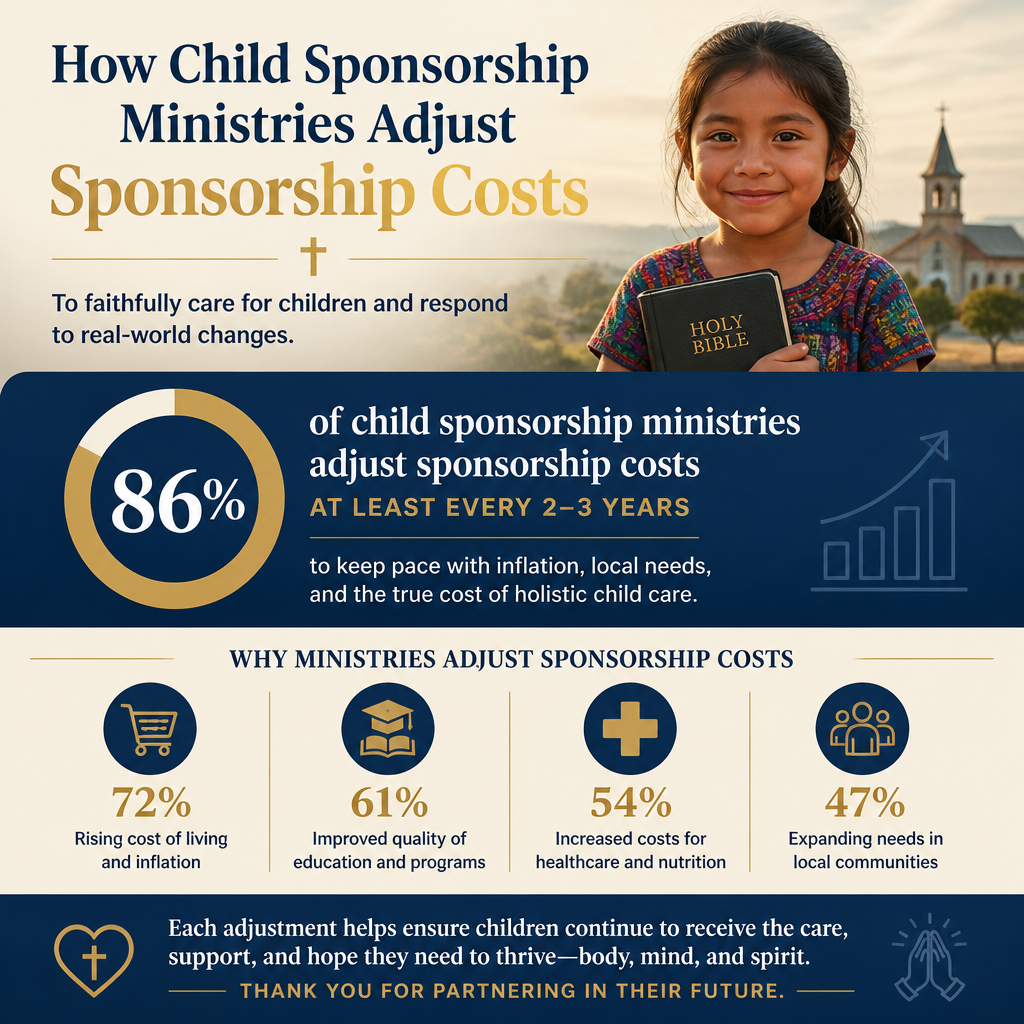
How child sponsorship ministries adjust sponsorship costs is not a minor administrative question; it is a moral and pastoral one. For Christian donors, the monthly amount is a promise made before God, and changes to that promise can either strengthen trust or quietly erode it.
Most sponsorship programs sit at the intersection of volatile local economies, cross-border banking realities, and a donor’s desire for stability and clarity. The best ministries do not pretend those tensions are easy. They communicate cost adjustments as part of faithful stewardship, treating sponsors as partners rather than payment sources.
Why sponsorship costs change in the first place
Local prices move, even when donors want predictability
Sponsorship budgets are built from real goods and services: school fees, tutoring, meals, transport, medical care, child protection staffing, and program oversight. When the local cost of staple food, fuel, rent, or school materials rises, the program cost of serving each child rises with it. A ministry that freezes sponsor amounts indefinitely must either reduce services, increase other fundraising, or draw down reserves.
Inflation is not theoretical for families living close to the margin. The World Bank has documented the pressure that rising food prices place on households in low- and middle-income countries, with disproportionate impact on the poor (World Bank).
Exchange rates and cross-border delivery costs are not optional
Many child sponsorship ministries receive gifts in US dollars and spend in local currency. When exchange rates swing, the purchasing power of a “fixed” monthly sponsorship can change quickly. Add the realities of international banking fees, compliance costs, and restrictions on cross-border transfers, and ministries can face rising friction even when local program design stays the same.
The practical effect is that sponsors may see an adjustment even when the ministry’s intent has not changed. The question is whether the ministry can explain the change in plain terms and show that the additional cost is tied to verifiable program needs rather than institutional drift.

Common models ministries use to adjust sponsorship costs
Incremental increases with long notice
The most common approach is a modest increase after several years, preceded by substantial notice. Ministries typically set a new “standard sponsorship amount” for new sponsors first, then invite existing sponsors to increase if they are able. Some programs later apply a uniform adjustment to bring older sponsorships into alignment, particularly when the gap becomes large enough that it distorts program planning.
This model respects donor stability while acknowledging that a ministry cannot responsibly promise the same nominal cost forever. It also avoids sudden shocks that can cause sponsors to cancel abruptly, leaving children and local partners to absorb the disruption.
Tiered sponsorship levels and optional add-ons
Some ministries establish tiers, such as a baseline amount that covers core services and an optional increment that supports additional educational support, medical assistance, or family livelihood strengthening. The upside is transparency: sponsors can understand what changes when giving changes. The downside is complexity, especially when a ministry must prevent the impression that one child receives “better” care because a sponsor chose a higher tier.
Well-governed programs handle this by ensuring core child protection and essential services are not contingent on optional giving. Optional increments may support community-level resources, emergency funds, or broader program capacity rather than individualized benefits that could create inequity among children.
Indexing to inflation with clear guardrails
A smaller number of ministries describe their adjustments as tied to inflation or cost-of-living measures in the field. Done carefully, indexing can reduce the drama of occasional large increases. Done poorly, it can feel like an automatic subscription escalator without moral explanation.
Donors should look for guardrails: a cap on annual increases, a commitment to explain adjustments in context, and evidence that the ministry is also controlling costs internally.
What trustworthy communication about increases looks like
Donors deserve reasons, not slogans
Christian sponsors do not need marketing language; they need a forthright account. The ministries that consistently build trust treat a cost adjustment as a moment to disclose the underlying economics and the ministry’s stewardship decisions. “Costs have risen” is insufficient. “School fees increased in these districts, our local staff salaries were adjusted to retain qualified child protection caseworkers, and currency depreciation reduced purchasing power” is the beginning of a responsible explanation.
Transparency is a theological posture before it is a communications strategy. Scripture repeatedly condemns dishonest scales and hidden terms in trade (Proverbs 11:1). When a ministry changes a sponsorship amount, it is obligated to speak truthfully and concretely about what is changing and why.
Specific documents and practices that signal integrity
Across our verification work at Most Trusted, we observe that the ministries most likely to merit long-term confidence pair cost adjustments with tangible, reviewable evidence. Sponsors can often find:
- Audited financial statements and a current annual report
- A clear description of what the sponsorship amount covers and what it does not
- Governance oversight that shows who approves changes and how conflicts of interest are managed
- A meaningful commitment to child safeguarding and field accountability
- Plain-language disclosure of how the ministry handles “excess” sponsorship funds, if any
This is also where category-level context helps. Donors who want to evaluate a sponsorship commitment over time often benefit from reviewing the broader practices associated with Managing a Child Sponsorship Commitment, including what to ask when a ministry changes terms midstream.
How cost adjustments relate to effectiveness and the ethics of sponsorship
Child-centered programming is more expensive than mail-centered programming
Some of the most significant cost drivers in sponsorship are not the visible items donors imagine, but the less visible work that keeps children safe and programs accountable: trained social workers, case management, background checks, incident reporting systems, monitoring and evaluation, and supervision of local partners. These are not “overhead” in any simplistic sense; they are often the costs of doing ministry responsibly.
The nonprofit sector has had to correct donors’ assumptions about overhead as a proxy for virtue. The leaders of Charity Navigator, GuideStar, and the BBB Wise Giving Alliance jointly argued that overhead ratios are a poor measure of nonprofit performance and can incentivize underinvestment in systems that protect mission outcomes (Charity Navigator).
Christians genuinely disagree about sponsorship mechanics
The field has had to reckon with legitimate questions: Should funds be restricted to an individual child or pooled for community-based development? How should ministries avoid creating perverse incentives for families or local institutions? How can donor communications avoid portraying children as commodities? These debates are not distractions; they are part of ethical maturity.
Many responsible ministries use a hybrid approach: the sponsorship gift supports a defined set of child-focused services delivered through a local program, while financial management may pool resources to stabilize funding and ensure consistent care. For donors, the question is not whether the ministry uses pooling, but whether it discloses its policy clearly and can demonstrate that children are actually served as promised.
The When Helping Hurts framework, articulated by Steve Corbett and Brian Fikkert, has reshaped how many Christian organizations think about dependency, dignity, and the importance of local participation. Cost adjustments sometimes reflect this maturation: shifting from short-term relief spending toward longer-term development that strengthens families and communities.
How we recommend sponsors respond when a ministry raises the monthly amount
Discern the nature of the request
A faithful response begins with clarity about what the ministry is asking. Some increases are optional invitations. Others are required to continue sponsorship. Either can be legitimate, but each should be framed honestly, with adequate notice and a clear explanation of implications for the child and program.
We recommend asking questions that reveal whether the ministry is operating with disciplined stewardship or simply passing along internal inefficiency. For example: What portion of the increase is tied to local program costs versus international operations? What changed in-country? Who approved the adjustment? How does the ministry ensure child safeguarding and program accountability as it scales?
Evaluate the ministry against a serious verification framework
When sponsors feel pressure to decide quickly, the temptation is to rely on sentiment or a single metric. A more reliable path is to assess the organization’s overall trustworthiness. Most Trusted exists to help donors give with confidence by evaluating Christian nonprofits against The Most Trusted Standard, a 15-criteria framework that examines faith foundation, financial integrity, governance and leadership, and transparency and effectiveness.
Cost increases become less destabilizing when a donor has already done the work of understanding a ministry’s operating model and accountability. The broader landscape of Child Sponsorship Ministries includes programs with real differences in governance quality, field controls, and transparency. A disciplined framework helps donors separate “normal economic pressure” from “unexplained institutional expansion.”
FAQs for How child sponsorship ministries adjust sponsorship costs
Is it normal for child sponsorship costs to increase over time?
Yes. Even well-run sponsorship programs face inflation in local markets, exchange-rate volatility, and rising compliance and safeguarding costs. What donors should expect is not a permanent price freeze, but clear communication, adequate notice, and evidence that the adjustment is tied to program realities rather than vague appeals.
Should we keep sponsoring if we cannot afford the increased amount?
Many ministries allow sponsors to remain at their current amount, offer a temporary hardship option, or provide a pathway to transition the child to another sponsor. A trustworthy organization will address this pastorally and transparently, without manipulation. If the ministry frames a sponsor’s inability as moral failure, that is a warning sign; Scripture commends generosity, but it also condemns coercion and dishonest pressure.
Cost adjustments can strengthen trust when handled with truth
Child sponsorship asks for durable commitment, and durable commitment requires truthful terms. When a ministry explains why costs are rising, shows disciplined stewardship, and maintains child-centered safeguards, an increase can be a moment of earned credibility rather than donor fatigue. For Christian donors, the question is not whether money changes over time, but whether the ministry’s handling of those changes reflects the God it proclaims.



