
Christian donors often ask why child sponsorship ministries fund community programs when a sponsor gives “for a child.” The question is not cynicism; it is stewardship. When donors picture a named child, they rightly want to understand how a ministry can honor that relationship while addressing the real conditions that shape a child’s daily life.
The most faithful answers begin with a simple truth Scripture never lets us evade: children are not abstractions. They are image-bearers held in families, neighborhoods, schools, churches, and local economies. A ministry that supports a child while ignoring the systems that endanger that child is frequently offering a temporary relief where the need is structural. That is why many child sponsorship ministries fund community programs alongside direct child-focused support.
Child well-being is rarely separable from household and community conditions
Sponsorship works best when it strengthens the people around the child
Sponsorship is often framed as a personal connection, and that is not wrong. Yet a child’s nutrition, safety, learning, and spiritual formation are mediated through adults and institutions: caregivers, teachers, clinics, local churches, and child-protection systems. If a caregiver cannot access basic health services, the sponsored child’s health is still fragile. If a community has no safe water, the sponsored child is still vulnerable to repeated illness.
Many ministries have learned that “child-focused” can be either narrow or comprehensive. A narrow approach might pay school fees but leave the child returning to a home without food security, safe sanitation, or protection from exploitation. A comprehensive approach still prioritizes the child, but it also addresses the drivers that keep families stuck.
Community investments can reduce preventable harms that sponsorship alone cannot
Some of the most predictable threats to children are communal: waterborne disease, gaps in primary care, school quality, or unsafe transit to and from class. When ministries invest in community programs, they are often attempting to prevent harms that would otherwise consume sponsorship resources through crisis response.
Global health research has consistently shown the protective value of safe water and sanitation for child health. For example, the World Health Organization summarizes evidence that improved water, sanitation, and hygiene are linked to reductions in diarrhoeal disease, a major driver of child morbidity and mortality in low-resource settings (World Health Organization).
Theology of Christian mercy includes both the person and the conditions
Scripture’s compassion is personal, and it is also public
Christian compassion is never a mere transaction. The prophets condemn those who “trample the poor” through systems of injustice, not only those who ignore an individual beggar. Jesus’ mercy is personal—he touches lepers and names individuals—yet his kingdom teaching confronts social realities: debt, exploitation, and neglect of neighbors in need.
For donors, this matters because sponsorship can drift into a comforting story: one child rescued by one gift. The New Testament insists on a larger moral imagination. James ties “pure religion” to concrete care for vulnerable people (James 1:27), and he also rebukes a faith that offers words without material help (James 2:15–17). Ministries that fund community programs are often trying to practice both: personal commitment and practical, contextual care.
When poverty is relational, responses must be relational
The When Helping Hurts framework, articulated by Steve Corbett and Brian Fikkert, has reshaped evangelical thinking about poverty by emphasizing that poverty is not only a lack of things; it is also broken relationship with God, self, others, and creation. That lens pushes ministries toward approaches that strengthen households, restore dignity, and build local capacity rather than unintentionally reinforcing dependency (Moody Publishers).
Christians genuinely disagree about how far a sponsorship ministry should extend beyond the sponsored child. The disagreement often turns on prudence, not on whether Scripture calls believers to mercy. Yet in settings where the child’s risks are communal, community programs can be a theologically serious attempt to love the child’s neighbor in order to love the child well.
Effective sponsorship requires safeguarding, quality services, and local systems
Child protection is a community reality, not a private purchase
Donors are right to be vigilant about child sponsorship models because the sector has faced documented failures: weak safeguarding, perverse incentives, and misleading communications. Programs that isolate benefits to a single child without adequate community accountability can produce jealousy, pressure on families, or even incentives for intermediaries to manipulate enrollment.
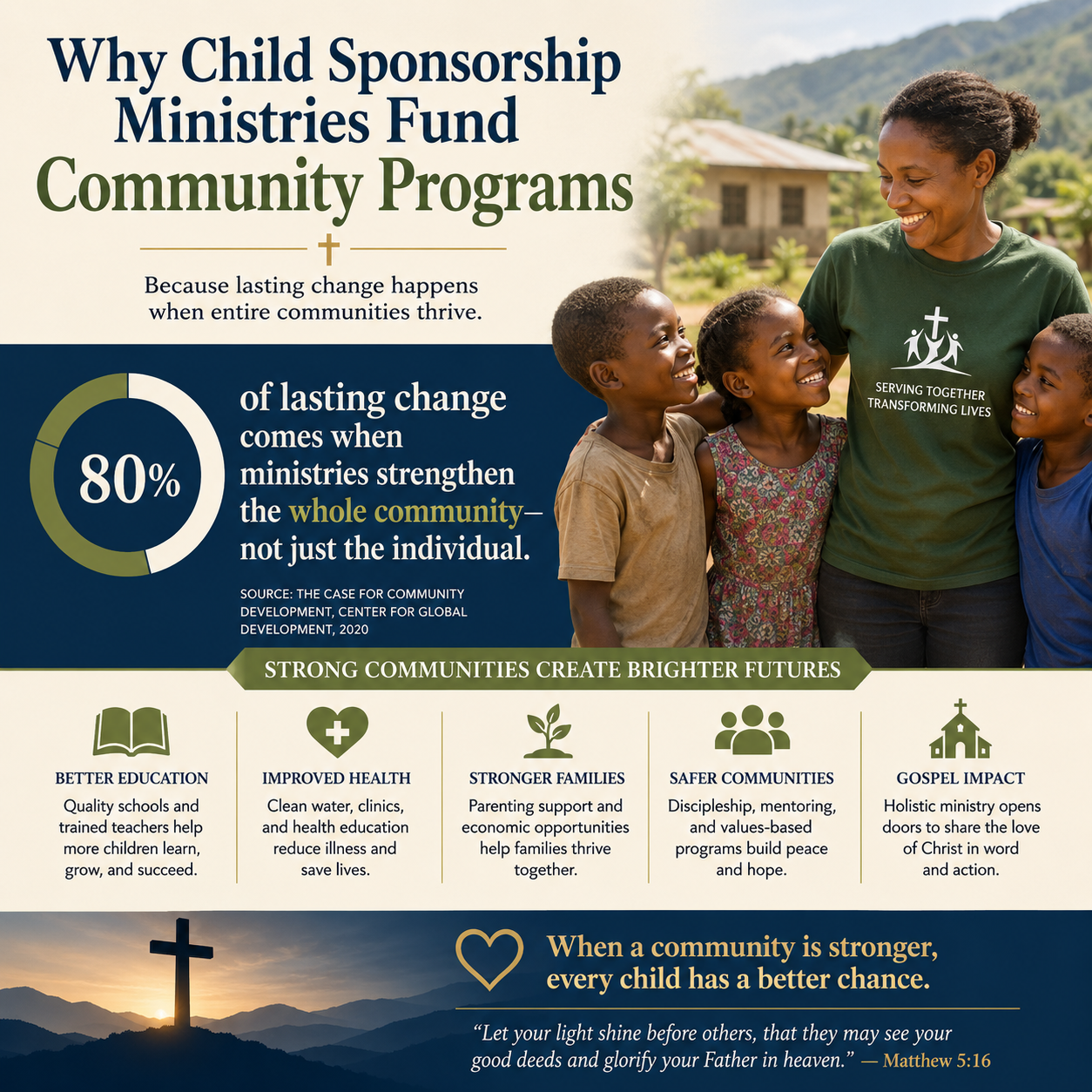
By contrast, community-oriented programming can create shared standards and oversight: child-protection committees, training for teachers, referral networks with clinics, and mechanisms for reporting abuse. Those are not “extras.” They are part of the moral duty to protect children from harm. A sponsorship ministry that claims to help children while neglecting safeguarding infrastructure is not practicing biblical care.
Services like education and health depend on quality institutions
Even when sponsorship funds are used for fees, supplies, or tutoring, outcomes depend on the quality of local schools, the availability of clinics, and the reliability of community leadership. Investing in teacher training, early childhood development, or basic clinic support can be a way of ensuring that child-focused expenditures are not wasted by systemic failure.
This is where sophisticated donors often ask the harder question: what is the ministry’s theory of change? Is the organization simply distributing benefits, or is it strengthening local capacity so that families and churches can sustain progress after external funding diminishes?
Donor expectations are legitimate, and ministries must communicate clearly
“For a child” language should never become a permission slip for vagueness
Child sponsorship lives on trust. Donors give because they believe their gift is tied to a real child and a real set of outcomes. When a ministry expands into community programs, the ethical requirement for clarity increases, not decreases. If sponsors are led to believe that nearly all funds go directly to a single child when the model actually blends child and community support, that is a transparency failure even if the programs themselves are wise.
We encourage donors to read sponsorship explanations with the same seriousness they bring to major financial decisions. The strongest ministries describe how sponsorship revenue is allocated, what is designated to local program work, how much supports administration and fundraising, and how the organization safeguards children’s data and dignity.
What to look for when evaluating community-funded sponsorship
Across our verification work at Most Trusted, the ministries that meet The Most Trusted Standard tend to treat community programs as a measurable strategy rather than a vague justification. Donors can ask for clear answers to questions such as:
- What specific community interventions are funded, and how do they reduce risk for sponsored children?
- What outcomes are tracked, and how are results validated in-country?
- How does the ministry prevent inequity or conflict between sponsored and non-sponsored children?
- What safeguarding standards govern staff, partners, and communications with children?
- How does the ministry partner with local churches and community leaders without displacing them?
Donors who want broader context on how sponsorship ministries handle funds can review How Child Sponsorship Ministries Use Donations for the categories of spending and the accountability questions that matter most.
Community programs can be faithful stewardship when they are bounded and accountable
The risk of mission drift is real, so boundaries matter
Community programming is not automatically virtuous. It can become a catch-all for ambitions that are not properly resourced, or a rhetorical shield against hard questions about sponsorship allocations. It can also drift from child well-being into projects that are impressive but unmeasured, or that unintentionally compete with local government and church responsibilities.
The best practice is disciplined focus: community programs that are directly connected to child outcomes, implemented with local ownership, and evaluated with transparent metrics. This is where governance and leadership are not secondary issues. A ministry’s board oversight, risk controls, and reporting culture determine whether community work stays aligned with the mission or becomes diffuse.
Financial integrity and transparency are part of Christian witness
Some donors have absorbed the idea that “low overhead” is the primary sign of faithfulness. The field has had to reckon with the fact that this assumption can be misleading. The Overhead Myth letter, signed by leaders including GuideStar and BBB Wise Giving Alliance, argues that administrative and fundraising ratios alone do not measure a nonprofit’s performance and can distort donor decision-making (GuideStar).
That does not excuse waste; it clarifies what to measure. Community programs require competent staff, monitoring, safeguarding, and financial controls. A ministry that cannot explain these costs with clarity is asking donors to supply trust without evidence.
For donors who want to evaluate sponsorship organizations with a wider lens—faith commitments, governance, financial integrity, and evidence of effectiveness—our team at Most Trusted built The Most Trusted Standard to give donors a consistent set of criteria. For additional background on this ministry category, see Child Sponsorship Ministries.
FAQs for Why child sponsorship ministries fund community programs
Does funding community programs mean my sponsored child receives less help?
Not necessarily. In many models, community programs are the means by which the child’s help becomes durable: fewer preventable illnesses, safer school environments, stronger household stability, and better child-protection systems. The relevant question is whether the ministry clearly explains its allocation model and can show how community investments improve outcomes for sponsored children without misleading sponsors about what their gift does.
How can donors tell whether a sponsorship ministry is being transparent about community spending?
Transparent ministries publish clear descriptions of how sponsorship funds are used, provide audited financial statements, and report measurable program outcomes. They avoid implying that each monthly gift functions like a private bank account for one child, and they explain safeguarding practices for child data and correspondence. Donors should expect straightforward answers, written policies, and reporting that a board would recognize as accountable.
A sponsorship relationship is strengthened, not weakened, by honest community investment
Child sponsorship is most faithful when it refuses sentimental simplicity and embraces the real moral terrain in which children live. Funding community programs can be an act of stewardship: protecting the child by strengthening the household and the shared institutions that shape daily life. For Christian donors, the standard is not whether the model feels emotionally direct, but whether it is truthful, accountable, and ordered toward the child’s long-term flourishing before God.



