

What share of sponsorship dollars reaches children is a stewardship question before it is a marketing question. Christian donors are not merely purchasing services; we are participating in mercy, justice, and witness, and Scripture treats money as a diagnostic of the heart and a trust to be handled with fear and joy.
The difficulty is that “reaches children” can mean several different things. Some sponsors mean “cash in a child’s hand.” Others mean “direct benefits received by the child and household.” Still others mean “ministry spending that would not occur without sponsorship.” A serious answer requires clarity about definitions, and the humility to admit that simplified ratios often obscure the moral questions donors actually care about: truthfulness, priority for the vulnerable, and faithfulness in administration.
Define what it means for dollars to reach a child
Three common definitions and why they differ
Most child sponsorship ministries do not hand each child an envelope of money every month, and many should not. Cash transfers can create protection risks, distort household dynamics, and invite exploitation in settings where informal power structures are already predatory. Instead, ministries tend to channel sponsorship gifts into a mix of child-focused services, family support, and community development. That is often a reasonable strategy, but only if donors are told the truth about how the model works.
In our verification work at Most Trusted, the most persistent confusion comes from collapsing these distinct categories:
- Direct-to-child cash: money given to the child or household as cash or cash-equivalent.
- Direct program benefits: services the child receives because the ministry operates (school support, medical care, nutrition, tutoring, discipleship programming).
- Shared or community benefits: services that improve the child’s environment (clean water, school infrastructure, caregiver livelihoods, child protection systems).
- Support costs: fundraising, donor care, compliance, finance, safeguarding oversight, monitoring and evaluation.
- Local partnership and church strengthening: training, pastoral oversight, and capacity building that sustains the work beyond the sponsorship relationship.
Each category can serve a child. Each category can also become a hiding place for vague claims. The ethical question is not whether administrative or shared costs exist; it is whether the ministry has defined them clearly, reported them honestly, and governed them with discipline.
Scripture’s moral emphasis is not a ratio but integrity
Paul’s collection for the Jerusalem church is instructive here. He insisted on careful handling “so that no one should blame us about this generous gift” and sought accountability in administration (2 Corinthians 8:20–21). The biblical standard for financial handling is not a single percentage that proves righteousness; it is transparent integrity that can withstand scrutiny.
Why a single percentage is usually the wrong question
The overhead debate and what mature donors should learn from it
Many donors have been trained to ask for a neat ratio: “How much goes to programs?” The sector has had to reckon with how that obsession can reward underinvestment in governance, safeguarding, and evaluation. A notable corrective came in the “Overhead Myth” letter signed by GuideStar, Charity Navigator, and the BBB Wise Giving Alliance, arguing that overhead percentages alone are a poor measure of nonprofit performance and can pressure organizations into unhealthy financial choices (GuideStar).
Child sponsorship adds another layer: fundraising and donor communication are not peripheral to the model; they are built into it. Sponsor updates, translation, receipts, compliance, and the infrastructure for child protection and case management all cost money. The relevant question is whether those costs are proportionate, well-governed, and truthfully presented, not whether they can be driven to a number that sounds pious.
What “direct impact” can hide
Christians genuinely disagree about whether sponsorship should be primarily child-specific or primarily community-based. That disagreement is not trivial. A child-specific model can sharpen accountability and relational focus, but it can also create inequity in a classroom or village and tempt ministries to portray a one-to-one funding relationship that does not exist. A community-based model can reduce inequity and address root causes, but it can become so diffuse that donors cannot tell what their gift actually accomplished.
Marketing language is where these tensions become moral. If a ministry implies that “your $X provides these items to your sponsored child” while pooling funds broadly, that is not merely a communications weakness; it is a truthfulness problem. If a ministry uses child imagery to fund general operations without clear explanation, donors should pause.
What credible child sponsorship ministries typically do with funds
Pooled funding is common and can be legitimate
In many reputable sponsorship programs, funds are pooled at the project level. Sponsors are matched to real children for relational connection and accountability, while spending supports a basket of services that children in the program receive. The legitimacy of pooling depends on clear disclosure: donors should be told that sponsorship supports a local program serving many children, not a private bank account for one child.
Across our verification work, ministries that meet The Most Trusted Standard tend to do three things consistently: they describe the model plainly, they publish financial statements that allow donors to trace spending categories, and they can explain how child protection and local accountability function where the work actually happens.
Child protection and monitoring are not optional line items
Sponsorship ministries work with minors, which elevates ethical and legal responsibility. Safeguarding training, background checks where applicable, incident response protocols, and ongoing monitoring are expensive, but neglect is costlier. Donors should not reward organizations for starving these systems.
For donors who want deeper context about how giving is handled in this field, we maintain ongoing coverage of How Child Sponsorship Ministries Use Donations with an emphasis on verifiable reporting and governance signals rather than donor-facing slogans.
How to evaluate a ministry’s claims about where sponsorship money goes
What transparent reporting looks like
Transparency is not a glossy impact story; it is documentation that invites informed questions. Ministries serving international communities should be able to show audited financials, a clear breakdown of program versus support costs, and an explanation of how money moves across borders and partners. When reporting is vague, donors are forced to rely on trust alone, and trust without light is rarely a biblical virtue.
In practice, donors can ask for plain answers to questions such as:
- Is sponsorship revenue restricted to specific programs, or treated as general support?
- Are children matched to sponsors for relationship while funds are pooled for program delivery?
- How does the ministry prevent inequity or favoritism among children in the same community?
- What safeguarding standards govern communications, visits, photographs, and data privacy?
- What portion of work is implemented by local partners, and how are partners monitored?
These questions are not cynical. They are a form of love. When donors ask them, we help ministries build structures that protect children and honor the church’s witness.
What to watch for in sponsor communications
Sponsor letters and child profiles can either dignify a child or turn the child into a fundraising asset. Donors should be wary of communications that trade in helplessness, exaggerate the one-to-one financial relationship, or imply outcomes that the ministry does not measure. A mature approach uses careful language: “Your sponsorship supports the program serving your sponsored child and other children in the community,” coupled with specific, verifiable descriptions of what the program provides.
The harder question is whether the ministry’s internal accounting matches its external claims. A donor cannot always verify that alone, which is one reason independent verification exists. Most Trusted evaluates ministries against The Most Trusted Standard, a 15-criteria framework spanning faith commitments, financial integrity, governance, and transparency and effectiveness. The goal is not to replace donor discernment but to strengthen it with evidence.
What share should reach children and how to think about stewardship
Healthy expectations without false precision
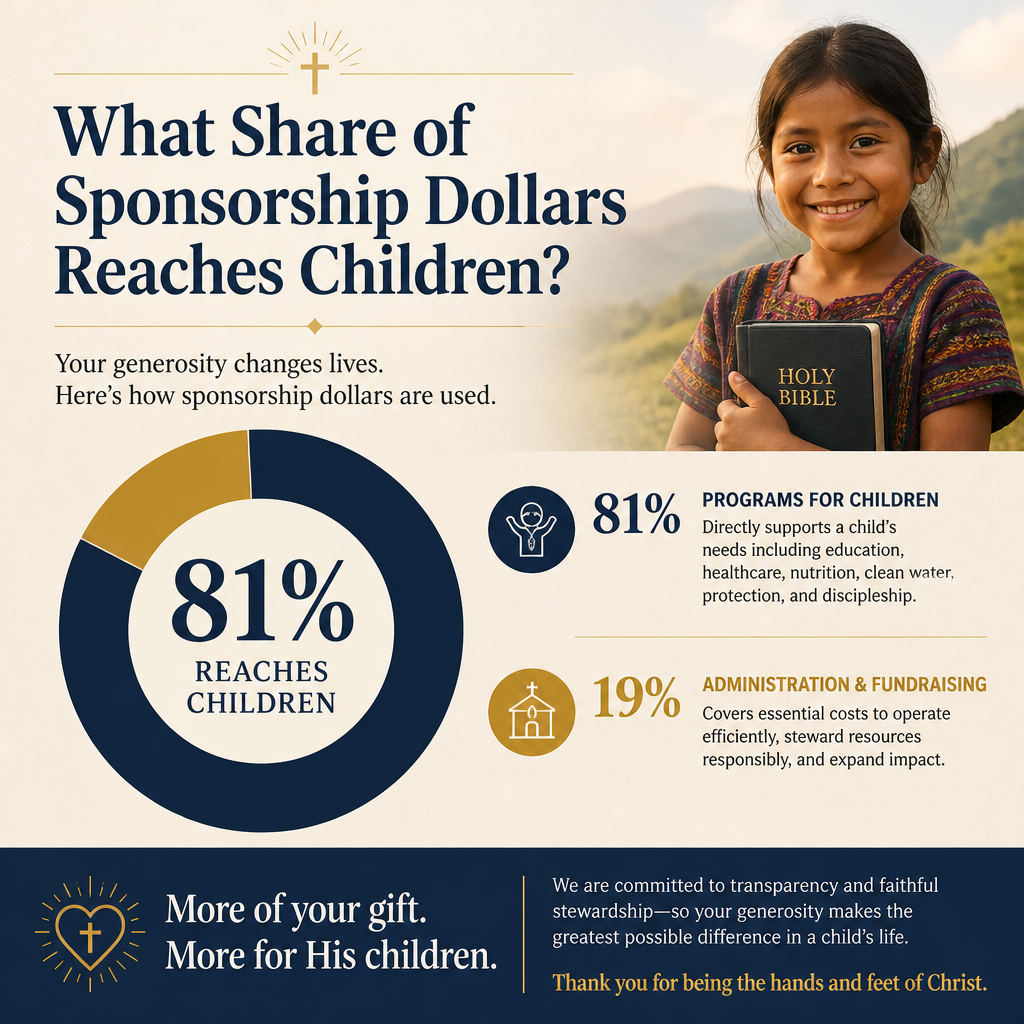
Donors often want a threshold: “If less than X percent reaches children, it is unfaithful.” We resist that framing because it can be manipulated and because different models carry different legitimate cost structures. International sponsorship requires translation, compliance, currency transfer costs, field monitoring, and safeguarding. A ministry with rigorous child protection and serious evaluation may look “less efficient” on a simplistic ratio and yet be far more faithful in the duties Scripture places on those entrusted with care.
What can be said with confidence is that donors should expect a clear, consistent accounting story. A ministry should be able to show that sponsorship revenue is materially advancing child-focused outcomes, not simply sustaining an attractive brand. It should also show that the costs of fundraising and administration are governed, reviewed, and justified in light of mission.
Stewardship requires both generosity and vigilance
Jesus commended sacrificial giving, but he also condemned religious show and devouring the vulnerable. Mature stewardship holds those together. Christian donors can give generously and still insist on integrity in how funds are described and deployed. When a sponsorship organization welcomes scrutiny, tells the truth in plain language, and protects children with seriousness, it is not merely efficient; it is worthy of trust.
For donors comparing approaches across the field, our broader work on Child Sponsorship Ministries addresses the theological aims of sponsorship, common operating models, and the governance and reporting practices that tend to correlate with long-term faithfulness.
FAQs for What share of sponsorship dollars reaches children
Should sponsorship dollars be given directly to the child or family as cash?
Not necessarily. Cash can be appropriate in some contexts, but it also introduces protection risks and can undermine local accountability. Many credible programs deliver benefits through services and child-focused support delivered by vetted staff and partners. The stewardship question is whether the ministry explains the model clearly and can demonstrate that children meaningfully benefit, not whether money is physically handed to a child.
Is a low overhead percentage proof that more sponsorship money reaches children?
No. Overhead percentages can be managed in ways that are misleading, and an intense focus on minimizing overhead can pressure ministries to underinvest in safeguarding, financial controls, and measurement. The nonprofit sector’s “Overhead Myth” statement cautions donors against treating overhead as a standalone indicator of effectiveness (Charity Navigator). Donors should look for transparent reporting, credible governance, and truthful communications about how sponsorship funds are used.
A faithful answer is evidence plus honesty
What share of sponsorship dollars reaches children cannot be reduced to a single number without first defining “reaches” and examining whether the ministry’s accounting and communications align. Christian donors should seek ministries that tell the truth about pooled funding, invest appropriately in safeguarding and oversight, and can show, with documentation, that sponsorship revenue is advancing tangible child and family outcomes. That is the kind of clarity that strengthens generosity rather than replacing it.



