
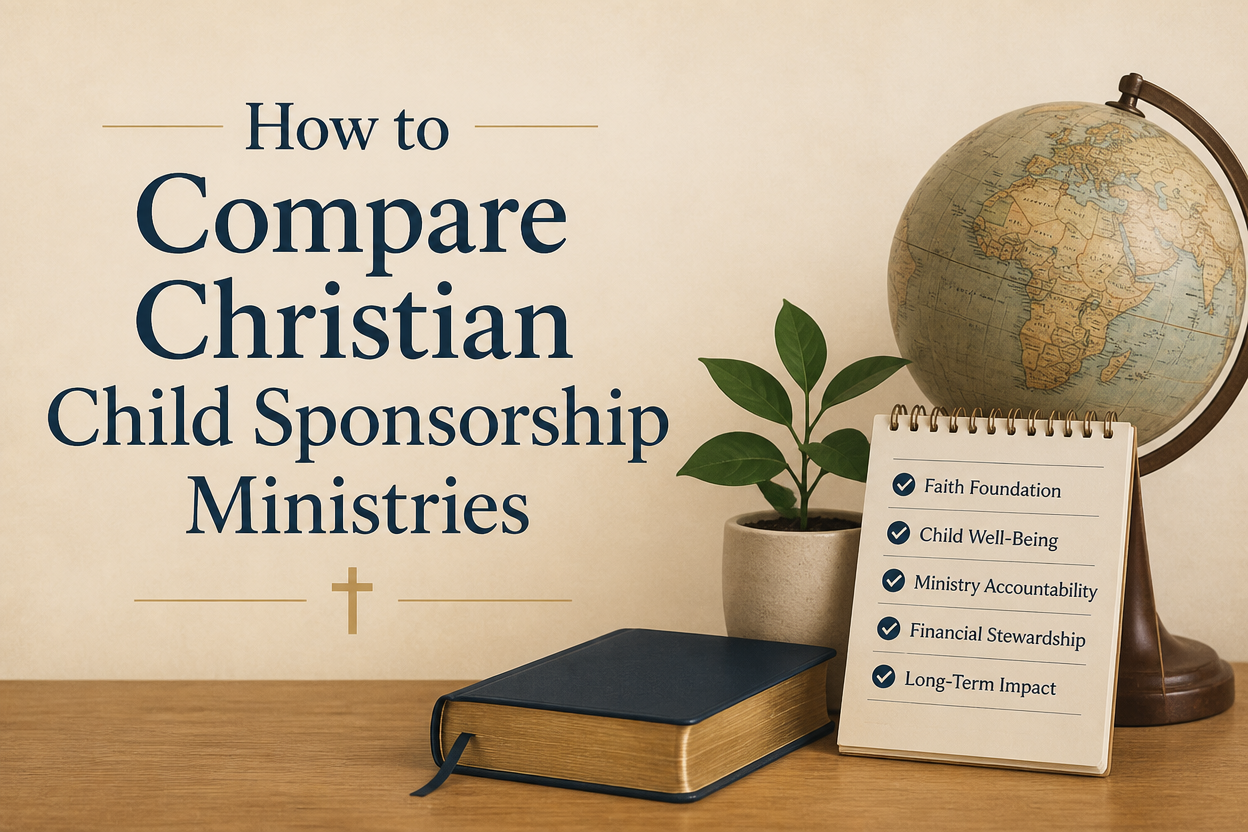
To compare Christian child sponsorship ministries well, donors have to evaluate more than sentiment. Sponsorship is an unusually personal form of giving: a name, a face, a letter, a monthly commitment. That personal connection can deepen Christian compassion, but it can also narrow discernment unless we ask disciplined questions about theology, child protection, family integrity, and verifiable outcomes.
Scripture binds the church to the care of vulnerable children without ambiguity. God identifies himself as “Father of the fatherless” (Psalm 68:5), and James describes care for orphans and widows as “pure and undefiled religion” (James 1:27). Yet the same Bible that commands mercy also warns against partiality, careless speech, and the misuse of power. Sponsorship ministries touch the lives of children and families at their most impressionable points; they deserve a level of scrutiny that matches the moral weight of the work.
Begin with the ministry model not the marketing
Child sponsorship is not one program. It is a funding mechanism that can sit on top of very different approaches to poverty alleviation, discipleship, education, and family support. Comparing ministries begins with identifying what your sponsorship payment actually funds and what commitments the ministry makes to the child, the family, and the local church.
Individual benefit or community development
Some ministries direct a significant portion of each sponsorship gift toward services tied to the sponsored child: tutoring, school fees, case management, and documented child protection interventions. Others treat sponsorship as a doorway into broader community development—water, school improvements, livelihood training, pastoral care—so the “sponsored child” is a representative beneficiary within a defined program area. Both models can be faithful; both can be misrepresented. The comparison question is whether the ministry describes its model plainly and can show evidence that the model protects children and strengthens families.
Church partnership and local ownership
Many Christian donors rightly ask whether sponsorship is an extension of the Great Commission or an adjacent humanitarian effort with Christian language. The distinction is not always clean, and Christians genuinely disagree about appropriate boundaries between evangelism and aid. Still, a mature ministry can articulate its ecclesiology: how it relates to local churches, what discipleship means in its context, and how it avoids coercion. A ministry that partners with indigenous churches should be able to describe the partnership in concrete terms: training, accountability, safeguarding, and shared leadership rather than symbolic affiliation.

Evaluate child protection and family integrity with sober realism
Comparisons that fixate on administrative ratios often miss what is morally central: whether a ministry’s practices reduce harm. Child sponsorship ministries operate in environments where power imbalances are unavoidable. A well-governed ministry assumes risk is present and designs its systems accordingly.
Safeguarding policies you can actually verify
Donors should look for a published child safeguarding policy, clear reporting pathways, background screening protocols, and training requirements for staff and volunteers. The harder question is enforcement: whether allegations are documented, escalated, investigated, and reported to appropriate authorities when required. Ministries may be limited in what they can disclose publicly, but they should be willing to describe processes, not merely intentions. When a ministry cannot explain how it handles misconduct, the donor is being asked to substitute trust for accountability.
A bias toward family based care
Over the last two decades, research and practice have increasingly favored family strengthening over institutional care when safe family options exist. UNICEF states that institutionalization can harm children’s development and that family-based alternatives are generally preferable when possible UNICEF. Not every sponsorship ministry runs residential care, but many intersect with schooling, boarding options, or vulnerable-child programs that can unintentionally incentivize separation. Comparing ministries requires asking whether the program design helps families stay intact: parent engagement, economic strengthening, case management, and reunification strategies where relevant.
Ask disciplined financial questions that fit the ethics of sponsorship
Sponsorship is funded through recurring, restricted-feeling gifts. Donors deserve clarity about what “restricted-feeling” actually means in accounting and practice. A ministry can be financially sound and still communicate imprecisely, leaving sponsors with expectations that cannot be met.
What your monthly gift is and is not
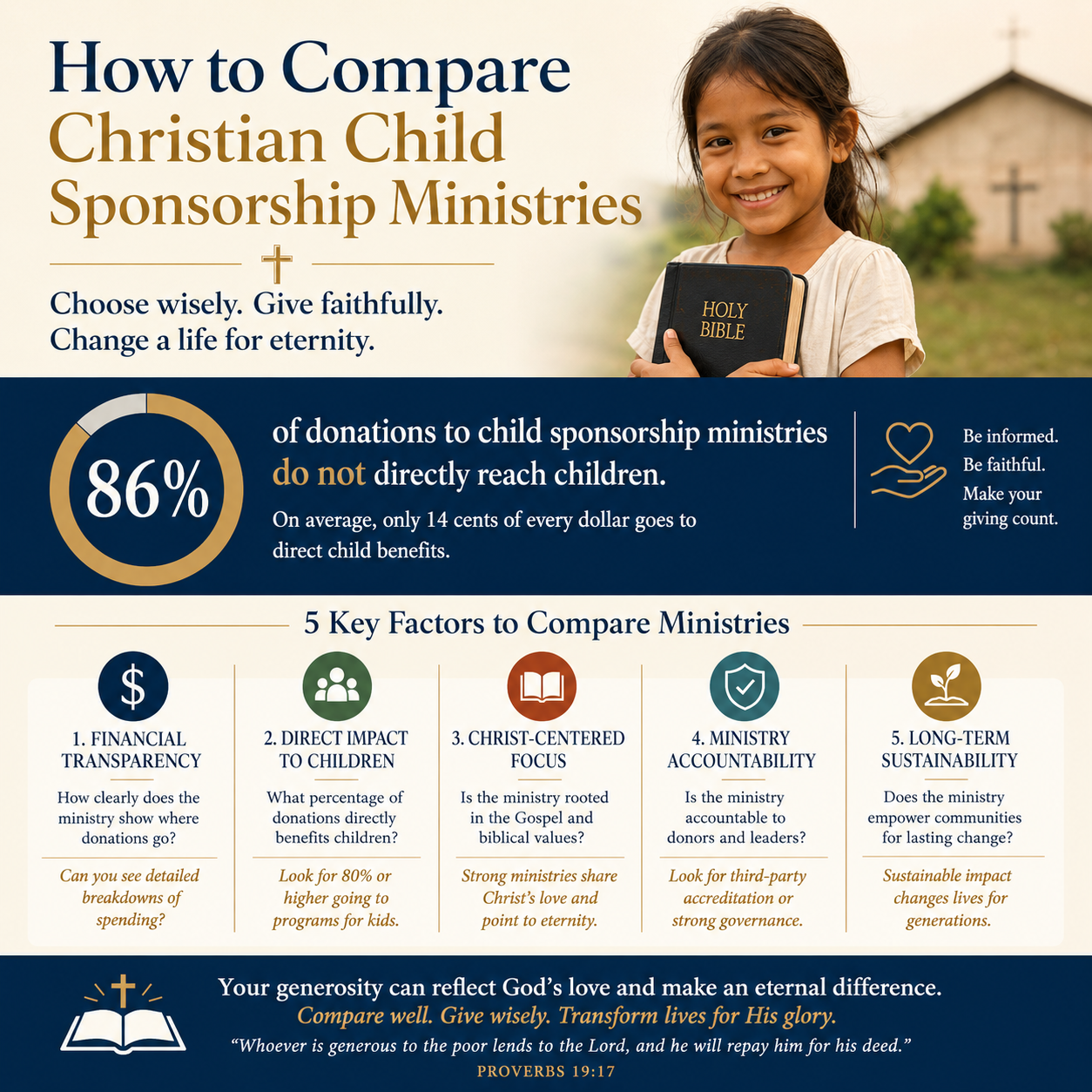
Some ministries allocate sponsorship gifts to a pooled program fund in the child’s community rather than an individual account. That approach can be responsible and often more equitable, but it must be described without ambiguity. When sponsors are led to believe that “$X goes directly to your child” and the reality is substantially different, the problem is not merely marketing; it is truthfulness in Christian stewardship.
Use overhead ratios carefully
Donors often reach for a single number to settle comparison debates. That impulse is understandable but usually insufficient. The widely cited “Overhead Myth” letter—signed by GuideStar, BBB Wise Giving Alliance, and Charity Navigator—argues that overhead ratios are a poor proxy for nonprofit performance and can create perverse incentives Candid GuideStar. What this means in practice is that a ministry may need meaningful investment in safeguarding, financial controls, data systems, and staff training. Those costs are not distractions from mission; they are part of moral competence.
Across our verification work at Most Trusted, the ministries that meet The Most Trusted Standard tend to treat financial transparency as a form of discipleship: they present audited financials when appropriate, describe fundraising practices candidly, and avoid implying that donors can purchase a child’s transformation for a fixed monthly price.
- Audited financial statements or a clear explanation of why an audit is not feasible and what independent review exists
- Plain-language disclosure of how sponsorship funds are allocated
- Board oversight of executive compensation and related-party transactions
- Documented controls for cash handling and field disbursements
- Fundraising that avoids manipulation, exaggeration, or guilt-based pressure
Compare transparency and effectiveness without demanding false precision
Donors should expect evidence, but they should also recognize what evidence can and cannot do in complex social environments. Child well-being is influenced by household economics, community safety, school quality, health systems, and local governance. Ministries that promise certainty rarely deserve it.
What outcomes are appropriate to measure
Some outcomes are measurable and ethically appropriate: school attendance, grade progression, access to clean water, malnutrition screening, immunization referrals, or the completion of a child protection case plan. Others are more contested: long-term spiritual outcomes, poverty “exit,” or the causal impact of a single program when families face multiple overlapping constraints. A credible ministry will name the limits of attribution and still make a disciplined effort to learn.
What to do with research on sponsorship
Academic research on sponsorship has produced both supportive findings and methodological debates. One frequently cited study by economists Bruce Wydick, Paul Glewwe, and Laine Rutledge examined long-term outcomes associated with participation in a sponsorship program and reported positive effects on education and some adult outcomes National Bureau of Economic Research. The research does not settle every question: selection effects, program differences, and cultural variation matter. Still, it underscores that sponsorship can be more than sentiment when it is integrated with real services, local accountability, and long-term commitment.
Donors comparing ministries should look for publicly accessible monitoring and evaluation summaries, not just stories. Stories belong in Christian giving, but they must not replace measurable integrity.
Test the ministry against The Most Trusted Standard
Comparisons become clearer when donors use a consistent set of criteria rather than shifting questions from ministry to ministry. Most Trusted exists to help Christian donors give with confidence by evaluating ministries against The Most Trusted Standard, a 15-criteria framework covering Faith Foundation, Financial Integrity, Governance and Leadership, and Transparency and Effectiveness. The framework is not designed to reward polish; it is designed to surface whether a ministry’s public claims align with verifiable practices.
Faith foundation that is more than branding
In sponsorship work, a ministry’s theology shapes program choices: how it understands dignity, agency, the local church, and the difference between compassion and control. The question is not whether a ministry uses Christian vocabulary; it is whether it demonstrates doctrinal clarity, avoids coercion, and treats those it serves as neighbors rather than projects. Mature ministries can articulate how they honor religious freedom while remaining meaningfully Christian.
Governance and leadership that can withstand pressure
Sponsorship creates specific governance pressures: donor expectations, emotionally charged communications, and the temptation to over-promise. Strong boards create restraint. They require accurate reporting, oversee risk management, and ensure leadership is accountable. When boards are absent, conflicted, or opaque, sponsorship programs can drift into messaging that is effective for fundraising but misaligned with truth.
For donors who want to keep the broader landscape in view, the Child Sponsorship Ministries topic page provides a structured way to explore key questions and recurring patterns without relying on slogans or single-issue scorecards.
FAQs for How to compare Christian child sponsorship ministries
Does sponsorship money go directly to my child
Sometimes it supports services tied closely to that child, and sometimes it is pooled to fund community programs in the child’s area. Either approach can be responsible if it is disclosed plainly and consistently. Donors should look for written explanations of fund allocation, examples of funded services, and financial reporting that aligns with the ministry’s claims.
What warning signs should lead a donor to pause
Common concerns include vague descriptions of how funds are used, no public safeguarding policy, pressure-driven fundraising language, an inability to explain governance and oversight, and impact claims that sound certain but cannot be substantiated. Donors seeking a disciplined comparison framework will often find the most clarity by grounding their questions in How to Give Wisely to Child Sponsorship Ministries rather than relying on emotional resonance alone.
A sober comparison is an act of love
Christian sponsors are not merely funding a program; they are entering a relationship of moral responsibility. Comparing ministries carefully honors the child, protects the family, strengthens the credibility of Christian witness, and guards the donor from a false peace that comes from untested assumptions. The most faithful giving is rarely the most impulsive giving; it is giving that has learned to love with both compassion and truth.



