

Christian donors asking how child sponsorship ministries use donations are not merely asking an accounting question. They are asking whether their giving is faithful stewardship, whether it protects children, and whether it honors the truth. Sponsorship sits at the intersection of compassion, marketing, cross-cultural partnership, and fiduciary responsibility, which means it demands a higher level of clarity than many ministries provide by default.
Most sponsorship programs do not function as a simple pass-through from donor to a single child’s wallet. Some donors welcome that; others feel unsettled when they learn it. The harder question is not whether a ministry uses funds only for “the child,” but whether the ministry’s practices are truthful, child-centered, and verifiable. Across our verification work at Most Trusted, the ministries that meet The Most Trusted Standard tend to communicate their funding model plainly, document restrictions carefully, and show evidence that program spending is producing durable outcomes rather than short-lived sentiment.
How sponsorship dollars typically move through a ministry
In most mature sponsorship models, donations support a package of services delivered to a registered child within a defined program area. The services are usually administered through local staff and partner churches, schools, clinics, or community committees. Even when a donor is matched to a child for relational purposes, the financial flow is often pooled within the program to ensure consistent delivery and to prevent inequities between sponsored and unsponsored children in the same community.
Program services are the center of the model
Common direct program costs include school fees or tuition support, uniforms, books, tutoring, nutrition supplementation, basic healthcare access, case management, child protection training, and pastoral care or discipleship where appropriate and lawful. Some ministries also fund vocational training for older youth, parenting support, and safe meeting spaces. These line items can be legitimate expressions of “sponsorship,” but they should be described as such—clearly and without sentimental ambiguity.
Many donors have learned to distrust the word “overhead,” assuming it signals waste. The nonprofit sector has had to correct that assumption publicly. Charity Navigator, GuideStar, and the BBB Wise Giving Alliance jointly warned donors that narrow focus on overhead can distort decision-making and harm effectiveness; they called this dynamic the “overhead myth” and urged evaluation that includes transparency and results, not expense ratios alone Charity Navigator.
Support costs make programs possible but should be bounded and explained
Child sponsorship requires systems: child enrollment and verification, safeguarding protocols, monitoring visits, financial controls, translation for correspondence, donor receipting, and data protection. These are not decorative features. If a ministry lacks basic governance and controls, children can be harmed and funds can be diverted, especially in cash-based contexts and in regions with weak institutional enforcement.
Even so, sophistication does not excuse opacity. The ministries we view as trustworthy set clear policies on what counts as program, administration, and fundraising; they disclose material related-party transactions; and they show how donor restrictions are tracked. These practices matter because they reduce the gap between a donor’s intent and a ministry’s actual use of funds.
Restricted and unrestricted gifts are not a technicality
Some sponsorship gifts are legally restricted by the donor’s designation or by how the ministry solicits the gift. Others are treated as program-restricted but flexible within that program. Still others are unrestricted, allowing the ministry to allocate funds where needed. A donor’s moral question is whether the ministry’s solicitation creates a specific expectation—and whether the ministry honors that expectation without evasive language.
For donors who want a broader framework for evaluating the models and claims made across the sector, we maintain editorial analysis on Child Sponsorship Ministries. It is not enough to know that a ministry “does sponsorship.” The details determine whether the approach is consistent with truthfulness, local dignity, and durable benefit.

What “reaches the child” can mean and why the phrase misleads
Donors often ask what percentage of sponsorship dollars “reaches the child.” That question is understandable, but it is also easily manipulated. “Reaches” can mean cash transferred to the child, goods handed to the child, services delivered to the child, or community investments intended to benefit the child’s household and neighbors. Ministries can publish an impressive-sounding percentage by choosing a favorable definition while leaving donors with an impression the numbers do not actually support.
Direct cash is rare and sometimes unwise
Some ministries provide direct cash assistance to families, sometimes with conditions such as school attendance or health visits. Others avoid cash because it can increase family conflict, expose children to exploitation, or create perverse incentives within a community. Christians genuinely disagree about the best approach. The When Helping Hurts framework, articulated by Corbett and Fikkert, has shaped many ministries’ caution by arguing that assistance can unintentionally reinforce dependency or undermine local agency if not designed carefully Moody Publishers.
When a ministry does provide direct material support, the primary question is not whether cash changed hands, but whether the ministry has controls and safeguarding around distribution. Without controls, the most vulnerable can become targets, and good intentions can become fuel for harm.
Services and community goods may be the most defensible use
Education support, medical access, nutrition programs, and child protection systems are often more sustainable than periodic gifts. A tutoring program can raise learning outcomes for many children at once. A strengthened local child protection committee can reduce abuse risk in ways no single cash transfer can accomplish. Donors should not be asked to suspend discernment here; they should be invited into a clear explanation of why a programmatic approach is used and how effectiveness is measured.
The caution is that “community benefit” language can become a catch-all that obscures weak accountability. If a ministry claims sponsorship funds support community development, it should be able to show: (1) the theory of change, (2) where the money went, (3) who decided, (4) what outcomes were observed, and (5) how children’s safety and voice were protected.
Emotional framing can pressure donors into accepting vagueness
Sponsorship marketing has sometimes implied a one-to-one financial relationship that does not exist. That is not a small matter. Scripture repeatedly condemns false weights and measures; God’s people are to be known for honest dealing, not merely heartfelt intention. A ministry can run a pooled program model with integrity, but it must avoid presenting the model in a way that trades on a donor’s mental picture while disclaiming the reality in fine print.
For sophisticated donors, the goal is not to punish ministries for complexity. The goal is to require truthful speech. If a ministry cannot explain its funding flow plainly, it is not ready to receive sacrificial gifts.
What financial integrity looks like in a sponsorship ministry
Because sponsorship programs operate across borders, they face higher risks: currency exchange losses, cash handling, limited banking infrastructure, third-party partners, and uneven regulatory oversight. A trustworthy ministry treats these as governance problems to be solved, not inconveniences to be ignored. Financial integrity is not simply low administrative cost; it is the presence of controls that make theft, deception, and mission drift harder.
Clear financial statements and credible oversight
Mature ministries publish audited financial statements, not just internal summaries. They disclose the auditor, the year, and material notes that affect interpretation. Donors should be able to find consolidated statements if the ministry has multiple entities, and should be able to see how international field operations are accounted for. Many ministries in the United States file an annual Form 990, which can be reviewed publicly through the IRS and other databases Internal Revenue Service.
Financial transparency does not guarantee faithfulness, but opacity reliably increases risk. When a ministry resists basic disclosure, donors should assume the burden of proof remains unmet.
Allocation practices should be consistent with how gifts are solicited
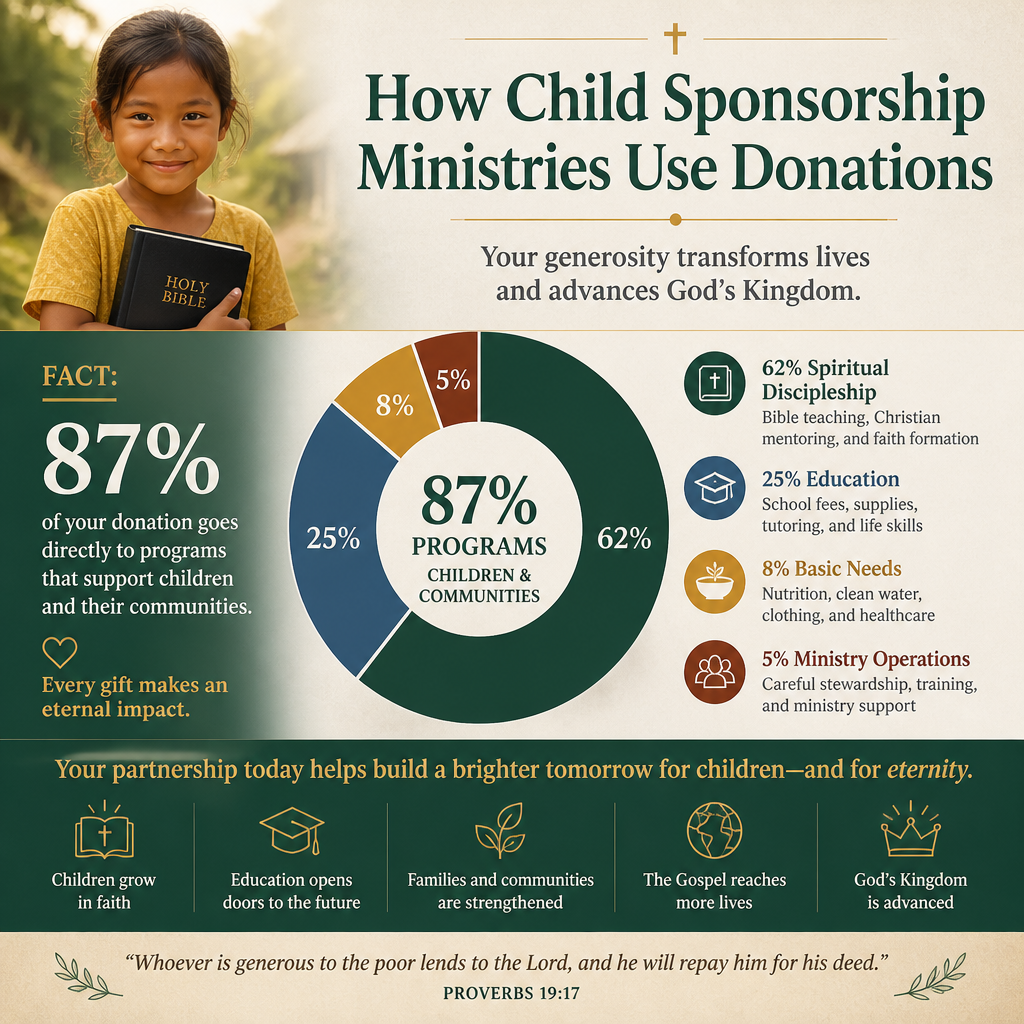
Some ministries allocate sponsorship revenue across multiple categories: child-focused services, community investments, and shared operational support. That can be legitimate. The question is whether the allocation matches the representation made to donors at the point of giving. If a donor is told “$X provides school fees for your sponsored child,” but the ministry treats the gift as general revenue with minimal program restriction, the issue is not merely accounting—it is truthfulness.
Responsible ministries document their allocation methodology, explain what proportion supports program delivery versus fundraising and administration, and identify what portion of sponsorship revenue is used for donor communication and retention. Donors are not served by vague assurances. They are served by verifiable categories, applied consistently across years.
Safeguarding and governance are not optional costs
Child sponsorship ministries hold sensitive data and operate relational programs where power differences are real. Donors should expect background checks where legally possible, safeguarding training, incident reporting procedures, and partner oversight. These systems cost money. Refusing to fund them in the name of “sending more to the field” can be a serious moral error.
In the strongest ministries, boards oversee risk, executives can explain how internal controls work in the field, and whistleblower mechanisms are credible rather than cosmetic. These are marks of leadership that understands stewardship as accountability before God, not merely donor satisfaction.
How to evaluate a ministry’s claims without cynicism
Sponsorship can be a faithful form of Christian mercy, but it is not exempt from scrutiny. Donors can hold ministries to high standards without assuming bad faith. The aim is to give in a way that is both compassionate and discerning—“wise as serpents and innocent as doves.”
Ask for definitions, not slogans
When a ministry says “most funds go to the child,” ask what that means. Does it mean direct benefits to the registered child, benefits to children in the program area, or overall mission spending? Ask whether sponsorship gifts are restricted, and if so, how restrictions are tracked across entities and countries. A trustworthy organization will answer without irritation and without shifting the conversation back to emotion.
Look for consistency across publications
Compare what the ministry says on its sponsorship landing pages with what it says in audited statements, annual reports, and Form 990 narratives. Inconsistencies are not always evidence of deception, but they do signal weak governance or weak communication discipline. Both should concern donors who are funding long-term commitments.
Consider effectiveness alongside expenditure
Financial ratios can alert donors to extreme cases, but they cannot tell the whole story. A low fundraising ratio achieved by underinvesting in compliance, safeguarding, or monitoring is not a virtue. Conversely, a ministry investing in evaluation and child protection may appear “less efficient” in simplistic charts while actually being more faithful and more protective of children.
Across our work applying The Most Trusted Standard, we find that the most credible ministries are candid about trade-offs. They explain why they fund both direct services and the systems that keep those services honest. They treat donors as partners in stewardship, not as a revenue source to be managed.
Giving with confidence requires truth, controls, and child-centered outcomes
Child sponsorship ministries use donations in a range of ways, from direct services for registered children to community programs that strengthen the environments children live in. The moral test is not whether a model is simple, but whether it is truthful, governed with integrity, and demonstrably ordered toward children’s good.
Christian donors have the right to expect clarity that matches the seriousness of the work. When ministries speak plainly about how funds are used, submit themselves to credible oversight, and build programs that protect children rather than using them as fundraising symbols, sponsorship can be a disciplined expression of Christian love rather than a leap of sentiment.



