
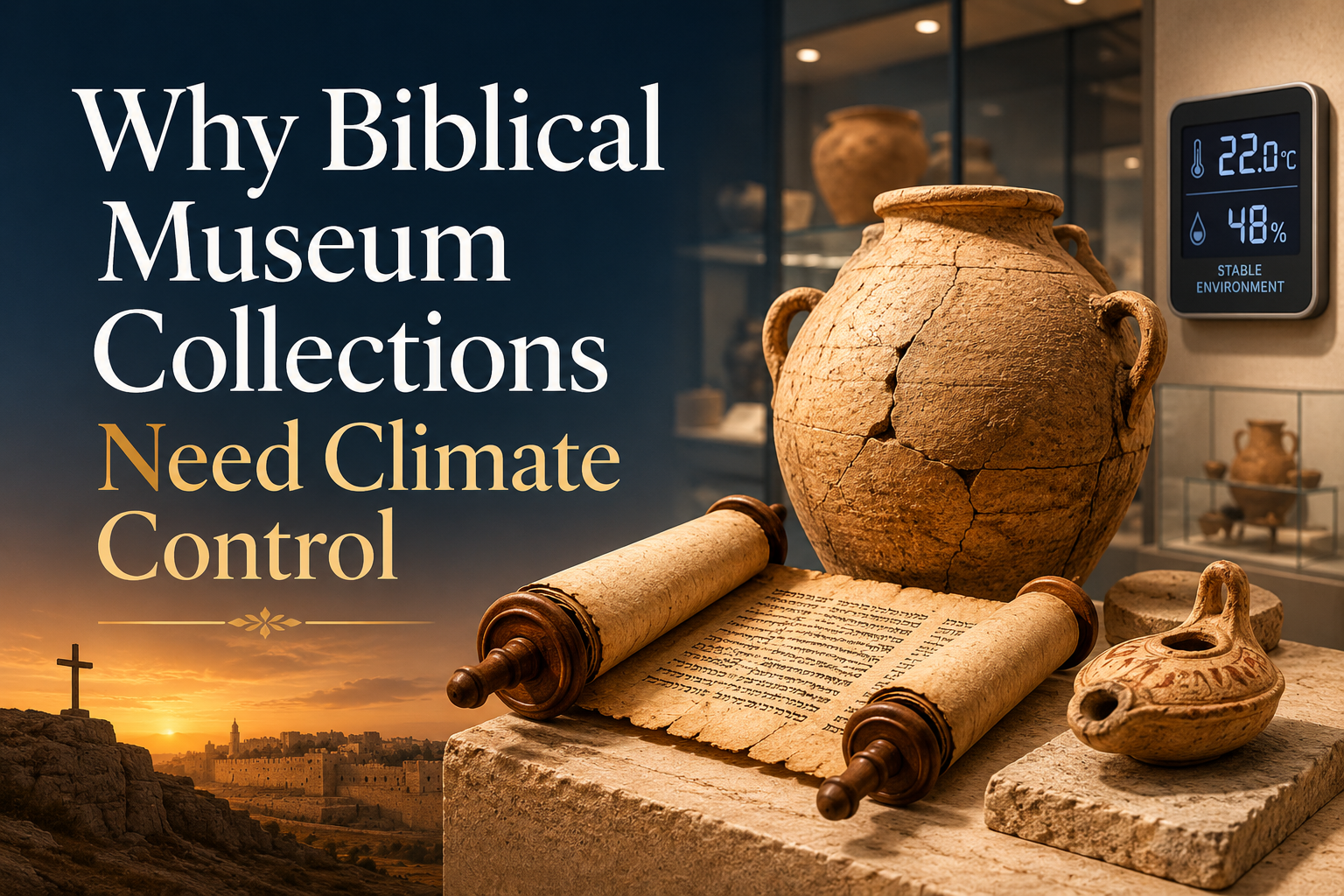
Why biblical museum collections need climate control is not a question of luxury. It is a question of whether irreplaceable witnesses to the biblical world will still be intelligible in fifty years, and whether the donors who funded their care can reasonably trust that a ministry has done what stewardship requires.
Biblical museums occupy a charged space in Christian life. They can strengthen confidence in the historical setting of Scripture, invite careful learning, and serve the church’s teaching. They can also drift into spectacle, or confuse apologetic ambition with curatorial responsibility. Climate control belongs to that second category of responsibilities: it is unglamorous, costly, and difficult to explain in a newsletter—yet it determines whether artifacts endure or quietly deteriorate.
Climate control is not comfort for visitors. It is risk management for the collection
Temperature and humidity are the primary drivers of preventable damage
Most materials in biblical museum collections are chemically and physically active. Papyrus and parchment respond to moisture; wood and bone swell and shrink; metals corrode; pigments fade; adhesives fail. The central issue is not simply “warm versus cool,” but stability—especially relative humidity stability. Rapid fluctuations can be as damaging as an extreme value, because expansion and contraction create repeated mechanical stress.
Conservation science has developed a mature vocabulary for these risks. The Image Permanence Institute, for example, summarizes how elevated temperature and humidity accelerate chemical decay in paper-based materials and increase mold risk, while instability increases mechanical stress across composite objects and layered surfaces. See the Image Permanence Institute at https://www.imagepermanenceinstitute.org/.
What donors often miss is the difference between storage and display conditions
Many ministries can maintain a reasonably stable environment in storage but struggle in galleries, traveling exhibits, multi-use church spaces, or older buildings with limited HVAC zoning. Display cases can create microclimates—sometimes protective, sometimes destructive—depending on seals, internal materials, and how silica gel or other buffering agents are managed. A museum can intend to “do the right thing” and still create harm if its systems are not engineered and monitored for the realities of the building and the collection.
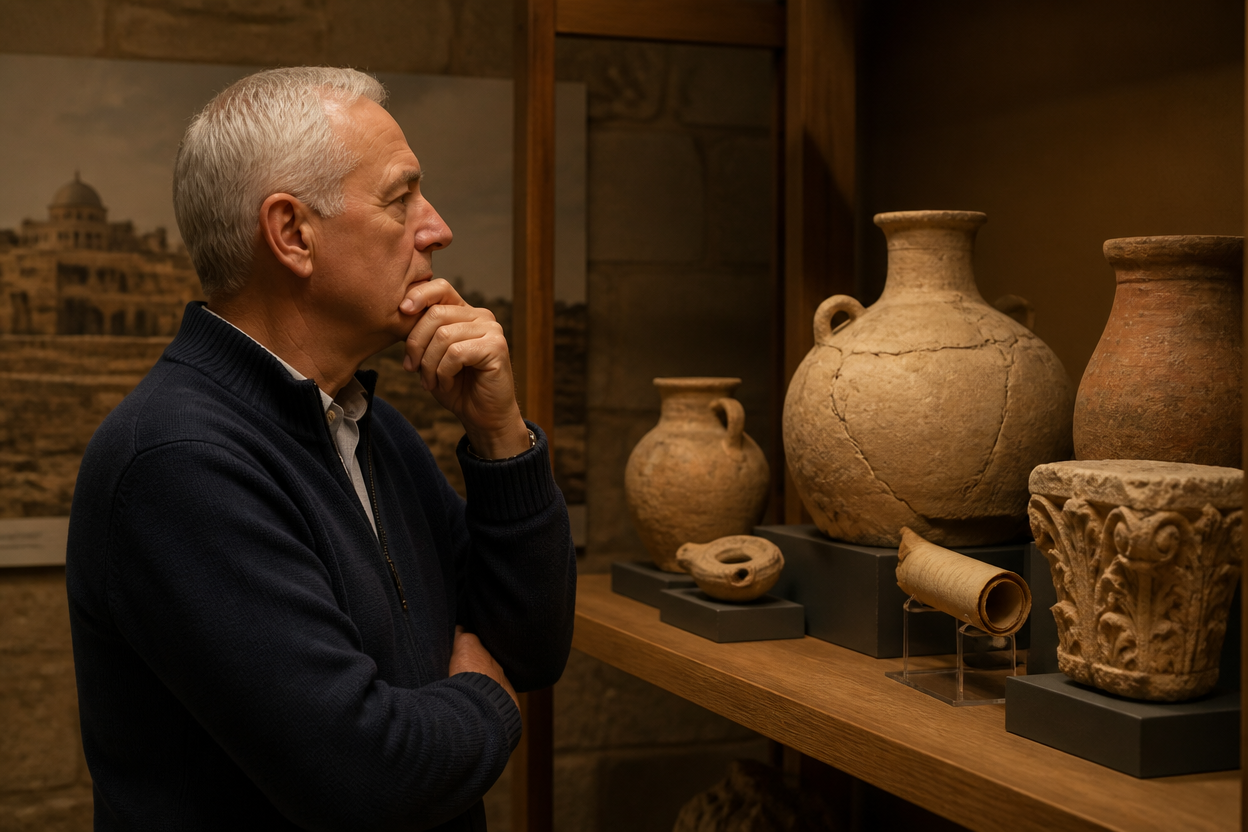
Different materials fail in different ways, and biblical collections are often mixed
Organic materials are vulnerable to moisture and biological growth
Textiles, leather, wood, papyrus, parchment, and other organic substrates are particularly sensitive to humidity. High relative humidity increases the likelihood of mold and pest activity; low relative humidity can embrittle fibers and increase cracking. The American Institute for Conservation outlines how environmental conditions affect collections and why stable relative humidity and temperature matter across organic categories. See AIC at https://www.culturalheritage.org/.
Metals, pigments, and composite objects create complex trade-offs
Many biblical-era objects are composite: metal fittings on wood, painted plaster, inks on papyrus, gilded surfaces on gesso. These combinations make “one-size” climate targets difficult. Lower humidity can slow corrosion for many metals, yet overly dry conditions can stress wood and layered paint. Even when a museum chooses a defensible set point, it must manage gradients—between the gallery and the case, between day and night, between seasons, and between zones within the building.
Christians genuinely disagree about how much uncertainty is tolerable when artifacts are used for public teaching rather than purely for preservation. The more frequently objects are handled, transported, or displayed outside controlled cases, the more the ministry must compensate with tighter environmental discipline and stronger protocols.
Climate control is also a governance issue, because it determines long-term obligations
Collections create ongoing costs that must be acknowledged honestly
Acquisitions are often celebrated; preservation rarely is. Yet accepting artifacts—even as loans—creates a moral and operational obligation that extends beyond a capital campaign. HVAC, monitoring, maintenance contracts, case upgrades, emergency response planning, and trained staff are not optional if a ministry intends to keep faith with donors and with lenders.
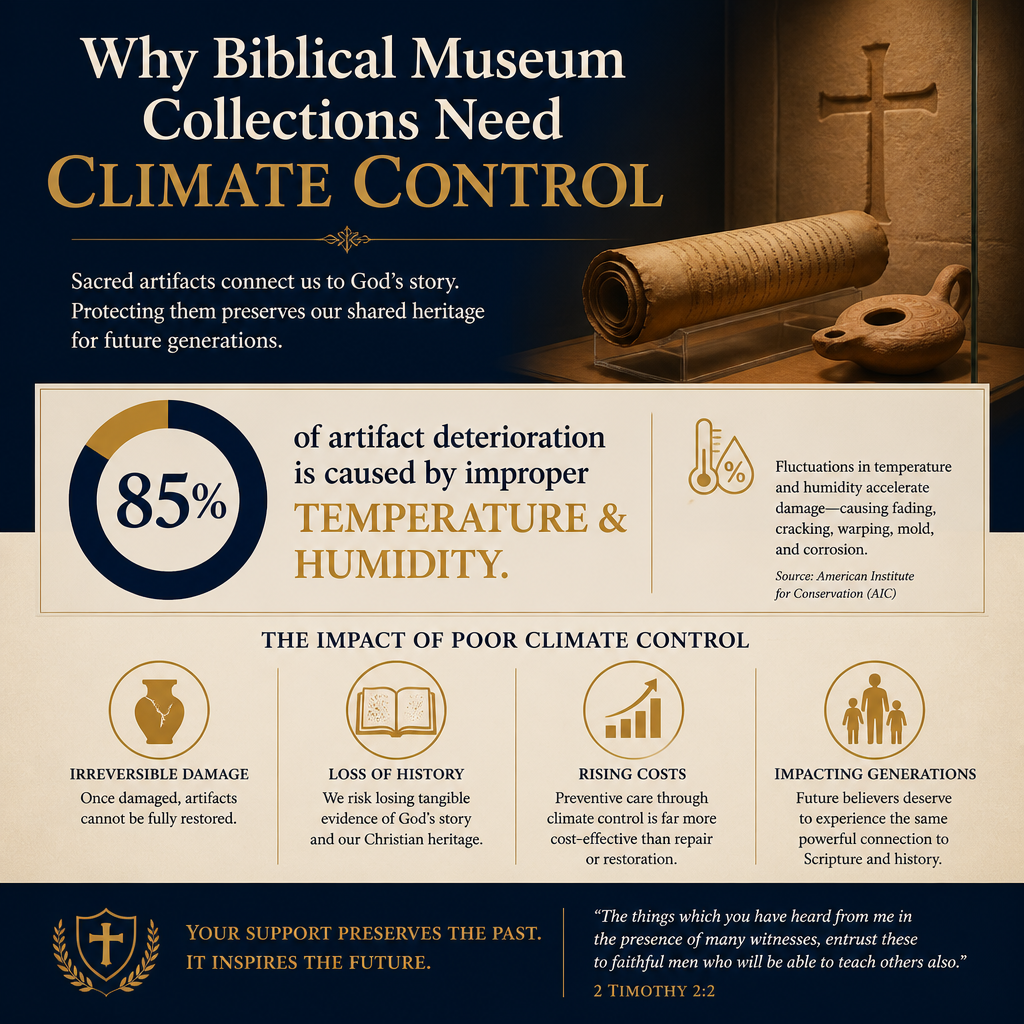
The stewardship framework is not foreign to Scripture. Jesus’ parable of the talents assumes that resources entrusted to servants are to be managed with foresight, not consumed by short-term pressure (Matthew 25:14–30). For a museum, “foresight” includes funding the systems that prevent slow loss. Climate control is one of the simplest places to test whether a ministry’s internal commitments match its public claims.
When budgets tighten, climate control is often the first place corners are cut
We observe across our verification work that ministries under financial strain sometimes defer maintenance, reduce monitoring, or “temporarily” relax environmental set points. The problem is that collections damage is typically cumulative and frequently invisible until it becomes expensive or irreversible. A cracked lacquer surface or mold bloom does not behave like deferred cosmetic upkeep; it is loss.
This is one reason sophisticated donors increasingly ask questions about reserves, facility planning, and whether leadership treats preservation as mission-critical rather than as overhead. The Overhead Myth letter—signed by Charity Navigator, Candid (GuideStar), and the BBB Wise Giving Alliance—helped the sector name why simplistic cost ratios mislead donors; responsible stewardship is better evaluated through outcomes, capacity, and transparency. See Charity Navigator’s homepage for context on this sector discussion at https://www.charitynavigator.org/.
What responsible climate control looks like in practice
Environmental targets, monitoring, and documented response plans
Climate control is not merely buying equipment. It is a system: defined parameters, continuous measurement, documented review, and a plan for what happens when a parameter is missed. Many collections failures come not from a lack of good intentions, but from gaps between “we have HVAC” and “we manage an environment.”
In ministries that tend to be operationally mature, we see several recurring practices:
- Clear environmental targets for different material classes, with rationale documented for the board and major donors.
- Continuous data logging for temperature and relative humidity, with routine review rather than occasional spot checks.
- Defined alarm thresholds and response procedures, including who has authority to act after hours.
- Preventive maintenance schedules and budget lines that do not depend on year-end surplus.
- Exhibit and loan policies that require condition reporting and address transport, handling, and acclimatization time.
Right-sizing is not negligence, but it must be evidence-based
Not every museum needs a brand-new system or the strictest set points used by a national archive. Smaller ministries can sometimes protect collections through well-designed cases, buffered microclimates, limited display rotations, and disciplined storage practices. The moral question is not whether a ministry can afford perfection; it is whether it can afford custody. If an artifact’s preservation requirements exceed a ministry’s capacity, the responsible choices may include declining the acquisition, seeking a loan rather than ownership, or partnering with an institution better equipped for long-term care.
Donors can support this maturity by resisting the temptation to fund only visible expansions. Climate control upgrades, endowments for collections care, and staff training are often the most preservation-effective gifts, even when they do not produce immediate public-facing growth.
How donors can evaluate biblical museums with confidence
Ask questions that reveal stewardship, not marketing
Christian donors are not obligated to become conservators. They are obligated to practice wise generosity. The most useful questions are practical, specific, and tied to accountability. The answers do not need to be perfect, but they should be transparent and internally consistent.
Consider asking:
- What environmental ranges does the museum maintain in storage and in galleries, and how are they monitored?
- Who reviews the data, and how often does leadership see a summary?
- What is the plan during HVAC failure, severe weather, or power loss?
- Does the museum have a collections care budget and a preventive maintenance schedule?
- How does the museum decide what to acquire, and what does it decline because it cannot responsibly preserve it?
Use verification to reduce information asymmetry
Many donors feel a familiar tension: biblical museums can be deeply meaningful, yet the technical realities of preservation are hard to evaluate from a distance. This is where independent verification is especially valuable. At Most Trusted, we assess ministries against The Most Trusted Standard, a 15-criteria framework that examines doctrinal commitments, financial integrity, governance and leadership, and transparency and effectiveness. For collections-focused ministries, climate control practices often function as a concrete indicator of whether governance, budgeting, and operational discipline are aligned with mission.
Donors also benefit from understanding the ecosystem in which a museum operates. Collections may involve complex provenance questions, loan agreements, legal compliance, and ethical standards that are not always visible in public communications. For readers seeking broader context on the field, see Biblical Museum Ministries and the specific preservation focus within How Biblical Museum Ministries Preserve Artifacts.
FAQs for Why biblical museum collections need climate control
Is climate control mainly about preventing mold?
Mold prevention is a significant reason, but it is not the only one. Temperature and relative humidity influence chemical decay, mechanical stress from expansion and contraction, corrosion in metals, and the stability of pigments and adhesives. A ministry can avoid visible mold and still experience slow, cumulative damage if conditions fluctuate widely or remain consistently outside appropriate ranges.
Should donors avoid supporting museums that cannot meet top-tier museum standards?
Not necessarily. Responsible stewardship is not identical to maximal technical sophistication. The more decisive question is whether leadership understands the preservation requirements of its collection, measures conditions consistently, discloses limitations candidly, and makes governance and budget decisions that match its custodial obligations. A smaller museum that is disciplined and transparent can be more trustworthy than a larger institution that is evasive about its risks.
Stewardship that preserves witness
Biblical museum collections are not merely educational assets. They are fragile physical witnesses that, once lost, cannot be replaced by enthusiasm or fundraising. Climate control is one of the clearest ways a ministry demonstrates that it understands the difference between possessing artifacts and preserving them.
For Christian donors, the aim is not technical perfection. The aim is faithful stewardship: giving to institutions that tell the truth about their responsibilities, govern themselves with sobriety, and invest in the hidden systems that keep a public ministry honest over time.



