
How biblical museum ministries preserve artifacts is not a secondary operational concern; it is central to whether these ministries can faithfully steward what they have received and responsibly present it to the public. The physical care of an inscription, manuscript fragment, textile, lamp, or coin is a moral question as well as a technical one, because deterioration is often irreversible, and poorly governed collecting can entangle a ministry in harm.
Donors who love Scripture and care about Christian witness often feel a tension here. Many want tangible connections to the biblical world to strengthen faith and educate the next generation. Yet the last two decades have also made plain that the antiquities market can incentivize looting, fraud, and the laundering of cultural property. Mature giving does not choose between reverence and rigor; it insists on both.
Preservation begins with theology of stewardship, not romance
Biblical museum work can easily be sentimentalized: the sense that faith is strengthened simply by proximity to ancient objects. Scripture itself pushes us toward a different posture. The tabernacle artisans in Exodus were filled with skill for careful work, and the New Testament repeatedly frames Christian life as stewardship of what belongs to God (1 Corinthians 4:2). For museums, “faithfulness” is expressed in controlled environments, documented decisions, and the humility to say no when a gift or acquisition cannot be verified.
Across our verification work at Most Trusted, ministries that meet The Most Trusted Standard tend to treat collections care as an integrated responsibility across leadership, finance, and program staff. Preservation requires governance that understands risk, budgeting that funds long-term care, and communications that tell the truth about what is known, what is uncertain, and what will never be known about an object’s history.
Why donors should care about preservation systems
Artifacts are often received as “one-time” gifts, but their care is a recurring obligation. A museum can accept a donated papyrus fragment at minimal cost and then incur years of storage, monitoring, insurance, conservation assessment, and security. Wise donors ask whether a ministry is building the systems that keep the object stable, accessible, and ethically interpretable for decades, not merely display-ready for the next event.
What preservation is and what it is not
Preservation is not the same as restoration. In serious collections care, the primary goal is stabilization and prevention of further loss, not making an object look “new.” Conservation ethics generally prioritize reversibility, minimal intervention, and documentation so that future specialists can reassess earlier treatments with better tools and better knowledge.
Climate control and handling are where most preventable damage happens
Most artifact degradation is mundane rather than dramatic. Light, heat, humidity swings, pests, pollutants, and improper handling do slow, relentless damage. For donors, the practical question is whether a ministry has invested in routine disciplines that are rarely visible to visitors but decisive for long-term survival.
Environmental control for mixed collections
Biblical museum collections are often mixed: ceramics, metals, papyrus, parchment, wood, textiles, and stone in one institution. Each material responds differently to humidity and temperature. Paper-based materials and organic fibers can become brittle or mold-prone; metals corrode; adhesives fail; inks fade under light exposure. The most reliable preservation programs use stable set points, continuous data logging, and trained response protocols when systems drift.
The U.S. National Park Service’s Conserve O Gram guidance summarizes the baseline reality: fluctuations in relative humidity and temperature accelerate deterioration, especially for organic materials and composite objects. National Park Service Museum Conservation guidance
Handling, housing, and the disciplines of ordinary care
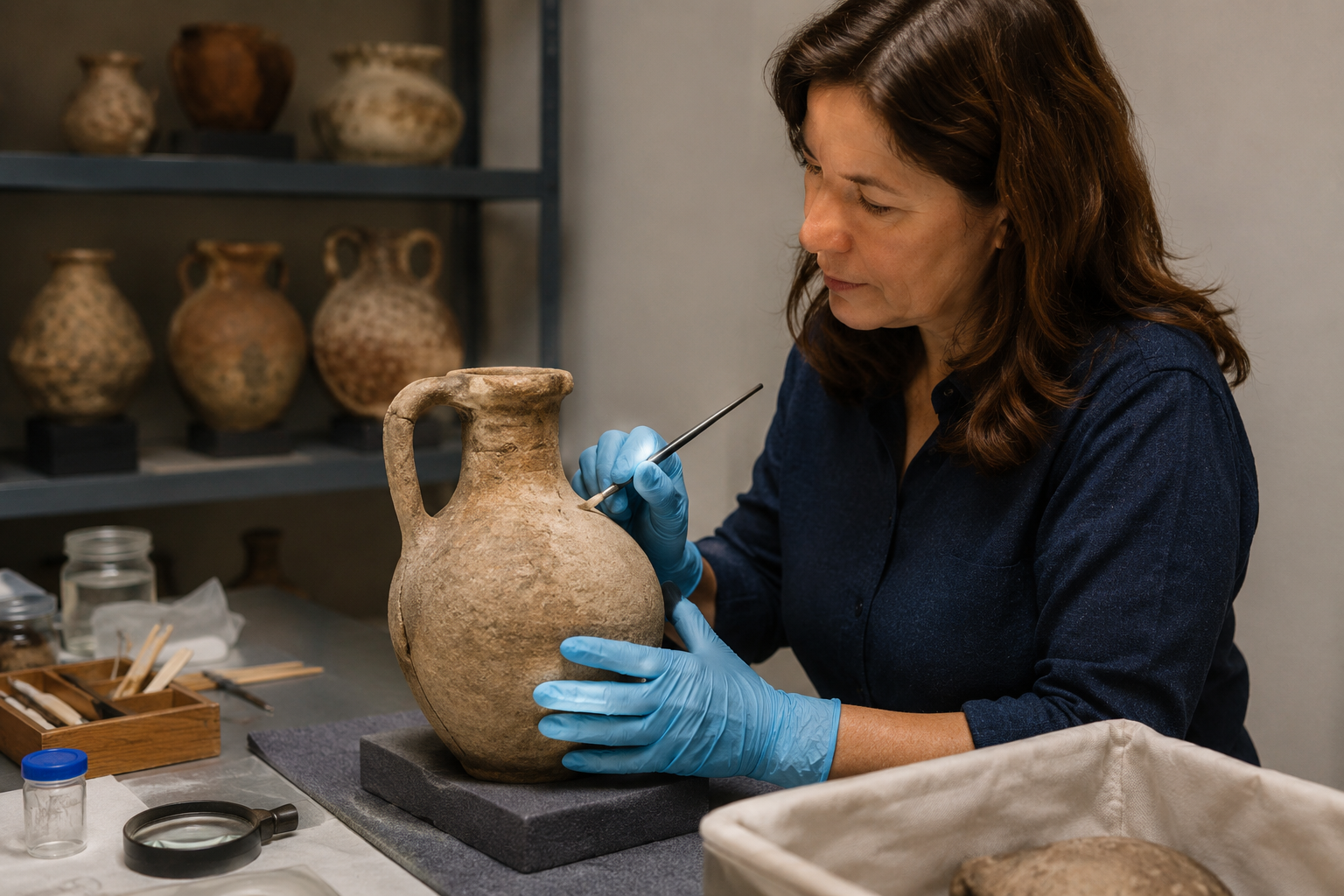
Many objects are damaged not by catastrophe but by casual contact: bare hands, unsupported lifting, improper packing, or storage in acidic materials. A credible museum ministry trains staff and volunteers, limits access, uses archival supports, and treats storage as a primary “exhibit” where most of the collection lives most of the time.
Donors can reasonably ask for evidence of routine practices: written handling procedures, condition reporting, integrated pest management, and a maintenance plan for HVAC and filtration. These measures rarely produce exciting photos, but they are the quiet work of faithfulness.
Security and disaster preparedness are preservation issues
Stewardship also requires the realism that theft and disaster occur. Fire suppression choices, flood risk mitigation, controlled access, and incident response planning are part of a credible preservation program. A museum that cannot describe how it would respond to water intrusion, power loss, or a security breach has not completed its duty of care.
Conservation work is expensive because it is skilled, slow, and documented
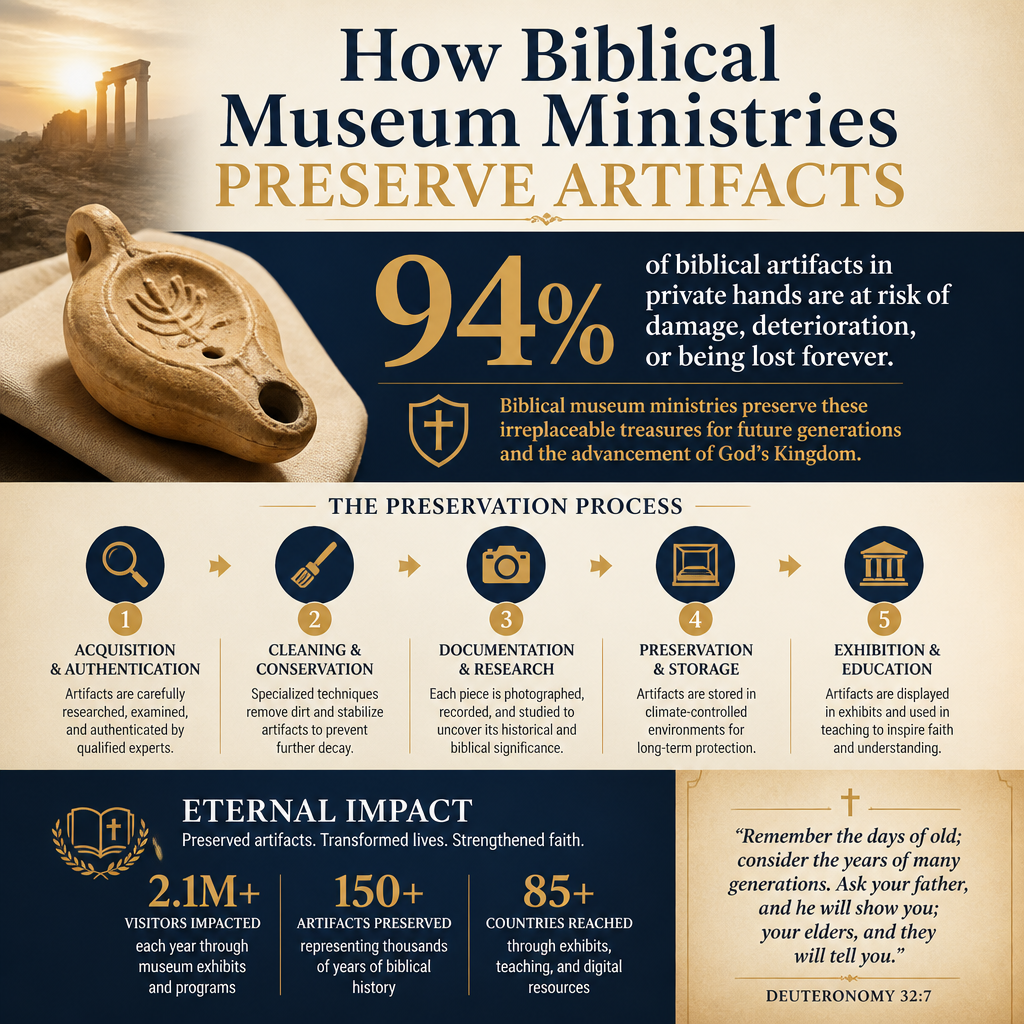
Donors sometimes assume conservation is primarily “hands-on repair.” In practice, a responsible conservation workflow begins with assessment, scientific analysis when appropriate, consultation, written treatment proposals, and careful documentation. The work often involves custom supports, specialized materials, and painstaking time under magnification. That is why conservation costs can feel disproportionate to an object’s physical size.
What donors are actually funding in conservation
When a donor funds conservation, they are often funding three categories of work. First is stabilization: arresting active deterioration such as corrosion, flaking pigment, or embrittlement. Second is housing and mount-making so the artifact can be stored and displayed with minimal stress. Third is documentation—photography, written reports, and archival records that allow transparency and future accountability.
This is a place where Christian donors should resist the false dichotomy between “mission” and “overhead.” Conservation is mission when a museum’s mission is education and preservation. The broader nonprofit sector has repeatedly warned donors against simplistic overhead ratios as measures of effectiveness. Charity Navigator statement on overhead and impact
Why responsible ministries sometimes decline gifts
A gift can be a burden if it arrives without provenance, without funds for ongoing care, or in a condition that would consume staff capacity at the expense of public programming and existing collections. Mature museum ministries develop acceptance policies that allow them to decline gifts that compromise long-term stewardship. This is not ingratitude; it is governance.
Acquisitions are ethically complex, and provenance is central
Artifact acquisition is where preservation, ethics, and public witness converge. Christians genuinely disagree about how museums should relate to private collecting, the legitimate antiquities trade, and contested claims of ownership. Yet there is wide agreement on one non-negotiable: museums must not incentivize looting or traffic in objects that cannot be responsibly documented.
Best practice increasingly emphasizes strong provenance research, compliance with cultural property laws, and a willingness to return objects when credible claims emerge. International frameworks such as the 1970 UNESCO Convention have shaped modern expectations around illicit import and export of cultural property. UNESCO 1970 Convention overview
What careful donors should ask and how Most Trusted evaluates ministries
Many donors want to support biblical museum ministries but do not want their giving to subsidize avoidable deterioration, inflated claims, or ethically compromised collecting. The wise response is not cynicism; it is due diligence shaped by Christian commitments to truthfulness, justice, and stewardship.
Questions that reveal whether preservation is real
Donors can ask specific, verifiable questions without micromanaging professionals:
- Does the ministry have a collections care policy, a conservation plan, and documented environmental monitoring?
- What percentage of the collection is on display versus in storage, and how is storage quality assessed?
- Are condition reports completed when objects are moved, loaned, or exhibited?
- Is there a disaster preparedness plan, and has staff been trained on it?
- For acquisitions, what standards govern provenance research and legal compliance?
Strong ministries answer these questions with documents, not assurances. They can describe who is accountable, how decisions are recorded, and what external expertise is used when internal capacity is limited.
How funding can be structured for long-term faithfulness
Preservation is often best supported through restricted, multi-year funding that matches the reality of the work. Conservation projects can be sponsored object-by-object, but responsible donors also fund shared infrastructure: archival storage, environmental control upgrades, security improvements, and staff training. A museum that can only conserve artifacts when a donor sponsors a dramatic “before and after” will struggle to care for the full collection entrusted to it.
Acquisitions funding, in particular, should be tied to clear ethical and documentation standards. Donors can require that any funded acquisition includes vetted provenance, legal documentation, and a budget line for ongoing care. This protects the ministry and the donor’s witness.
Where verification adds clarity for donors
Most Trusted exists to help donors give with confidence. When we evaluate biblical museum ministries against The Most Trusted Standard, we look for evidence across faith commitments, financial integrity, governance and leadership practices, and transparency about outcomes and risks. In museum work, that often means evaluating whether leadership treats collections care as a governed responsibility, whether financial statements and policies support long-term stewardship, and whether public claims about artifacts are careful, sourced, and appropriately qualified.
For donors seeking a broader view of the field—its practices, pressures, and points of real disagreement—our coverage of Biblical Museum Ministries provides context that supports more discerning generosity.
Preserving artifacts is preserving credibility
Biblical museum ministries can serve the church and the public by presenting the material culture of Scripture with intellectual honesty and physical care. The same commitments that govern Christian discipleship—truthfulness, justice toward neighbors, and stewardship before God—also govern collections care. Donors strengthen this work when they fund the unglamorous disciplines: climate stability, documentation, conservation skill, and ethical provenance standards that protect both artifacts and witness.



