
What artifact conservation work costs biblical museum ministries is less about cosmetic restoration and more about long-term stewardship under moral, scientific, and spiritual constraints. For Christian donors, the question is not merely whether a ministry has preserved an object, but whether it has preserved truthfulness, provenance integrity, and public trust while doing so.
Biblical museums occupy a complicated space. They are asked to serve the church, educate the public, and contribute to scholarship, while operating under donor expectations that often underestimate the cost of doing preservation well. The ministries that endure are typically those that treat conservation as a form of neighbor-love: careful, accountable work that resists shortcuts and refuses to confuse excitement with evidence.
Conservation is not optional if a ministry claims educational integrity
Most biblical museum ministries do not primarily “collect.” They interpret: they curate artifacts, inscriptions, papyri, coins, textiles, and architectural fragments to help visitors understand the ancient world that forms Scripture’s backdrop. But interpretation without conservation is unstable. If an object degrades, the ministry’s ability to teach from it degrades with it.
Christian donors often ask whether conservation is “overhead.” That is the wrong category. For collections-based ministries, conservation is mission-critical program work, akin to the labor required to translate a text faithfully rather than loosely.
What conservation actually includes
Professional conservation covers far more than “cleaning.” It includes condition assessments, preventive care, treatment planning, documentation, storage design, and environmental monitoring. Many of these costs are invisible to a visitor but decisive for an object’s survival.
Conservation also includes ethical restraint. A conservator may decide to do less rather than more, leaving an object stable but not visually “improved,” because the goal is not cosmetic perfection. It is preservation and honesty about what the object is and what is unknown.
Why the timeline is measured in decades
Artifact care is long obedience in the same direction. Climate control, safe storage, integrated pest management, and periodic re-assessment are recurring expenses. A museum that funds treatment but not preventive care is purchasing brief relief rather than durable stewardship.
For donors evaluating ministries in this space, the broader context matters. The Biblical Museum Ministries landscape includes organizations with different collection sizes, interpretive aims, and research responsibilities, and those differences shape what conservation “must” cost.
The largest cost drivers are environment, expertise, and documentation
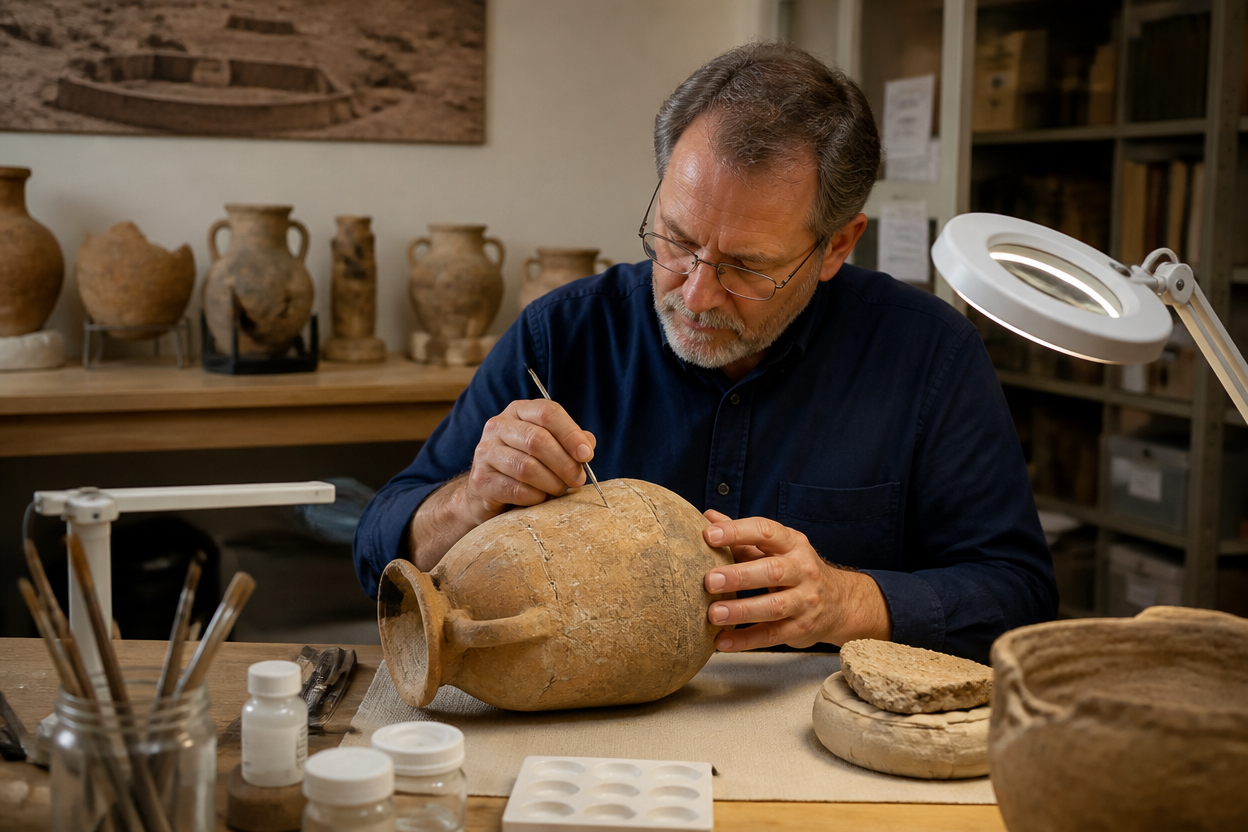
Donors are often surprised that the biggest bills are not dramatic restorations. They are the unglamorous systems that prevent restoration from being necessary. In our verification work at Most Trusted, we repeatedly see that the ministries with stable collections have invested in controls and documentation before they invested in publicity.
Environmental control is the quiet center of preservation
Temperature and relative humidity stability matter because organic materials respond to fluctuations by expanding and contracting, which accelerates cracking, warping, and delamination. Light exposure, especially ultraviolet, fades inks and dyes and breaks down cellulose and proteins. The costs show up in HVAC design, filtration, monitoring equipment, and staff time.
What this means in practice is that a modest gallery can require substantial infrastructure: sealed cases, silica-gel buffering systems, data loggers, and protocols for seasonal shifts. Those are not luxuries; they are the difference between stewardship and slow loss.
Skilled labor is expensive because the work is exacting
Conservators are specialized professionals trained to work on specific material types. A paper conservator is not interchangeable with a textiles conservator, and neither should be asked to treat metal corrosion. When ministries do not have in-house conservators, they pay for consultants, lab time, and sometimes travel. When they do have staff conservators, compensation must be sufficient to retain them.
The U.S. Bureau of Labor Statistics classifies conservators under “Archivists, Curators, and Museum Workers,” and reports a 2024 median pay level for that category, which helps explain why personnel can be a major line item even for modest institutions. U.S. Bureau of Labor Statistics
Documentation and chain of custody protect the ministry and the church
Condition reports, treatment records, high-resolution imaging, and secure collections databases are not bureaucratic add-ons. They protect against accidental damage, clarify what is original versus repaired, and preserve institutional memory when staff turns over. They also support responsible scholarship and transparent public communication.
The harder question is that documentation also intersects with provenance and legal compliance. Ministries that acquire, conserve, or exhibit artifacts without clear ownership histories risk reputational harm and, in some cases, legal exposure. In biblical material culture, where looting and illicit trafficking have been persistent problems, conservation and provenance review cannot be separated responsibly.
Material type changes the budget more than most donors expect
“Artifact” is a single word that hides many disciplines. The cost profile for a bronze coin, a parchment fragment, and a dyed textile differs sharply, not because one is more spiritually significant than another, but because materials respond differently to time, handling, and environment.
Organic materials are fragile and expensive to stabilize
Wood, leather, parchment, papyrus, and textiles are vulnerable to humidity swings, mold, pests, and light damage. They often require tight environmental tolerances and careful mounting and storage. Treatments can involve humidification chambers, custom supports, and reversible adhesives or consolidants that meet conservation standards.
Even when treatment is minimal, storage can be costly. Archival-grade enclosures, inert foams, buffered tissues, and custom-made boxes add up across a collection. These are recurring costs as collections grow and as materials age.
Metals and stone have different risks but not simpler ones
Metals corrode, and corrosion can accelerate if chloride contamination or fluctuating humidity is present. Stabilization may involve mechanical cleaning under magnification, chemical treatments, and protective coatings chosen for reversibility and long-term stability.
Stone and ceramics are comparatively stable, but they have structural risks: cracks, previous repairs with inappropriate materials, or salt efflorescence that can slowly fracture surfaces. Large stone objects also carry rigging, shipping, and mounting costs that donors may not anticipate.
Exhibit design can either protect artifacts or slowly destroy them
Exhibitions are frequently where conservation budgets rise. Display cases must be sealed, secure, and made of materials that will not off-gas harmful compounds. Lighting must be calibrated for preservation, not drama. Mounts must support objects without stress points. Security systems and visitor flow also matter, because the most common damage in museums is not theft but accidents.
- Custom mounts and inert case materials
- Light management and UV filtration
- Environmental buffering inside cases
- Security glazing and alarm integration
- Handling protocols and trained installation crews
Ethics and credibility are part of the true cost
Some conservation expenses are best understood as credibility expenses. Biblical museums serve a public that is alert to exaggeration, contested claims, and sensationalism. Christians genuinely disagree about how museums should frame the relationship between faith and historical evidence, but there is broad agreement that ministries should not manipulate objects, overstate certainty, or use conservation to create an appearance of authenticity.
Conservation cannot be separated from provenance diligence
A museum may face a choice: decline an artifact with unclear history, or accept it and assume future risk. Proper diligence includes reviewing documentation, export and import records, previous ownership, and sometimes commissioning external expertise. That work costs money, but it also protects the ministry from participating—knowingly or unknowingly—in harm to source communities and from encouraging looting markets.
Responsible institutions also align with sector ethics that have become more explicit in recent decades. The International Council of Museums maintains a global Code of Ethics that addresses acquisition, documentation, and cultural property responsibilities. International Council of Museums
Restraint is a theological posture as much as a professional one
Scripture commends careful handling of what belongs to God and integrity in witness. “We refuse to practice cunning or to tamper with God’s word” (2 Corinthians 4:2) is not a proof-text for museum work, but it is a relevant moral analogy. Ministries that handle artifacts should resist the temptation to “tamper” in the sense of altering an object so it better serves a preferred story.
That restraint carries costs. It can mean slower exhibition timelines, fewer dramatic “after” photos for donors, and more investment in peer review and transparency. Those are costs worth bearing because the church’s credibility is not easily rebuilt once compromised.
What donors should look for when funding conservation
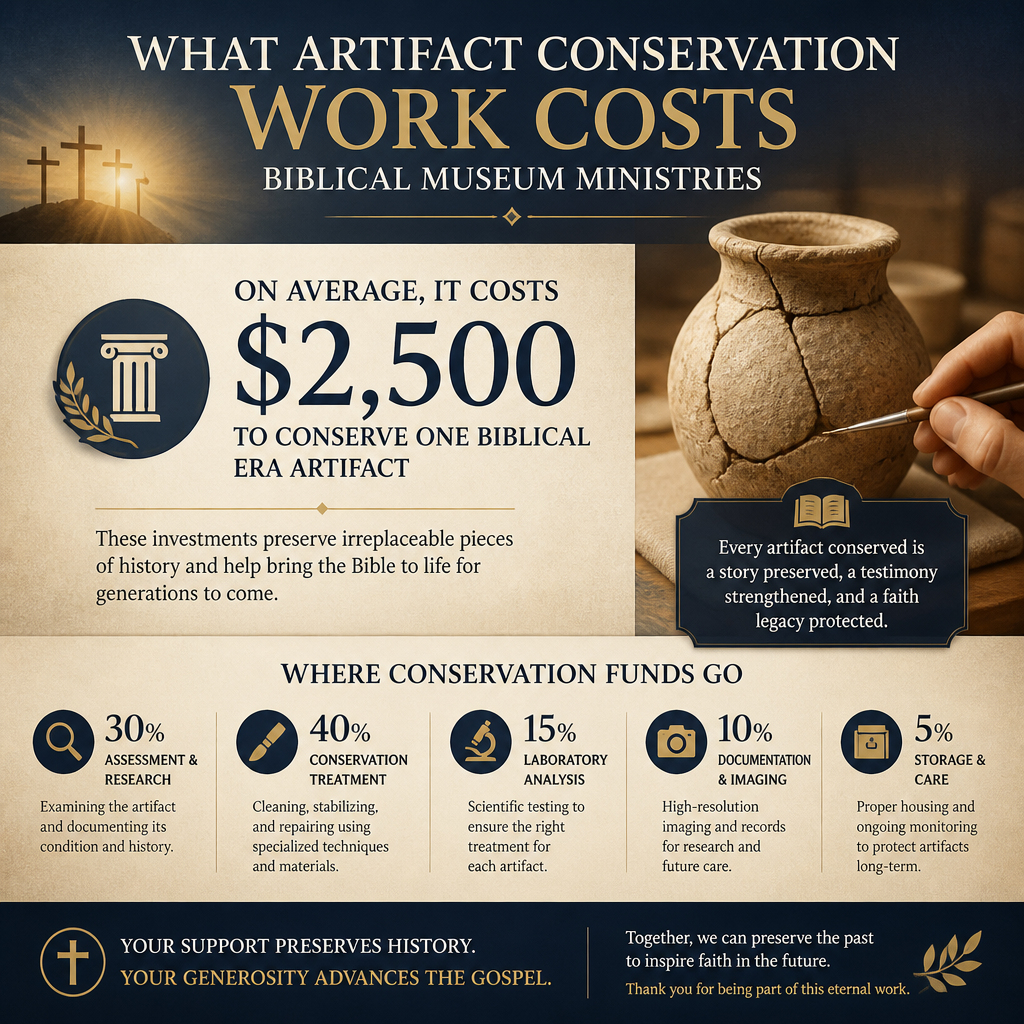
Christian donors want to fund faithfulness, not just activity. For conservation, that means supporting ministries that treat preservation as accountable stewardship, with clear internal controls and public-facing honesty about uncertainty. Across our verification work, we observe that strong ministries do not merely spend more; they spend with documented rationale, appropriate oversight, and measurable preservation outcomes.
Signals of disciplined stewardship
When we evaluate ministries against The Most Trusted Standard, conservation-related questions often fall under governance, transparency, and effectiveness as much as under program activity. The patterns below tend to indicate maturity:
- Clear collections management policies, including acquisition and deaccession rules
- Documented conservation plans tied to risk assessment rather than donor preference
- Qualified staff and external advisors with relevant conservation credentials
- Budgeting for preventive care, not only high-visibility treatments
- Public transparency about provenance, condition, and interpretive uncertainty
How to ask better funding questions
Donors can serve ministries by asking questions that honor complexity. “What will this treatment prevent over the next ten years?” is often more helpful than “How quickly can this be restored?” “What environmental controls are in place?” is more consequential than “How much of my gift goes directly to the artifact?”
It also helps to fund what is hardest to fund. Preventive conservation, storage upgrades, documentation systems, and training are rarely named on a gala stage, but they are where collections are saved. The ministries that can explain these priorities plainly are often the ones that will still be worthy of trust when leadership changes.
For donors seeking to understand the practices involved, the category on How Biblical Museum Ministries Preserve Artifacts offers a wider view of the operational disciplines behind faithful public exhibition.
FAQs for What artifact conservation work costs biblical museum ministries
Is conservation spending just museum overhead, or is it ministry program work?
For collections-based biblical museum ministries, conservation is program work because it sustains the very materials used to teach, research, and disciple through public education. The line between “program” and “operations” is not morally decisive here; what matters is whether the spending is necessary, disciplined, and transparent. Donors should expect credible ministries to budget for preventive care, documentation, and qualified expertise as essential inputs to truthful interpretation.
What is a reasonable way for donors to fund conservation without chasing hype?
Restricted gifts can be appropriate when they align with a documented conservation plan, but unrestricted or broadly designated support is often more stabilizing because it allows ministries to address the highest risks first. A constructive approach is to fund environmental upgrades, collections storage, and professional assessments, then ask for reporting that includes before-and-after condition documentation and a clear explanation of why each intervention was necessary and reversible where possible.
Stewardship that preserves artifacts should also preserve trust
What artifact conservation work costs biblical museum ministries is ultimately the price of taking truth and time seriously. Artifacts are finite, fragile witnesses to history; they deserve care that is competent, restrained, and ethically grounded. Donors best serve these ministries by funding the quiet infrastructure of preservation and by rewarding transparency, so that what is displayed to the public is not only compelling but credible.
At Most Trusted, we encourage donors to treat conservation budgets as a window into a ministry’s character. A museum that can explain its conservation decisions with clarity and humility is often a museum that understands stewardship in the fuller biblical sense: faithful handling of what has been entrusted for the good of the church and the integrity of its witness.



