
Why Bible translation ministries work with local churches is ultimately a question about authority, formation, and faithfulness. Scripture does not treat the church as a helpful accessory to mission; it names the church as the body through which Christ builds, teaches, corrects, and sends his people (Ephesians 4:11–16). Translation that arrives detached from the life of a worshiping community may still produce a text, but it often struggles to produce durable discipleship.
For Christian donors, the stakes are practical as well as theological. Bible translation is long-horizon work: it requires linguistic rigor, community trust, trauma-aware engagement, and decades of stewardship. Partnerships with local churches are one of the primary ways translation ministries pursue legitimacy, accuracy, and lasting use rather than a short-lived distribution event.
The church is not a delivery channel but a covenant community
Translation serves worship, not only access
The Bible’s end is not simply that individuals possess Scripture, but that the people of God hear it, obey it, sing it, and pass it on. Local churches are where that happens week after week: public reading, preaching, catechesis, pastoral care, discipline, and mutual encouragement. When translation ministries work with local churches, they are aligning with the ordinary means through which Scripture shapes a people.
That alignment matters because translation is never merely technical. Word choice, register, and genre cues affect how a community understands God’s character, human sin, salvation, and the church’s life together. A church-shaped context helps ensure the translated Scriptures are received as Scripture—authoritative, teachable, and usable in gathered worship—rather than merely as a religious artifact.
Local churches provide accountable local leadership
Christians genuinely disagree about the ideal “distance” between outside specialists and local authority in mission work. Some fear church partnerships can politicize translation or entangle it in denominational rivalries. Others fear outsider control can suppress local agency. The healthier models we see work hard to establish accountable local leadership: elders and pastors who can speak for the community, name pastoral concerns, and protect vulnerable people from extraction.
Across our verification work at Most Trusted, ministries that meet The Most Trusted Standard tend to treat local ecclesial authority as a governance question, not only a relationship question. They clarify who approves key decisions, how conflicts are handled, and how power is constrained when money and expertise flow from outside.
Local churches strengthen accuracy and legitimacy in the language community
Community checking depends on trust
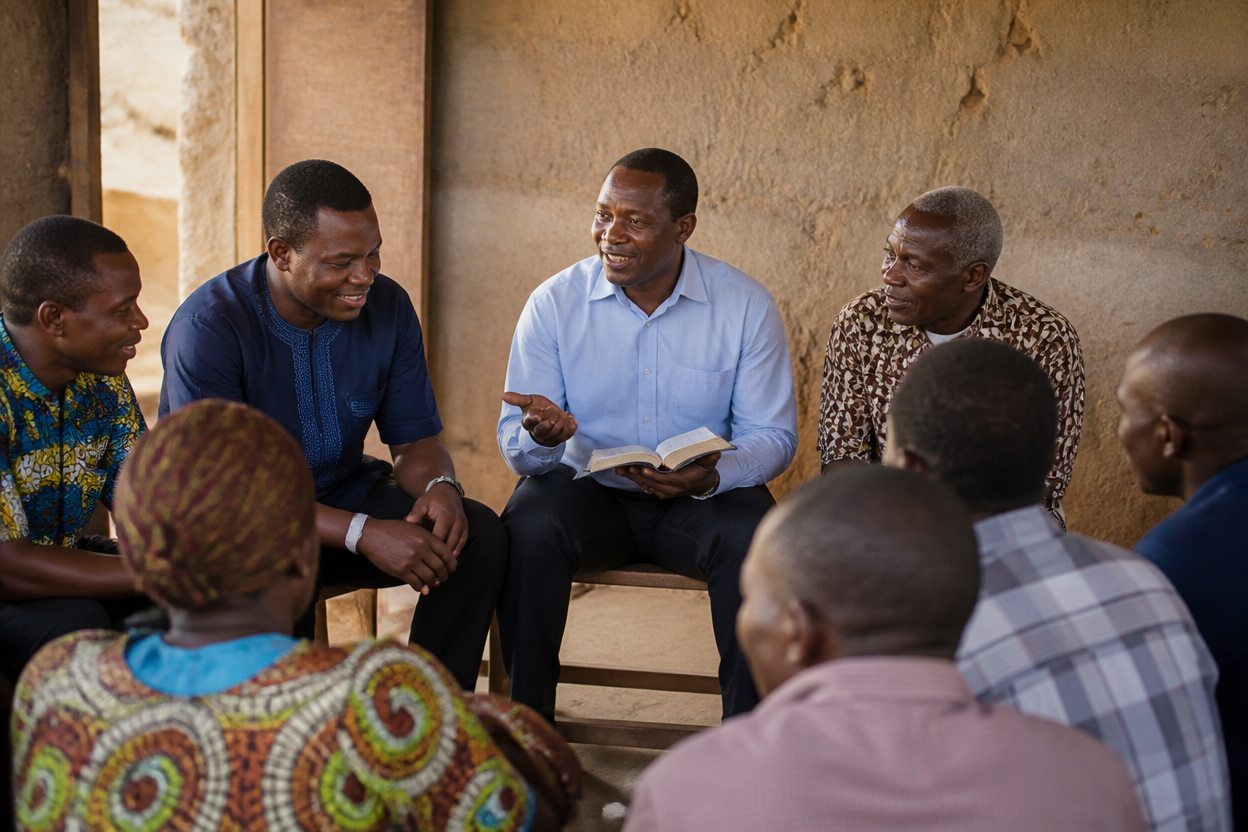
Even with strong linguistic tools, translation quality rises or falls on whether real speakers engage the drafts honestly. That requires trust—especially in communities where literacy may be uneven, where religious identity has social consequences, or where outside organizations are viewed with suspicion. Pastors and church leaders often carry social credibility that translators do not, and they can convene people for review in a way that is relationally legitimate.
Many translation efforts include structured community checking and consultant review, but those processes are not conducted in a vacuum. Churches can help surface whether a term sounds unnatural, whether a metaphor lands as intended, and whether a passage will be misunderstood in ways that create pastoral harm. This is one reason donors often see translation timelines extend: careful checking is slow, but speed is a poor substitute for accuracy when the goal is a Bible a community will live with for generations.
The church helps answer the harder question of acceptance
A translation can be linguistically defensible and still fail to be adopted. Acceptance is a social reality. Churches influence what gets read publicly, what is used in teaching, and what becomes “normal” in family discipleship. When translation ministries bypass the church, they may secure distribution counts without securing meaningful integration into the life of the believing community.
For donors trying to evaluate legitimacy, this is a useful diagnostic: does the ministry have credible local partnerships that can withstand leadership changes, conflict, or persecution pressure? A ministry can report activity without being rooted. The best partnerships show evidence of shared ownership, not just cooperation on paper.
Scripture engagement and discipleship require more than printing and delivery
Translation is part of a wider formation ecosystem
It is common for donors to think of translation as a linear pipeline: translate, print, distribute, done. The field has had to reckon with a more complex reality. Literacy, oral preference, teaching capacity, and cultural barriers all influence whether Scripture is understood and obeyed. The local church is the primary setting where those barriers can be addressed in an ongoing way through preaching, small-group instruction, and pastoral counseling.
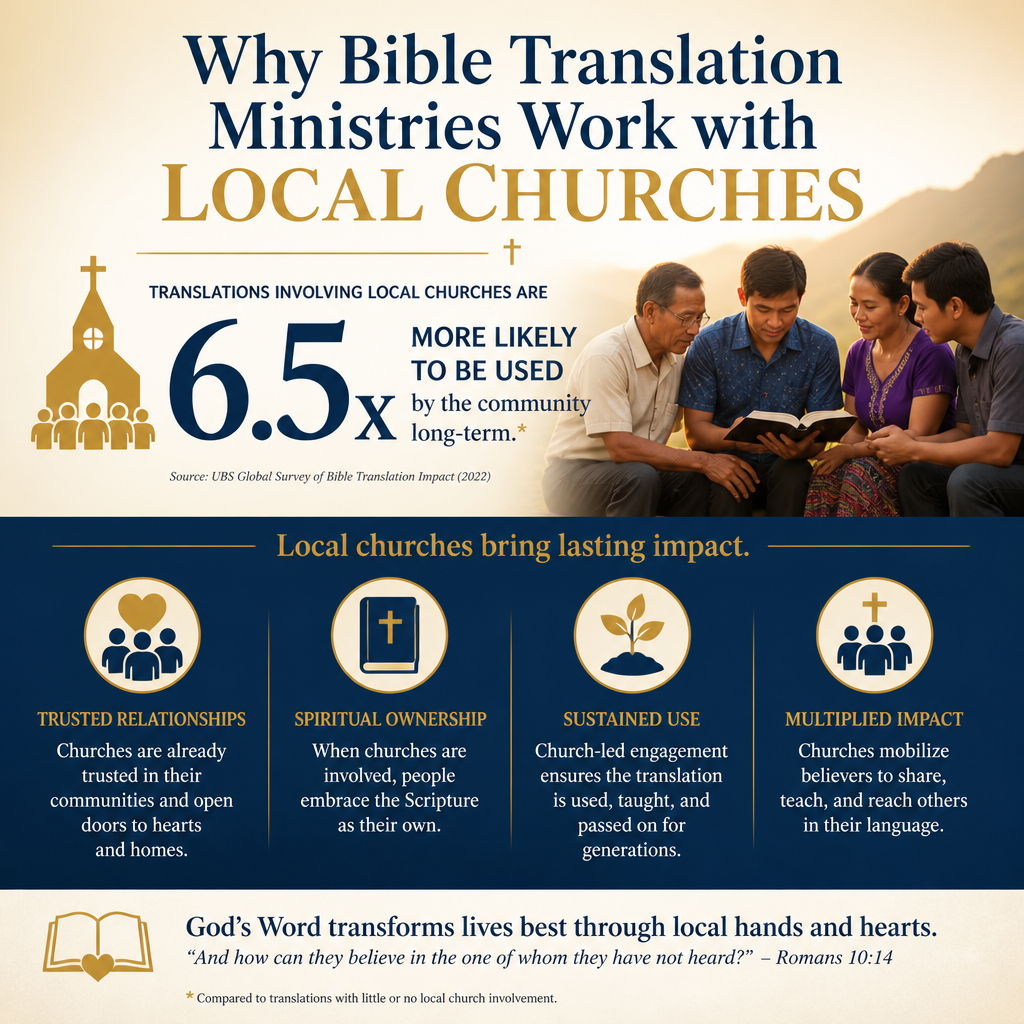
When ministries work alongside churches, translation can be paired with Scripture engagement: training for Bible teachers, contextualized helps, audio formats for oral learners, and community reading practices. Those supports can be misused if they become vehicles for external control, so responsible ministries keep them tethered to local church leadership and to clear doctrinal commitments.
What donors should listen for in ministry reporting
Translation ministries often feel donor pressure to report simple metrics. Christians genuinely want clarity about impact, and ministries should not hide behind complexity. Still, wise evaluation asks for a mix of outputs and signs of durable use. A mature report might include progress in translation stages, but it also shows evidence that churches are preparing to teach the text well and correct misuse.
As donors consider Bible translation ministries, it can be helpful to review the broader landscape of Bible Translation Ministries so impact claims can be understood in context—especially the difference between producing a text and producing a Scripture-shaped community.
Partnership with churches is also a safeguard against common cross-cultural failures
A clear answer to the temptation of control
Funding can distort mission. When an outside organization controls the budget, the schedule, and the publicity, local voices can become performative. Church partnership is not a guarantee against this temptation, but it creates a structure in which power can be shared and questioned. Local pastors can say, “This is not wise,” and their objection carries moral weight within the community.
This is one place where established missiological critique has served the church well. The When Helping Hurts framework, articulated by Steve Corbett and Brian Fikkert, has sharpened evangelical awareness that well-resourced outsiders can unintentionally do harm by reinforcing dependency and undermining local dignity and agency. Scripture’s vision is not paternalism but fellowship—shared life under Christ’s lordship.
Practical indicators of healthy church partnership
Donors can ask concrete questions without treating themselves as auditors. The goal is not suspicion; it is responsible stewardship. A short list of indicators we often find useful includes:
- Named local church partners and leaders, not only unnamed “community stakeholders”
- Evidence of local decision-making authority in translation choices and rollout plans
- Plans for Scripture use in preaching, teaching, and discipleship, not only distribution targets
- Clear theological commitments and conflict-resolution processes when churches disagree
- Safeguards for vulnerable participants, especially where religious change carries social risk
These indicators sit naturally within the concerns donors already carry: faithfulness to Scripture, integrity with money, and truthful reporting about what translation can and cannot accomplish quickly. They also map cleanly onto the kinds of questions a verification process should ask when assessing ministries against The Most Trusted Standard.
Donor confidence rises when church partnership is verifiable, not assumed
Verification should test governance and transparency, not only storytelling
Many ministries can tell a compelling story about “working with local churches.” The more relevant question is whether that partnership is structured in a way that can be evaluated. Are roles defined? Is there a local board or advisory structure? Are there documented processes for community checking and theological review? Are financial flows and in-kind contributions disclosed with clarity?
Most Trusted exists because donors are often asked to give across distance, language, and complex operating environments. Our work as an independent verification service is to help donors give with confidence by assessing ministries against The Most Trusted Standard—looking for evidence of faith foundation, financial integrity, governance and leadership, and transparency and effectiveness. When a translation ministry’s church partnership is genuine, it usually shows up across those criteria, not only in narrative.
The harder questions donors should not avoid
Church partnerships can be messy. Local churches may be divided. Pastors may lack training. Political pressure may distort what can be publicly acknowledged. In some contexts, formal church affiliation may increase risk for believers. Responsible translation ministries name these tensions and show how they weigh them, rather than presenting partnership as a simple virtue.
For donors wanting to understand how translation work is carried out operationally—how decisions are made, how quality is guarded, and how outcomes are reported—our coverage of How Bible Translation Ministries Work is often a helpful frame for asking better questions.
FAQs for Why Bible translation ministries work with local churches
Do local churches slow down Bible translation?
They can, and sometimes they should. Translation that is rushed may achieve faster milestones but produce a text that lacks acceptance, readability, or theological clarity in the receptor community. Churches introduce real-world constraints—time, conflict, pastoral concerns, and the need for consensus—but those constraints often protect the long-term goal: Scripture that is understood, trusted, and used in worship and discipleship.
What if there are few established churches in the language community?
In frontier contexts, the “local church” may be small, young, and dispersed, and the partnership may look different. Healthy ministries still seek credible local spiritual authority—believers recognized by the community—and they avoid treating translation as a substitute for church formation. Where mature churches are absent, donors should expect humility, careful risk management, and transparent reporting about what is realistically possible in a given timeframe.
Church partnership is how translation becomes a living word among a people
Bible translation ministries work with local churches because Scripture is given to a people before it is received by individuals. The church is where the Word is read aloud, preached faithfully, and embodied over time. Donors who want their giving to endure should look for ministries that can demonstrate—not merely claim—shared ownership with local churches, careful attention to power, and transparent evidence that translated Scripture is becoming part of the community’s worship and obedience.



