
When donors ask what steps are involved in translating the Bible, they are usually asking something deeper than process. They are asking whether the finished Scripture in a new language will be faithful to the God who speaks, responsible toward the people who will receive it, and trustworthy in the way it was produced.
Bible translation is not only a linguistic achievement. It is an ecclesial and moral undertaking that touches authority, power, culture, and money. For Christian donors who want to fund this work without naivety, the steps matter because they reveal where a ministry has built safeguards for fidelity, accountability, and long-term fruit.
1. Clarify the translation purpose and the people it will serve
Define the language and the community
Most translation projects begin with careful scoping. “A language” is rarely a single, uniform reality. Languages have dialect continua, social registers, and communities dispersed across borders. A decision about which variety to translate is therefore a decision about whom the project will prioritize and which local leaders will have meaningful voice.
Responsible teams start with sociolinguistic research, community consultation, and a clear plan for how the church will own and use the translation. Ethically, this matters because translation can either strengthen local discipleship or become an imported product that local believers did not request and cannot sustain.
Choose a translation approach with theological and pastoral clarity
Translation teams also decide what kind of translation they are attempting: more formally equivalent, more meaning-based, or something closer to oral or performance-based Scripture for primarily oral cultures. Christians genuinely disagree about where the best balance lies for faithfulness and comprehension, and the field has had to reckon with the fact that “accuracy” is not a single-variable measurement.
What this means in practice is that a strong ministry can explain its approach in plain terms, name its trade-offs, and show how it protects core doctrinal content while serving real readers and listeners.
2. Build the team and governance required for faithful work
Translation is collaborative by design
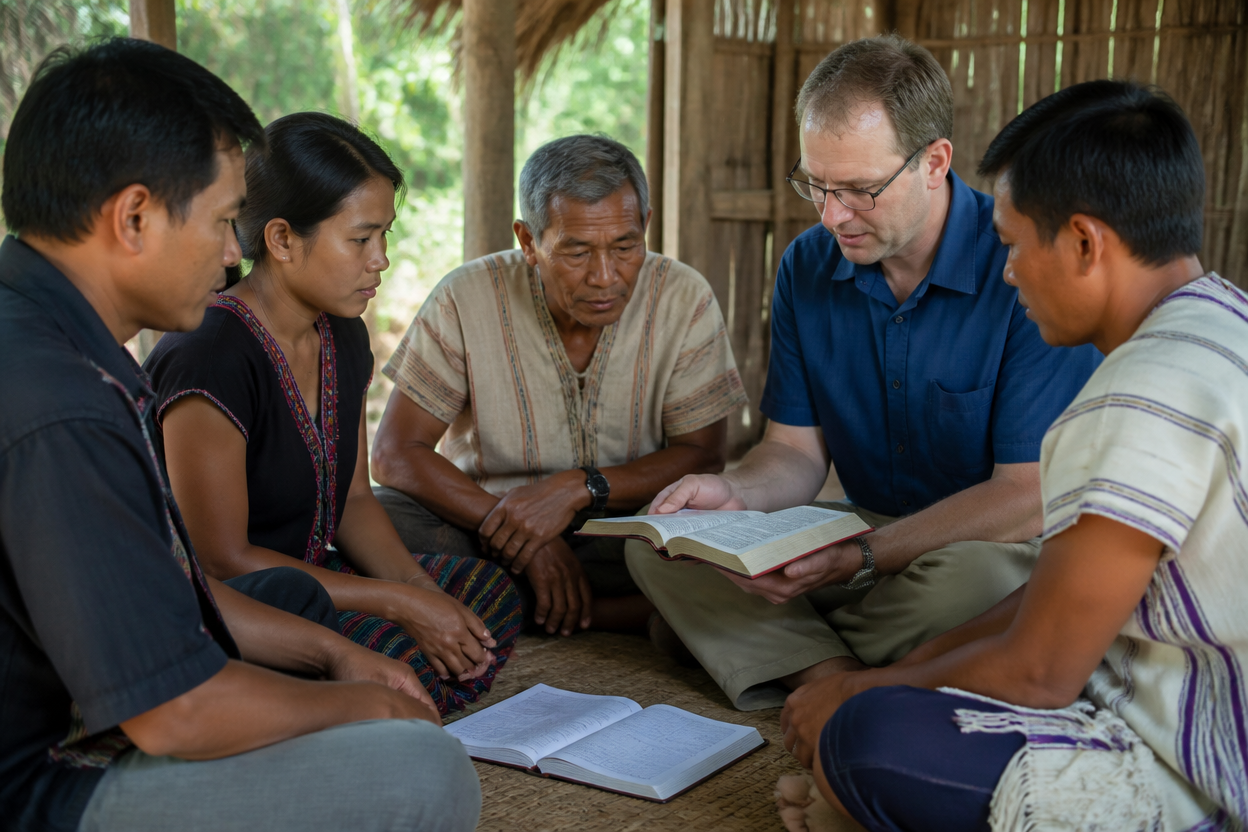
High-quality Bible translation requires multiple competencies: mother-tongue speakers with deep intuition for the target language, biblical language specialists, exegetes, reviewers, and project managers who can keep a years-long effort coherent. Mature projects treat this as a collaborative process rather than a single expert’s output. Scripture itself commends this posture of accountable teaching and testing: “Do your best to present yourself to God as one approved… rightly handling the word of truth” (2 Timothy 2:15).
In many contexts, the most critical staffing question is not how many expatriate linguists are involved, but whether local church leaders and local language experts have real authority in decisions that shape meaning and reception.
Governance and accountability protect both doctrine and donors
Translation is slow, expensive, and vulnerable to mission drift if leadership is weak. Donors should expect credible governance structures: clear roles, documented decision rights, and independent oversight for theological and financial integrity.
Across our verification work at Most Trusted, we observe that the ministries most likely to produce durable translations are the ones that can demonstrate accountability in both theology and operations—policies for conflict of interest, meaningful board oversight, and transparent reporting that allows supporters to understand progress without pressuring teams to overpromise.
For donors who want broader context on how translation organizations function operationally, our coverage of How Bible Translation Ministries Work addresses common models and where they tend to succeed or struggle.
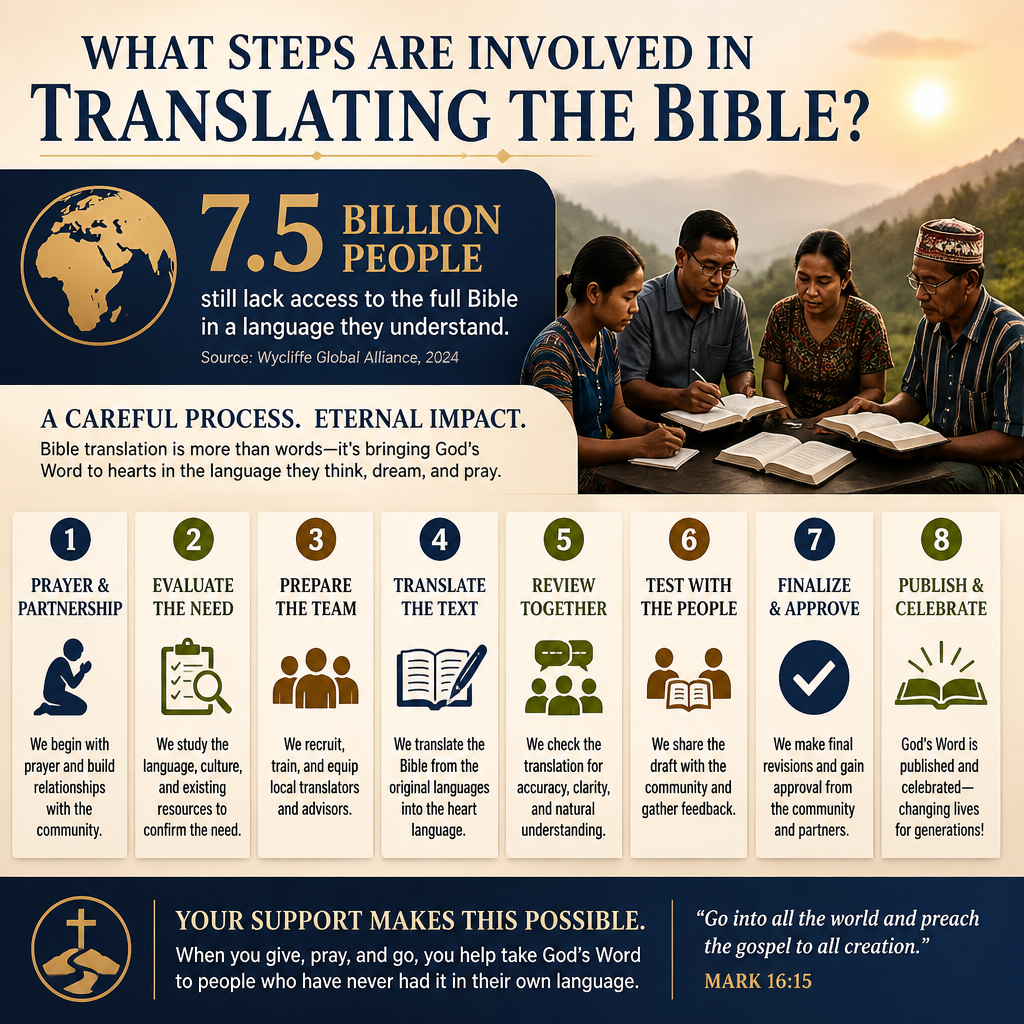
3. Do the linguistic groundwork before drafting a single verse
Orthography and literacy decisions shape the entire project
In some languages, there is no widely accepted writing system when a project begins. Teams may need to develop an orthography, test it with community members, and coordinate with educators and church networks. The choice is not merely technical. If the writing system is inaccessible or contested, Scripture distribution will be constrained for decades.
Even where a writing system exists, literacy levels and reading practices matter. Some communities will receive Scripture primarily through oral means, audio, or dramatized formats. Translation planning increasingly accounts for these realities so that “publication” is not limited to print.
Exegesis and term work prevent downstream confusion
Before drafting, teams often conduct focused exegesis and develop key term lists: words for “God,” “spirit,” “covenant,” “righteousness,” and other concepts that carry doctrinal weight. These choices are often the flashpoints where translation becomes contested, because the target language may have religious vocabulary already shaped by other faiths or by syncretistic practice.
A mature team does not pretend these tensions are easy. It documents decisions, tests comprehension, and consults the wider church where possible. This is one of the places where donors should expect to see humility paired with rigor.
4. Draft, test, and revise through layered checking
Drafting is iterative, not linear
After groundwork, the team drafts Scripture portions, often starting with selected books that serve immediate discipleship needs. Drafting typically proceeds with a mother-tongue translator producing the first rendering, followed by team review and reconciliation with the source texts (Hebrew, Aramaic, and Greek) and with a reliable base translation when appropriate.
Because translation choices interact across the canon, early decisions are revisited as the project progresses. That is not a sign of weakness; it is the normal discipline of consistent meaning across thousands of verses.
Checking protects against both error and unintended harm
The credibility of a translation depends heavily on its checking process. Strong projects employ multiple layers: community testing for comprehension and naturalness, internal theological review, consultant checks by trained translation consultants, and broader church review where feasible.
Donors can reasonably ask ministries to describe their checking process in verifiable terms. A responsible organization can answer questions such as:
- Who are the mother-tongue reviewers, and how are they selected and trained?
- What is the role of church leaders in review and approval?
- How are consultant checks conducted, and what qualifications are required?
- How are disputed renderings documented and resolved?
- What safeguards prevent a single individual from having unchecked authority?
These questions are not adversarial. They are a donor’s way of honoring the seriousness of Scripture and the stewardship of resources entrusted for gospel purposes.
5. Publish, distribute, and sustain Scripture use over time
Publication includes formats and rights management
Publication decisions extend beyond printing. Audio Scripture, mobile apps, and other digital tools may be the primary access point for many communities. Distribution partnerships—church networks, denominational bodies, or local publishers—often determine whether Scripture is actually used rather than merely produced.
Rights and licensing are also practical ministry questions. Some organizations emphasize open licensing to maximize access; others maintain tighter control to protect integrity and ensure quality reproductions. Each approach has trade-offs, and the best ministries can articulate why their policy serves both stewardship and mission.
Scripture engagement is the fruit donors should care about
Translation is not the end of the story. The New Testament’s pattern assumes that the Word will be read, taught, and obeyed within the church (Colossians 4:16). Many translation ministries therefore invest in Scripture engagement: training local pastors, developing study materials, encouraging public reading, and supporting oral Bible storying where literacy is limited.
The harder question for donors is measurement. Counting printed copies can be straightforward; evaluating long-term discipleship outcomes is more complex and can tempt ministries toward inflated claims. Mature organizations report what they can honestly know, distinguish outputs from outcomes, and welcome external scrutiny.
For donors seeking to compare organizations within this field, our broader coverage of Bible Translation Ministries addresses what tends to distinguish trustworthy translation work across contexts.
FAQs for What steps are involved in translating the Bible
How long does Bible translation usually take?
Timelines vary widely based on the language situation, team capacity, and the scope of the project, but full-Bible translation commonly takes many years because drafting, testing, consultant checking, revision, and community approval are all time-intensive. Donors should be cautious of ministries that promise fast completion without clearly explaining how quality and community ownership are preserved.
What should donors ask to verify a translation ministry is trustworthy?
Donors should ask for evidence of layered checking, qualified oversight, and transparent reporting. At Most Trusted, we encourage donors to look for ministries that can document theological accountability, financial integrity, governance practices, and honest communication about progress and setbacks—areas we evaluate through The Most Trusted Standard, a 15-criteria framework spanning Faith Foundation, Financial Integrity, Governance and Leadership, and Transparency and Effectiveness.
A donor’s role in a work that must be done carefully
Bible translation is often described as urgent, and it is. Yet the steps involved in translating the Bible exist for a reason: Scripture must not be rushed in ways that weaken fidelity, fracture local trust, or substitute donor expectations for local ownership. The most faithful funding posture is patient, evidence-minded generosity that supports both the slow craft of translation and the long ministry of helping the church hear, understand, and live by the Word of God.



