
How Bible translation ministries work is not chiefly a question of linguistics. It is a question of how the church carries the Word of God across languages and cultures without reducing it to a product, a western export, or a private devotional tool detached from the life of local congregations. Donors fund far more than a book project; they fund years of painstaking collaboration, theological judgment, and local capacity-building that can strengthen or distort a Christian movement for generations.
Scripture assumes the public intelligibility of God’s Word among God’s people. When Ezra read the law, the Levites “gave the sense, so that the people understood the reading” (Nehemiah 8:8). At Pentecost, the gospel was heard “in our own tongues” (Acts 2:8). Bible translation sits inside that same pastoral and missional logic: God speaks, the church receives, and the message is understood in the language of actual worshipers.
Translation begins with the church, not with a printing press
The strongest Bible translation ministries treat local churches as more than distribution channels. They recognize that translation is a long obedience of teaching, worship, and discipleship in a particular place. That posture changes nearly every operational decision: who is invited into leadership, what “success” means, and how authority is shared.
What translation ministries actually do
A typical ministry’s work spans far beyond the moment a New Testament is dedicated. It may begin with language assessment, orthography development, literacy planning, and Scripture engagement—work that looks unremarkable to a donor until one sees the alternative: a “finished” translation that cannot be read, cannot be taught well, or never becomes the church’s own.
Many contexts require language development work before translation can proceed. Ethnologue’s global catalog of living languages illustrates the scale and diversity of the task across thousands of languages, many with limited published resources (Ethnologue).
Why ministries work with local believers
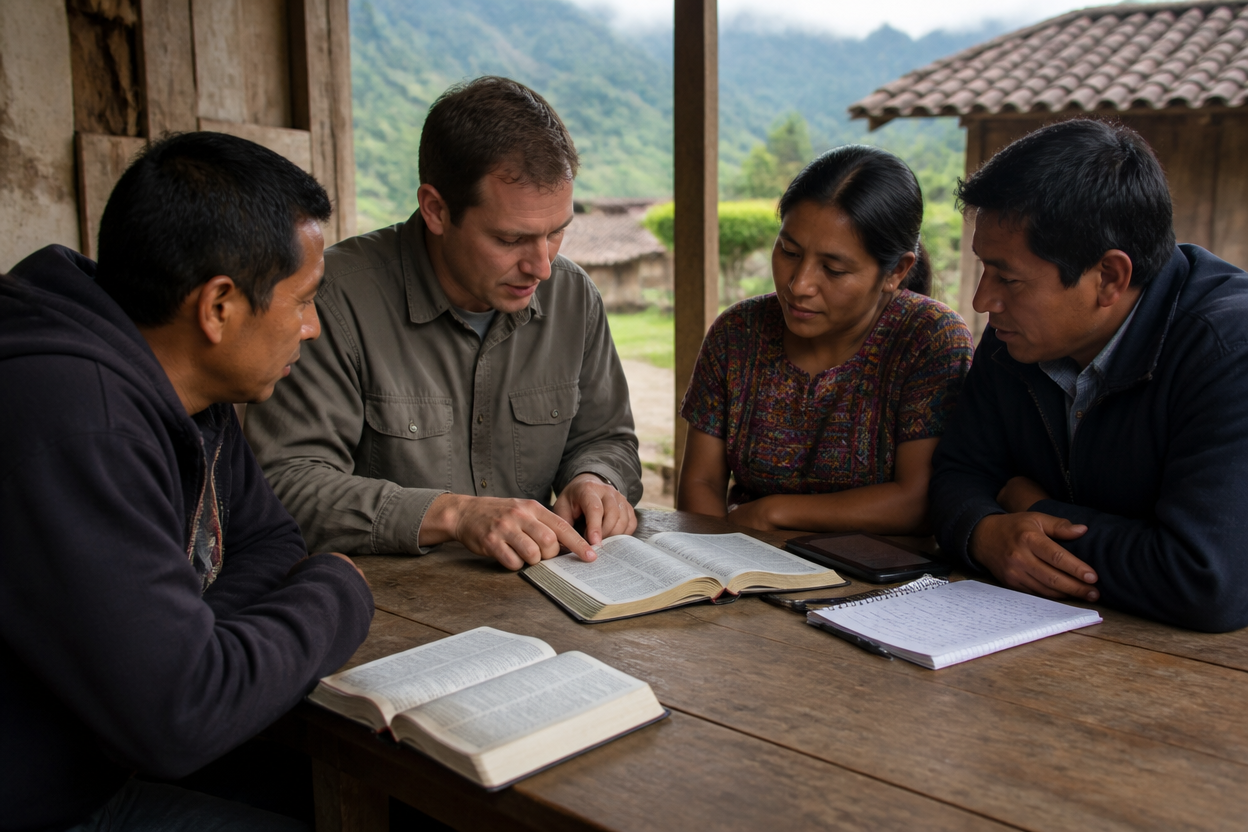
Local participation is not a public-relations gesture; it is a theological and practical necessity. The church is the steward of the Word (Romans 3:2), and the people who will proclaim Scripture in sermons, counsel it in suffering, and sing it in worship must be able to recognize whether the translation speaks truthfully and naturally. Local translators also know where a community’s language is contested, where metaphors misfire, and where a seemingly precise rendering fails to communicate.
This is also where donors should expect complexity. In some settings, the “local church” is fragmented by ethnicity, denominational history, or political pressure. Translation ministries are sometimes asked to mediate disputes they did not create. Sophisticated organizations make the process accountable without becoming a parallel ecclesial authority.
The unavoidable question of theological commitments
Bible translation is never theologically neutral. Choices about manuscripts, translation philosophy, and key terms (for example, how to render “righteousness,” “covenant,” or familial language for God) are interpretive acts. Christians genuinely disagree about when a rendering crosses the line from translation into paraphrase, and about how to handle terms that are culturally explosive in Muslim-majority contexts or in places shaped by animist categories.
For donors, the relevant question is not whether the field has debates; it does. The question is whether a ministry can explain its translation philosophy plainly, submit its work to review, and demonstrate that the resulting Scriptures serve the church’s worship and doctrine rather than the ministry’s brand.
Choosing languages is a stewardship decision under constraint
Translation ministries do not choose languages in a vacuum. They face real constraints: finite funding, limited qualified personnel, security risks, and the moral weight of leaving some communities waiting longer than others. The result is a triage process that can look cold unless donors understand what is being weighed.
How language prioritization typically works
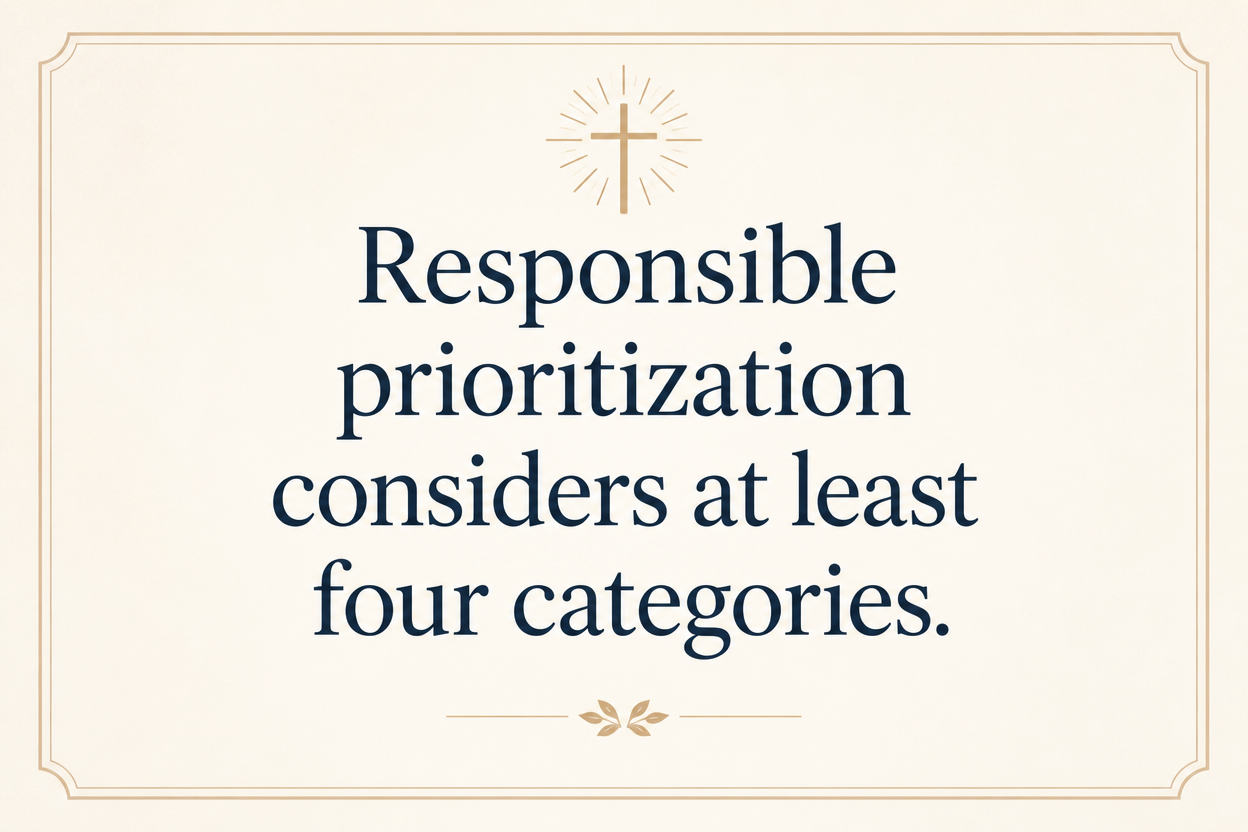
Responsible prioritization considers at least four categories. First is need: does the community lack Scripture in a language they understand well? Second is viability: is there a stable community of speakers, and is there openness to a translation effort? Third is local ownership: are there credible local church partners and potential translators? Fourth is strategic stewardship: will this work strengthen broader church health, literacy, and discipleship, or will it remain isolated?
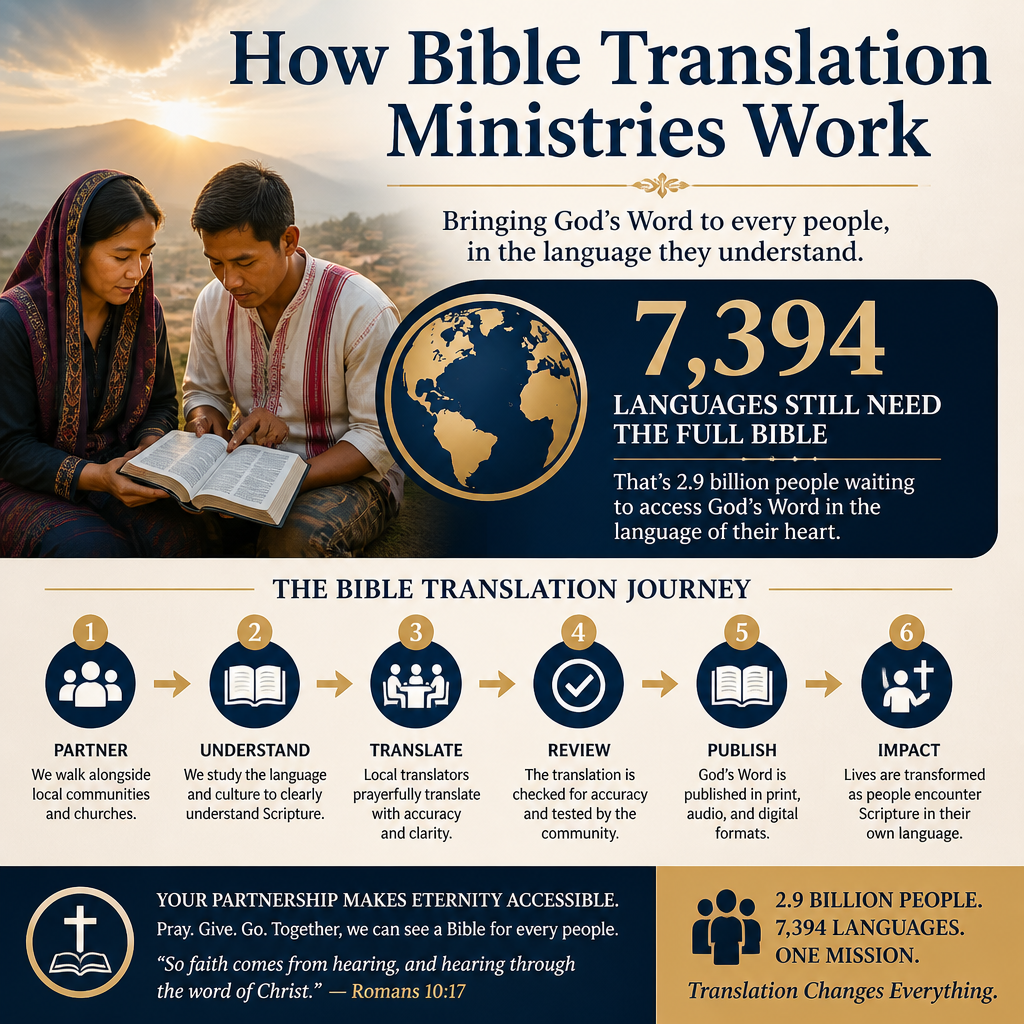
Global need is real, but donors should be careful with simplistic claims. Counts shift as languages are reclassified, as partial translations become available, and as digital access changes what “available” means. Translation ministries often cite the scale of global need using data compiled by organizations such as Wycliffe Global Alliance and its partners (Wycliffe Global Alliance). Donors should still ask a ministry to define its categories: “no Scripture,” “some Scripture,” “New Testament,” and “full Bible” are not interchangeable.
When trade-offs become moral decisions
Sometimes the question is whether to translate into a smaller heart language or into a regional trade language that more people share. Sometimes it is whether to begin where persecution is most severe, knowing that publicity could endanger local believers. Sometimes it is whether to prioritize oral Scripture, literacy, or printed publication first. These are not merely technical decisions; they are decisions about love of neighbor under constraint.
This is where donors can add stability rather than noise. Unrestricted support and multi-year commitments allow ministries to make disciplined choices instead of chasing the next fundable story.
Why “speed” is not the primary metric
Donors understandably ask how long a Bible translation project takes. A mature answer admits that timelines vary with language complexity, the availability of trained mother-tongue translators, team stability, review capacity, and security. Some organizations have shortened timelines through better tools and workflows, but compressing the process without weakening review is difficult.
What this means in practice is that donors should ask for evidence of progress that is not mere speed: draft completion milestones, community testing results, reviewer feedback, consultant checks, and Scripture engagement outcomes that show the translation is being received and used.
The translation process is rigorous because Scripture is weighty
Bible translation ministries worthy of long-term donor trust tend to treat accuracy as a disciplined community practice, not as a claim. They build redundant checks into the process because the stakes are doctrinal, pastoral, and cultural.
From source text to first draft
Most projects begin with careful exegesis from the Hebrew, Aramaic, and Greek texts, using established critical editions and scholarly tools. Mother-tongue translators draft in the target language, aiming for a translation that is faithful to the meaning of the original and natural for real listeners and readers. Drafting is often done in teams to reduce the risk of idiosyncratic phrasing or theological drift.
Translation philosophy matters here. Some ministries prioritize a more formally equivalent approach (staying closer to the structure of the source), others a more functionally equivalent approach (prioritizing meaning and naturalness). Most responsible projects blend approaches, recognizing that rigid adherence to either extreme can misfire. Donors should expect a ministry to articulate where it lands and why, especially for key theological terms.
Community testing and church review
Drafts are tested with representative speakers: not only educated leaders, but ordinary hearers, including those with limited literacy. The goal is to surface misunderstanding, awkwardness, and unintended meanings. Many projects also conduct checks with pastors and church leaders to ensure the text can be taught publicly without constant explanation that the translation itself should have supplied.
This step can expose hard tensions. A phrase that is “accurate” in a word-for-word sense may communicate a different concept in the target culture. Conversely, a rendering that feels natural may flatten important theological distinctions. Mature translation teams treat these tensions as the normal discipline of faithfulness, not as inconveniences to be managed away.
Consultant checks, back translation, and publication
External consultants or trained reviewers evaluate the translation for accuracy and consistency. Back translation—rendering the new text back into a language of wider communication—can help reviewers see what meaning the translation is actually conveying, though it is not a perfect tool. Many projects also use computational checks for consistency in key terms and names, but software cannot replace theological and linguistic judgment.
Publication is no longer only print. Digital distribution, audio Scripture, and app-based delivery can expand access quickly. But donors should not assume “digital” is always safer or cheaper; in some settings, digital footprints increase risk, and hardware access is uneven.
Donor due diligence should match the ministry’s long horizon
Translation projects can span a decade or more, and they leave an enduring artifact that shapes preaching and discipleship long after the original staff have moved on. Because the time horizon is long and the outcomes are difficult to measure in the short term, Bible translation is particularly vulnerable to two donor errors: funding based on sentiment and funding based on simplistic metrics.
What healthy accountability looks like for translation ministries
Translation work requires strong governance, transparent financial reporting, and clear policies around theological commitments and partnerships. It also requires credible measurement that respects the complexity of spiritual fruit. Counting “languages started” is not the same as establishing a usable, trusted translation in the life of the church. Counting “Scriptures distributed” is not the same as Scripture read, heard, and obeyed.
Across our verification work at Most Trusted, the ministries that meet The Most Trusted Standard tend to provide donors with documentation that is both specific and humble: clear milestones, named review practices, audited financials, board independence, and transparent explanations of how they handle contested translation decisions. They also tend to speak candidly about risk—security risk, partner risk, and the risk of creating dependency by importing expertise without training local leaders.
Questions donors should ask before funding
- Ecclesial partnership: Which local churches or networks are meaningfully involved, and how is their counsel incorporated?
- Translation philosophy: How does the ministry balance accuracy, clarity, and naturalness, and who has authority to resolve disputes?
- Quality control: What review steps are required before publication, and are external consultants involved?
- Security and ethics: How does the ministry protect local believers, data, and partners, especially in high-risk contexts?
- Financial integrity: Are audited statements available, and does the ministry explain how restricted gifts are tracked and reported?
- Scripture engagement: What is done to help churches actually use the translation—training, literacy, audio, and discipleship materials—without replacing the church’s responsibility to teach?
These questions are not adversarial. They are the ordinary responsibilities of Christian stewardship. Jesus commends faithfulness over spectacle (Luke 16:10), and donors honor the church by funding work that is both spiritually serious and verifiably responsible.
For donors comparing organizations or seeking clearer categories, our coverage of Bible Translation Ministries reflects the questions we return to across The Most Trusted Standard: faith foundation, financial integrity, governance and leadership, and transparency and effectiveness.
Funding translation is funding the public voice of Scripture
Bible translation ministries work at the intersection of worship, doctrine, and language. When done well, they serve the church by giving congregations Scripture they can understand, trust, preach, and pass on to their children. When done poorly, they can produce texts that are technically impressive and pastorally unusable, or culturally natural and theologically unstable.
Christian donors should not accept either false certainty or paralyzing cynicism. The work can be evaluated. The process can be examined. And the ministries most worthy of long-term partnership are usually those that welcome serious questions, because they understand that the Word they serve will outlast every organization that handles it.



