

Choosing a trustworthy Bible translation ministry is not primarily an exercise in personal preference about English style. It is a stewardship decision about whether a ministry is faithfully handling the Word of God, protecting vulnerable communities, and telling the truth about what it can and cannot deliver. Scripture treats these questions with moral seriousness: “Moreover, it is required of stewards that they be found faithful” (1 Corinthians 4:2).
Bible translation sits at a crossroads of theology, linguistics, local church formation, and cross-cultural power dynamics. The field has also had to reckon with real failures: inflated progress claims, paternalistic project control, and financial opacity that leaves donors unable to discern whether gifts are strengthening long-term local capacity or underwriting inefficiency. Trustworthiness is not a vibe. It is a set of verifiable commitments.
Start with theological fidelity and ecclesial accountability
Ask what the ministry believes about Scripture and how that belief is governed
A translation ministry can speak warmly about “impact” while holding an anemic doctrine of Scripture or a functional pragmatism that treats faith commitments as marketing. Donors should begin with a ministry’s published statement of faith, but not stop there. The harder question is whether doctrinal commitments have governing force: do they constrain methodology, partnerships, and editorial decisions when those decisions are costly?
Trustworthy ministries are typically explicit about the authority of Scripture, the Trinity, the person and work of Christ, and the nature of the church. They also describe how theological oversight functions in practice. A doctrinal statement that never touches governance can become ornamental, especially when projects span cultures and denominations.
Expect a sober approach to contested translation questions
Christians genuinely disagree about some translation decisions: formal equivalence versus functional equivalence, how to render key theological terms in receptor languages, and how much to adapt to local discourse patterns. Donors do not need to become linguists, but they should expect intellectual honesty. A ministry that claims there are no hard trade-offs is rarely telling the truth.
One credible marker is whether the ministry can explain its translation philosophy without disparaging other orthodox approaches. Another is whether local churches and qualified local believers have meaningful authority in review and approval, rather than serving as symbolic validators for decisions made elsewhere.
Evaluate translation quality through process, not slogans
Look for mature quality assurance and Scripture engagement practices
Translation quality is difficult for donors to audit directly, especially when the target language is unfamiliar. That is why trustworthy ministries make their process visible. A serious process usually includes trained translators, iterative drafting, community testing for comprehension, back translation or other checking mechanisms, and independent review by qualified consultants.
It is also reasonable to ask how the ministry connects translation to Scripture engagement: literacy, oral Bible storying where appropriate, audio Scripture distribution, and local training that equips churches to teach faithfully. The goal is not merely a text produced, but a church strengthened over time.
Insist on clarity about what is being translated and why
Ministries sometimes advertise “Bible translation” while primarily funding distribution, evangelism, or church planting. Those activities may be faithful and necessary, but donors deserve accurate labels. A trustworthy ministry will clearly distinguish among original translation, revision work, consultant checking, publishing, and distribution. Clarity here protects both integrity and expectations.
- What portion of Scripture is in scope, and what is the timeline for each stage?
- Who owns the translation and the publishing rights, and what does that mean for local access?
- How are local churches and local language communities represented in decisions?
- What are the ministry’s quality checkpoints and independent reviews?
- What does success look like five and ten years after publication?
Follow the money with realism and moral seriousness
Use audited financials and filings as a baseline, not a finish line
A Bible translation ministry may operate in remote locations with legitimate security constraints, but “security” should not become a blanket excuse for financial invisibility. Donors should expect audited financial statements when the organization’s scale warrants it, clear summaries of revenue sources, and reasonable detail about program spending. For U.S. nonprofits, IRS Form 990s are also a basic transparency tool.
Overhead ratios alone are an unreliable measure of health. The sector has repeatedly warned donors against treating low overhead as synonymous with effectiveness; the “Overhead Myth” statement was issued jointly by GuideStar (now Candid), BBB Wise Giving Alliance, and Charity Navigator, arguing that simplistic overhead benchmarks can mislead donors about true performance and needed capacity-building (Candid).
Ask how translation economics are structured
Translation work often involves multi-year project funding, restricted gifts, and partnerships with local entities. Those realities can hide risk. Donors should ask whether the ministry is dependent on a narrow donor base, whether it has reserves appropriate to multi-year commitments, and whether restricted funding is creating program distortion.
We also recommend donors ask about compensation policies and related-party transactions. A trustworthy ministry is prepared to describe how it prevents conflicts of interest, particularly when leadership and governance overlap with family networks or affiliated entities.
Examine governance, leadership formation, and conflict safeguards
Board strength matters more than brand recognition
Translation ministries often attract charismatic founders and gifted cross-cultural leaders. Those gifts can be an asset, and they can also become a risk when a board functions as a cheering section rather than a governing body. Trustworthy ministries tend to have boards that are independent, engaged, and willing to ask unwelcome questions about results, timelines, and financial choices.
Donors can request basic governance indicators: how often the board meets, whether it reviews the CEO’s performance, and whether it has an audit or finance committee appropriate to the organization’s complexity. In our verification work at Most Trusted, the ministries that meet The Most Trusted Standard typically treat governance as a spiritual responsibility, not a legal formality.
Safeguarding and power dynamics are part of translation integrity
It is tempting to treat safeguarding as a separate category from Bible translation, but field realities do not allow that separation. Translation projects often place expatriate staff and local workers in asymmetrical relationships involving money, travel, and access. A trustworthy ministry should have clear safeguarding policies, reporting pathways, training, and documented responses to allegations—along with humility about the risks inherent in cross-cultural work.
Donors should also ask how the ministry handles local partner disagreements. Healthy partnerships do not avoid conflict; they handle it with clarity, shared authority, and documented expectations that protect the local church from coercion.
Demand transparent reporting and credible claims of progress
Require definitions for words like reached, access, and completed
Translation ministries use specialized terms—“language,” “dialect,” “access,” “Scripture portion,” “New Testament complete,” “Bible complete.” Those terms can be used precisely or loosely. Donors should require definitions in writing and compare them across reports. If a ministry cannot define its terms, it cannot be evaluated.
What this means in practice is that donors should ask for project-level reporting: which language community, what stage, what has been completed, who validated it, and what remains. Trustworthy ministries can share meaningful progress without compromising security. When security truly limits detail, a mature ministry will still provide third-party verification pathways and aggregated reporting that can be tested.
Anchor your expectations in credible, public field data
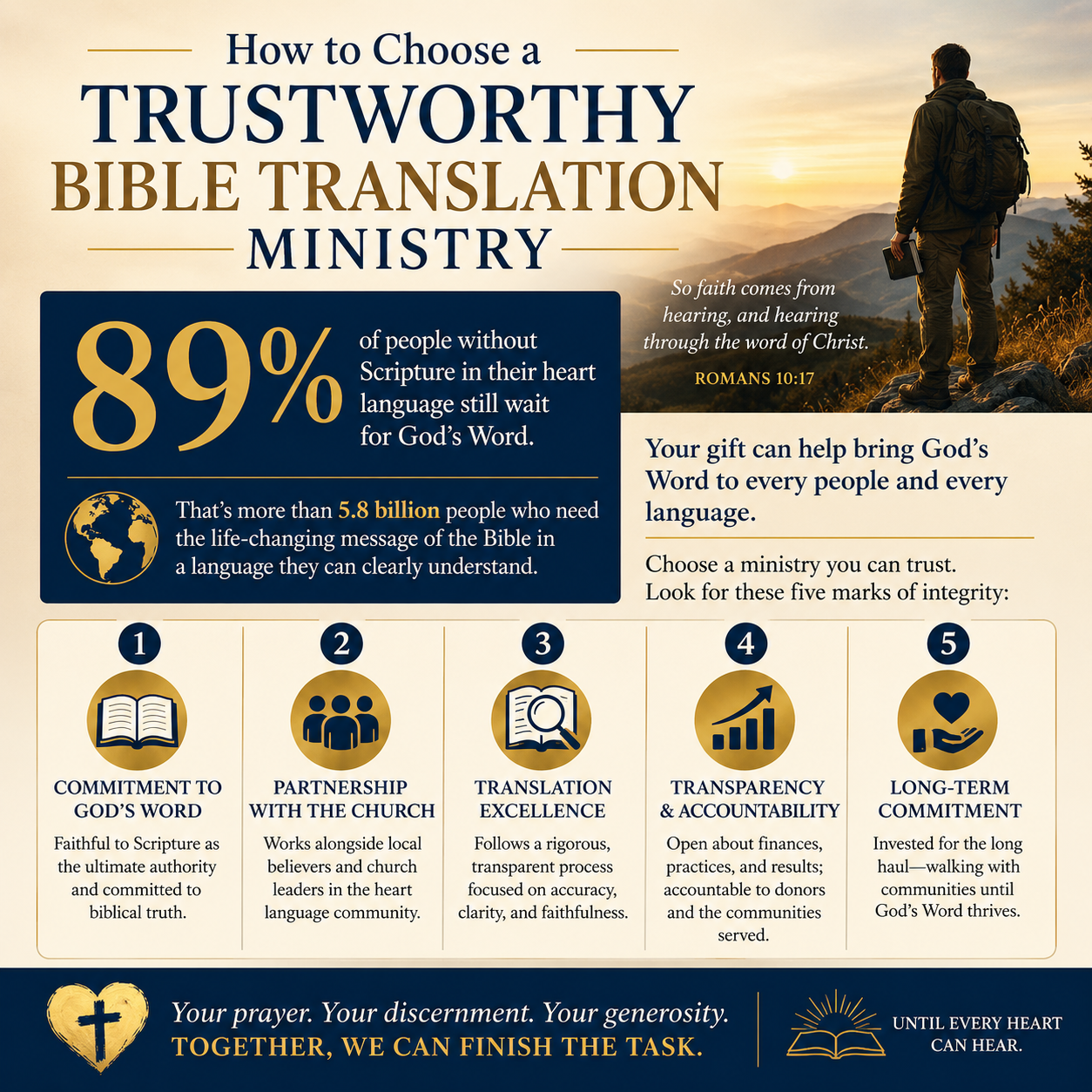
Bible translation progress is often summarized by the share of the world with Scripture in a language they understand. The broad picture is encouraging, but donors should interpret promotional claims cautiously. For example, Wycliffe Global Alliance reports that as of 2023, the full Bible had been translated into 736 languages, and the New Testament into 1,658 languages (Wycliffe Global Alliance). That headline number does not settle questions about quality, local use, revision needs, or whether “language” categories mask substantial dialect diversity.
For donors who want to make a careful decision within this field, we recommend using Bible Translation Ministries as a starting point to compare how organizations describe their theology, methods, governance, and results. We also recommend reading How to Give Wisely to Bible Translation Ministries to frame the kinds of evidence that should carry weight when ministries ask for trust.
FAQs for How to choose a trustworthy Bible translation ministry
Should donors prioritize speed of translation or depth of checking and community review?
Faithful stewardship holds speed and quality together without collapsing one into the other. Faster progress can be a legitimate aim when a community has little or no Scripture, but speed that bypasses trained checking, church review, and comprehension testing often produces texts that require costly revision later. Trustworthy ministries explain where they move quickly and where they refuse to move without verification, and they can name the quality controls that govern that choice.
How can donors evaluate a ministry when security concerns limit what can be published?
Security constraints are real in some contexts, but trustworthy ministries do not use them as a substitute for accountability. Donors can ask for aggregated reporting, independent audit confirmation, governance documentation, and third-party validation of project milestones. A mature ministry will also communicate what it can disclose, what it cannot, and why, rather than asking donors to accept vagueness as a mark of faithfulness.
A trustworthy ministry is one that can be tested
Trustworthy Bible translation ministries invite scrutiny because their work is sacred and their claims are measurable. The donor’s task is not to demand perfection, but to require evidence of fidelity: faithful doctrine with real oversight, translation quality grounded in disciplined process, financial integrity that can be examined, governance strong enough to restrain power, and reporting that tells the truth. That is the posture The Most Trusted Standard is designed to reinforce, so that Christian generosity rests on clarity rather than assumption.



