

Why Bible translation ministries partner with local leaders is not a public-relations question; it is a faithfulness question. Translation is an act of stewardship over God’s word, and stewardship is tested not only by theological conviction but by whether a ministry honors the people for whom the Scriptures are being translated.
Christian donors often ask whether local partnership is primarily about access, cost, or credibility. Those factors exist. But the deeper issue is ecclesial: God has not left any people without witnesses to his glory, and the Spirit does not outsource the formation of the church to foreign expertise. Healthy translation work treats local leaders not as implementers but as accountable agents within the body of Christ.
Local partnership is a theological commitment, not a fundraising preference
The church is not a mission field forever
Scripture gives a consistent pattern: the gospel takes root through local elders, local teachers, and local communities called to maturity. Paul’s missionary work aimed toward established leadership—appointing elders and entrusting teaching to faithful people who can teach others (Titus 1:5; 2 Timothy 2:2). Bible translation is not identical to church planting, but it shares the same ecclesial gravity. The translated text is received, taught, and obeyed in a real community with real authority structures.
When a translation ministry sidelines local leadership, it often produces a fragile outcome: Scripture may exist in print, but the community’s confidence, interpretive habits, and long-term adoption remain thin. Conversely, when pastors, catechists, and community leaders help shape the process, the translation is more likely to be received as “our Bible,” not as a foreign artifact.
Incarnation shapes method as well as message
Christ did not redeem us at arm’s length. The Word became flesh and dwelt among us (John 1:14). Christian missions has always wrestled with what it means to honor that incarnational pattern without confusing it with cultural relativism. Partnering with local leaders is one practical expression: translation work is done “among,” not merely “for.”
This does not mean local leaders are automatically right on every linguistic or doctrinal question. It does mean a ministry should be structured so that outside expertise serves the church rather than replacing it. Mature donors recognize that this is slower and often more complex, but it is closer to the grain of the New Testament.

Translation quality depends on local knowledge that outsiders cannot supply
Language competence is more than vocabulary
A reliable translation requires deep command of meaning, register, metaphor, and social context. Fluency is not merely conversational comfort; it includes how a community signals respect, how it handles taboo topics, how it uses honorifics, and how it distinguishes proverb from narrative. Local leaders—especially those who teach publicly and carry communal trust—often understand these layers in ways that visiting consultants cannot.
Across our verification work at Most Trusted, we observe that ministries with strong local partnership are more likely to document how they resolve contested terms, ambiguous idioms, and sensitive theological phrases. This is not because local leaders remove ambiguity; it is because their participation forces ministries to articulate decisions in ways the community can test over time.
Acceptance and use are part of effectiveness
Donors sometimes treat “completed translation” as the finish line. Responsible ministries define effectiveness more rigorously: comprehension, acceptance, and sustained use in preaching, discipleship, and family life. Local leaders are the primary interpreters who will either reinforce a translation’s credibility or quietly replace it with another text, another language, or oral paraphrase.
That dynamic is well known in the broader field of Bible translation. The Ethnologue identifies thousands of living languages worldwide, reflecting the practical reality that language communities are more numerous and more complex than many donors assume Ethnologue. In that setting, translation decisions that ignore local usage patterns can produce a text that is technically accurate yet socially unusable.

Local leadership is a safeguard against harm, dependency, and distortion
When helping hurts applies to translation work
Christians have learned, sometimes painfully, that good intentions do not prevent harmful outcomes. The “When Helping Hurts” framework, articulated by Steve Corbett and Brian Fikkert, has helped many ministries see how external resources can create dependency, displace local initiative, or weaken accountability structures Moody Publishers. Translation ministries are not exempt from these dynamics.
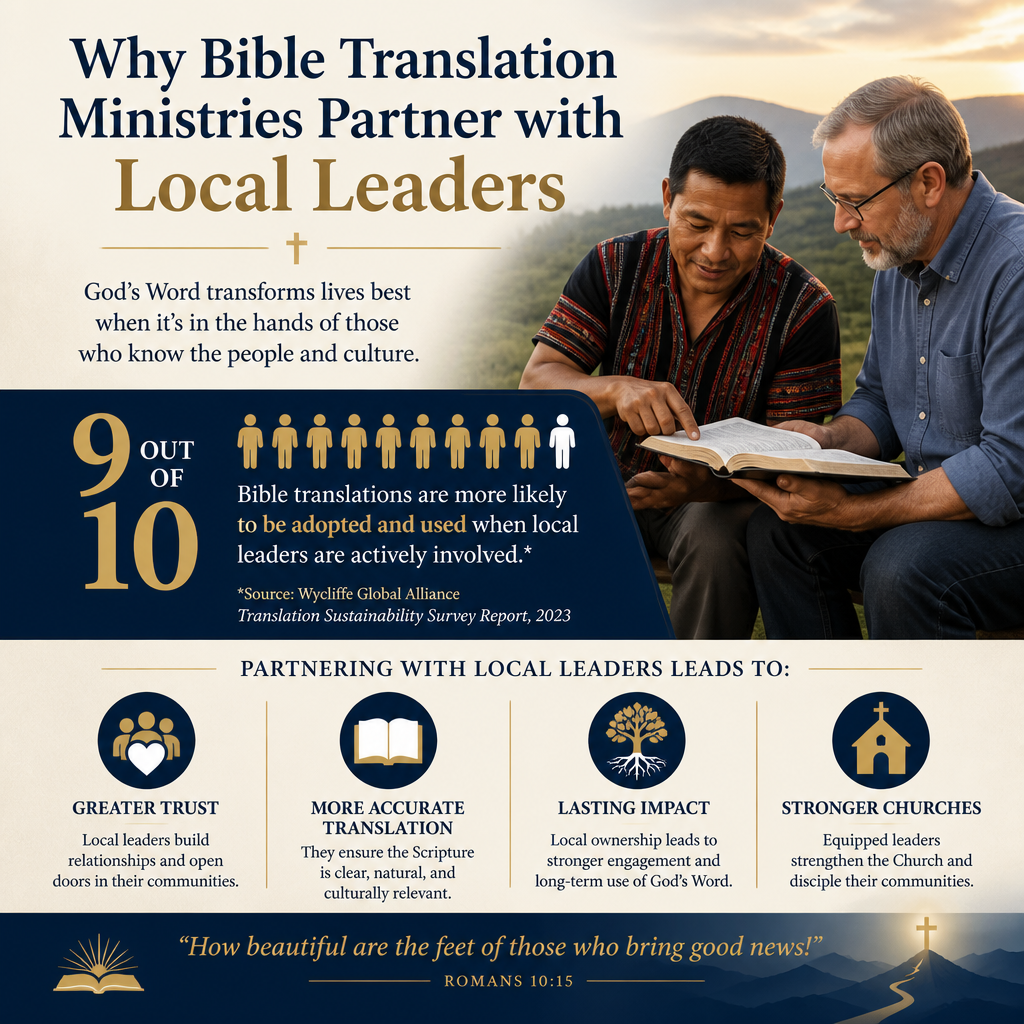
When outsiders control budgets, staffing, timelines, and public messaging, local leaders may become functionally dependent on a foreign organization for what should be a church-owned responsibility: the reception of Scripture in the language of the people. Partnership is one way to resist paternalism—not as a slogan, but as an operational discipline.
Partnership reduces the risk of capture and misrepresentation
Bible translation work can become entangled with politics, ethnic conflict, or denominational competition. Local leaders see fault lines that outsiders miss, including who benefits from certain terminology, whose dialect becomes “standard,” and how a text may be weaponized. Their presence does not eliminate risk, but it improves early warning and correction.
For donors, this is not merely a prudential concern. Scripture repeatedly condemns false weights and measures (Proverbs 11:1). A translation ministry must resist the temptation to present progress in simplified terms that obscure genuine local dissent or unresolved controversies. Partnering with local leaders increases the likelihood that reporting reflects reality rather than aspiration.
Accountability improves when authority and transparency are shared
Who can challenge a decision in real time
Donors rightly ask about doctrinal fidelity and translation standards. But another accountability question is just as important: who can meaningfully challenge leadership when a decision is misguided? In many ministry failures, the problem is not a lack of stated values; it is a lack of credible internal dissent.
Local partnership can strengthen accountability when it is built into governance and process: local review committees, community testing, documented dispute resolution, and clear authority lines between translators, reviewers, and sponsoring agencies. Where those structures are absent, “partnership” can become a photograph rather than a safeguard.
What we look for under The Most Trusted Standard
Most Trusted exists to help Christian donors give with confidence by evaluating ministries against The Most Trusted Standard. In translation ministries, we pay close attention to whether local partnership is evidenced in verifiable practices rather than general claims. The ministries that meet The Most Trusted Standard tend to show donors not only the outputs, but also the accountability mechanisms that protect the integrity of those outputs.
Several indicators are especially revealing:
- Documented local governance or advisory authority with named responsibilities
- Community testing methods and how feedback changes drafts
- Clear theological review processes with accountable sign-off
- Transparent budgeting that distinguishes external funding from local contributions
- Public explanations of major translation choices when controversy exists
Donors who care about long-term fruit should also pay attention to leadership development. A translation completed without strengthened local capacity often requires indefinite external rescue. A translation completed with trained local leaders can serve as a foundation for future revisions, literacy efforts, and teaching materials.
What donors should ask before funding a partnership claim
Questions that reveal substance rather than slogans
Christians genuinely disagree about the best translation philosophy in some settings: formal equivalence, functional equivalence, oral strategies, or hybrid approaches. That debate is often sincere, and different contexts warrant different methods. Donors do not need to adjudicate every technical argument, but donors should ask questions that expose whether a ministry’s partnership model is accountable and church-serving.
For example, a ministry can claim “local ownership” while retaining unilateral control of hiring, money, and timelines. Another can claim “high standards” while refusing to explain how local concerns are handled. The prudent donor asks for specifics.
Due diligence that aligns with Christian stewardship
The following questions are concrete enough to be answered, and serious enough to reveal maturity:
- Which local churches or networks formally recognize the translation effort, and how is that recognition documented?
- Who has authority to pause the project if community testing shows confusion or offense?
- How are translators and reviewers selected, and what protects against nepotism or factional capture?
- How does the ministry handle dialect diversity without privileging one subgroup unjustly?
- What is the plan for training, revisions, and long-term custodianship after the initial publication?
Donors who want to go deeper into how this fits within the broader landscape of Bible Translation Ministries will find that local partnership is not an accessory. It is one of the recurring dividing lines between work that is merely funded and work that is truly received.
For those focused on risk, integrity, and credible reporting, our coverage of Accountability and Ethics in Bible Translation Ministries addresses the governance and transparency practices that distinguish mature ministries in a field where donors often cannot observe results directly.
FAQs for Why Bible translation ministries partner with local leaders
Is partnering with local leaders mainly about cultural sensitivity?
Cultural sensitivity is part of it, but the core issue is ecclesial accountability. A translation is meant to be read, preached, and obeyed in the life of the local church. Local leaders help ensure that the language is understandable, the text is received with trust, and the work strengthens rather than displaces the church’s own responsibility to teach Scripture faithfully.
Can strong local partnership compromise doctrinal fidelity?
It can if a ministry treats “local” as a substitute for theological clarity. Healthy partnership includes transparent doctrinal commitments, qualified reviewers, and documented decision-making. The more responsible model is mutual accountability: outside specialists serve the process, and local leaders hold the work to the community’s linguistic realities and the church’s long-term needs.
Partnership is how translation becomes Scripture in the life of the church
Bible translation ministries partner with local leaders because the goal is not merely a text produced but a people formed. Donors who fund translation are funding the church’s access to God’s word, and that access is secured over generations through local authority, local comprehension, and local custody. The most trustworthy ministries build their work so that the community can recognize the translation as faithful, receive it as their own, and sustain it without permanent dependence on outside control.



