
Accountability and ethics in Bible translation ministries are not secondary questions for Christian donors; they are part of what it means to honor the Word of God and the people who will receive it. Translation work touches doctrine, culture, power, and money at once. It can also touch communities that are politically vulnerable, economically marginalized, or newly exposed to attention they did not seek. Donors who give with a clear conscience are right to ask not only whether translation is happening, but whether it is happening faithfully, safely, and truthfully.
Scripture gives the frame. God’s Word is to be handled with reverence rather than opportunism (2 Timothy 2:15). Those who lead are to be “above reproach” (1 Timothy 3:2). And the church is repeatedly warned against manipulating spiritual language for gain (1 Timothy 6:5–10). Bible translation ministries can be deeply faithful to this calling, and many are. Yet the field has also had to reckon with real failures: exaggerated claims, paternalistic decision-making, poorly governed partnerships, and communications that treat people as fundraising assets.
Accountability begins with who holds authority and how it is constrained
The first accountability question is governance: who has the authority to make decisions, and what prevents that authority from becoming self-referential. In Bible translation, power can concentrate easily. A small group may control project timelines, theological decisions, funding flows, and the public narrative. Mature accountability requires an independent board, credible oversight of executive leadership, and clear boundaries around conflicts of interest.
Across our verification work at Most Trusted, we find that ministries meeting The Most Trusted Standard usually make governance visible rather than implicit. They disclose board composition, clarify how board members are selected, and show that the board actually governs rather than merely endorses. Where translation work is carried out through affiliates or local partner entities, the donor-facing organization should be able to explain how accountability functions across those relationships, not simply assert that it does.
What meaningful board oversight looks like in practice
Christian donors often assume that a well-known brand implies robust oversight. That assumption can be costly. Board oversight becomes meaningful when it is observable: documented meeting cadence, audit and finance committees, executive evaluation, and a credible process for handling complaints. If a ministry cannot explain how allegations are investigated, who receives reports, and what safeguards exist against retaliation, its accountability is largely aspirational.
Financial accountability without reducing ministry to ratios
Donors want financial integrity, and Scripture commends careful stewardship (Luke 14:28). Yet the modern nonprofit environment has trained many Christians to look for a single “overhead” number and treat it as a moral verdict. Serious accountability is more demanding. It asks whether financial statements are independently audited, whether restricted gifts are honored, whether related-party transactions are disclosed, and whether financial controls prevent misuse.
The sector has publicly rejected simplistic overhead thinking for good reason. Leaders across major evaluators and oversight bodies have argued that overhead ratios are a poor proxy for effectiveness and can incentivize underinvestment in governance and systems. See the “Overhead Myth” statement from BBB Wise Giving Alliance, GuideStar (now Candid), and Charity Navigator here: BBB Wise Giving Alliance.
Ethics in translation quality involves theology, linguistics, and local authority
Translation quality is not only a technical question; it is a spiritual and ecclesial one. Christian donors typically care about fidelity to Scripture, clarity in the target language, and the long-term formation of local churches. The harder question is that these goods can come into tension. A translation can be linguistically elegant but theologically imprecise. It can be doctrinally careful but unusable in everyday speech. It can be produced quickly but fail to earn trust in local congregations.
Quality standards exist, but they are not uniform across the movement, and Christians genuinely disagree about certain translation philosophies. What donors can reasonably expect, however, is that a ministry can name its translation approach, the checks it uses, and the voices that have final review authority.
Common quality safeguards donors should be able to see
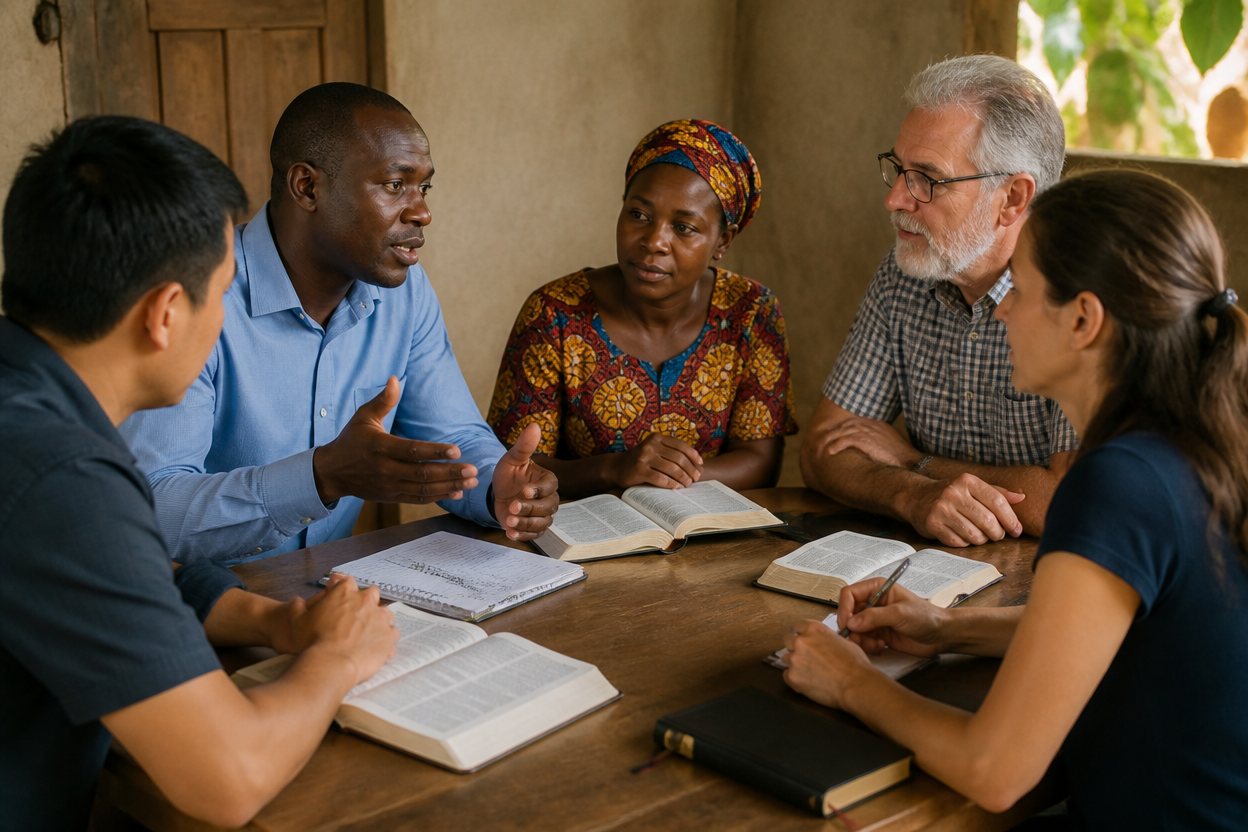
Responsible ministries generally describe (in accessible terms) how they handle: source texts, key terms with theological weight, back-translation or other review methods, and community testing for comprehension. They should also be clear about how local church leaders and mother-tongue speakers are involved, not simply as informants, but as recognized contributors with authority in the process.
Many ministries also align translation work with broader Scripture engagement, literacy, and pastoral training efforts, because a printed text by itself does not guarantee healthy reception. Donors need not insist that every organization do everything, but it is reasonable to ask how a ministry avoids producing a text that is technically “complete” yet ecclesially orphaned.
Partnerships with local leaders are an ethical requirement, not a branding choice
Bible translation has a long history intertwined with missions, colonial histories, and geopolitical pressures. That history does not invalidate translation; it does raise the ethical bar. Partnership is not simply a way to “increase buy-in.” It is a form of accountability that recognizes local churches, local scholars, and local institutions as moral agents rather than recipients of outside expertise.
Donors should listen for specificity: Which local bodies are partners? What authority do they have? How are disputes resolved? Who owns the data and linguistic resources produced? A ministry that speaks only in generalities about “empowering locals” often has not done the harder work of sharing decision rights.
Protecting vulnerable communities requires security discipline and consent, not sentiment
Some Bible translation work happens in contexts where Christians face legal penalties, social hostility, or violence. In those settings, accountability and ethics in Bible translation ministries must include operational security. A beautiful story can become a security incident. A donor report can become a public record. A photo can expose a person to surveillance.
Responsible ministries practice a disciplined approach to risk: careful data handling, role-based access to sensitive information, and communications policies that assume adversarial scrutiny. Donors should expect clear guardrails around what is published, how locations are described, and how staff and partners are trained.
Informed consent and the limits of publicity
Ethical storytelling is not a matter of tone; it is a matter of truth and consent. The church is commanded not to bear false witness (Exodus 20:16), and the prohibition applies to fundraising narratives as much as to courtroom testimony. Ministries should be able to explain how consent is obtained for photos, quotes, and testimonies, and what happens when consent cannot be safely or freely given.
There are also cases where the ethical choice is to publish less. Donors sometimes interpret restraint as a lack of fruit. In high-risk environments, restraint may be evidence of maturity. The biblical pattern includes both proclamation and prudence; Paul at times publicly reasoned in synagogues, and at times avoided exposure that would endanger the mission (Acts 9:25).
Safeguarding against spiritual and social harm
Vulnerability is not only about persecution. Communities can be vulnerable to economic coercion, elite capture, or intra-community conflict. Translation projects can elevate certain dialects, clans, or leaders, sometimes unintentionally. Ethical practice includes community consultation, transparent criteria for language decisions, and humility about unintended consequences. Donors should be wary of ministries that describe every challenge as spiritual warfare but rarely address the ordinary mechanics of power.
Donor trust is built by transparent reporting and disciplined privacy practices
Most donors are not linguists and will not evaluate draft texts. Their accountability lens is therefore mediated through reporting: how a ministry describes progress, setbacks, costs, and outcomes. The temptation in donor communications is to promise certainty where translation work is inherently complex. Delays are common because language work depends on team continuity, local review cycles, and sometimes changing security realities. Integrity requires reporting that respects the donor without flattering them.
Transparent reporting includes clear project definitions (what counts as “started” and “completed”), time horizons that do not treat estimates as vows, and financial reporting that distinguishes between project costs, support costs, and shared services. Donors should be able to trace how designated gifts are applied, and whether the ministry’s public claims match its internal accounting.
What credible outcome reporting can and cannot do
Some outcomes are measurable: completion milestones, distribution figures, training participation, and literacy program reach. Yet donors should also be cautious about treating spiritual fruit as a metric that can be industrialized. Scripture presents growth as real and observable, but not fully controllable (1 Corinthians 3:6–7). Ministries should resist the pressure to present neat causal claims such as “your gift resulted in X conversions,” especially where such claims cannot be responsibly verified or could endanger local believers.
When ministries do publish numbers, donors should expect definitional clarity. A “Bible” may mean a full translation, a New Testament, a portion, or a revision. “Access” may mean physical copies, audio availability, or digital reach. Precision is not pedantry; it is truth-telling.
Donor privacy as a matter of stewardship
Donor information is a trust, and mishandling it can be both unethical and legally risky. Mature ministries have privacy policies that address data collection, sharing, and retention. They honor opt-outs, limit internal access, and do not treat donor lists as assets to be monetized through undisclosed exchanges.
In the United States, baseline expectations for data privacy are shaped partly by enforcement actions of the Federal Trade Commission, which has emphasized that misrepresentations about data practices can be treated as deceptive. See the FTC’s consumer privacy materials here: Federal Trade Commission. While nonprofits’ obligations vary by jurisdiction, donors are right to expect that ministries behave with the seriousness appropriate to handling sensitive personal information.
For donors evaluating Bible translation work more broadly, the most helpful context often includes how theology, governance, finances, and communications reinforce one another over time. Many readers begin by orienting themselves to the full landscape of Bible Translation Ministries and then work toward specific organizations and projects.
Giving with confidence requires evidence that integrity is systemic
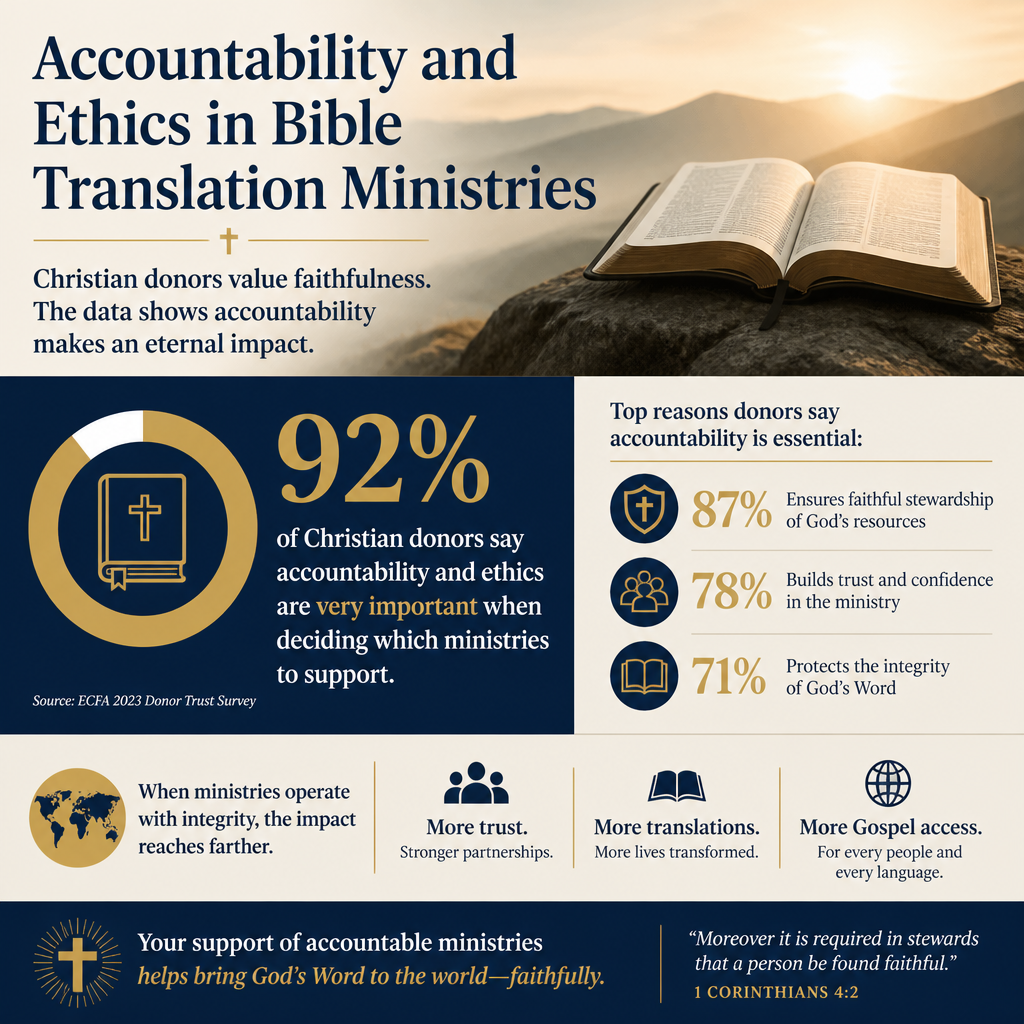
Accountability and ethics in Bible translation ministries are best understood as a system, not as a collection of reassuring statements. Donors should look for ministries that can show how decisions are governed, how translation quality is reviewed, how vulnerable people are protected, and how reporting stays truthful under fundraising pressure. The ministries that meet The Most Trusted Standard tend to treat these questions as part of discipleship and stewardship, not as public relations.
Christian donors cannot eliminate all risk, and no verification can replace prayerful judgment. Yet donors can insist on evidence that integrity is built into structures and habits, because Scripture’s call to handle God’s Word and God’s resources faithfully is not optional. The aim is not suspicion; it is mature confidence grounded in truth.



