
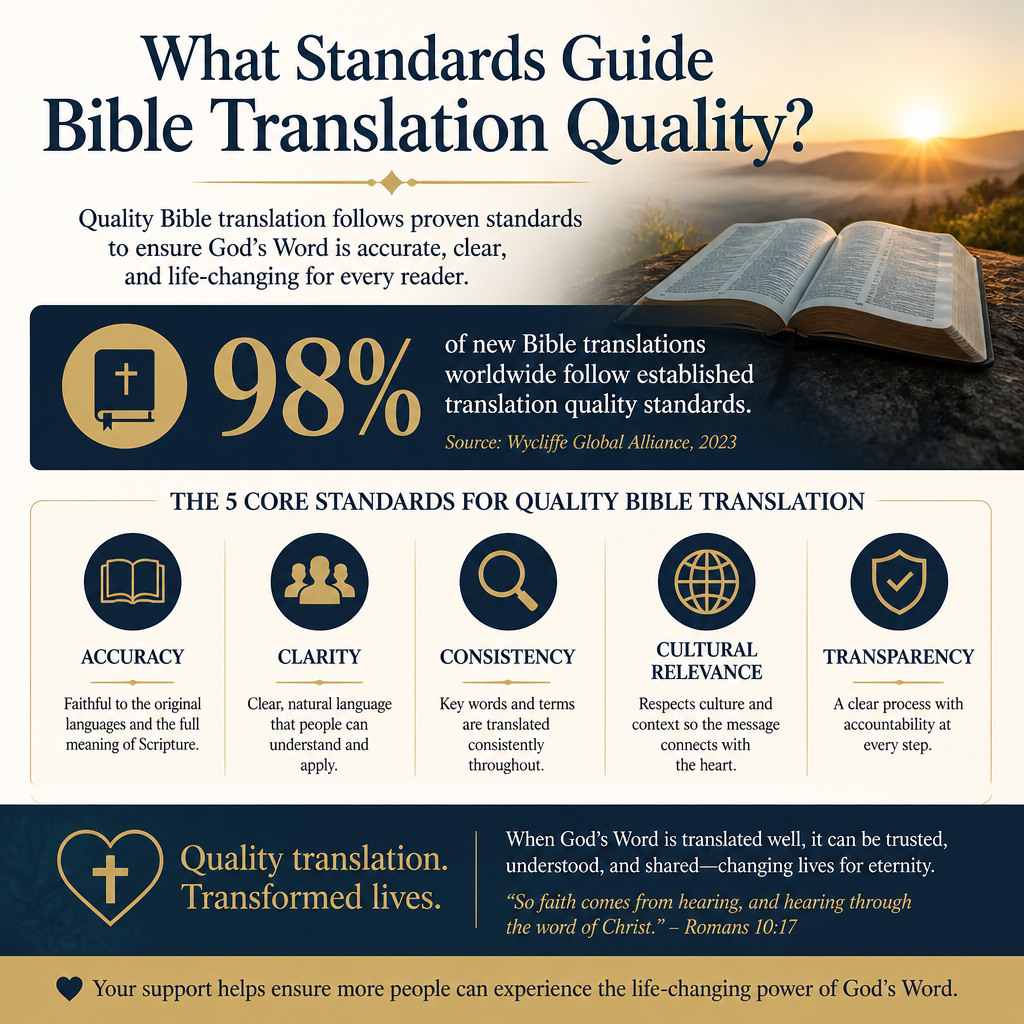
What standards guide Bible translation quality is not a merely technical question. For Christian donors, it is a stewardship question with doctrinal and pastoral consequences: the words a community receives as Scripture will shape preaching, discipleship, evangelism, and the church’s long obedience in the same direction.
That weight produces a predictable tension. Many supporters want speed and scale because access to Scripture is urgent. Others want maximal precision and stability because errors, ambiguities, and poorly chosen phrasing can mislead a church for generations. Responsible giving does not pretend this is an easy trade-off. It asks what translation “quality” actually means, how it is verified, and whether a ministry has the integrity to pause, revise, and be accountable when problems surface.
Quality begins with a doctrinal account of Scripture and a public translation philosophy
A translation standard starts with what a ministry believes Scripture is
Translation quality is downstream from theology. A ministry’s statement of faith should address the authority of Scripture, the uniqueness of Christ, and the church’s responsibility to teach “the whole counsel of God” (Acts 20:27). When those commitments are thin or ambiguous, translation decisions tend to drift toward what is culturally expedient rather than what is textually and theologically warranted.
In practice, donors should look for a translation philosophy that is stated plainly and applied consistently: how the team handles form and meaning, how it treats metaphor, how it renders key theological terms, and what guardrails exist against ideological pressure. Christians genuinely disagree about some of these questions—especially around gender language and how to balance “meaning-based” versus “form-based” approaches—but high-quality work does not hide the disagreements. It documents the rationale and invites serious review.
Clarity about intended use prevents category mistakes
Some translations are optimized for public reading, some for initial comprehension by new readers, and some for detailed study. A serious standard names the intended use case and refuses to market every product as ideal for every purpose. Donors can ask a simple but revealing question: is this translation being presented as a first-access text, a church liturgy text, a study text, or a bridge that will later be paired with deeper teaching?
We recommend donors keep the broader ministry landscape in view. Many translation organizations serve the church alongside literacy, Scripture engagement, and pastoral training initiatives. The category of Bible Translation Ministries is healthiest when translation is treated as one element of building durable local churches rather than as a stand-alone deliverable.

Textual and linguistic rigor are nonnegotiable standards
Quality requires disciplined handling of original-language texts
A credible translation process articulates what source texts are being used (Hebrew, Aramaic, and Greek), how textual variants are evaluated, and how the team documents decisions. Donors do not need to adjudicate textual criticism, but they can assess whether a ministry is transparent about its method and whether it respects the complexity of the manuscript tradition instead of oversimplifying it for marketing purposes.
A long-standing benchmark for scholarly rigor in the field is the United Bible Societies’ Greek New Testament, which provides an apparatus and a disciplined approach to variant readings. The existence of such reference works does not guarantee a translation is sound, but refusing to engage the wider scholarly ecosystem is a warning sign. For reference, the UBS maintains its catalog and standards information publicly through United Bible Societies.
Exegesis, not word substitution, is the real work
Good translation is interpretive by necessity. Languages do not map cleanly onto each other; syntax, idiom, and semantic range require judgment. That is why quality standards emphasize exegetical process: how the team determines meaning in context, how it handles discourse features, how it distinguishes what must be explicit from what can remain implicit, and how it avoids importing later theological debates into the phrasing of the text.
Donors should also ask about the linguistic profile of the target language community. Is the translation into a language with established literacy and print norms, or into a language where orthography is still developing? Is the project primarily written, audio, or both? The standards for readability, consistency, and community testing will differ, and a responsible ministry will explain those differences without lowering expectations for accuracy.
Community engagement is part of fidelity, not a substitute for it
The church receives Scripture, and the church should be involved
Translation is not only an academic exercise; it is ecclesial. High-quality projects involve local church leaders and mature speakers of the target language in structured review, not as token representatives but as responsible participants. The goal is not to “vote” meaning into the text, but to ensure the translation communicates what the text says in the language people actually speak and understand.
Standards here include documented community testing, feedback mechanisms, and a willingness to revise. Donors can ask whether a ministry keeps records of comprehension testing, whether it has thresholds for acceptability, and whether it can show how feedback changed the text rather than merely affirming the process.
Safeguards against capture by local and external pressures
Community involvement can fail in two directions. Projects can be captured by outside preferences—often well-intentioned donor expectations about style or terminology. Or they can be captured by a narrow slice of local power—clan, denomination, or political interest—that treats the translation as an instrument for control.
A mature standard names these risks and builds safeguards: diverse local review panels, clear conflict-of-interest practices, and external peer review. This is one reason donors should care about governance and ethics, not only linguistics. The wider conversation on accountability belongs within Accountability and Ethics in Bible Translation Ministries, because translation quality and institutional integrity cannot be separated for long.
Quality is verified by transparent process, qualified reviewers, and documented revisions
Peer review and consultant checking are measurable practices
Translation ministries often describe “consultant checking,” “peer review,” or “back translation.” Those terms matter only if the ministry can describe what they mean in practice: who the consultants are, what qualifications they hold, what the review stages are, and what happens when reviewers disagree.
Donors should look for at least three features: (1) reviewers with demonstrated competency in original languages and translation theory, (2) reviewers who are independent enough to challenge the internal team, and (3) written documentation of changes across drafts. An organization that cannot show its work is asking donors to fund trust rather than fund truthfulness.
Readability and comprehension testing should be reported with integrity
Some ministries claim high comprehension without explaining how it was measured. Where testing is used, donors should ask for plain descriptions of methods: sample selection, questions used, and what constitutes “understood.” If a ministry presents comprehension results, they should be tied to a documented methodology rather than to slogans.
One reason these questions are timely is that global literacy remains a major barrier to Scripture access. UNESCO estimates that hundreds of millions of adults worldwide lack basic literacy skills, which affects whether a written translation alone will serve the church effectively. UNESCO’s current global education and literacy reporting is available through UNESCO.
For donors, the most reliable standards are governance, financial integrity, and candor about outcomes
Translation quality is inseparable from institutional trustworthiness
Even technically competent teams can be undermined by weak governance, opaque finances, or incentives that reward speed over accuracy. Donors should care about board oversight, conflict-of-interest policies, and whether leadership welcomes scrutiny. A ministry that will not answer straightforward questions about decision rights, review processes, or revision history is not merely inconvenient; it is misaligned with Christian stewardship.
Financial integrity matters because translation is long-horizon work. Projects often take years, sometimes decades, and they require stability, honest budgeting, and realistic timelines. The same donor pressures that distort other categories of ministry—overpromising results, underreporting challenges, minimizing overhead that is actually essential—can distort translation efforts as well. Quality standards therefore include sober fundraising practices and reporting that does not confuse activity with impact.
What donors can ask without becoming translation specialists
Across our verification work at Most Trusted, we find that donors do best when they ask for evidence of process rather than assurances of excellence. The ministries that meet The Most Trusted Standard tend to treat scrutiny as part of discipleship, not as an obstacle to fundraising.
- Translation philosophy: Is the approach stated clearly, with examples of how difficult passages are handled?
- Qualified review: Who checks the work, and what are their competencies and independence?
- Community testing: How is comprehension assessed, and how does feedback shape revisions?
- Documentation: Are draft histories and major decision rationales recorded and available to appropriate stakeholders?
- Governance and ethics: What safeguards exist against conflicts of interest and ideological capture?
Donors should also ask how the ministry evaluates Scripture engagement after publication. Distribution numbers can be helpful, but they are not the same as durable church formation. The field has had to reckon with the difference, and responsible organizations now distinguish between access, adoption, and long-term use.
FAQs for What standards guide Bible translation quality
Is speed a legitimate measure of Bible translation quality?
Speed can be a legitimate measure of operational capacity, but it is not a direct measure of translation quality. In contexts with urgent need—conflict, displacement, or rapid church growth—timely access to Scripture matters. Yet the same contexts also magnify the cost of errors because local theological formation may be thin. The sound standard is not “slow” or “fast,” but a process that can justify its pace in light of review, testing, and revision safeguards.
Should donors prefer a word-for-word approach to ensure faithfulness?
“Word-for-word” is often used as shorthand for fidelity, but languages do not correspond one-to-one. Faithfulness requires conveying meaning accurately, and sometimes that means departing from the surface form to preserve the sense. Donors should look less for slogans and more for evidence: clear philosophy, qualified review, and documented decisions on passages where literal rendering would confuse or mislead readers.
Giving that honors the weight of the Word
The standards that guide Bible translation quality are ultimately standards of truthfulness before God and service to the church. Accurate handling of the text, disciplined review, meaningful community engagement, and transparent accountability are not optional features; they are the ordinary marks of integrity in a work that claims to deliver Scripture to God’s people. Donors who fund translation with discernment help ensure that urgency does not eclipse faithfulness, and that faithfulness is verified rather than merely asserted.



